
Reimbursements paid under a properly administered IRS accountable plan are excluded from employee wages — no income tax withholding, no payroll tax on either side. That single fact is worth real money to any service business with employees driving personal vehicles, buying job supplies, or covering work-related phone costs. The tax advantages of accountable plans are significant, but they disappear the moment your process breaks down.
To keep reimbursements tax-free, every payment must pass three IRS tests, per IRS Publication 463:
- Business connection: The expense must have a clear, documented business purpose.
- Adequate substantiation: Employees must provide receipts, mileage logs, or other records showing the amount, date, place, and business purpose.
- Return of excess: Any advance or allowance that exceeds actual documented expenses must be returned within a reasonable time.
The IRS also sets safe-harbor timing windows you should embed in your policy:
- Advances issued within a reasonably short period before the expense occurs
- Substantiation submitted within a reasonably short period after the expense
- Excess amounts returned within a reasonably short period after the expense
Miss any of these windows and the IRS can reclassify the entire reimbursement as taxable wages.
Key Takeaways
A properly administered IRS accountable plan keeps employee reimbursements out of taxable wages, saving both sides payroll taxes and preserving the employer’s business deduction.
| Point | Details |
|---|---|
| Three IRS tests required | Every reimbursement must show business connection, adequate substantiation, and return of excess to stay tax-free. |
| Safe-harbor timing windows | Advances within 30 days, substantiation within 60 days, excess returned within 120 days of the expense. |
| Documentation specifics | Itemized receipts for expenses $75 or more; mileage logs for all vehicle reimbursements; four-year minimum retention. |
| Written policy is non-negotiable | A signed policy with an effective date (plus a corporate resolution for S-Corps) is the foundation of audit protection. |
| Truemeasureaccounting can implement it | Truemeasureaccounting drafts policies, configures QuickBooks, and provides monthly reconciliation to keep your plan compliant year-round. |
Table of Contents
- What is an IRS accountable plan, and why does it matter to your business?
- The three IRS tests explained with practical examples
- What are the IRS safe-harbor timing rules for reimbursements?
- What documentation actually counts for IRS reimbursements?
- Accountable plan vs. nonaccountable plan: what’s the real cost difference?
- Common qualifying expenses and how to handle mixed-use items
- How to write, adopt, and run an accountable plan from day one
- If you get it wrong: how to fix misclassified reimbursements
- Employer-ready checklist and sample policy for service businesses
- What running accountable plans actually looks like in practice
- How Truemeasureaccounting helps you set up and maintain a compliant reimbursement plan
- Sources
What is an IRS accountable plan, and why does it matter to your business?
An accountable plan is a formal employer reimbursement arrangement that meets the three IRS requirements above, causing payments to flow to employees tax-free and to be deductible to the business. The authority is IRS Publication 463 and Treasury Regulation §1.62-2, which together define what qualifies and what does not.
From an employer’s perspective, the stakes are straightforward:
- Payroll tax savings: Reimbursements excluded from wages avoid the employer’s share of FICA (7.65% on covered wages). On $50,000 in annual reimbursements, that is roughly $3,825 in employer payroll taxes preserved each year.
- Clean P&L: Reimbursements flow through as a business expense, not compensation, keeping your labor cost line accurate for job costing and profitability analysis.
- Employee take-home pay: Employees receive the full reimbursement without income tax withholding, which matters for retention in competitive trades.
- S-Corp owner benefits: Owner-employees of S-Corps can reimburse themselves for legitimate business expenses through an accountable plan, reducing taxable distributions without triggering payroll tax on those amounts.
For HVAC companies, plumbing contractors, truckers, and other service businesses where employees regularly use personal vehicles and buy job-site supplies, a properly run plan is one of the cleaner tax deductions for service business owners available.
The three IRS tests explained with practical examples
Understanding the rules in the abstract is easy. Applying them to a crew of technicians or a fleet of owner-operators is where most businesses run into trouble.
1. Business connection
The expense must be ordinary and necessary for the business and incurred while performing services as an employee. Personal expenses do not qualify, even if the employee paid out of pocket.
Passes: An HVAC technician drives a personal truck to a job site and logs 47 miles. The mileage has a clear business purpose tied to a specific job.
Fails: The same technician submits mileage for the commute from home to the shop. Commuting is never a qualifying business expense.
2. Adequate substantiation
Employees must document the amount, time, place, and business purpose of every expense. For vehicle use, that means a mileage log. For meals, a receipt showing the restaurant, date, amount, and who was present. For supplies, an itemized receipt tied to a specific job or project.
Passes: A plumber submits a hardware store receipt for $214 in pipe fittings with a note referencing job number 1042. The receipt shows the vendor, date, and items purchased.
Fails: A general contractor submits a credit card statement showing a $214 charge at a hardware store with no itemization and no job reference. A credit card statement alone does not meet the substantiation standard.
3. Return of excess
If you advance $500 to an employee for a business trip and the actual documented expenses total $380, the employee must return $120 within the safe-harbor window (120 days). If they do not, the $120 becomes taxable wages.
Common failure modes the Journal of Accountancy highlights include:
- Allowing employees to keep unspent advances indefinitely
- Accepting summary expense reports without underlying receipts
- Reimbursing personal-use portions of mixed-use items (phone, vehicle) without an allocation calculation
- Failing to document the business purpose for meals and entertainment
What are the IRS safe-harbor timing rules for reimbursements?
Treasury Regulation §1.62-2(g) gives employers two safe-harbor methods for meeting the “reasonable period of time” requirement. Both protect you from an auditor arguing that your timing was too loose to qualify as an accountable plan.
Fixed-date method: The employer sets specific calendar deadlines. Advances must be issued within a near-term period before the expense. Employees must substantiate within a near-term period after the expense. Excess amounts must be returned within 120 days after the expense. These are the windows most small service businesses adopt because they are simple to communicate and enforce.
Periodic-statement method: The employer issues statements (at least quarterly) showing any outstanding advances or unsubstantiated amounts. Employees then have 120 days from the statement date to substantiate or return. This method works well for businesses with ongoing travel or per-diem advances where expenses accumulate over time.
| Feature | Fixed-date method | Periodic-statement method |
|---|---|---|
| Advance window | 30 days before expense | Ongoing; statement triggers reconciliation |
| Substantiation deadline | 60 days after expense | 120 days from statement date |
| Return of excess deadline | 120 days after expense | 120 days from statement date |
| Best for | Monthly reimbursement cycles | Ongoing travel advances |
| Admin complexity | Low | Moderate |
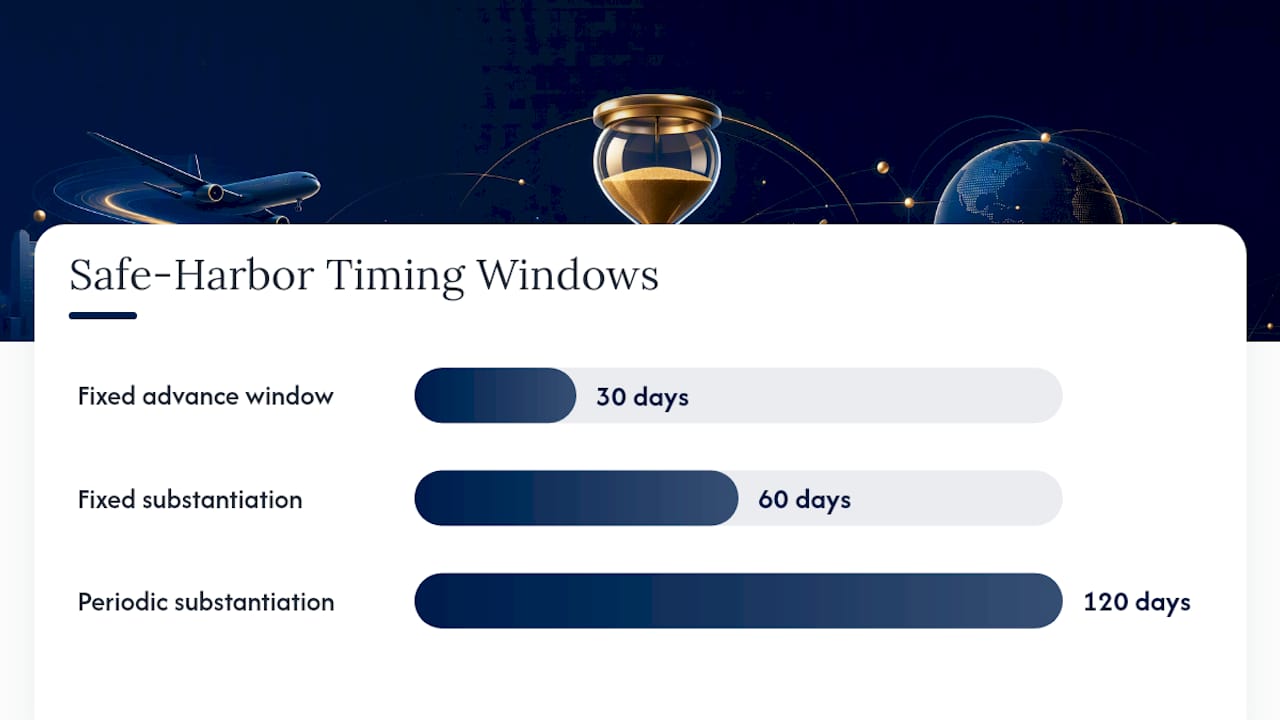
For most HVAC, plumbing, electrical, and construction businesses running monthly expense cycles, the fixed-date method is the right call. It maps cleanly onto a monthly close, keeps your payroll team on a predictable schedule, and gives employees a clear deadline they can remember.
Pro Tip: Set your expense submission deadline at the 25th of each month. That gives you five days to review, approve, and cut reimbursement checks before month-end close — and keeps you well inside the 60-day substantiation window for expenses incurred at the start of the month.
What documentation actually counts for IRS reimbursements?
Good documentation is what separates a clean reimbursement from a taxable wage. The IRS is specific about what it needs, and “close enough” does not hold up in an audit.

Receipt requirements
Every receipt must show:
- Date of the expense
- Vendor name and location
- Amount paid (itemized, not just a total)
- Business purpose (written by the employee if not obvious from the receipt)
Lodging always requires a receipt, regardless of amount. For other expenses, the IRS has historically applied a practical threshold: receipts are required for expenses of $75 or more, though best practice is to require receipts for all expenses to avoid any gray area. A credit card statement does not substitute for an itemized receipt, particularly for meals and supplies, as noted in Kent State University’s tax office guidance.
Mileage log requirements
A compliant mileage log must record:
- Date of each trip
- Starting point and destination
- Business purpose of the trip
- Odometer readings or total miles driven
Apps like MileIQ, Everlance, or TripLog automate this for service crews and owner-operators, reducing the chance of missing entries. Reimbursing at or below the IRS standard mileage rate (check irs.gov each January for the current-year rate) keeps vehicle reimbursements within accountable-plan safe harbors and simplifies bookkeeping for businesses with multiple technicians using personal trucks.
Per-diem vs. actual costs
Employers can reimburse meals and lodging using IRS-published per-diem rates instead of actual receipts. When you use federal per-diem rates, employees do not need to submit individual meal receipts — only a log showing the travel dates, destination, and business purpose. Actual-cost reimbursement requires full receipts but allows recovery of the precise amount spent.
Record retention: Keep all expense reports, receipts, mileage logs, and reimbursement records for a minimum of four years, aligned with employment-tax recordkeeping requirements, as recommended by Sharper.
Accountable plan vs. nonaccountable plan: what’s the real cost difference?
The difference between these two arrangements is not administrative. It is a direct hit to your payroll tax bill and your employees’ paychecks.
| Factor | Accountable plan | Nonaccountable plan |
|---|---|---|
| Employee income tax | Not withheld | Withheld as wages |
| Employer FICA | Not owed | Owed (7.65% employer share) |
| Employee FICA | Not owed | Owed (7.65% employee share) |
| W-2 reporting | Not included in Box 1 | Included in Box 1 wages |
| Business deductibility | Deductible as business expense | Deductible as compensation |
| Meals 50% rule | Applies to employer’s deduction | Applies to employer’s deduction |
A concrete example: your electrical contracting business reimburses $10,000 in employee vehicle and supply expenses during the year. Under an accountable plan, that $10,000 flows through as a business expense with no payroll tax on either side. Under a nonaccountable plan, it becomes $10,000 in additional wages — triggering roughly $765 in employer FICA, $765 in employee FICA, and income tax withholding on top of that.
The Journal of Accountancy confirms that reimbursements failing the three tests are treated as wages on Form W-2, meaning both sides pay taxes they could have legally avoided.
Common qualifying expenses and how to handle mixed-use items
Most service businesses have the same core categories of reimbursable expenses. The documentation requirements and allocation rules vary by type.
- Business mileage: Personal vehicle used for job-site travel, client visits, supply runs. It requires a mileage log. Reimburse at or below the current IRS standard mileage rate.
- Travel expenses: Airfare, hotel, rental car for out-of-town jobs or training. Receipts required for all items; lodging always needs an itemized receipt.
- Meals: 50% deductible to the employer. Requires receipt or per-diem documentation showing business purpose and who was present.
- Phone and internet: The business-use percentage of a personal phone or home internet plan. Requires a reasonable allocation calculation (e.g., 60% business use based on call logs or usage analysis).
- Home office: Square footage used exclusively and regularly for business as a percentage of total home square footage. Relevant for owner-operators and remote employees.
- Job supplies and tools: Items purchased for a specific job. Requires itemized receipts tied to a job number or project.
Mixed-use allocation: a short example
A plumbing technician uses a personal phone for both personal and work calls. That allocation must be documented and consistent — you cannot change the percentage month to month without a new analysis.
For trucking businesses, per-diem rates for meals are often more practical than actual receipts for drivers on multi-day runs. The Corpay resource on employee expense reimbursement notes that using IRS per-diem rates simplifies recordkeeping for crews that are on the road frequently. Pair that with a GPS-based mileage log and your documentation burden drops significantly.
| Expense type | Documentation required | Notes |
|---|---|---|
| Business mileage | Mileage log (date, purpose, miles) | Reimburse at or below IRS rate |
| Travel | Receipts for all items | Lodging always needs itemized receipt |
| Meals | Receipt or per-diem log | 50% deductible to employer |
| Phone/internet | Allocation calculation + bill | Document basis for percentage |
| Home office | Square footage calculation | Exclusive and regular use required |
| Job supplies | Itemized receipt + job reference | Tie to specific job or project |
How to write, adopt, and run an accountable plan from day one
Setting up a compliant plan takes less than a day if you follow a clear sequence. The Taxstra guide for S-Corps recommends starting with a simple written policy and a corporate resolution (for S-Corps), then building the workflow around it.
Step-by-step setup
- Draft a written policy. The policy must define which expenses qualify, submission deadlines, required documentation, advance procedures, and repayment terms for excess amounts.
- Adopt the plan formally. For S-Corps and corporations, pass a board resolution adopting the plan and record it in your meeting minutes. For sole proprietors and partnerships, a signed policy document with an effective date is sufficient.
- Set an effective date. The plan must be in place before the expenses occur. Retroactive adoption does not protect prior reimbursements.
- Create an expense submission form. The form should capture: employee name, date of expense, vendor, amount, business purpose, job or project reference, and a signature line.
- Set up your payroll and bookkeeping workflow. Reimbursements should be coded as a business expense, not compensation, in QuickBooks or your accounting system. Keep them separate from payroll runs.
- Train employees and managers. Every person who submits or approves expenses needs to understand the deadlines and documentation requirements.
- Run a quarterly mini-audit. Pull a sample of expense reports each quarter and verify that receipts are attached, business purposes are documented, and no excess amounts are outstanding.
Sample policy clauses
The following language can be adapted for your business:
- “The Company will reimburse employees for ordinary and necessary business expenses incurred in the performance of their duties, provided the employee submits an expense report with supporting documentation within 60 days of the expense.”
- “Any advance issued by the Company must be substantiated within 60 days of the advance date. Any unsubstantiated or excess amount must be returned within 120 days of the advance date.”
- “Expenses of $75 or more require an itemized receipt. Mileage must be documented in a mileage log showing date, starting point, destination, and business purpose.”
Pro Tip: For HVAC and plumbing businesses with field crews, build the expense form into your job management software (ServiceTitan, Jobber, or similar) so technicians can attach photos of receipts from the field. This cuts the time between expense and submission from weeks to hours.
If you get it wrong: how to fix misclassified reimbursements
When a reimbursement fails the three tests — missing documentation, no return of excess, no business connection — the IRS treats it as wages. That triggers a cascade of corrections.
What happens immediately
- The reimbursement amount is added to the employee’s taxable wages.
- Income tax withholding is required on the reclassified amount.
- Both employer and employee FICA taxes are owed.
- The amount must appear in Box 1 of the employee’s W-2.
Correction checklist
- Identify which reimbursements failed and in which tax year.
- Calculate the additional wages, income tax withholding, and FICA owed for each affected employee.
- Remit the employer’s share of payroll taxes to the IRS using Form 941 (or an amended 941-X if the period is closed).
- Issue corrected W-2c forms to affected employees showing the revised Box 1 wages.
- Adjust your employer-side tax return (Form 1120S, 1065, or Schedule C) to reflect the reclassification.
- Document the error, the correction steps taken, and the controls you put in place to prevent recurrence.
Audit-readiness checklist
Keep the following on hand for any IRS inquiry:
- Signed written accountable plan policy with effective date
- Corporate resolution (S-Corps)
- All expense reports with attached receipts and mileage logs
- Advance records showing issuance date and repayment
- Payroll records showing reimbursements were coded separately from wages
- Four years of records minimum, per employment-tax retention guidance from sharper.tax
Employer-ready checklist and sample policy for service businesses
This section gives you a working template and a sequenced checklist you can use to implement a plan this week. The examples are filled for a contracting or HVAC business, but the structure applies equally to trucking, plumbing, and property management operations.
Sample accountable plan policy (condensed)
[Company Name] Accountable Plan Policy — Effective [Date]
Scope: Applies to all employees who incur business expenses on behalf of the Company.
Submission deadline: Expense reports must be submitted within 60 days of the expense date.
Documentation required: Itemized receipts for all expenses of $75 or more. Mileage log for all vehicle reimbursements. Business purpose noted on every submission.
Advances: Advances will not be issued more than 30 days before the anticipated expense. Employees must substantiate advances within 60 days of receipt.
Repayment: Any advance amount exceeding documented expenses must be returned to the Company within 120 days of the advance date. Unreturned excess will be added to the employee’s taxable wages.
Record retention: The Company will retain all expense reports, receipts, and supporting documentation for a minimum of four years.
Implementation checklist
- Draft and sign the written policy (use the template above as a starting point).
- Pass a corporate resolution if operating as an S-Corp or corporation.
- Set an effective date and communicate it to all employees.
- Create or update your expense submission form to capture all required fields.
- Configure QuickBooks (or your accounting system) to code reimbursements as a business expense, not payroll.
- Train field supervisors and office staff on submission deadlines and documentation requirements.
- Run your first monthly expense cycle and audit a sample of submissions for completeness.
- Schedule a quarterly mini-audit to catch documentation gaps before year-end.
Filled examples
Monthly mileage entry (HVAC technician): Employee drives 340 business miles in March using a personal vehicle. At the current IRS standard mileage rate, the reimbursement is calculated and paid by April 25 (within the 60-day window). The mileage log shows each trip date, job address, and miles driven.
Advance repayment scenario: A general contractor receives a $600 advance for a two-day out-of-town job. Actual documented expenses total $510. The employee returns $90 within 30 days of returning. The $510 is reimbursed tax-free; the $90 return is recorded and the advance is closed.
Pro Tip: Run a simple monthly financial reconciliation that includes a line for outstanding expense reports. Any open items older than 45 days should trigger a follow-up before they breach the 60-day window.
What running accountable plans actually looks like in practice
Most small service businesses do not fail their accountable plans because they do not understand the rules. They fail because the process breaks down between the field and the office.

The most common pattern: a technician submits a stack of receipts at year-end, the bookkeeper processes them as reimbursements, and nobody checks whether the 60-day window was missed for expenses from January. By the time a payroll tax issue surfaces, it covers twelve months of reimbursements and the correction is painful.
The fix is simpler than most owners expect. A monthly submission cycle, a one-page expense form, and a 15-minute review by whoever runs payroll is enough to keep most service businesses compliant. The Taxstra guide for S-Corps makes the point clearly: a short written policy and a signed corporate resolution materially reduce the chance of an auditor reclassifying reimbursements as wages. The paperwork matters as much as the process.
For growing businesses, the payroll-tax savings add up faster than most owners realize. A service company with five technicians each driving 8,000 business miles per year and submitting $2,000 in supply reimbursements annually is running roughly $50,000 in total reimbursements. Under a nonaccountable arrangement, the employer’s FICA exposure on that amount is real money that could stay in the business. Correcting the plan and running it properly going forward is one of the higher-return administrative fixes available to a service business owner.
Delegating approvals to a field supervisor or office manager works well once the policy is written and the form is standardized. Monthly reconciliations, not year-end dumps, are what keep the plan clean and your financial reporting accurate.
How Truemeasureaccounting helps you set up and maintain a compliant reimbursement plan
Getting the policy written is the easy part. Keeping it running cleanly through payroll, bookkeeping, and quarterly reconciliations is where most service businesses need support.
Truemeasureaccounting works with HVAC companies, plumbing contractors, electrical firms, general contractors, trucking operations, and other owner-operated service businesses to draft accountable plan policies, configure QuickBooks to code reimbursements correctly, and align the plan with monthly bookkeeping and payroll workflows. For S-Corp owners, that includes the corporate resolution and the ongoing reconciliation that keeps owner reimbursements clean at tax time.
A typical engagement starts with a one-time setup (policy drafting, QuickBooks configuration, employee training materials) and transitions into monthly bookkeeping and reconciliation support that includes expense report review as part of the close. Fractional CFO clients get quarterly plan audits and proactive alerts when documentation gaps appear.
If your current reimbursement process is informal or you are not sure whether your plan meets the three IRS tests, schedule a call with Truemeasureaccounting. The how it works page outlines the service model and next steps.
Sources
Use these primary sources to verify current rules, rates, and requirements before making payroll or policy changes.
- Publication 463 (Travel, Gift, and Car Expenses) — PDF | Internal Revenue Service
- 26 CFR § 1.62-2 — Allowances or reimbursements for expenses of employees | Cornell Law
- Employee Expense Reimbursement: Process, IRS Rules, and Timelines (2026) | Corpay
- Employee expenses: Accountable plan | Journal of Accountancy
This article provides general information about IRS accountable plan rules and is not a substitute for professional tax or legal advice. Confirm current rates, thresholds, and requirements with a qualified tax professional or directly with the IRS before making payroll or policy changes.