
If you have even one employee working from a different state than your business is registered in, you likely owe withholding, registration, or unemployment insurance filings in that state. Multi-state payroll taxes generally follow the work-state rule: you withhold income tax based on where the employee physically performs the work, not where your company is headquartered. A single remote hire in a new state can create payroll tax nexus immediately, with no revenue threshold required.
Three moves protect you this week:
- Confirm every employee’s actual work location, including remote hires, field crews crossing state lines, and anyone who relocated without telling HR.
- Register in any state that’s triggered, opening withholding, State Unemployment Insurance (SUI), and workers’ comp accounts as required.
- Collect the right paperwork and update payroll settings before your next pay run, including reciprocity exemption certificates where applicable.
Pro Tip: Set a hard deadline for each action item. State registration windows often run 15 to 20 days, and state penalties for unremitted payroll taxes commonly range from 5% to 25% plus interest, so delay carries a real dollar cost.
Key Takeaways
Multi-state payroll compliance depends on tracking where employees physically work, registering promptly, and allocating withholding and SUI to the correct single state every pay period.
| Point | Details |
|---|---|
| Work-state rule governs withholding | Withhold based on where the employee physically performs the work, not company headquarters. |
| Nexus triggers instantly | One remote employee in a new state can require registration with no revenue threshold. |
| Reciprocity requires paperwork | Without a signed exemption certificate on file, withhold for the work state regardless of residency. |
| Penalties escalate fast | Unremitted payroll taxes commonly draw 5% to 25% penalties plus interest, and FUTA credit loss raises federal unemployment tax sixfold. |
| Get payroll folded into your bookkeeping | TrueMeasure Accounting integrates multi-state payroll support into monthly bookkeeping to catch registration gaps before they become penalties. |
Table of Contents
- What Counts as Multi-State Payroll for a Small Employer?
- How States Establish Payroll Nexus and What to Register First
- Which State Should You Withhold For?
- The Convenience-of-the-Employer Rule Can Override Everything
- SUI Allocation and the DOL’s Four-Factor Test
- Local Taxes, Paid Leave, and Minimum Wage Rules You Can’t Skip
- What Non-Compliance Actually Costs You
- Keeping Payroll Accurate as Your Business Grows
- Fixing Past Multi-State Payroll Mistakes: A 30/60/90 Plan
- How TrueMeasure Accounting Approaches Multi-State Payroll
- State Filing Deadlines and Frequency Vary More Than Owners Expect
- Choosing a Payroll System That Actually Handles Multiple States
- Remote Work Has Made Multi-State Payroll a Default Condition, Not an Exception
- Let TrueMeasure Accounting Handle the Payroll Complexity You Don’t Have Time For
- Payroll Compliance Is a Cash Flow Discipline, Not Just a Legal One
- Sources
What Counts as Multi-State Payroll for a Small Employer?
Multi-state payroll applies any time employees earn wages while physically working in more than one U.S. state during a tax year. That’s a broader trigger than most owners assume. It’s not about where your business is incorporated or where your office sits. It’s about where the work happens.
For owner-operated service businesses, the common triggers include:
- A remote administrative hire who lives across a state line from your shop.
- Field technicians, installers, or drivers who regularly cross state boundaries for jobs.
- An employee who relocates mid-year and keeps working the same role remotely.
- Temporary assignments, storm response crews, or hybrid schedules that mix home and job-site states.
Here’s the part that catches contractors off guard: sales tax nexus usually requires hitting a revenue threshold before you owe anything. Payroll tax nexus doesn’t work that way. In most states, one employee physically working there for one day can trigger a registration and withholding obligation. There’s no dollar floor to clear first.
How States Establish Payroll Nexus and What to Register First
An employee’s physical presence in a state is usually enough to create nexus on its own. You don’t need an office, a warehouse, or a signed lease. Some states start the clock the moment wages are paid for work performed within their borders, which means retroactive liability builds fast if you miss the registration window.
Once nexus exists, plan on opening three types of accounts:
- State withholding account with the state’s department of revenue, so you can remit income tax withheld from that employee’s pay.
- State unemployment insurance (SUI) account with the state workforce agency, which sets your initial contribution rate.
- Workers’ compensation coverage, where the state requires it for the class of work your employee performs.
Federal guidance points employers toward registering with both the state revenue department and workforce agency promptly once wages are paid in-state, and many states expect this within a 15 to 20 day window. Build a short onboarding checklist that flags a new-state hire before the first paycheck runs, not after.
Pro Tip: Ask every new hire and every existing employee, twice a year, “What state did you physically work in most this pay period?” It sounds simple. It’s the single most effective habit for catching nexus before it becomes a violation.
Which State Should You Withhold For?
The default rule is straightforward: withhold income tax for the state where the employee physically performs the work, not where they live and not where your business is based. When an employee splits time between two states, you generally allocate wages using days worked in each state divided by total workdays, a method Paycor’s payroll guidance confirms is the standard approach among payroll processors.
A few complications change that default:
- Reciprocity agreements. Roughly thirty bilateral reciprocity agreements exist among states and D.C., letting an employee who lives in one state and works in another pay tax only to their home state. The employee must file a state-specific exemption certificate with you first; without it on file, you’re required to withhold for the work state regardless of where they live.
- Courtesy withholding. Some employers voluntarily withhold for an employee’s home state as a convenience, even when not legally required. It reduces the employee’s tax-time surprise but adds a filing obligation and recordkeeping burden you don’t otherwise have. Only do this with a documented employee request on file.
The Convenience-of-the-Employer Rule Can Override Everything
A handful of states, New York among them, apply a “convenience of the employer” rule that can flip the work-state default on its head. Under this rule, if an employee works remotely by their own choice rather than because the employer required it, the state can tax those wages as if the employee still worked at the employer’s location. The IRS confirms this creates real double-taxation risk when the employee’s resident state doesn’t offer an offsetting credit.
The defense is documentation. Keep a clear record showing remote work was employer-directed: written job requirements, an assigned territory or client base that requires travel, and dated approvals for any remote arrangement. That paper trail is what distinguishes “employer necessity” from “employee convenience” if a state auditor asks.
Pro Tip: If you want to limit where employees can work from, put it in writing before the arrangement starts, not after a state flags the return. A signed remote-work policy is cheap insurance against a nexus surprise.
- Draft the policy before offering remote flexibility, not retroactively.
- Specify approved work states explicitly rather than leaving it open-ended.
- Require written approval for any change in an employee’s primary work location.
SUI Allocation and the DOL’s Four-Factor Test
Unemployment insurance can’t be split across two states for the same wages. One state gets the SUI contribution, full stop, and the Department of Labor’s four-factor localization test determines which one. The sequence runs: where the work is localized, then base of operations, then where the employer directs and controls the work, then the employee’s state of domicile. You work down the list until one factor clearly resolves the question.
This matters for cash flow, not just paperwork. Each state sets its own SUI rate based on your claims history in that state, and a new-state registration typically starts you at a new-employer rate before you’ve built experience history. For traveling crews, misapplying the test means paying into the wrong state, which doesn’t just risk a penalty; it can also mean the correct state has no record of coverage if a former employee ever files a claim.
- Run the four-factor test for any employee whose work crosses state lines regularly.
- Reassess coverage whenever a base of operations changes.
- Track SUI rate notices by state so budget forecasts stay accurate.
Local Taxes, Paid Leave, and Minimum Wage Rules You Can’t Skip
Withholding and SUI aren’t the whole picture. Several other state and local obligations shift with employee location and change your payroll math quietly if you’re not watching for them.
- Paid family and medical leave (PFML) programs. A growing number of states run mandatory PFML contributions, split between employer and employee in most programs, and they require separate registration from standard withholding.
- Local income taxes. Certain cities and counties levy their own payroll tax layered on top of state withholding, which means a separate account and a separate filing calendar.
- Minimum wage and pay transparency rules. State and local minimum wage floors vary widely, and pay transparency laws increasingly require posting salary ranges, both of which affect your job costing if you price labor using a single blended rate across states.
Treat each new work-state as its own small compliance project, not an addendum to your existing setup.
What Non-Compliance Actually Costs You
The financial exposure here isn’t hypothetical. State penalties for unremitted payroll taxes commonly run 5% to 25% of the unpaid amount plus interest, and some jurisdictions impose fines as steep as $250,000 per violation.
The mistakes that cause this most often aren’t exotic:
- Worker misclassification that masks a multi-state issue until an audit surfaces it.
- Missed state registrations after a remote hire or relocation.
- Missing reciprocity exemption forms, defaulting withholding to the wrong state.
- Untracked employee address or location changes that HR never learns about.
Keeping Payroll Accurate as Your Business Grows
Payroll accuracy erodes gradually, not all at once. An employee moves, a crew picks up a job three states over, someone’s home office quietly becomes permanent, and six months later your withholding doesn’t match reality anymore. The fix is operational, not just a policy memo.
- Integrate time-tracking with payroll. Recording days worked by state gives you the audit-ready allocation data you need and directly supports the days-worked method most payroll processors use for splitting wages between states.
- Standardize your onboarding checklist. Every new hire should generate a state withholding form, a SUI registration check, a workers’ comp confirmation, and a signed remote-work policy before the first paycheck.
- Run a quarterly location audit. Confirm every employee’s current work state and compare it against your active payroll configuration.
Track a simple KPI alongside this: the percentage of remote or field employees with current, on-file state withholding forms. Pairing accurate bookkeeping and reconciliations with this kind of operational tracking is what keeps payroll liabilities from quietly becoming a cash flow problem.
Pro Tip: Operational drift, employees relocating without telling anyone in HR, is one of the most common and least discussed causes of long-term payroll misconfiguration. A calendar reminder for a quarterly location check costs you nothing and catches almost all of it.
Fixing Past Multi-State Payroll Mistakes: A 30/60/90 Plan
If you’ve discovered an unregistered state or misapplied withholding, move fast and in the right order. Registrations and SUI reporting come first, because that’s what protects your FUTA credit; corrected income tax withholding and W-2s come after.
- Days 1 to 30: Triage. Identify every affected employee, estimate the unpaid withholding and SUI by state, and register in any missing states immediately.
- Days 31 to 60: File and correct. Submit amended returns, calculate accrued interest and penalties, and prepare corrected payroll reports and W-2s for affected employees.
- Days 61 to 90: Rebuild the process. Put the onboarding checklist and quarterly audits in place, and if your exposure runs into meaningful dollars across several states, consider a voluntary disclosure program or specialized guidance on resolving payroll tax delinquencies.
Pro Tip: Don’t wait for a clean quarter to start remediation. Amended filings almost always get better treatment from state agencies when the employer discovers and reports the error first, rather than after a notice arrives.
How TrueMeasure Accounting Approaches Multi-State Payroll
We built our approach around one idea: payroll accuracy isn’t a compliance checkbox, it’s a cash flow lever. When withholding or SUI is misapplied, you don’t just risk a penalty letter; you risk a surprise liability landing on the books at the worst possible time. For our trucking and contracting clients especially, we tie payroll data directly to cash flow forecasting and job costing, so a new-state hire shows up in your numbers before it shows up in an audit.
Typical engagements include:
- A remediation plan that prioritizes registrations and SUI reporting first, then corrected withholding and W-2s.
- Coordination on amended filings and state registrations across multiple jurisdictions.
- Ongoing monthly bookkeeping that keeps payroll data reconciled against your broader financials, not treated as a separate system.
The objective is faster state registration, fewer retroactive discoveries at year-end, and cleaner W-2s when tax season arrives.
State Filing Deadlines and Frequency Vary More Than Owners Expect
Every state that requires income tax withholding sets its own filing calendar, and the frequency you’re assigned usually depends on how much you withhold, not a fixed statewide rule. Most states place employers into one of three tiers: monthly, quarterly, or semi-weekly filers, with the largest withholders often required to remit within a few business days of each payroll run.
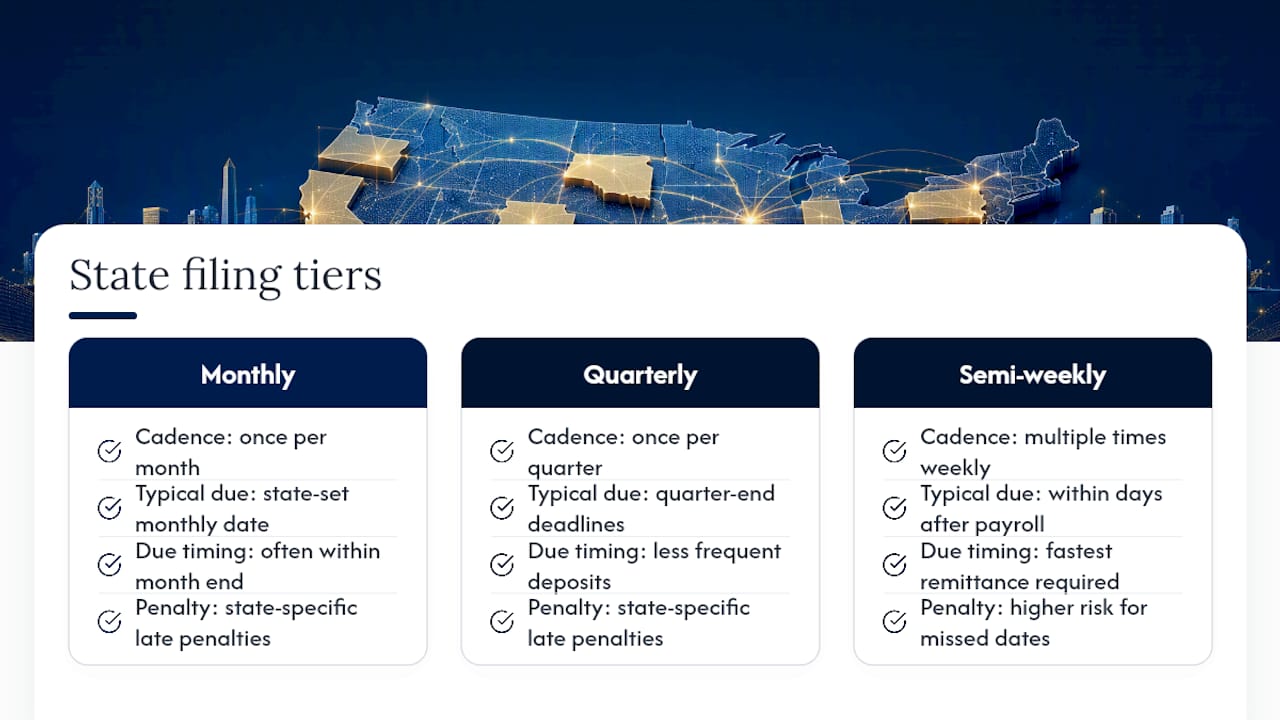
This matters because a single business operating across three or four states can end up managing three or four different filing calendars simultaneously, each with its own due date, its own online portal, and its own penalty structure for late submission. A contractor who’s used to a single quarterly state filing suddenly finds themselves tracking monthly deposits in one state and semi-weekly deposits in another, purely because that state’s rules classify a mid-size employer differently.
State unemployment insurance filings run on their own separate schedule, almost always quarterly, and that schedule doesn’t automatically align with your income tax withholding deadlines. It’s entirely possible to be current on SUI in a state while missing an income tax withholding deposit in the same state, because the two obligations live in different systems with different due dates.
The practical fix is building a master compliance calendar the moment you register in a new state, not relying on memory or a generic annual planner. Note the specific due date, the filing frequency tier you’ve been assigned, and whether that frequency can change as your withholding volume grows. States periodically reassess your filing frequency based on prior-year withholding totals, so an assignment that fit your business two years ago may not fit it today. Review your assigned frequency annually alongside your other year-end tax planning, particularly if you’ve added headcount or expanded into new states.
Choosing a Payroll System That Actually Handles Multiple States
Not every payroll platform handles multi-state complexity the same way, and the gap between “technically supports multiple states” and “actually gets the allocation right” is where most small employers get burned. A system that only lets you assign one work state per employee record will silently miscalculate withholding the moment someone splits time between states.

Look for a platform built to handle per-pay-period state allocation, not just a static state field on the employee profile. The stronger systems let you code hours or days worked by state directly at the time entry level, then calculate withholding and SUI allocation automatically based on that data rather than requiring manual recalculation every pay period. That capability directly supports the days-worked allocation method payroll processors rely on for splitting wages between states.
Reciprocity handling matters just as much. A platform should let you upload state-specific exemption certificates and apply them automatically, rather than requiring your bookkeeper to remember which of your fifteen remote employees filed one last year. Ask any vendor directly how their system handles convenience-of-the-employer states, because that’s the feature most platforms get wrong or skip entirely.
Integration with your general ledger and job costing system is the piece owner-operated businesses underestimate most. If payroll data doesn’t flow cleanly into the same books you use for job costing and cash flow forecasting, you end up reconciling two systems by hand every month, which is exactly the kind of manual work that lets errors slip through. Technology consulting focused on accounting system integration can shortcut a lot of this trial and error.
Remote Work Has Made Multi-State Payroll a Default Condition, Not an Exception
Remote and hybrid work arrangements have quietly turned multi-state payroll from a rare event into a standard operating condition for a huge share of small service businesses. A dispatcher, estimator, or bookkeeper working from home in a neighboring state used to be unusual. Now it’s routine, and the payroll rules haven’t gotten simpler to match.

The core problem is that remote work severs the old assumption that an employee’s work state matches your business’s physical footprint. A general contractor headquartered in one state can now have a project manager working remotely from a state three time zones away, an HVAC dispatcher covering multiple job sites across a metro area that straddles a state line, or a bookkeeper who relocated for family reasons and never told anyone it changed her tax situation. Each of those is a live multi-state payroll obligation, whether or not anyone in the business has registered it as one.
Telecommuting also raises the stakes on the convenience-of-the-employer rule specifically, because that rule was written with exactly this scenario in mind: an employee choosing to work from home rather than the employer requiring it. As remote arrangements become more common and more employee-initiated, more businesses fall into convenience-rule territory without realizing it, particularly if any employee works for or reports to a manager in a state with an aggressive convenience rule on the books.
The businesses handling this well share one habit: they treat “where does this person actually work” as a live data point that gets checked regularly, not a one-time fact captured at hire. That single shift, from a static assumption to an ongoing verification, is what separates companies that stay ahead of multi-state obligations from ones that discover them during an audit.
Let TrueMeasure Accounting Handle the Payroll Complexity You Don’t Have Time For
Running a multi-state payroll audit, registering in three new states, and correcting a year of misallocated withholding is a full-time project layered on top of running your business. Truemeasureaccounting is the alternative to handling this alone or hiring a full-time payroll administrator you don’t yet need: we fold multi-state payroll accuracy directly into your monthly bookkeeping, so registrations, withholding allocation, and SUI reporting get checked as part of your regular financial close, not as a separate fire drill.
For contractors, HVAC companies, trucking operators, and construction businesses juggling crews across state lines, that means fewer retroactive surprises, cleaner year-end W-2s, and a clearer picture of how payroll liabilities affect your cash position month to month. Our payroll support services cover registration triage, ongoing withholding accuracy, and coordination with tax preparation when corrected filings are needed.
If you already know you have exposure, or you’re just not confident your current setup is catching new-state hires before they become a problem, reach out to discuss your payroll support options and get a clear read on where you stand.
Payroll Compliance Is a Cash Flow Discipline, Not Just a Legal One
The businesses that stay clean on multi-state payroll aren’t the ones with the best lawyers. They’re the ones who check employee locations on a schedule instead of by accident. I’ve seen owners discover a two-year-old SUI gap only after a former employee’s unemployment claim got rejected, and by then the fix costs far more than the registration would have.
Register first. Audit quarterly. Automate the tracking last, once the process is right.
— Tony