
Every financial statement heading follows the same three-line rule: the company’s legal name on line one, the statement title on line two, and the reporting period or date on line three. That structure is the standard across US GAAP reporting entities, confirmed by textbook resources and practical teaching examples alike.
The wording on line three changes depending on the type of statement:
- Balance sheet: “As of December 31, 2025” (point-in-time)
- Income statement: “For the Year Ended December 31, 2025” (period-based)
- Statement of Cash Flows: “For the Year Ended December 31, 2025” (period-based)
Minor qualifiers such as “Consolidated,” “Unaudited,” or “Parent Company Only” are acceptable additions. Place them either as part of the statement title on line two or on a fourth line directly beneath the date.
Pro Tip: If a reviewer or lender has to ask “what period does this cover?” your heading has already failed its job. Get the period wording right before anything else.
Table of Contents
- What should each of the three heading lines contain?
- Copy-and-paste heading templates for each core statement
- What US standards actually govern financial statement headings?
- Which title variants and qualifiers are acceptable?
- Heading templates tuned for owner-operated service businesses
- Key Takeaways
- Why heading precision matters more than most accountants admit
- Professional financial reporting, done right from the start
- Useful sources and further reading
What should each of the three heading lines contain?
Each line carries a specific job. Getting any one of them wrong creates confusion for lenders, auditors, and tax reviewers.
Line 1: Legal company name
Use the full legal name as registered, not a trade name or DBA. “Apex Mechanical LLC” is correct; “Apex HVAC” is not, unless that is the registered entity. For consolidated statements, the parent entity’s legal name goes here, and “Consolidated” moves to line two as a qualifier on the statement title.
Line 2: Statement title
Investopedia’s overview of financial statements identifies four core statements, each with an accepted title. The table below shows the most common alternatives:
| Statement | Primary Title | Acceptable Alternative |
|---|---|---|
| Balance Sheet | Balance Sheet | Statement of Financial Position |
| Income Statement | Income Statement | Statement of Operations / Statement of Profit or Loss |
| Cash Flow Statement | Statement of Cash Flows | Cash Flow Statement |
| Equity Statement | Statement of Changes in Equity | Statement of Stockholders’ Equity |
Both the primary title and the alternative are acceptable under US GAAP. Choose one and use it consistently across all periods. Add “Consolidated” before the title when the statement rolls up multiple entities.
Line 3: Reporting period or date
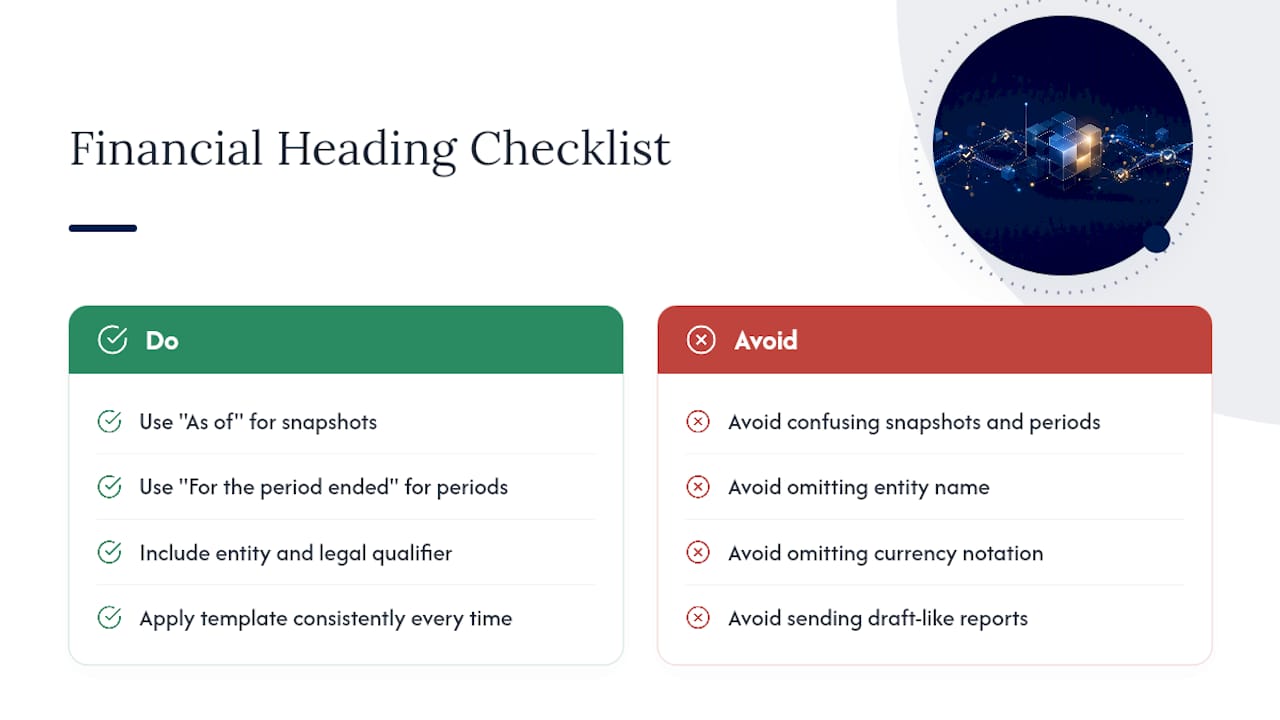
This is where most errors occur. Balance sheets capture a single moment in time, so the heading reads “As of [Date].” Income statements and cash flow statements cover a span of time, so they read “For the [period] ended [Date].” The PwC financial statement presentation guide reinforces that this distinction is not cosmetic. It directly affects how a reader interprets the numbers.
For comparative presentations, list both dates: “As of December 31, 2025 and 2024.”
Formatting conventions
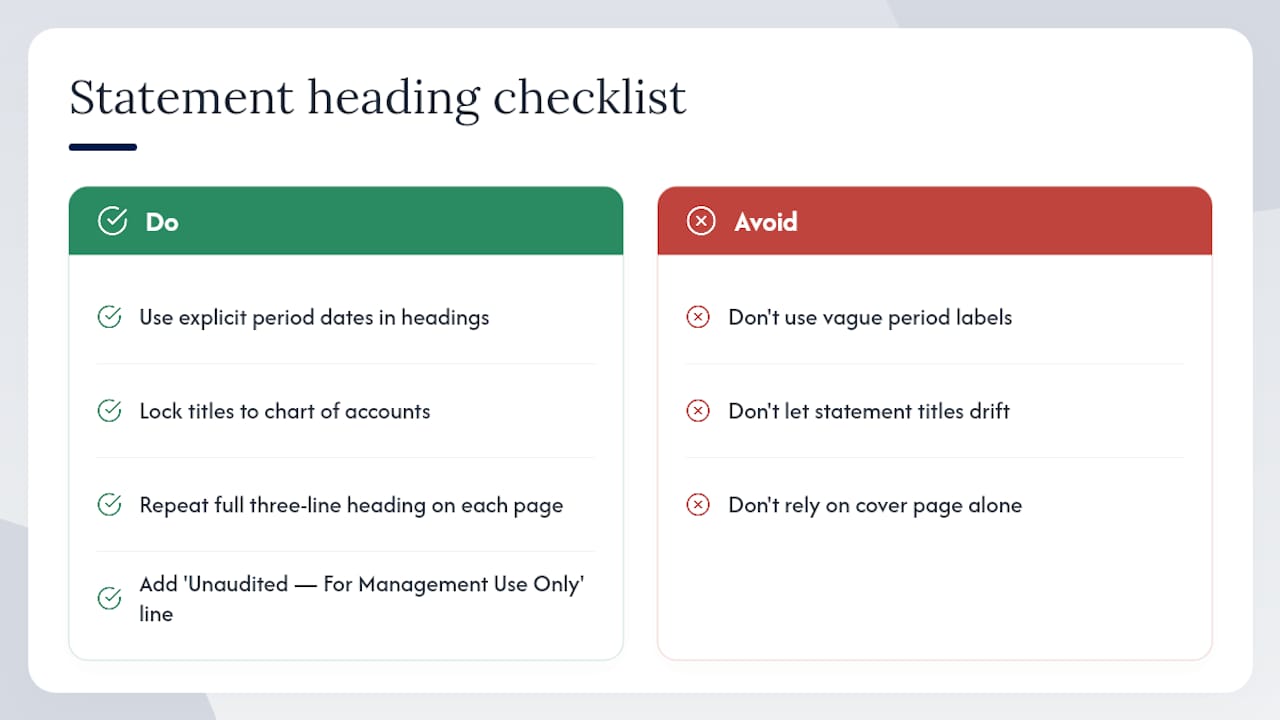
- Center all three lines horizontally on the page, or align them consistently left for internal reports.
- Use a font size hierarchy: company name slightly larger or bold, statement title slightly smaller, date line in regular weight.
- Place currency notation on a fourth line or directly beneath the heading block: “All amounts in U.S. dollars, rounded to the nearest dollar.”
- Audit qualifiers (“Unaudited” or “Audited by [Firm Name]”) go in parentheses after the statement title or on a separate line beneath the date.
Pro Tip: For small business balance sheets, keep the heading block to four lines maximum. A cluttered heading signals disorganized reporting before a lender reads a single number.
Copy-and-paste heading templates for each core statement
These templates are ready to use. Swap in your entity name, dates, and any applicable qualifiers.
Balance sheet templates
Single period:
Apex Mechanical LLC
Balance Sheet
As of December 31, 2025
All amounts in U.S. dollars
Comparative:
Apex Mechanical LLC
Balance Sheet
As of December 31, 2025 and 2024
All amounts in U.S. dollars
Interim (unaudited):
Apex Mechanical LLC
Balance Sheet (Unaudited)
As of September 30, 2025
All amounts in U.S. dollars
Income statement templates
Annual:
Apex Mechanical LLC
Income Statement
For the Year Ended December 31, 2025
Comparative:
Apex Mechanical LLC
Income Statement
For the Years Ended December 31, 2025 and 2024
Quarterly interim:
Apex Mechanical LLC
Income Statement (Unaudited)
For the Three Months Ended March 31, 2025
Statement of cash flows
Annual:
Apex Mechanical LLC
Statement of Cash Flows
For the Year Ended December 31, 2025
Interim:
Apex Mechanical LLC
Statement of Cash Flows (Unaudited)
For the Six Months Ended June 30, 2025
Statement of changes in equity
Apex Mechanical LLC
Statement of Changes in Equity
For the Year Ended December 31, 2025
For owner-operated firms, this statement sometimes appears as “Statement of Owner’s Equity” when there is a single owner. Both are acceptable. SEC registrants use “Statement of Stockholders’ Equity.”
Currency and units placement: Place the currency line either as the last line of the heading block or as the first line of the body notes. Either placement works; just be consistent across all statements in the same report.
Pro Tip: For interim reports, always include “(Unaudited)” in the statement title. Dropping it on a quarterly report that goes to a lender or investor creates a liability. One word prevents a lot of friction.
What US standards actually govern financial statement headings?
Three authorities shape heading and presentation requirements in the United States. Understanding which one applies to your client or employer determines how strictly you must follow specific rules.
| Authority | Applies to | Key heading and presentation impact |
|---|---|---|
| ASC 205 (FASB) | All US GAAP entities | Baseline presentation rules; requires a complete set of statements with proper identification |
| SEC Regulation S-X | Public registrants (SEC filers) | Mandates comparative periods, specific statement titles, and auditor identification |
| GASB / ACFR standards | State and local governments | Requires expanded report structure with introductory, financial, and statistical sections |
PwC’s financial statement presentation guidance confirms that ASC 205 is the baseline for all US GAAP entities, while SEC Regulation S-X adds a layer of specificity for registrants. KPMG’s presentation handbook describes how these two frameworks interact and where best-practice alignment matters for nonpublic entities.
For SEC registrants: Comparative periods are mandatory. The heading must show two balance sheet dates and two income statement periods at minimum. The auditor’s report must be identified in the filing.
For private companies: Comparative periods are best practice, not a legal requirement. Simplified heading wording is acceptable as long as the three core lines are present and the period type is unambiguous.
For government entities: The Washington State ACFR and the City of Tampa ACFR both illustrate how public-sector reports organize headings across an expanded structure that includes an introductory section, financial section, and statistical section. The US Government’s consolidated financial report applies these conventions at the largest scale, compiled in conformity with GAAP and subject to a governmentwide audit.
- For most small-business clients, ASC 205 is the relevant standard.
- SEC rules apply only when a company files with the SEC or is preparing for a transaction that requires SEC-style presentation.
- GASB applies to government entities, not private businesses.
Which title variants and qualifiers are acceptable?
The guiding principle is simple: the title should faithfully describe what the statement shows. Both “Balance Sheet” and “Statement of Financial Position” are accepted under US GAAP. The choice is a matter of preference or industry convention, not a compliance requirement.
Accepted alternative titles:
- Balance Sheet / Statement of Financial Position
- Income Statement / Statement of Operations / Statement of Profit or Loss
- Statement of Cash Flows / Cash Flow Statement
- Statement of Changes in Equity / Statement of Stockholders’ Equity / Statement of Owner’s Equity
Qualifiers and where to place them:
- “Consolidated” goes before the statement title: “Consolidated Balance Sheet”
- “Parent Company Only” goes after the title or on a separate line beneath it
- “Unaudited” goes in parentheses after the title: “Income Statement (Unaudited)”
- “For Management Use Only” goes on a separate line beneath the date, not embedded in the title
Comparative headings for internal vs. external reports: External audited reports should never carry “For Management Use Only.” Internal rolled-up reports should always carry it. Mixing these qualifiers is a common source of confusion during lender reviews.
One wording trap to avoid: Never use “Year-to-Date” in a heading when you mean “For the Year Ended.” Year-to-date implies the period is still open. “For the Year Ended December 31, 2025” is closed and final. The distinction matters to any reviewer reading the numbers.
Heading templates tuned for owner-operated service businesses
The templates in the copy-and-paste section above work for any entity. These variations address the specific situations that come up most often for HVAC companies, plumbing contractors, trucking firms, and construction businesses.
Annual package (service business):
Apex Plumbing & Mechanical LLC
Balance Sheet
As of December 31, 2025
All amounts in U.S. dollars, rounded to the nearest dollar
Apex Plumbing & Mechanical LLC
Income Statement
For the Year Ended December 31, 2025
Quarterly internal review:
Apex Plumbing & Mechanical LLC
Income Statement (Unaudited — For Management Use Only)
For the Three Months Ended March 31, 2025
Trucking client case example: A trucking client was presenting a comparative balance sheet to a lender for a seasonal line of credit. The prior year’s heading read “As of December 2024” without a specific date. The lender’s underwriter flagged it and requested a corrected statement. Changing the heading to “As of December 31, 2024 and 2023” resolved the issue immediately. The lender could then see the seasonal cash position clearly across both periods, which supported the credit approval.
Preventing title drift in internal reports: When a business runs multiple internal reports monthly, headings tend to drift. One month it reads “Income Statement,” the next it reads “P&L Summary.” That inconsistency creates confusion when comparing periods. Tie your statement titles to your chart of accounts naming conventions and lock them in a template file.
Cover page vs. statement page: For client deliverables in PDF format, the cover page carries the entity name, report period, and preparer information. Each individual statement page repeats the full three-line heading. Never rely on the cover page alone to identify the period.
Pro Tip: Add a usage qualifier line to every internal report: “Unaudited — For Management Use Only — Not for Distribution.” One line prevents a draft report from being mistaken for a final audited statement.
Key Takeaways
Correct financial statement headings require three mandatory lines, period-specific wording, and consistent qualifiers across every statement in the report package.
| Point | Details |
|---|---|
| Three-line rule | Every statement needs the legal entity name, statement title, and reporting period or date. |
| Point-in-time vs. period wording | Balance sheets use “As of [Date]”; income and cash flow statements use “For the [period] ended [Date].” |
| Qualifiers matter | “Consolidated,” “Unaudited,” and “For Management Use Only” must be placed consistently and never mixed across a report package. |
| Currency notation | State “All amounts in U.S. dollars” on the heading block or directly beneath it for any external report. |
| Truemeasureaccounting approach | Truemeasureaccounting standardizes heading templates and report packages for service businesses, reducing lender friction and supporting clearer cash-flow analysis. |
Why heading precision matters more than most accountants admit
Most accounting courses spend about ten minutes on headings and move on. That is a mistake. The heading is the first thing a lender, tax reviewer, or business partner reads. If it is ambiguous, the credibility of everything beneath it drops before they reach line one of the numbers.
The “As of” versus “For the period ended” distinction is not a formatting preference. It tells the reader whether they are looking at a snapshot or a movie. A lender evaluating a trucking company’s seasonal borrowing needs reads those two heading types very differently. A balance sheet dated “As of September 30, 2025” tells them the cash position on that specific day. An income statement “For the Nine Months Ended September 30, 2025” tells them what the business earned over nine months. Confuse those two, and the lender’s underwriter has to call and ask. That call delays the draw, which delays operations.
The other thing most guides miss: internal reports are where heading discipline breaks down fastest. When a business owner or office manager pulls a QuickBooks report and emails it to a banker without checking the heading, that report often reads “Profit & Loss — January through September 2025.” No entity name. No legal qualifier. No currency notation. It looks like a draft. Because it is one.
For owner-operated service businesses, the fix is not complicated. It is a template, applied consistently, every time. The businesses that get loan approvals faster and with fewer back-and-forth requests are the ones whose reports look like they were prepared by someone who knows what they are doing. Correct headings are the first signal of that.
Professional financial reporting, done right from the start
Correct headings are one piece of a report package that actually works for your business. Truemeasureaccounting builds complete, lender-ready financial report packages for owner-operated service businesses across the US, including HVAC companies, plumbing contractors, construction firms, and trucking operations.
Every client engagement includes standardized heading templates, a report review against US GAAP presentation standards, and monthly financial statements that are ready for lenders, tax preparers, and business decisions. No more draft reports going to bankers. No more heading errors triggering underwriter questions.
If your current reports are inconsistent, missing qualifiers, or built from QuickBooks exports with no formatting, our bookkeeping services include a full report standardization as part of onboarding. You get clean, properly headed statements from month one.
Ready to get your financial reporting in order? Schedule a call with Truemeasureaccounting to review your current statements and set up templates that work every time.
Useful sources and further reading
| Source | What it covers | Best used for |
|---|---|---|
| PwC Financial Statement Presentation Guide | ASC 205 baseline rules and SEC Reg S-X alignment | Registrants and private entities checking presentation requirements |
| KPMG DPP Handbook — Financial Statement Presentation | SEC rules, ASC alignment, nonpublic entity best practices | Practitioners advising both public and private clients |
| Principles of Accounting — Four Core Financial Statements | Textbook confirmation of heading and dating requirements | Students and instructors |
| Accountingverse — Income Statement Example | Practical three-line heading illustration | Classroom use and quick reference |
| Investopedia — Financial Statements | Overview of the four primary statements and their purposes | Students and non-accountant business owners |
| US Government Financial Report — Bureau of the Fiscal Service | Large-scale application of GAAP heading and presentation conventions | Government accounting and consolidated reporting examples |
| Washington State ACFR — Office of Financial Management | ACFR structure: introductory, financial, and statistical sections | Government and public-sector reporting |
| City of Tampa ACFR | Municipal ACFR layout, notes placement, and heading conventions | Public-sector practitioners and students |
This article provides general educational information about financial statement presentation under US GAAP. It is not a substitute for professional accounting advice. Confirm current requirements with the applicable authoritative standard or a qualified CPA.