
The percentage of completion method (POC) recognizes contract revenue and costs in proportion to work finished each period, instead of waiting until a project wraps. Use it when you can reliably estimate total contract costs and collection from the customer is reasonably assured, which describes most fixed-price construction and long-term service work under ASC 606 and GAAP.
Three things to know before your next close:
- Measurement: most contractors track progress with cost-to-cost, though effort-based or unit-based measures work too.
- Balance sheet: unbilled progress shows up as Costs in Excess of Billings; overbilling shows up as Billings in Excess of Costs.
- Governance: GAAP and ASC 606 expect a documented policy and consistent disclosure, not a guess made in a spreadsheet once a year.
TrueMeasure Accounting builds this into monthly close work for contractors who need the numbers to hold up to a bank, a bonding company, or an IRS review.
Key Takeaways
The percentage of completion method works only as well as the cost estimate feeding it, which is why monthly job-cost integration matters more than the formula itself.
| Point | Details |
|---|---|
| Use POC when estimates are reliable | Apply it when total cost can be reasonably estimated and customer payment is reasonably assured. |
| Cost-to-cost is the common formula | Percentage complete equals costs incurred to date divided by total estimated cost. |
| Recognize losses immediately | Book the full expected contract loss in the period you identify it, not gradually. |
| Watch CIP and progress billings | These balance-sheet accounts show whether you’re financing the customer’s project with your own cash. |
| TrueMeasure builds the controls | TrueMeasure Accounting supports job-cost integration, monthly close discipline, and tax planning that keep POC numbers accurate and audit-ready. |
Table of Contents
- What Is the Percentage of Completion Method Used For?
- How Percentage of Completion Recognizes Revenue
- Calculating Percentage of Completion: Formulas That Matter
- A Worked Example With Journal Entries
- PCM vs. Completed Contract Method: Which One Fits?
- Does ASC 606 Still Allow Percentage of Completion Accounting?
- Loss Recognition and Balance Sheet Presentation
- Building Controls That Keep POC Accurate
- Tax Treatment vs. Financial Reporting Under POC
- What Most Contractors Get Wrong About Estimate Discipline
- Get Your POC Numbers Audit-Ready With TrueMeasure
- Sources
What Is the Percentage of Completion Method Used For?
POC recognizes revenue as work progresses rather than at contract signing or final delivery, matching income to the labor and materials that earned it. That distinction matters for any business billing customers over months or years instead of per transaction.
You’ll see it applied most often in:
- Fixed-price construction and general contracting
- Long-term HVAC, electrical, or plumbing installation contracts
- Custom fabrication and large-scale renovation work
- Shipbuilding and heavy equipment manufacturing
- Select custom software or engineering-build projects
Pro Tip: Skip POC when your cost estimates are shaky or the customer’s ability to pay is in question. If you can’t confidently size the finish line, don’t recognize revenue as if you can see it.
How Percentage of Completion Recognizes Revenue
Each period, you recognize the slice of total contract revenue that matches how much of the job is actually done. Get the percent complete wrong, and every number downstream, revenue, margin, tax liability, follows it into error.
The monthly flow looks like this:
- Estimate total contract cost at the outset and revisit it regularly
- Measure costs incurred to date (or hours, or units, depending on your method)
- Calculate percent complete for the period
- Recognize revenue and cost of goods sold based on that percentage
- Adjust Construction in Progress (CIP) and progress billings to reflect the gap between what’s earned and what’s invoiced
The accounts doing the work: CIP (also called Costs in Excess of Billings), Progress Billings (Billings in Excess of Costs), contract receivable, revenue, and COGS. Get comfortable with how these four interact, because they’re the backbone of every job-costing conversation you’ll have with your accountant.
Calculating Percentage of Completion: Formulas That Matter
Three accepted methods exist, and cost-to-cost is the most common practical approach for construction because most contractors already track costs closely.
Cost-to-cost: Percentage complete = Costs incurred to date ÷ Total estimated cost. This mirrors the formula Deltek uses in its own walkthroughs: Actual Costs Incurred ÷ Total Estimated Costs.
Efforts-expended: Percentage complete = Labor hours to date ÷ Total estimated labor hours. Useful when labor, not materials, drives the job.
Units-of-delivery: Percentage complete = Units delivered ÷ Total contracted units. Common in fabrication or repetitive-unit installation work.
Once you have percent complete, multiply it by total contract price to get cumulative revenue earned to date, then subtract revenue already recognized in prior periods to isolate what belongs to the current period.
- Calculate cumulative percent complete
- Multiply by total contract revenue for cumulative earned revenue
- Subtract prior periods’ recognized revenue
- Post the remainder as this period’s revenue
Pro Tip: When a change order hits, add its value to both contract price and estimated cost immediately, don’t wait for month-end. Delivered-but-uninstalled materials generally shouldn’t count toward percent complete unless they were fabricated specifically for that job. And if your total cost estimate shifts by more than a small, material amount, document the change and run a full catch-up calculation that period rather than smoothing it over three months.
A Worked Example With Journal Entries
Say you sign a contract with a total price and estimated cost that imply a target profit margin.
Journal entries for Period 1 would look like this:
- Debit Construction in Progress $100,000; credit Cash/AP $100,000 (costs incurred)
- Debit Accounts Receivable/Contract Asset $125,000; credit Revenue $125,000 (revenue earned)
- Debit COGS $100,000; credit Construction in Progress $100,000 (cost matched to revenue)
- Debit Cash $110,000; credit Progress Billings $110,000 (amount actually invoiced)
Now suppose in Period 2 your estimator revises the total estimated cost upward, reducing your margin. You recalculate percent complete using the new denominator and post a catch-up entry that period, adjusting revenue recognized to date to match the revised estimate. If the revision pushes the entire contract into a loss position, GAAP requires you to recognize the full expected loss immediately, not spread it across remaining periods.
PCM vs. Completed Contract Method: Which One Fits?
POC recognizes revenue as work happens; the completed contract method (CCM) waits until the job is finished. Choose POC when your estimates are reliable and collectability is reasonably assured; lean toward CCM when either one is genuinely in doubt.
- Timing: POC smooths revenue across periods; CCM creates lumpy, single-period spikes
- Volatility: POC shows steadier margins; CCM can mask problems until the very end
- Tax treatment: long-term contracts often require POC for tax purposes regardless of your book method, per IRS practice guidance
- Lender and bonding view: POC gives banks and sureties a clearer read on in-progress performance
- Audit scrutiny: POC draws more attention to estimate quality and documentation
Decision checklist:
- Can you estimate total cost within a reasonable margin?
- Is customer payment reasonably assured?
- Does the contract run long enough that timing distortion matters?
If you answer yes to all three, POC is almost always the better fit.
Does ASC 606 Still Allow Percentage of Completion Accounting?
Yes. ASC 606 and IFRS 15 don’t use the term “percentage of completion” anymore, but both standards permit revenue recognition over time when specific criteria are met, which is the same underlying logic POC has always followed.
Over-time recognition applies when:
- The customer receives and consumes benefits as you perform (common in service contracts)
- Your work creates or enhances an asset the customer controls as it’s built
- The asset has no alternative use to you, and you have an enforceable right to payment for work completed
Pro Tip: Write down your revenue recognition policy in plain language: which progress method you use, how often you re-estimate, and who signs off on changes. Auditors and lenders both want to see that documentation, not just the resulting numbers.
Loss Recognition and Balance Sheet Presentation
If a contract is expected to lose money overall, you recognize the entire projected loss in the period you identify it, not gradually as the job winds down. This is one of the least intuitive parts of POC accounting, and it’s also one auditors check first.
On the balance sheet, two line items carry the weight:
- Costs in Excess of Billings (an asset): you’ve earned more revenue than you’ve invoiced
- Billings in Excess of Costs (a liability): you’ve invoiced more than you’ve earned
These figures directly affect working capital and how lenders read your balance sheet. If you’re carrying large Costs in Excess of Billings balances, you’re financing the customer’s project with your own cash, which is worth flagging early, not at year-end.
For any contract with a projected loss or a significant cost revision, disclose the change, the reason for it, and the dollar impact on current-period earnings.
Building Controls That Keep POC Accurate
Reliable POC accounting starts with one job-cost source of truth, a monthly re-estimate habit, and clear ownership over who signs off on progress numbers before they hit the books.
- Pick a single system of record for job costs and stop reconciling between spreadsheets and QuickBooks after the fact
- Schedule a monthly re-estimate for every active job, not just the ones that look off
- Reconcile project manager hours and material receipts against the job-cost ledger every close
- Log every change order the day it’s approved, with its cost and revenue impact attached
- Run a variance report by job monthly, flag any job where actual cost drifts more than a small percentage from budget
Pro Tip: Separate the person estimating percent complete from the person posting the accounting entries. When the same person controls both, estimate quality tends to drift toward whatever result looks best, not what’s true. TrueMeasure typically closes this gap through QuickBooks cleanup, job-cost system setup, and fractional CFO oversight that catches drift before it becomes a surprise. A structured job-costing approach also makes the monthly re-estimate far less painful.
Tax Treatment vs. Financial Reporting Under POC
Financial statement POC and tax POC often produce different numbers, and that gap catches contractors off guard every year. For book purposes, you follow ASC 606 and recognize revenue as work progresses, subject to the estimate and disclosure rules already covered.
For tax purposes, the IRS generally requires long-term contracts, defined as contracts not completed within the tax year they’re started, to use the percentage of completion method for contracts exceeding certain size thresholds, with limited exceptions for small contractors and home construction contracts. The IRS practice unit on long-term contract accounting walks through how examiners test whether a business applied the required method correctly.
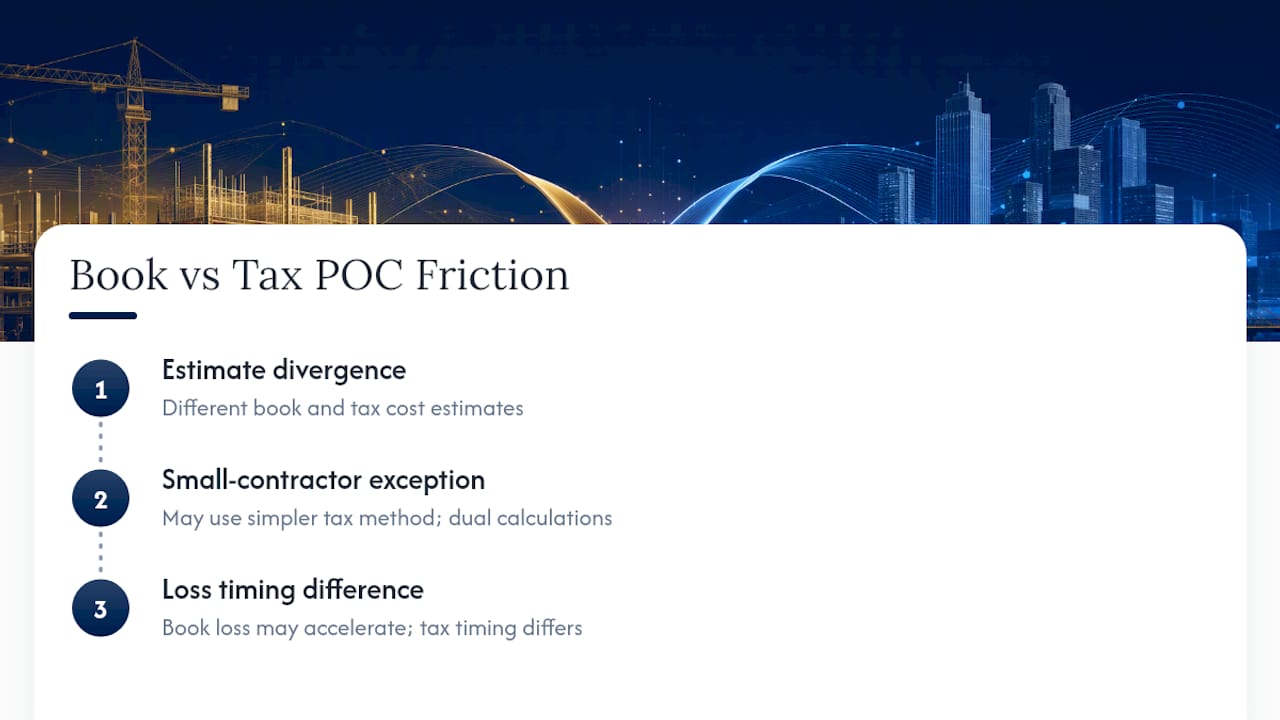
The practical friction shows up in three places. First, your book estimate of total cost and your tax estimate might diverge slightly if you’re conservative on one set of books and aggressive on the other, creating a temporary book-tax difference that needs tracking. Second, the small-contractor exception (tied to average annual gross receipts) can let qualifying businesses use a simpler method for tax while still using POC for financial statements, which means maintaining two sets of calculations side by side. Third, a mid-contract loss recognized immediately for book purposes doesn’t always accelerate the same way for tax, depending on which exception applies.
None of this is optional paperwork. A mismatch between your book revenue and your tax return revenue is one of the first things a tax preparer or IRS examiner reconciles, and getting it wrong either overstates taxable income in a cash-tight year or understates it in a way that draws attention.
What Most Contractors Get Wrong About Estimate Discipline
The businesses that struggle with POC almost never struggle with the math. The formulas are simple enough that a decent bookkeeper can run them in an afternoon. Where it breaks down is the discipline behind the number going into the formula: the total estimated cost.
Two patterns show up constantly. A project manager under-estimates total cost early to make a bid look better or a job look healthier, and the accounting team keeps recognizing revenue against that optimistic number for months. By the time reality catches up, the required catch-up entry is large enough to wipe out a quarter’s reported profit in a single close, and that volatility is what spooks a lender reviewing your financials. On the other end, a contractor with genuinely clean job-cost integration, PM hours and material receipts flowing into the same system the accountant uses, sees percent complete tighten up naturally, and monthly margins stop swinging wildly from one close to the next.

Neither outcome is really about accounting knowledge. It’s about whether the number feeding the formula reflects what’s actually happening on the job site that month.
Get Your POC Numbers Audit-Ready With TrueMeasure
TrueMeasure Accounting builds the job-cost integration and monthly close discipline that makes percentage of completion accounting hold up under a lender review or an IRS examination, without you having to become an accountant yourself.
Our team handles the pieces that typically break down for growing contractors: monthly bookkeeping and reconciliations tied directly to job cost, QuickBooks cleanup so your progress numbers stop fighting your spreadsheets, financial reporting built around real contract balances, retainage tracking, and proactive tax planning that keeps book and tax POC calculations aligned instead of working against each other. For businesses that have outgrown basic bookkeeping but aren’t ready for a full-time controller, our fractional CFO services add the estimate governance and monthly re-estimate discipline that keeps catch-up entries from blindsiding you.
If your monthly close currently involves guessing at percent complete or reconciling two sets of numbers by hand, start with a conversation about bookkeeping and job-cost support built specifically for contractors and project-based businesses.
Sources
Technical claims in this article draw on the following sources:
- Percentage of completion method — AccountingTools
- Percentage of Completion Method Defined With Examples | NetSuite
- IFRS 15 — Revenue from Contracts with Customers (IFRS Foundation)
- Percentage of Completion Method: Key Concepts & Applications | Deltek
This article is general information, not a substitute for advice from a qualified financial advisor. Consult a qualified financial professional about your own circumstances before acting on anything here.