
A balance sheet is a financial statement that shows exactly what your small business owns, owes, and the equity held by its owners at a specific point in time. Known formally as the statement of financial position, it is built on one unbreakable rule: Assets = Liabilities + Equity. Every small business owner needs to understand this document because it reveals the true financial health of the business, not just whether last month was profitable. Your profit and loss statement tells you how you performed. Your balance sheet tells you where you actually stand. Understanding what is a balance sheet for a small business is the first step toward making decisions grounded in financial reality rather than gut feeling.
What are the main components of a small business balance sheet?
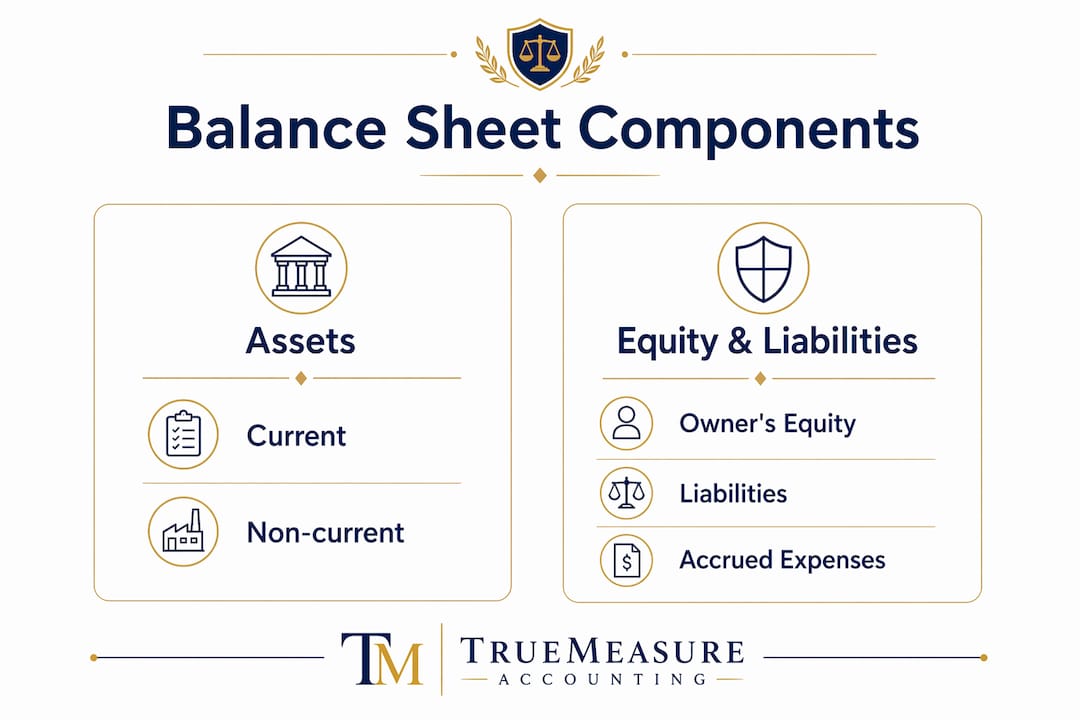
A balance sheet has three sections: assets, liabilities, and owners’ equity. Each section tells a different part of your financial story, and all three must balance according to the accounting equation.

Assets: what your business owns
Assets are divided into current and non-current categories. Current assets convert to cash within 12 months. Non-current assets are held longer.
- Current assets: Cash in your bank accounts, accounts receivable (money customers owe you), inventory, and prepaid expenses like insurance paid in advance
- Non-current assets: Equipment, vehicles, real estate, and other property your business holds for long-term use
- Intangible assets: Goodwill, trademarks, or patents if applicable to your business
For a plumbing company, current assets might include $40,000 in cash and $25,000 in outstanding invoices. Non-current assets would include service vans and specialized equipment, recorded at cost minus accumulated depreciation.
Liabilities: what your business owes
Liabilities are also split between current and long-term. Current and long-term categories give lenders and owners a clear picture of payment obligations.
- Current liabilities: Accounts payable, accrued wages, sales tax payable, and any loan payments due within 12 months
- Long-term liabilities: Business loans, equipment financing, and mortgages with repayment terms beyond one year
Owners’ equity: the net worth of your business
Owners’ equity is what remains after subtracting liabilities from assets. It includes your initial investment in the business, any additional capital contributions, and retained earnings accumulated over time. Retained earnings grow when the business earns profit and the owner does not withdraw it all. This number is one of the clearest indicators of whether your business is building real wealth.
Pro Tip: Many small businesses omit accrued expenses and deferred revenue from their balance sheets. Leaving these out makes your business look more liquid and profitable than it actually is, which leads to poor cash flow decisions.
Why is a balance sheet critical for small business financial health?
A balance sheet is not a compliance document. It is a decision-making tool. Viewing all three financial statements together gives you the full picture: the income statement shows profit, the cash flow statement shows movement of cash, and the balance sheet shows your financial position.
A business can show strong profit on its income statement while quietly running out of cash. This happens when customers are slow to pay, when debt payments are high, or when the owner is drawing too much from the business. The balance sheet catches these problems before they become crises.
Using ratios to read your balance sheet
Three ratios turn your balance sheet from a static document into a real-time diagnostic tool.
- Current ratio (current assets divided by current liabilities): Lenders expect at least 1.5:1 to consider a business creditworthy. A ratio of 9:1 signals very strong liquidity.
- Quick ratio (current assets minus inventory, divided by current liabilities): This strips out inventory to show whether you can cover short-term obligations with cash and receivables alone.
- Debt-to-equity ratio (total liabilities divided by total equity): Low leverage signals financial strength and a greater ability to borrow responsibly when growth opportunities arise.
For an HVAC company carrying $15,500 in debt against $87,900 in equity, the debt-to-equity ratio is well below 1.0. That business has strong borrowing capacity if it needs to purchase new equipment or expand its fleet.
Balance sheets and your ability to borrow or attract investment
Accurate balance sheets directly influence whether a bank approves your loan and at what rate. Lenders review your balance sheet to assess collateral, existing debt load, and net worth before making a credit decision. A clean, well-organized balance sheet signals that you run a serious operation. A messy or incomplete one raises red flags, even if your revenue is strong.
Spotting early warning signs
Rising accounts receivable is one of the most common early warning signs visible on a balance sheet. If customers owe you significantly more this month than last month, your cash flow is about to tighten. A 30-minute post-month-end review of your current ratio, quick ratio, debt-to-equity ratio, and Days Sales Outstanding can surface these risks before your bank balance shows the problem. Most small business owners skip this review entirely, which is why cash shortfalls feel sudden even when the warning signs were there weeks earlier.
How to prepare an accurate balance sheet for your small business
Preparing a reliable balance sheet starts with gathering the right documents. Skipping this step produces numbers that look clean but mislead you.
Gather these documents before you begin:
- Bank statements for all business accounts, including savings and lines of credit
- Loan documents showing current balances and payment schedules
- Accounts receivable aging report listing what customers owe and how long it has been outstanding
- Accounts payable records showing what you owe vendors and suppliers
- Payroll reports capturing accrued wages not yet paid
- Invoices and receipts for major asset purchases
- Records of owner contributions and any distributions taken
Once you have these documents, separate every item into current or long-term. Cash, receivables due within 30 to 90 days, and inventory are current assets. Equipment and vehicles go into non-current assets. Loan balances due within 12 months are current liabilities. The remainder of those loans is long-term.
Valuing assets correctly
Equipment and vehicles must be recorded at cost minus accumulated depreciation, not at what you paid for them years ago. A service truck purchased for $45,000 three years ago is not worth $45,000 on your balance sheet today. Depreciation reduces the recorded value each year. Overstating asset values inflates your equity and gives you a false sense of financial strength.
Pro Tip: If you use QuickBooks or similar accounting software, set up a fixed asset register and record depreciation monthly. This keeps your balance sheet current and prevents a large, unexpected adjustment at year-end.
Verifying the accounting equation
Before you finalize any balance sheet, confirm that total assets equal total liabilities plus total equity. If the numbers do not balance, something is missing or miscategorized. Common causes include forgetting to record a loan, missing an owner contribution, or double-counting an asset. Do not move forward until the equation holds.
How often should you prepare a balance sheet?
Preparing your balance sheet monthly or quarterly gives you the ongoing visibility needed to manage cash flow and make sound decisions. Annual preparation is the minimum for tax purposes, but it is far too infrequent to catch problems in time. For service businesses with variable revenue, monthly preparation is the standard that Truemeasureaccounting recommends to its clients.
How can small business owners use balance sheets to drive growth?
A balance sheet read in isolation is interesting. A balance sheet read alongside your income statement and cash flow statement every month is a business management system. Accurate bookkeeping and timely financial reporting form the foundation for better pricing decisions, cash flow management, and job costing strategies.
Here is how to put your balance sheet to work:
- Identify underutilized assets. If you carry $80,000 in equipment on your balance sheet but that equipment sits idle three days a week, you have a utilization problem. Either put it to work or sell it and reduce your debt load.
- Monitor retained earnings. Growing retained earnings signal that your business is building real equity. Flat or declining retained earnings despite strong revenue often point to excessive owner draws or hidden cost problems.
- Use equity trends for reinvestment decisions. When equity grows consistently, you have the financial foundation to invest in hiring, equipment, or new service lines without taking on excessive debt.
- Support tax planning. Your balance sheet affects your tax position. Depreciation schedules, loan interest deductions, and the timing of asset purchases all show up here. Working with a financial advisor who understands both the balance sheet and your tax strategy produces better outcomes than treating them as separate concerns.
Pro Tip: Before meeting with a lender, financial advisor, or potential business partner, review your financial reports for the past 12 months. Walking in with clean, current statements signals credibility and shortens the approval process.
Connecting your balance sheet to day-to-day operations is where most small business owners leave money on the table. An HVAC owner who tracks receivables weekly knows when to push collections before payroll week. A general contractor who monitors equipment values knows when to refinance versus replace. These are operational decisions, and the balance sheet is the data source that makes them possible.
Key takeaways
A balance sheet is the single most important financial statement for understanding whether your small business is building wealth or quietly losing ground.
| Point | Details |
|---|---|
| Core equation | Assets = Liabilities + Equity; this must always balance before you finalize any statement. |
| Classify correctly | Separate current and long-term assets and liabilities to get an accurate picture of liquidity. |
| Use key ratios | Current ratio, quick ratio, and debt-to-equity ratio turn raw numbers into real financial intelligence. |
| Review monthly | Monthly balance sheet reviews catch cash flow problems weeks before your bank balance shows the issue. |
| Connect to decisions | Use balance sheet data to guide pricing, hiring, borrowing, and reinvestment decisions. |
What I’ve learned from 20 years of running service businesses
Most small business owners I talk to have never looked at their balance sheet outside of tax season. They track revenue, they watch their bank balance, and they assume that if the checking account looks healthy, the business is healthy. That assumption has cost more than a few business owners everything.
I built and operated multi-million-dollar service businesses before founding Truemeasureaccounting. The moment I started reading my balance sheet monthly, I stopped being surprised by cash crunches. I could see them coming six to eight weeks out because receivables were climbing or current liabilities were creeping up faster than assets.
The mistake I see most often is treating the balance sheet as a tax document rather than a management tool. Business owners hand it to their accountant once a year and never look at it again. That approach leaves you flying blind for 11 months out of 12. The business owners who grow consistently are the ones who know their current ratio, watch their retained earnings, and understand what their equity trend is telling them.
The second mistake is poor classification. Accrued expenses get left off. Deferred revenue gets recorded as income before it is earned. These errors make the business look stronger than it is, which leads to overconfident spending decisions. I have seen contractors buy equipment they could not afford because their balance sheet showed inflated equity. Clean numbers prevent that.
If you are not reviewing your balance sheet monthly alongside your monthly financial statements, you are not managing your business. You are reacting to it. The good news is that fixing this does not require a finance degree. It requires accurate books, a consistent review habit, and someone in your corner who can translate the numbers into decisions.
— Tony
Truemeasureaccounting helps you build financial clarity from the ground up
Running a service business is demanding enough without trying to decode financial statements on your own.
Truemeasureaccounting works with owner-operated businesses generating $250,000 to $5 million annually, providing professional bookkeeping services that produce accurate, timely balance sheets every month. The team goes beyond data entry to connect your financial statements to real business decisions around pricing, cash flow, hiring, and growth. Whether you need a QuickBooks cleanup, monthly financial reporting, or a fractional CFO who understands the operational side of your business, Truemeasureaccounting delivers the financial clarity you need to move forward with confidence. Reach out for a free consultation and see what your numbers are actually telling you.
FAQ
What is a balance sheet for a small business?
A balance sheet is a financial statement that shows a small business’s assets, liabilities, and owners’ equity at a specific point in time. It follows the equation Assets = Liabilities + Equity and must always balance.
How often should a small business prepare a balance sheet?
Monthly preparation is the standard for active businesses because it gives owners the visibility needed to manage cash flow and catch problems early. Annual preparation meets the minimum tax requirement but is too infrequent for sound financial management.
What is the most common balance sheet mistake small businesses make?
The most common error is omitting accrued expenses and deferred revenue, which makes the business appear more liquid and profitable than it actually is. This leads to poor spending decisions and unexpected cash shortfalls.
How does a balance sheet differ from a profit and loss statement?
A profit and loss statement shows revenue and expenses over a period of time. A balance sheet shows the financial position of the business at a single point in time, including what is owned, what is owed, and the net worth of the business.
Can a balance sheet help a small business get a loan?
Yes. Lenders review the balance sheet to assess collateral, existing debt, and net worth before approving credit. A clean, accurate balance sheet with a current ratio above 1.5:1 significantly improves your chances of approval and favorable terms.