
The single most effective way to stop contractor cash flow surprises is a weekly 13-week rolling cash forecast combined with billing discipline and active retainage management. Those three levers—forecasting, billing cadence, and working capital—catch shortfalls weeks before payroll is due. Everything else in construction cash management supports one of those three moves.
TL;DR:
- A weekly 13-week rolling cash forecast, combined with proactive billing and retainage management, is essential for catching cash shortages early.
- Tracking retainage, submitting change orders promptly, and negotiating faster releases can unlock significant cash that otherwise remains idle for months.
- Matching supplier and subcontractor payment terms to your own draw schedule prevents paying faster than you get paid, improving cash timing.
- Building and operating an accurate forecast relies on consistent job cost data, proper reconciliation, and daily monitoring of actual versus forecasted inflows and outflows.
- Outsourcing forecasting and bookkeeping to specialized firms can help contractors maintain discipline without overburdening staff.
Table of Contents
- What Are the Top Cash Flow Levers for Contractors Right Now?
- How Do You Build a 13-Week Rolling Cash Forecast for a Construction Business?
- Retainage and Billing: Where Contractors Trap Their Own Cash
- Which Payment Tools Actually Improve Timing Without Adding Cost?
- When Should a Contractor Use a Line of Credit?
- What Operational Habits Keep the Forecast Honest?
- How TrueMeasure Accounting Fixes Contractor Cash Flow Problems
- An Operator’s View on Where Contractors Actually Lose Cash
- Get Help Building Your Contractor Cash Flow System
- Sources
- FAQ
What Are the Top Cash Flow Levers for Contractors Right Now?
Contractors lose sleep over cash for one reason: the gap between doing the work and getting paid for it. Corpay’s research puts the average U.S. construction payment cycle around 90 days, which means a crew working today might not get paid for that labor until Thanksgiving. Closing that gap starts with a short list of moves, most of which cost nothing but attention.
- Run a 13-week forecast every single week, not monthly, so troughs show up before they become emergencies.
- Bill on the earliest date your contract allows, and front-load defensible line items in the schedule of values so early draws carry more weight.
- Submit change orders and invoice them the moment they’re approved. Don’t let them sit in a folder.
- Request mobilization deposits on new projects when the owner’s contract structure allows it.
- Track retainage by project and submit release invoices the day a trigger event hits, not weeks later.
- Match supplier and subcontractor payment terms to your own draw schedule instead of paying faster than you get paid.
None of these require new software or a finance degree. They require someone watching the calendar every week and acting on what it shows.
How Do You Build a 13-Week Rolling Cash Forecast for a Construction Business?
A 13-week forecast reconciled to your work-in-progress schedule is, according to Civil CFO’s construction cash flow methodology, the most reliable control contractors have for catching cash troughs while there’s still time to act. Building one isn’t complicated; operating it well is where most owners fall short.
Here’s the weekly routine:
- Update last week’s actuals. What actually came in and went out, versus what you forecasted?
- Roll the model forward one week, so you’re always looking 13 weeks out from today.
- Refresh every inflow: expected pay-app dates, retainage release dates, and change orders you’re billing, each weighted by how confident you are it lands on time.
- Refresh every outflow: payroll by pay date, subcontractor and vendor payments by their actual terms, debt service, equipment payments, and any owner distributions scheduled.
- Flag any week where the balance dips below your minimum threshold, and assign one specific action to fix it: accelerate a pay app, draw on your line of credit, or delay a noncritical payment.
Pro Tip: Set your minimum cash threshold at three to four weeks of operating expenses, not zero. A construction business that plans to the edge of empty has no room to absorb a late owner approval.
Forecasting by project, adjusted to each owner’s actual historical approval lag rather than a generic 30-day assumption, produces far more accurate warnings than a one-size-fits-all model.
Retainage and Billing: Where Contractors Trap Their Own Cash
Retainage typically holds back 5% to 10% of every progress payment, according to CFO Advisors’ construction cash flow research, and that money can sit for months after the work is done. On a $2 million contract, that’s up to $200,000 of earned cash sitting outside your bank account, waiting on a release trigger you may not even be tracking. Retainage isn’t just a bookkeeping line. It’s a cash management problem that needs the same attention as a slow-paying customer.
A few moves free that money faster:
- Negotiate the retainage rate down, or ask for a step-down to a lower percentage once the project hits 50% completion.
- Invoice retainage releases the moment the contract’s trigger event happens instead of waiting for the owner to remember.
- Front-load defensible items in your schedule of values so early billing better reflects the work already committed.
- Bill stored materials when the contract permits it, and require written authorization or time-and-material documentation before starting any change order work.
Keep a retainage release schedule for every active contract, tracked separately from your general accounts receivable. If your team is inconsistent about invoicing retainage as its own line item, our retainage accounting guide for contractors walks through the process end to end.
Which Payment Tools Actually Improve Timing Without Adding Cost?
How you pay and how you get paid matters almost as much as how much. Match the payment method to the situation instead of defaulting to the same tool for everything.
- Use ACH for routine subcontractor and vendor disbursements. It’s predictable and cheap.
- Use virtual cards selectively on supplier bills to create interest-free float, but only where reconciliation is manageable. Corpay’s research notes this float advantage disappears fast if the admin burden outweighs the benefit.
- Reserve commercial cards for field purchases and small equipment rentals.
- Save wires for high-dollar milestone payments where certainty matters more than speed.
- Negotiate supplier terms toward net 60 where you have volume leverage, and align subcontractor payment clauses to your own owner draw timing so you’re never paying out before you’ve been paid in.
The Xolapp invoicing guide offers a useful, vendor-neutral checklist for tightening the invoicing process on your end of the relationship, too.
When Should a Contractor Use a Line of Credit?
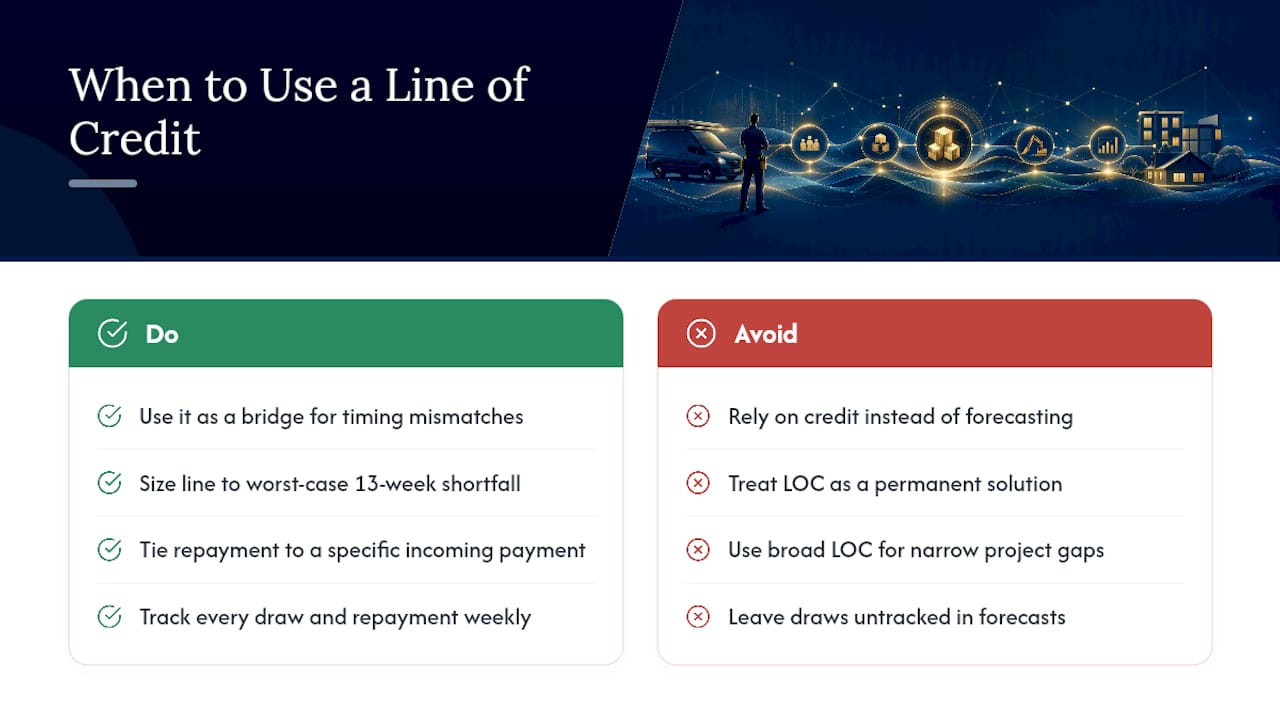
A revolving line of credit is a bridge for timing mismatches, not a replacement for forecasting or billing discipline. Customers Bank’s guidance on construction financing is blunt about this: leaning on credit because your forecasting failed is a management problem, not a financing solution, and treating it otherwise gets expensive fast.
Size your line conservatively. Tie your maximum exposure to the worst-case shortfall your 13-week forecast actually shows, with a repayment plan tied to a specific incoming payment. Track every draw and repayment inside that same weekly forecast so the line doesn’t become a black box. For narrower, project-specific gaps, a mobilization deposit or targeted equipment financing often solves the problem more cleanly than a broad credit line.
What Operational Habits Keep the Forecast Honest?
A forecast is only as good as the job cost data feeding it. Your WIP schedule, which reconciles earned revenue against billed revenue, is the earliest warning system you have. CFO Advisors notes that modest overbilling of 2% to 5% is a sign of health, while persistent underbilling is the clearest early signal of financial distress on a job.
Job-costed bookkeeping with properly mapped cost codes keeps that WIP schedule, and your forecast, tied to what’s actually happening on each project rather than a rough guess. Set payroll dates deliberately, and run a monthly cash-health checklist: every pay app submitted, every change order billed, every eligible retainage invoiced.
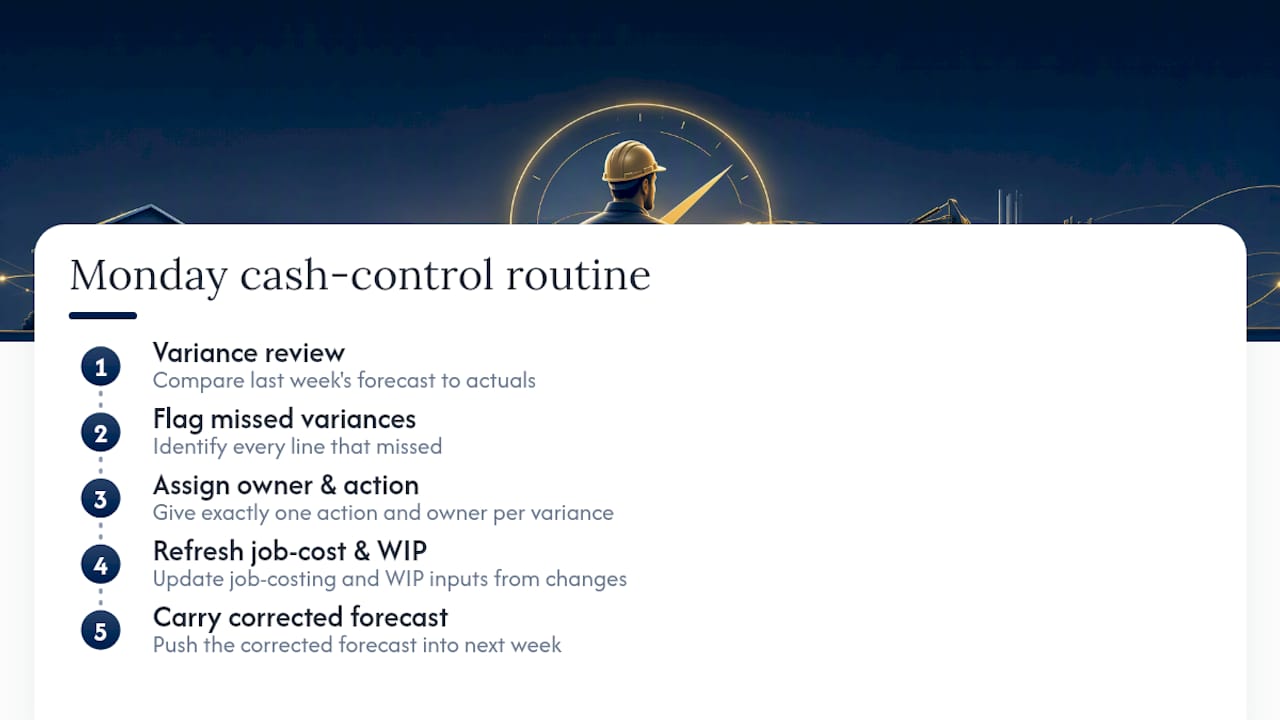
Pro Tip: Run a Monday variance review comparing last week’s forecast to actuals, and assign exactly one action to every line that missed. A variance with no owner attached never gets fixed.
Solid job costing setup work, the kind detailed in our bookkeeping and job costing guide for contractors, is usually the missing link between a forecast that looks right and one that actually is.
How TrueMeasure Accounting Fixes Contractor Cash Flow Problems
The first 30 to 60 days of working with a financial advisor typically involve a QuickBooks cleanup, mapping cost codes to your actual jobs, building an initial WIP schedule, and drafting your first 13-week forecast. That first forecast alone usually reveals which weeks need action.
From there, the ongoing work is monthly bookkeeping, a continuously updated rolling forecast, and financial advisory sessions to prioritize what the forecast flags. Contractors working this way typically see fewer emergency credit draws, clearer decisions on which bids to chase, and cash actions tied directly to forecast data instead of gut instinct. Truemeasureaccounting was founded by Anthony Boncimino, who spent more than 20 years building and operating multi-million-dollar service businesses before turning that operational lens toward accounting.
An Operator’s View on Where Contractors Actually Lose Cash
The pattern that shows up most often in cleanup engagements isn’t a bad month or a lost bid. It’s cash sitting uncollected because nobody assigned themselves the job of chasing it. A retainage release trigger passes and no invoice goes out. A change order gets verbally approved on-site and never makes it into the billing system. Three months later, someone finally asks where $80,000 went, and the honest answer is: nowhere. It never got billed.
This is what makes contractor cash flow different from a textbook problem. It’s not abstract. It’s a stack of specific invoices that didn’t get sent on time, sitting in specific job files, waiting on someone to notice. Treat the fix the same way: as an operational task list, not an accounting exercise.
— Tony
Get Help Building Your Contractor Cash Flow System
If your team is stretched thin running jobs, building and maintaining a weekly 13-week forecast on top of everything else is a real lift, and it’s the kind of work a specialized accounting firm can take off your plate. Such services typically combine monthly bookkeeping, QuickBooks cleanup, and financial advisory into one system built specifically around the payment cycles construction companies face, not generic small-business templates.
Engagements typically start with a cleanup of your books and job cost data, followed by a draft 13-week forecast within the first 60 days, so you can see your action weeks before they hit. If you’re a general contractor, trade contractor, or construction company owner tired of guessing at next month’s cash position, our fractional CFO services for cash flow leadership are built for exactly this. Reach out through our bookkeeping services page to get a draft forecast started for your business.
Sources
- Construction Cash Flow: How Project-Based Contractors Smooth a Structurally Lumpy Curve | Corpay
- 13-Week cash flow forecast for construction companies | Civil CFO
- Construction Company Cash Flow Management: WIP Schedules, Progress Billing, and Retainage (2026 Guide) – CFO Advisors
- Working capital line of credit for construction companies | Customers Bank
FAQ
How Do Contractors Make a Profit Despite Cash Flow Delays?
Contractors protect profit by pricing jobs with realistic overhead and margin, then protecting the cash timing around that profit through disciplined billing, retainage tracking, and a weekly forecast that flags shortfalls early. Profit on paper means little if slow collections force you to fund the gap with expensive credit.
How Do You Build a Cash Flow Forecast for a Construction Project?
Start with a 13-week rolling model that lists expected pay-app dates, retainage releases, and change order billings as inflows, matched against payroll, subcontractor payments, and debt service as outflows, updated every week against actuals.
What Are the Three Types of Cash Flow?
The three types are operating cash flow (from day-to-day job activity), investing cash flow (equipment and asset purchases), and financing cash flow (loans, lines of credit, and owner distributions). Construction cash flow challenges usually show up first in the operating category.
Why Do Some Contractors Prefer Being Paid in Cash?
Some contractors prefer immediate payment methods because construction’s typical around 90 day payment cycle creates real strain on payroll and material purchases, and faster payment removes that timing risk entirely. It’s a cash flow preference tied directly to how slow standard invoicing and owner approval can be, not a matter of avoiding proper bookkeeping.