

Trucking business cash flow is defined as the timing difference between when money leaves your account and when it arrives from brokers and shippers. You deliver a load today, but payment arrives 30–60 days later. Fuel, driver wages, and insurance are due immediately. That gap is the central financial challenge every trucking operator faces. Understanding how trucking business cash flow works is not an accounting exercise. It is the difference between a business that survives a slow month and one that cannot make payroll. Trucking is a “revenue-fast, collection-slow” business, and the operators who understand that reality run better companies.
How trucking business cash flow works: the timing gap explained
Cash flow in trucking is not about profit. It is about timing. A carrier can haul profitable loads every week and still run out of cash if the money does not arrive before the bills come due.
The core problem is a structural mismatch. Brokers and shippers typically pay on Net 30 to Net 60 terms, and some stretch to 90 days. Your fuel card, driver paycheck, and insurance premium do not wait. They hit your account within days of the load being delivered, sometimes before the ink is dry on the rate confirmation.
The gap between delivery and payment forces carriers to fund their own operations out of pocket. New operators should maintain $10,000–$15,000 in liquid reserves to cover 2–4 weeks of expenses. More established carriers should target $20,000–$30,000 to cover 6–8 weeks. Those numbers are not suggestions. They are the floor below which a single delayed payment can trigger a crisis.
Understanding trucking finances at this level means recognizing that your income statement and your bank account tell two different stories. A profitable month on paper can still leave you short on cash if your receivables are sitting unpaid. That disconnect is where most operators get into trouble.
What causes cash flow gaps in trucking and how to spot them
Cash flow gaps in trucking have three root causes: delayed payments, immediate expenses, and poor visibility into both.
The expense side hits first
Fuel is the largest variable cost in trucking, often 30–40% of gross revenue. A single price spike can add thousands of dollars per truck per month to your cost structure without any change in your rate. Driver wages, insurance premiums, and truck payments follow a fixed schedule regardless of freight volume. When freight slows down, those costs do not.

Fixed costs that grow faster than revenue are one of the most common cash flow traps in the industry. Operators add trucks, hire drivers, and take on lease obligations during strong markets. When rates soften, the fixed cost base stays the same while revenue drops.
The receivables side lags behind
Payment terms often stretch to 45–60 days, and delayed invoicing makes it worse. Every day you wait to submit an invoice is a day added to your collection cycle. Incomplete paperwork, missing proof of delivery, or billing errors push that timeline out further. Most operators underestimate how much this costs them.
Accounts receivable aging is the tool that makes this visible. It shows you exactly which invoices are outstanding, how old they are, and which brokers are consistently slow. Without it, you are managing cash flow by gut feel.
Pro Tip: Run your accounts receivable aging report every week, not every month. A 45-day-old invoice that you catch at 30 days is recoverable. One you catch at 60 days is a negotiation.
Here are the most common cash flow traps trucking operators fall into:
- Submitting invoices late or with incomplete documentation, extending the payment cycle
- Mixing emergency reserves with operating funds, so reserves disappear without notice
- Allowing fixed costs to outpace revenue growth during strong freight markets
- Failing to track receivables by broker, making slow payers invisible
- Not using accrual accounting, which harms loan eligibility and broker negotiations
- Skipping regular cash position reviews until a crisis forces attention
Each of these is a self-inflicted problem. The good news is that each one has a direct fix.
How to manage and improve trucking cash flow for stability
Trucking cash flow management comes down to four disciplines: accelerate what comes in, control what goes out, maintain reserves, and forecast what is coming.
Accelerate your receivables
Submit invoices the same day a load is delivered. Include all required documentation: signed bill of lading, proof of delivery, and rate confirmation. Incomplete submissions are the single most common reason payments are delayed. Follow up on any invoice that reaches 20 days without payment. Do not wait for the due date.
Build and protect your reserves
New operators need a minimum of $10,000–$15,000 in liquid reserves. More experienced carriers should hold enough to cover 6–8 weeks of operating expenses. Beyond that operating reserve, set aside a separate maintenance reserve. Trucks break down. An unexpected repair on a single unit can cost $5,000–$15,000. Without a dedicated fund, that repair comes out of your operating cash.
Structure your bank accounts by purpose
Separate bank accounts for operations, reserves, and taxes prevent the most common cash flow emergency in trucking: borrowing from the tax account to cover payroll. When funds are commingled, every account looks fuller than it is. When they are separated, you know exactly what is available for each purpose.
The recommended account structure for a trucking operator:
- Operating account — receives all revenue, pays all recurring expenses
- Reserve account — holds 6–8 weeks of operating expenses, untouched except for genuine emergencies
- Maintenance account — funded monthly based on fleet age and mileage
- Tax account — receives a fixed percentage of every deposit to cover quarterly estimated taxes
Use a 30-day rolling cash flow forecast
Cash flow visibility from tracking expected inflows and outflows over the next 30 days allows you to act before a problem becomes a crisis. A simple spreadsheet works. List every expected payment in, every bill due out, and the net position for each week. Update it weekly. This one habit eliminates most cash flow surprises.
Pro Tip: Ask your lender to align your truck payment due date with your typical revenue cycle. Lenders commonly adjust payment schedules upon request, and moving a payment from the 1st to the 15th can make a real difference in your weekly cash position.
Balance fixed and variable costs
| Cost Type | Examples | Cash Flow Risk |
|---|---|---|
| Fixed | Truck payments, insurance, lease | High. Due regardless of revenue |
| Variable | Fuel, driver pay per mile, tolls | Moderate. Scales with load volume |
| Semi-fixed | Dispatcher fees, factoring costs | Low to moderate. Adjustable with volume |
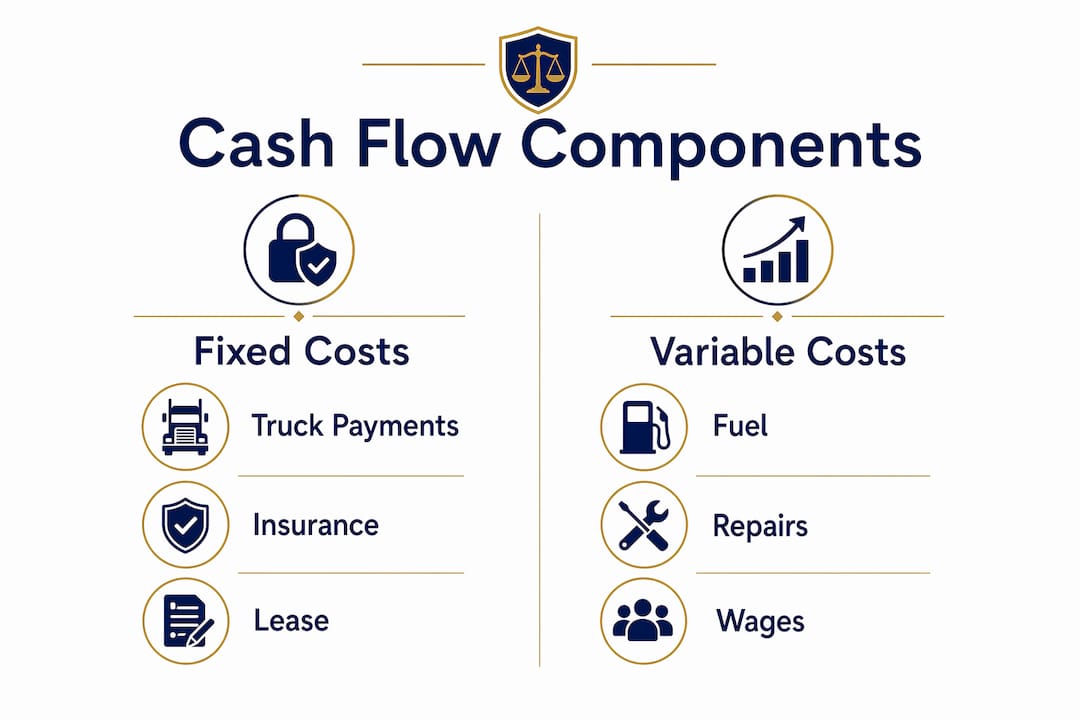
Monitoring your fixed-to-variable cost ratio tells you how exposed you are when freight slows. A business with 70% fixed costs has very little room to cut expenses in a down market. One with 50% fixed costs has more flexibility to survive a slow quarter.
You can also review your trucking business expenses by category to identify where your cost structure is most vulnerable.
What financing tools can bridge trucking cash flow gaps?
When reserves run thin and payment terms stretch, trucking operators have three practical financing tools available. Each one solves a different problem.
Freight factoring
Freight factoring is the most widely used cash flow tool in trucking. A factoring company advances 90% of your invoice value within 24 hours and collects from the broker later. The fee is typically around 3%. On a $5,500 load, that means a $165 fee for $4,950 in immediate cash.
Factoring works because it underwrites the broker’s creditworthiness, not yours. That makes it accessible to newer carriers who do not yet have established credit. The trade-off is cost. A 3% factoring fee on every load adds up quickly across a full fleet. Factoring is best used as a bridge, not a permanent operating model.
Quick pay programs
Quick pay programs let you get paid within a few days of delivery for a small per-load fee. They are flexible and load-by-load, with no long-term commitment. Use them when you need immediate cash for fuel or payroll on a specific load, not as a routine practice.
Equipment financing and working capital loans
Equipment financing preserves your operating cash by spreading truck and trailer costs over fixed monthly payments. This keeps large capital outlays from draining your reserves. Short-term working capital loans serve a similar purpose for operating expenses, but they carry interest costs and repayment obligations that add to your fixed cost base.
Here is how the three tools compare:
- Freight factoring: Fast access, no credit requirement, recurring fee per invoice, best for consistent cash flow support
- Quick pay: Flexible, load-by-load, no commitment, best for short-term cash crunches
- Working capital loan: Lump sum, interest-bearing, repayment schedule, best for planned investments or gap coverage during a defined slow period
The right tool depends on your situation. Factoring makes sense for a growing carrier with strong load volume but slow-paying brokers. A working capital loan makes sense for a carrier with good credit and a temporary revenue dip. Quick pay fills the gaps in between.
Common mistakes trucking owners make with cash flow
The most damaging mistake in trucking cash flow management is believing that a profitable load equals positive cash flow. It does not. Profit is what you earn. Cash flow is what you have available to spend right now. Operators who confuse the two frequently face solvency problems even during strong revenue periods.
Here are the mistakes that cause the most damage:
- Treating reserves as operating funds. When emergency cash sits in the same account as operating money, it gets spent. Separate accounts are not optional for a financially stable trucking business.
- Ignoring invoice follow-up. Invoices that are not actively tracked and followed up on age silently. A 60-day-old invoice from a broker who has since gone out of business is often uncollectable.
- Not using accrual accounting. Cash-basis accounting makes your books look simpler, but it hides the true timing of your income and expenses. Accounting professionals note that misaligned revenue recognition compromises loan eligibility and broker negotiations.
- Growing fixed costs ahead of revenue. Adding a second or third truck before the first is consistently profitable locks in fixed costs that survive a freight market downturn.
- Skipping cash flow forecasting. Treating cash flow as a monthly review rather than a weekly discipline means problems are visible only after they have already become crises.
Pro Tip: Review your cash position every Monday morning. Five minutes with your bank balance, outstanding invoices, and bills due that week tells you more about your financial health than any monthly report.
“Cash flow is not a finance problem. It is an operations problem. The way you invoice, the brokers you choose, and the costs you commit to all determine your cash position before the money ever hits your account.”
Correcting these mistakes does not require complex systems. It requires consistent habits: weekly cash reviews, prompt invoicing, separated accounts, and a realistic forecast. Operators who build these habits into their weekly routine rarely face cash emergencies. Those who skip them often do. Proper bookkeeping for a trucking company is the foundation that makes all of these habits possible.
Key Takeaways
Trucking cash flow is defined by a timing mismatch between immediate operating expenses and delayed broker payments, and managing that gap with reserves, forecasting, and disciplined invoicing is what separates stable carriers from struggling ones.
| Point | Details |
|---|---|
| The timing gap is the core problem | Brokers pay in 30–60 days; fuel, wages, and insurance are due immediately. |
| Reserves are non-negotiable | Hold $10,000–$15,000 minimum, targeting $20,000–$30,000 for 6–8 weeks of coverage. |
| Separate your bank accounts | Dedicated accounts for operations, reserves, maintenance, and taxes prevent fund misuse. |
| Invoice fast and follow up | Submit invoices same-day with complete paperwork and track aging weekly to shorten payment cycles. |
| Factoring bridges gaps, not profits | A 3% factoring fee gives immediate cash but adds cost; use it as a bridge, not a permanent strategy. |
What I’ve learned about cash flow in trucking after 20 years
Most trucking operators I work with are not failing because they run bad loads. They are failing because they are running a profitable business with broken cash flow habits.
The hardest thing to accept is that profit and cash are not the same thing. I have seen carriers with strong revenue and a full load board who could not make payroll because three brokers were 45 days past due and no one had followed up. The loads were profitable. The business was not functioning.
What I tell every trucking client is this: treat cash flow as an operational metric, not a financial one. Review it weekly. Know your 30-day inflow and outflow position at all times. During tight periods, review it daily. The operators who do this catch problems when they are still small. The ones who wait for the monthly report often catch them too late.
The other thing I see consistently is that carriers who maintain strong reserves negotiate from a position of strength. They can afford to walk away from a bad rate. They can wait out a slow broker. They can absorb a breakdown without going to a lender. That financial cushion is not just security. It is leverage.
If you are running a trucking business and you do not have a weekly cash flow review habit, that is the first thing to fix. Not factoring, not new software, not a new broker relationship. Start with visibility. Everything else follows from knowing exactly where your cash stands today.
— Tony
Trucking cash flow support from Truemeasureaccounting
Running loads is your job. Tracking the money behind every load is ours.
Truemeasureaccounting works with trucking operators to build the financial systems that make cash flow visible and manageable. From trucking-specific bookkeeping services that track revenue and expenses by load, to invoicing support and expense management that keep your receivables moving, we connect your financial data to real operational decisions. Our clients stop guessing about their cash position and start managing it. If you want financial clarity built for how trucking actually works, explore our trucking services to see how we can help.
FAQ
What is the biggest cash flow challenge in trucking?
The biggest challenge is the timing gap between immediate operating expenses and delayed broker payments, which typically run 30–60 days. Carriers must fund operations out of pocket while waiting for revenue to arrive.
How much cash reserve should a trucking company keep?
New operators should maintain $10,000–$15,000 in liquid reserves to cover 2–4 weeks of expenses. More established carriers should target $20,000–$30,000 to cover 6–8 weeks of operations.
How does freight factoring help with cash flow?
Freight factoring advances approximately 90% of an invoice’s value within 24 hours for a fee of around 3%. It gives carriers immediate cash without waiting for broker payment terms to expire.
Why do profitable trucking companies still have cash flow problems?
Profit and cash flow are not the same. A carrier can haul profitable loads and still run short on cash if payment terms are long, invoicing is delayed, or reserves are not maintained separately from operating funds.
How often should trucking owners review their cash flow?
Weekly reviews are the minimum standard for stable cash flow management. During slow freight periods or tight cash periods, a daily review of your bank position and outstanding receivables is the more reliable practice.