
Financial visibility in a small business is the clear, timely understanding of cash flow, expenses, accounts receivable, and profitability that lets you make confident decisions every day. Without it, you are running your business on guesswork, reacting to problems instead of preventing them. The industry term for this practice is management accounting, and it goes well beyond tax compliance or annual bookkeeping. For owner-operated service businesses in HVAC, plumbing, construction, trucking, and real estate, the ability to improve financial visibility in your small business is the single most direct path to stronger cash flow and higher profit margins.
What financial reports do you need to improve financial visibility?
The four reports every service business owner needs are a cash flow statement, an accounts receivable aging report, a profit and loss statement, and a revenue trend summary. Each one answers a different question about your business health. Together, they give you a complete picture of where money comes from, where it goes, and how much is left.
The cash flow statement tells you whether you can pay your bills next week. The profit and loss statement tells you whether the work you did last month was actually profitable. Many owners confuse the two and end up surprised when a profitable month still leaves them short on cash. That gap is usually sitting in unpaid invoices or untracked expenses.

Weekly revenue and margin summaries, combined with accounts receivable aging and cash runway forecasts, give owners a real-time read on financial health. Cash runway is the number of days your current cash balance can cover operating expenses at the current burn rate. Knowing your runway tells you exactly how much time you have to act before a cash shortage becomes a crisis.
Pro Tip: Set a 30-day cash runway threshold as your personal early warning line. If your cash balance drops below 30 days of operating expenses, treat it as an alert to collect faster, delay discretionary spending, or draw on a credit line.
| Report | Key Insight | Decision It Supports |
|---|---|---|
| Cash flow statement | Cash in vs. cash out by period | Payroll, vendor payments, credit decisions |
| AR aging report | Overdue invoices by customer and age | Collections priority, credit terms |
| Profit and loss statement | Revenue minus expenses by period | Pricing, cost control, service line cuts |
| Revenue trend summary | Month-over-month revenue movement | Hiring, capacity planning, sales targets |
| Cash runway forecast | Days of cash remaining at current spend | Emergency planning, credit line use |
Accurate reports depend entirely on accurate data entry. Continuous bank reconciliation and timely transaction categorization remove the month-end cleanup scramble and make every report reliable. A report built on stale or miscategorized data is worse than no report at all because it creates false confidence.
What tools and processes actually boost financial clarity?
The right bookkeeping system is the foundation of real-time financial clarity. Cloud-based accounting platforms that sync directly with your bank accounts capture transactions as they happen. That means your reports reflect today’s reality, not last month’s data.
Automation adds a second layer of protection. AI-enabled financial tools can monitor transactions around the clock, tracking invoice aging, expense trends, and cash flow health, and they can send predictive alerts up to 90 days out. That kind of early warning gives you time to act, not just react. For a trucking company waiting on freight broker payments or an HVAC contractor carrying large equipment costs, 90 days of forward visibility changes how you manage the business entirely.
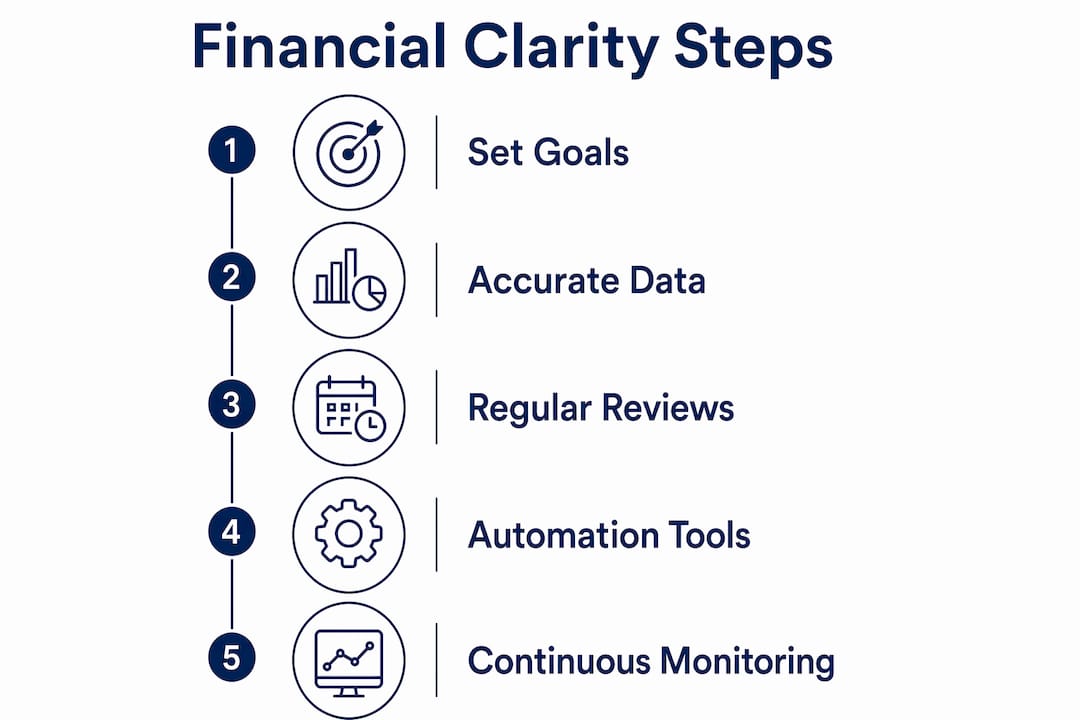
Consolidated dashboards that pull data from your accounting system, sales platform, and job management software eliminate the need to manually compile reports from multiple sources. When all your data lives in one view, you spend less time gathering numbers and more time acting on them.
Here is what a well-built financial visibility system includes:
- Automated bank feeds that categorize transactions daily without manual entry
- AR aging alerts that flag invoices past 30 and 60 days automatically
- Cash threshold notifications that trigger when balances drop below your set minimum
- Weekly dashboard reviews that take 15 minutes and cover the five core reports
- Monthly profit and loss reviews tied to specific service lines or job types
Pro Tip: Match your technology to your business complexity. A solo plumber with 20 jobs a month needs a simple cloud accounting setup with automated bank feeds. A general contractor running 15 simultaneous projects needs job costing, subcontractor tracking, and project-level profitability reports. Do not pay for features you will not use, and do not underbuy tools that leave gaps in your data.
For a deeper look at how financial reporting works for small businesses, the structure of automated reporting and alerting is worth understanding before you choose a platform.
How do you improve financial visibility step by step?
Improving financial clarity is a process, not a one-time setup. These six steps build on each other and create a system you can maintain without a full-time finance team.
-
Record transactions within 24 hours. Delayed entry is the most common cause of inaccurate reports. Set a daily habit or use automated bank feeds to keep your books current. Every day of delay compounds the cleanup work at month-end.
-
Set up weekly financial reporting. Pull your cash position, revenue for the week, and any invoices past due every Monday morning. This 15-minute review catches problems before they grow. Weekly financial reviews are the single most effective habit for maintaining cash flow awareness.
-
Build a rolling cash flow forecast. A 13-week cash flow forecast that accounts for expected receivables, upcoming payables, and seasonal patterns gives you a forward view of your cash position. Update it weekly. For a construction company with 60-day payment cycles, this forecast is the difference between planning and panic.
-
Implement automated alerts. Configure your accounting system to notify you when cash drops below your 30-day threshold, when an invoice ages past 30 days, or when a specific expense category spikes. Automated cash balance alerts are critical for catching problems before they require emergency action.
-
Review reports and adjust operations monthly. Your monthly profit and loss review should answer three questions: Which service lines made money? Which customers cost more to serve than they paid? What expenses grew faster than revenue? Use the answers to adjust pricing, cut unprofitable services, or renegotiate vendor terms.
-
Bring in expert oversight for interpretation. Reports are only useful if you understand what they mean and what to do next. A fractional CFO or advisory accountant translates the numbers into decisions. Truemeasureaccounting works with owner-operated businesses to connect financial data directly to operational choices, from pricing adjustments to hiring timelines.
Pro Tip: Do not wait until tax season to review your financials. Business owners who review monthly financials consistently make better pricing and hiring decisions than those who only look at numbers once a year.
What challenges get in the way of financial clarity?
Poor transactional data practices and limited review discipline are the two most common reasons service business owners lack financial clarity. The problems are predictable, and they are fixable.
Delayed or inaccurate data entry creates reports that do not reflect reality. An HVAC company that records material costs two weeks after a job closes cannot accurately measure job profitability. The fix is daily entry habits or automated bank feeds that categorize transactions as they post.
Difficulty interpreting reports is the second barrier. Many owners can read a bank balance but struggle to interpret gross margin by service line or understand what a rising accounts payable balance signals about cash flow. The solution is not more reports. It is simpler reports with clear benchmarks and a trusted advisor who explains what the numbers mean in plain language.
Cash flow surprises despite having reports happen when owners look at profit but ignore timing. A profitable month can still produce a cash shortfall if customers pay slowly and vendors require fast payment. Scenario planning, which models what happens to cash if your top customer pays 30 days late, prevents this kind of surprise.
Lack of review discipline is the most honest challenge. Owners of plumbing companies, electrical contractors, and trucking businesses are busy running operations. Financial reviews get skipped. The fix is scheduling a recurring 30-minute weekly block and treating it as non-negotiable as a job site visit.
Here is a summary of the most common obstacles and their direct solutions:
- Stale data: Switch to automated bank feeds and daily categorization
- Report confusion: Reduce to five core reports with written benchmarks for each metric
- Cash timing gaps: Build a 13-week rolling cash flow forecast updated weekly
- Skipped reviews: Block weekly review time on your calendar and protect it
- No context for numbers: Work with a financial advisor who understands your industry
How does ongoing financial monitoring support growth?
Continuous financial monitoring uncovers profitable services, reveals cost inefficiencies, and supports growth decisions like hiring and capital investment. It is not a one-time project. It is a management discipline that compounds over time.
Consider a trucking owner who reviews cash flow weekly and notices that one freight lane consistently produces lower margins than the others. Without visibility, that lane looks like revenue. With visibility, it looks like a cost center. The owner renegotiates rates or drops the lane entirely, freeing capacity for higher-margin freight. That decision is only possible with clean, current data.
The same logic applies to HVAC contractors who track profitability by service type. Maintenance contracts often look less profitable than emergency calls on a per-job basis, but they produce predictable cash flow that funds payroll during slow seasons. Visibility reveals that trade-off. Without it, owners cut maintenance programs and create cash flow volatility they did not anticipate.
Proactive financial visibility also informs hiring decisions. If your labor cost as a percentage of revenue is rising month over month, you have a productivity problem, a pricing problem, or both. Catching that trend at month two is manageable. Catching it at month eight means you have already absorbed months of margin erosion.
| Condition | Before visibility | After visibility |
|---|---|---|
| Cash flow management | Reactive, based on bank balance | Proactive, based on 13-week forecast |
| Profitability analysis | Revenue-focused, margin unknown | Service-line and job-level margins tracked |
| Hiring decisions | Based on gut feel and workload | Based on labor cost ratios and revenue trends |
| Expense control | Reviewed at tax time | Reviewed monthly with category benchmarks |
| Growth planning | Opportunistic and unplanned | Supported by cash runway and profit data |
AI-powered financial reports delivered weekly or monthly can replicate the insight level of a full-time CFO, covering revenue trends, customer concentration, expense breakdowns, and profitability analysis on a schedule that fits your business. That level of insight was once available only to companies large enough to afford a finance department.
What I have learned from working with owner-operated businesses
Most service business owners I work with are not struggling because they lack ambition or work ethic. They are struggling because they are making decisions without the financial data they need. They know their trade. They do not always know their numbers.
The most common gap I see is not a missing report. It is the absence of a routine. Owners who review their financials weekly make faster, better decisions than those who review them quarterly. The difference is not intelligence. It is information timing. A problem caught in week two costs a fraction of what it costs when caught in month six.
The second thing I consistently see is that owners underestimate how much their financial data can tell them about operations. A rising labor cost ratio is not just an accounting entry. It is a signal that a crew is running inefficient routes, a job was underpriced, or a technician is taking too long on calls. The numbers tell the operational story if you know how to read them.
Reactive financial management is the default for most small businesses. You get a surprise tax bill, a slow month hits harder than expected, or a big customer pays late and payroll gets tight. The owners who break that cycle are the ones who build a financial review habit and get help interpreting what they see. That combination, clean data plus expert interpretation, is what changes outcomes.
The goal at Truemeasureaccounting is not to hand you a stack of reports. It is to make sure you understand what those reports mean for your next decision, whether that is hiring a technician, dropping a low-margin customer, or timing a piece of equipment financing.
— Tony
How Truemeasureaccounting helps you gain financial clarity
Truemeasureaccounting works with owner-operated service businesses generating between $250,000 and $5 million annually, providing the bookkeeping, reporting, and advisory support that turns raw financial data into clear business decisions.
Every engagement starts with accurate books. From there, Truemeasureaccounting builds the reporting layer that gives you weekly and monthly visibility into cash flow, profitability, and key performance indicators. If you are running an HVAC company, a plumbing business, a construction firm, or a trucking operation, the bookkeeping services are built around your industry’s specific cash flow patterns and cost structures. For owners who need more than bookkeeping, the financial reporting services deliver the kind of insight that supports confident, proactive decisions every month. Schedule a free consultation to see what financial clarity looks like for your business.
Key Takeaways
Financial visibility is the foundation of every good business decision, and building it requires accurate data, consistent reporting routines, and expert interpretation of what the numbers mean.
| Point | Details |
|---|---|
| Define your core reports | Focus on cash flow, AR aging, profit and loss, and revenue trends as your weekly baseline. |
| Set a 30-day cash alert | Automate a notification when cash drops below 30 days of operating expenses to act before a crisis hits. |
| Build a weekly review habit | A 15-minute weekly financial review catches problems early and prevents costly surprises. |
| Connect numbers to operations | Rising labor costs and shrinking margins signal operational problems, not just accounting entries. |
| Get expert interpretation | Clean data plus professional insight turns reports into decisions that improve profitability and cash flow. |
FAQ
What is financial visibility in a small business?
Financial visibility is the ability to see your cash position, revenue, expenses, and profitability clearly and in real time. It gives business owners the information they need to make confident decisions about operations, pricing, and growth.
How often should a small business review its financials?
Weekly reviews of cash position and accounts receivable, combined with monthly profit and loss reviews, provide the most complete picture of financial health. Owners who review financials only at tax time miss months of correctable problems.
What is the most important financial report for a service business?
The accounts receivable aging report is the most immediately actionable report for service businesses. It shows exactly which customers owe money, how long they have owed it, and where collections effort should focus to protect cash flow.
How do automated alerts improve cash flow management?
Automated alerts notify you when cash drops below a set threshold or when invoices age past 30 days, giving you time to act before a shortfall becomes a crisis. This kind of early warning system replicates the function of a full-time finance team at a fraction of the cost.
When does a small business need a fractional CFO?
A small business benefits from fractional CFO support when it has outgrown basic bookkeeping but cannot justify a full-time finance hire. Businesses generating between $250,000 and $5 million annually typically reach this point when cash flow surprises, pricing uncertainty, or growth decisions require more than a monthly report.