
Business profitability is defined as the net income a company keeps after all costs are paid. Knowing how to improve business profitability means more than chasing higher revenue. It means controlling what you spend, pricing your work correctly, and running your operations without waste. The most effective path combines pricing discipline, cost management, and real-time financial insight. For small business owners in service industries like HVAC, plumbing, construction, and trucking, these levers are often underused. This guide covers the specific strategies that move the needle in 2026.
How can pricing strategy adjustments improve profitability?
Pricing is the fastest lever you have. A small increase in price flows directly to your bottom line, while a new customer only improves profit after covering acquisition costs. Many small businesses underprice their services due to inertia, and revisiting rates reveals significant margin improvement opportunities.
Start with small, deliberate increases
Incremental price increases of 5–10% improve profit margins without losing customers when framed around value or rising input costs. That framing matters. Customers accept price increases when they understand the reason. A plumbing company that raises its service call rate by $15 and ties the increase to fuel and parts costs will retain far more clients than one that raises prices without explanation.
Review your pricing at least twice per year. Set a calendar reminder for january and july. Check your material costs, labor rates, and what the market is bearing. If your prices have not moved in 18 months, you are almost certainly leaving money on the table.
Use value-based pricing, not cost-plus guessing
Value-based pricing sets rates based on what the service is worth to the customer, not just what it costs you to deliver. An HVAC contractor who prevents a $4,000 system failure with a $350 maintenance visit is delivering far more value than the invoice suggests. Pricing that reflects that outcome is both fair and profitable.
Positioning as a niche specialist helps justify higher pricing and attracts better-margin clients. If you are the go-to contractor for commercial refrigeration or medical office HVAC, you command a premium. Generalists compete on price. Specialists compete on expertise.
- Audit your current rates against local market benchmarks at least twice per year
- Identify your three highest-margin services and prioritize selling those first
- Communicate price changes in writing with a clear reason tied to costs or value
- Avoid discounting as a default response to price objections
- Test a 7% increase on new quotes before rolling it out across all existing clients
Pro Tip: Before your next price review, pull your last 12 months of invoices and calculate the gross margin on each service type. You will almost always find one or two services priced below cost.
What operational efficiencies can boost profitability without adding overhead?
Operational drag is the hidden tax on your profits. It shows up as time spent on rework, manual data entry, chasing unpaid invoices, and duplicated effort across your team. Removing these inefficiencies improves profitability without adding a single dollar of new revenue.
Map your processes before you fix them
Process mapping means writing down every step in a workflow, from customer inquiry to final payment. Most business owners skip this step and go straight to buying software or hiring more people. The map reveals where time is lost, where mistakes happen, and where handoffs break down.

A general contractor who maps the estimating process often discovers that three people are touching the same job file, each making small changes with no version control. Standardizing that process with a single template and one owner cuts estimate time in half and reduces errors that lead to underbidding.
Automate the tasks that eat your time
Automating repetitive tasks like invoicing and bank reconciliation reduces the time burden on business owners and frees them to focus on higher-margin work. The return on automation is not just time saved. It is also errors eliminated and cash collected faster.
- List every task your team repeats more than five times per week
- Identify which of those tasks require no judgment, only execution
- Prioritize automating invoicing, payment reminders, and expense categorization first
- Use accounting software with bank feed integration to eliminate manual data entry
- Review your automation setup every quarter to catch new repetitive tasks that have crept in
Subscription and vendor sprawl is another silent margin killer. Most businesses accumulate software subscriptions over time and forget to cancel tools they no longer use. A quarterly audit of every recurring charge, compared against actual usage, typically surfaces $300–$1,000 in monthly waste for businesses doing $1 million or more in revenue.
Pro Tip: Assign one person to own your vendor and subscription list. Have them review every recurring charge quarterly and flag anything unused for cancellation. This single habit pays for itself within 60 days.
Why does client retention drive better profits than new sales?
Retaining existing customers is significantly more cost-effective than acquiring new ones. New customer acquisition requires marketing spend, sales time, and onboarding effort. A retained customer already trusts you, knows your process, and is far more likely to accept a price increase without shopping around.
Focus on your most profitable clients first
Not all clients are equal. A profitability audit by client, job, or service line often reveals that 20% of customers generate 80% of net profit, while another segment actively drains margin through excessive service calls, slow payment, or constant scope changes. Identifying and prioritizing the high-margin segment is one of the most direct ways to increase business profits without adding revenue.
The bookkeeping role in profitability analysis is critical here. Accurate job costing data tells you which clients are worth keeping and which are costing you money to serve.
Build upselling and cross-selling into your service model
Upselling means offering a higher-tier version of what a customer already buys. Cross-selling means offering a related service they do not yet use. Both increase average revenue per client without the cost of acquiring a new one.
- Identify your top three upsell opportunities and train your team to offer them consistently
- Create service bundles that combine high-margin add-ons with core services
- Set up a 90-day follow-up system for every completed job to check satisfaction and offer next steps
- Track which clients have not purchased in 12 months and reach out proactively
- Segment clients by revenue and margin, then focus retention efforts on the top tier
Serving unprofitable customer segments is a real risk. A trucking company that keeps a low-rate freight client because “they give us volume” may be subsidizing that client with profits from better accounts. The data almost always tells a different story than the gut feeling.
How can real-time financial insights sustain profitability improvements?
Real-time management accounts allow small businesses to identify profit leaks quickly rather than waiting for an annual review to discover a problem that has been building for months. Annual financial reviews are too slow for operational decisions. By the time you see the problem in a year-end report, you have already lost the margin.
The KPIs that matter most for small business profitability
Tracking the right numbers weekly and monthly gives you early warning signals before a small problem becomes a cash crisis. The financial reporting services that Truemeasureaccounting provides are built around exactly this kind of real-time visibility.
| KPI | What it measures | Review frequency |
|---|---|---|
| Gross profit margin | Revenue minus direct costs, as a percentage | Weekly |
| Net profit margin | Revenue minus all costs, as a percentage | Monthly |
| Cash flow from operations | Cash generated by core business activity | Weekly |
| Customer lifetime value | Total revenue a client generates over their relationship | Quarterly |
| Accounts receivable aging | Outstanding invoices by age bucket | Weekly |
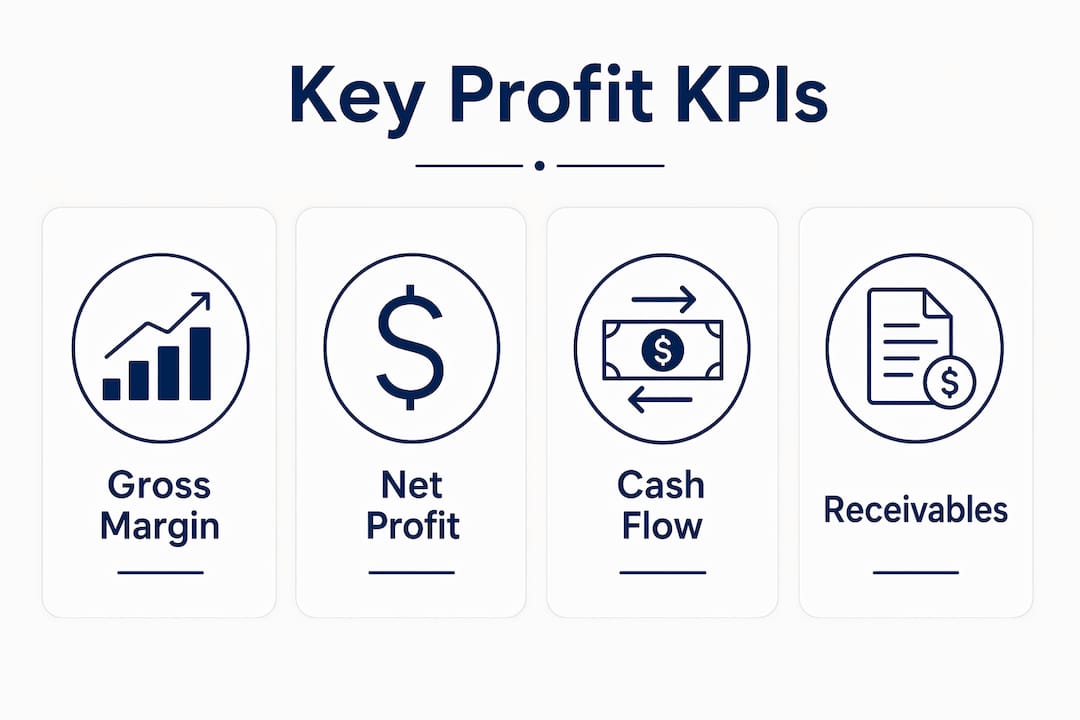
Each of these metrics tells you something different. Gross profit margin flags pricing and labor cost problems. Net profit margin shows whether overhead is eating your gains. Accounts receivable aging tells you whether slow collections are draining cash even when sales are strong.
Set a fixed weekly rhythm for reviewing your numbers. Fifteen minutes every Monday morning with your profit and loss statement and cash flow report is more valuable than a two-hour meeting once a quarter. A profitability decision rhythm with regular KPI tracking and small adjustments outperforms infrequent, large-scale cost cuts that damage quality.
What are best practices for cost management and supplier negotiations?
Cost management is not about cutting everything. It is about spending money where it creates value and eliminating spending that does not. The two cost categories that most directly affect profitability are cost of goods sold (COGS) and overhead. COGS includes materials, direct labor, and subcontractors. Overhead includes rent, insurance, software, and administrative salaries.
Regular supplier reviews and negotiating better terms reduce costs without sacrificing quality or delivery. Suppliers respond to predictable volume and reliable payment. If you pay on time and order consistently, you have leverage. Most small business owners never use it.
- Review every supplier contract annually and request updated pricing
- Consolidate purchases with fewer vendors to increase your volume leverage
- Negotiate payment terms that align with your cash flow cycle, not just the supplier’s preference
- Audit your overhead line by line every six months and challenge every item above $200 per month
- Apply lean principles: eliminate any expense that does not directly support revenue or customer satisfaction
Pro Tip: Before your next supplier renewal, get two competing quotes. You do not have to switch suppliers. The competing quote alone often produces a 5–8% reduction from your current vendor.
The most common cost-cutting mistake is reducing spending on customer-facing quality. Cutting the wrong costs, like technician training, quality materials, or customer communication, damages your reputation and accelerates client churn. Cut internal waste first. Protect what the customer sees and experiences.
Key Takeaways
Improving business profitability requires disciplined pricing, operational efficiency, client retention focus, real-time financial tracking, and smart cost management working together as a system.
| Point | Details |
|---|---|
| Price with intention | Review rates twice per year and use value-based pricing to protect and grow margins. |
| Remove operational drag | Map and automate repetitive processes to recover time and reduce errors that erode profit. |
| Retain your best clients | Focus upselling and retention efforts on high-margin clients, not just high-revenue ones. |
| Track KPIs weekly | Monitor gross margin, net margin, and cash flow weekly to catch profit leaks early. |
| Negotiate supplier costs | Review vendor contracts annually and use competing quotes to reduce input costs. |
What I’ve learned about profitability after 20 years of running businesses
Most business owners I work with are not failing because of bad products or poor service. They are failing to capture the profit their work deserves. The two most common culprits are pricing inertia and financial blindness.
Pricing inertia is when you set your rates years ago and never revisited them. Your costs went up. Your skills improved. Your reputation grew. But your prices stayed flat. That gap between what you charge and what you could charge is pure profit left on the table every single day.
Financial blindness is when you run your business by gut feel instead of numbers. You think you know which jobs are profitable. You think you know which clients are worth keeping. But without accurate, timely financial data, you are guessing. And guessing is expensive.
The fix is not complicated. It is a decision rhythm. Set a weekly time to review your numbers. Set a quarterly time to review your pricing, your client list, and your vendor contracts. Make small adjustments consistently rather than waiting for a crisis to force a big one.
Small businesses that need strategic accounting to grow are not looking for someone to do their taxes once a year. They need a financial partner who understands their operations and helps them make better decisions every month. That is the work I find most meaningful, and it is where the real profitability gains live.
The businesses I have seen grow their margins fastest are not the ones that worked harder. They are the ones that got clear on their numbers, fixed their pricing, and stopped serving clients who were costing them money. That clarity changes everything.
— Tony
Truemeasureaccounting helps small businesses build real profitability
Truemeasureaccounting works with owner-operated businesses generating $250,000 to $5 million in annual revenue. The firm goes beyond basic bookkeeping to connect your financial data to real operational decisions.
Whether you need monthly small business bookkeeping to get your numbers clean and current, or a fractional CFO to help you build a pricing strategy and KPI dashboard, Truemeasureaccounting brings 20 years of real business operating experience to every engagement. The goal is simple: help you keep more of what you earn. Schedule a call to see how the firm’s financial clarity process works for businesses in your industry.
FAQ
What is the fastest way to increase business profits?
Raising prices by 5–10% on your existing services is the fastest path to higher profit margins. Unlike new revenue, a price increase flows directly to the bottom line without additional cost.
How do I know if my clients are actually profitable?
Run a profitability audit that segments revenue and costs by client, job, or service line. Aggregate revenue figures often hide individual clients who are costing more to serve than they generate in margin.
How often should I review my business financials?
Review gross profit margin, cash flow, and accounts receivable aging weekly. Conduct a full profit and loss review monthly and a pricing and vendor review at least twice per year.
What KPIs matter most for small business profitability?
Gross profit margin, net profit margin, cash flow from operations, and accounts receivable aging are the four most critical metrics. Tracking these weekly gives you early warning before small problems become large losses.
Does automation really improve profitability for small businesses?
Automating invoicing, payment reminders, and bank reconciliation reduces time spent on low-value tasks and speeds up cash collection. The time recovered can be redirected to higher-margin work or client development.