
A fractional CFO delivers senior financial leadership, forecasts, cash discipline, and investor-ready reporting, at a fraction of the cost of a full-time hire. For a $2 million HVAC company or a growing trucking fleet, that means better cash flow, sharper pricing, cleaner board and lender reporting, and a finance function that scales up or down as revenue changes. The rest comes down to fit: knowing which deliverables to expect and when the fractional model beats a controller or a full-time CFO.
TL;DR:
- A fractional CFO typically costs a business between $2,000 and $20,000 per month, depending on scope, industry complexity, and book cleanliness.
- Their work starts with fixing bookkeeping accuracy within the first 30 days, which is essential for trustworthy forecasting and strategic decision-making.
- Deliverables include a 13-week cash flow forecast, a driver-based operating model, and monthly board reports, scaled to between 8 and 20 hours monthly.
- Business owners preparing for fundraising, sale, or expansion should prioritize fractional CFO support for rapid strategic setup and financial clarity.
- Clear contracts specifying scope, deliverables, and success criteria are vital to ensure the engagement’s effectiveness and alignment with business goals.
Table of Contents
- 12 Fractional CFO Benefits Every Owner Should Know
- What a Fractional CFO Actually Delivers Month to Month
- Fractional CFO vs Full-Time CFO vs Controller: How to Decide
- What Fractional CFO Services Actually Cost
- Real-World Outcomes: What 30, 60, and 90 Days Look Like
- How to Vet and Hire the Right Fractional CFO
- Why Fixing the Books Always Comes Before Fractional CFO Work
- Get Fractional CFO Support Built for Service Businesses
- Sources
12 Fractional CFO Benefits Every Owner Should Know
Most lists of fractional CFO benefits read like they were written for venture-backed tech startups. Owner-operated service businesses need a different lens. Here’s what actually moves the needle for HVAC companies, contractors, trucking fleets, and similar operations.
1. Cost-effectiveness and reduced overhead
A full-time CFO at a company doing $2 to $5 million in revenue typically costs $200,000 to $350,000 a year once you add salary, benefits, payroll taxes, and equity. A fractional engagement delivers the same strategic thinking for a fraction of that, because you’re buying hours, not a full-time seat. You get the judgment without the burden of a six-figure salary sitting on your books every month regardless of how busy the quarter gets.
2. Improved cash flow and working capital management
This is where most contractors and trucking companies feel the pain first. A fractional CFO digs into accounts receivable aging, tightens invoicing timelines, and renegotiates payment terms with vendors. Shaving a few days off your average collection period can free up significant working capital for a mid-sized contractor, cash that would otherwise sit uncollected while you’re still paying crews and buying materials.
3. Strategic forecasting and driver-based models
Rather than a static annual budget, a fractional CFO builds a driver-based operating model, tying revenue and cost lines to the actual levers in your business (jobs booked, trucks running, technicians billable). A 13-week cash flow forecast shows you exactly when cash gets tight, often weeks before it would show up as a problem on your bank statement.

4. Investor and board readiness
If you’re raising capital, adding partners, or reporting to a bank covenant, a monthly board pack with consistent metrics changes the conversation. Lenders and investors trust businesses that can produce clean financial reporting on demand rather than scrambling to reconstruct numbers before a meeting.
5. Scalability and flexible engagement
You can dial hours up during a fundraise, an acquisition, or a seasonal cash crunch, then dial back down once things stabilize. That flexibility is structurally impossible with a full-time hire, whose salary doesn’t shrink in a slow quarter.
6. Faster onboarding, immediate impact
Full-time CFO searches often take three to six months, and the new hire still needs ramp-up time. A fractional CFO who has worked across multiple service businesses can usually identify your biggest financial gaps within the first two weeks.
7. Access to better tools and automation
Fractional CFOs often bring a financial tech stack they’ve already tested elsewhere, and they can leverage automation to speed up reporting and reduce manual data entry across your accounts payable and receivable processes.
8. Stronger internal controls
Segregation of duties, approval thresholds, reconciliation cadence: a fractional CFO tightens the controls environment, drawing on frameworks similar to what the AICPA’s guidance on service organization controls outlines for outsourced finance functions.
9. More productive finance teams
Your bookkeeper stops guessing at strategic questions and focuses on transactional accuracy. The CFO handles the “what does this number mean and what should we do about it” layer, and each role gets sharper because it’s narrower.
10. Objective, unbiased decision support
Founders get attached to a customer, a truck route, or a service line for reasons that have nothing to do with profitability. A fractional CFO looks at the numbers without that history, and will tell you plainly when a “loyal” customer is actually losing you money.
11. Specialized project support
Fundraising prep, acquisition due diligence, pricing overhauls: these are exactly the projects where a fractional CFO earns their fee fastest, because they’re work most owners have never done before and don’t want to learn under deadline pressure.
12. Profitability gains through pricing and job costing
This is the benefit owners underestimate most. A fractional CFO who runs job costing by project, crew, or service line frequently finds that your “busiest” jobs aren’t your most profitable ones, and that a 3 to 5% pricing adjustment on the right service line adds more to your bottom line than a 20% increase in volume.
Pro Tip: Before you hire a fractional CFO, pull your last six months of job-level or customer-level profitability data. If you can’t produce it, that’s your first sign your books need cleanup before strategic work can even begin.
What a Fractional CFO Actually Delivers Month to Month
The benefits above only materialize if the deliverables are concrete. A fractional CFO engagement should produce specific, recurring artifacts, not vague “strategic guidance.”
Expect these on a regular cadence:
- A rolling 13-week cash flow forecast, updated weekly or biweekly
- A driver-based operating model tied to your actual revenue and cost drivers
- A monthly board or owner reporting pack with consistent KPIs
- Investor or lender updates when you’re raising or renewing credit
- Scenario analysis for major decisions (a new hire, a truck purchase, a new location)
Most engagements run somewhere between 8 and 20 hours a month, scaling with company complexity, according to market data on fractional CFO engagements. What’s explicitly out of scope: daily bookkeeping, monthly reconciliations, and tax filings. A well-run fractional CFO should refuse to spend high-cost hours on transactional cleanup work that a bookkeeper or outsourced bookkeeping team should handle instead. The CFO builds on top of clean books; they don’t create them from scratch every month.
That handoff matters. Your bookkeeper closes the books and reconciles accounts. Your CPA handles tax filings and compliance. Your fractional CFO takes those clean numbers and turns them into forecasts, pricing decisions, and growth plans. When those three roles are clearly separated, nobody’s stepping on anyone else’s work, and nobody’s paying CFO rates for data entry.
Fractional CFO vs Full-Time CFO vs Controller: How to Decide
The right choice depends on where your business actually sits, not where you wish it sat.
- You’re hitting a growth inflection (new locations, new service lines, sudden headcount growth): a fractional CFO can guide the transition without the long hiring runway a full-time search requires.
- Your runway or cash position feels shaky: fractional support gets a forecast in place within weeks, versus months for a full-time search.
- Your books are messy or unreliable: fix the bookkeeping first through a cleanup engagement, then bring in fractional strategic support. Strategic work on bad data just produces confident wrong answers.
- You’re preparing to raise capital, sell, or go through an audit: this is precisely the specialized work fractional CFOs are built for.
- Your leadership team has no bandwidth for finance: a controller handles the operational reporting layer; a fractional CFO adds the strategic layer on top. Full-time only makes sense once you have enough recurring complexity to fill 30+ hours a week consistently.
What Fractional CFO Services Actually Cost
Pricing depends heavily on scope, industry complexity, and how clean your books already are.
- Light engagements for smaller service businesses: often a few thousand dollars a month
- Growth-stage retainers: frequently move into five figures monthly for companies with fundraising, multi-entity structures, or heavy transaction volume
- Hourly arrangements: common for project-based work like due diligence or a one-time pricing overhaul
- Blended models: a base retainer covering core deliverables plus hourly billing for special projects
Published market syntheses put typical monthly retainers roughly between $2,000 and $20,000, depending on stage and hours committed. Several factors push pricing toward the higher end: books that need significant cleanup before strategic work can start, industries with complex revenue recognition (construction with percentage-of-completion accounting, trucking with fuel surcharge tracking), active fundraising or M&A work, and compressed timelines. If a proposal seems unusually cheap, ask exactly what’s included. A retainer that excludes forecasting or board reporting isn’t really a fractional CFO engagement, it’s a bookkeeper with a different title.
Real-World Outcomes: What 30, 60, and 90 Days Look Like
A general contractor doing $3.2 million in annual revenue came in with accurate books but zero visibility into which projects actually made money. Within 60 days, job-level costing revealed that two of their “signature” commercial jobs were running at break-even after overhead allocation, while a smaller residential niche was quietly delivering their best margins. Pricing adjustments on the underpriced commercial work added several points of margin within one quarter.
A regional trucking company had reliable revenue but constantly scraped bottom on cash because fuel costs and driver pay outpaced collections timing. Building a 13-week rolling forecast exposed the exact weeks cash ran thin, letting the owner negotiate a small line of credit before it became an emergency instead of during one.
The pattern repeats across industries: the businesses that get the most from a fractional CFO are the ones that fix bookkeeping accuracy first, then hand the CFO clean data to work with. Strategic advice built on unreliable numbers is worse than no advice at all.
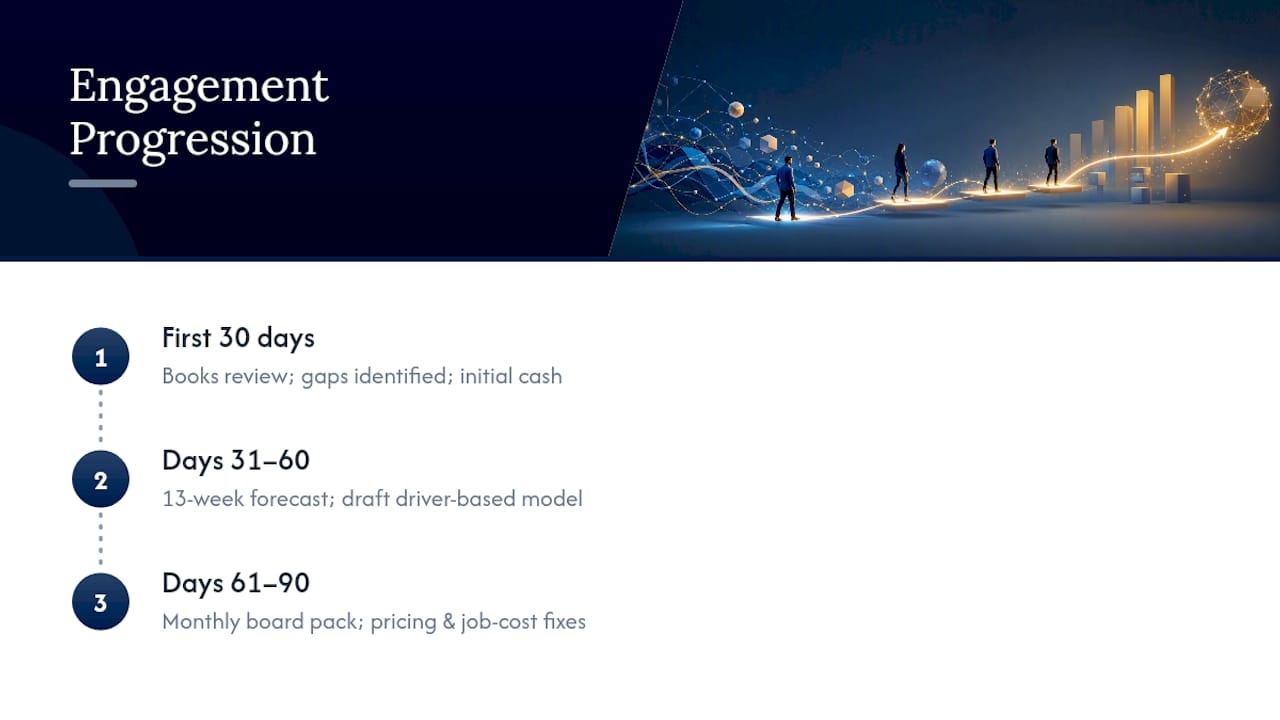
Here’s the general arc most engagements follow. In the first 30 days, expect a books review, gap identification, and an initial cash position assessment. By day 60, a working 13-week forecast and a first-draft driver-based model should be in place. By day 90, you should have a monthly board pack running on a repeatable cadence, with early pricing or job-costing findings already surfaced. TrueMeasure Accounting works with service businesses generating $250,000 to $5 million annually across HVAC, plumbing, electrical, construction, trucking, and real estate investing, exactly the profile where this progression tends to play out fastest.
Pro Tip: Ask any fractional CFO candidate for a sample 30/60/90-day plan before you sign anything. If they can’t give you specifics, they’re guessing along with you.
How to Vet and Hire the Right Fractional CFO
Set clear success criteria in the contract itself, not just verbal expectations. Include specific KPIs (AR days reduced, forecast accuracy within a stated variance, board pack delivered by a fixed date each month) so both sides know what success looks like at 90 days.
- Ask for their specific first-30-day plan for a business your size, not a generic pitch.
- Ask how many other clients they’re serving concurrently and how they prioritize during crunch periods.
- Ask for two references from businesses in a similar revenue range or industry.
- Confirm exactly which deliverables are included versus billed separately.
- Clarify communication cadence: weekly calls, monthly reviews, or ad hoc only.
Your contract should spell out scope bands (what happens if hours run over), fees and payment terms, notice period for either party to exit, and confidentiality provisions given the sensitivity of your financial data.
| Contract Element | What to Confirm |
|---|---|
| Scope and hours band | Monthly hour range and what happens if you exceed it |
| Deliverables list | Named artifacts (forecast, model, board pack) with delivery dates |
| Fee structure | Retainer, hourly, or blended, and what triggers extra billing |
| Communication cadence | Frequency of calls, response time expectations |
| Exit terms | Notice period and transition support if the engagement ends |
Why Fixing the Books Always Comes Before Fractional CFO Work
I’ve watched plenty of business owners bring in strategic help before their financial data could support it. Here’s what I’ve noticed: the fractional CFO benefit that gets talked about least, cleanup discipline, is usually the one that determines whether every other benefit actually shows up.
You can hire the sharpest fractional CFO in your market, but if your books are three months behind or your job costing is inconsistent, you’re paying senior rates for someone to reconstruct data that a bookkeeper should have caught. Fixing the foundation first is what makes the forecast, the pricing analysis, and the board pack actually trustworthy. Look back at the signals covered earlier, messy books, cash uncertainty, an upcoming raise, and be honest about which ones apply to your business today.
— Tony
Get Fractional CFO Support Built for Service Businesses
This is a direct alternative to hiring a full-time CFO you can’t yet justify and don’t have time to manage. These deliverables include a 13-week cash flow forecast, a driver-based operating model, monthly board reporting, and job-level profitability analysis designed for HVAC, plumbing, electrical, construction, trucking, and real estate businesses generating $250,000 to $5 million a year.
If your books need cleanup before strategic work makes sense, we start there through our bookkeeping services, then layer in fractional CFO support once your numbers are reliable. Engagements are scoped to the relevant industry, which might involve percentage-of-completion accounting for contractors or fuel-cost tracking for trucking fleets. Visit our how it works page to see the process, or reach out through our contact page to get a 30/60/90-day plan built around your specific numbers.
Sources
The claims in this article draw on published guidance and market research from established sources in the finance and accounting field:
- AICPA — SOC for Service Organizations
- What Does a Fractional CFO Do? — StartupCFO
- What Is a Fractional CFO? Definition, Role, and How It Works — 5FT View
- Bill