
Commercial trucks and heavy work vehicles can generally be fully expensed in the year you buy them, as long as they clear the weight and business-use tests. For 2026, the top-line numbers are a $2,560,000 maximum Section 179 deduction and a $32,000 cap on heavy SUVs. Vehicles over 6,000 lbs GVWR generally sidestep the passenger-car limits. Anything under that weight faces much tighter caps, no matter how the vehicle gets used.
TL;DR:
- Vehicles over 14,000 lbs GVWR, such as box trucks and Class 4 vocational vehicles, are fully eligible for Section 179 expensing without passenger-car or SUV caps.
- Vehicles between 6,001 and 14,000 lbs GVWR, like heavy pickups and full-size SUVs, qualify for the full Section 179 limit if excluding cargo configurations, but are subject to a $32,000 SUV cap for passenger-designed models.
- Vehicles under 6,000 lbs GVWR face stricter limits under Section 280F, with only about $20,300 of deduction available in the first year, including bonus depreciation and Section 179.
- Purchases must be properly documented with GVWR labels, placed-in-service dates, and accurate mileage logs, especially for audit-proofing claiming procedures.
- Combining Section 179 and bonus depreciation maximizes immediate deductions, but business income limits and state tax conformity can affect the actual benefit and recovery.
Table of Contents
- Which Section 179 Vehicles Qualify Based on Weight?
- What Are the 2026 Section 179 Limits and Caps?
- How Do You Claim Section 179 on a Vehicle?
- Section 179 or Bonus Depreciation: Which Should You Use?
- Recordkeeping and Audit Red Flags for Vehicle Deductions
- Worked Examples: Real Numbers for Common Vehicle Purchases
- TrueMeasure Perspective: Buying Vehicles for Profit, Not Just Tax Savings
- How Do Section 179 Vehicle Deductions Affect State Taxes?
- What Happens If Business Use Drops Below 50%?
- Should You Lease or Buy for Section 179 Eligibility?
- What Happens to Section 179 When You Trade In or Sell the Vehicle?
- Editorial Take: Vehicle Tax Planning Deserves More Than a Year-End Scramble
- Get Vehicle Tax Planning Handled Before Year-End
- Where to Verify the Rules Yourself
- Sources
- FAQ
Which Section 179 Vehicles Qualify Based on Weight?
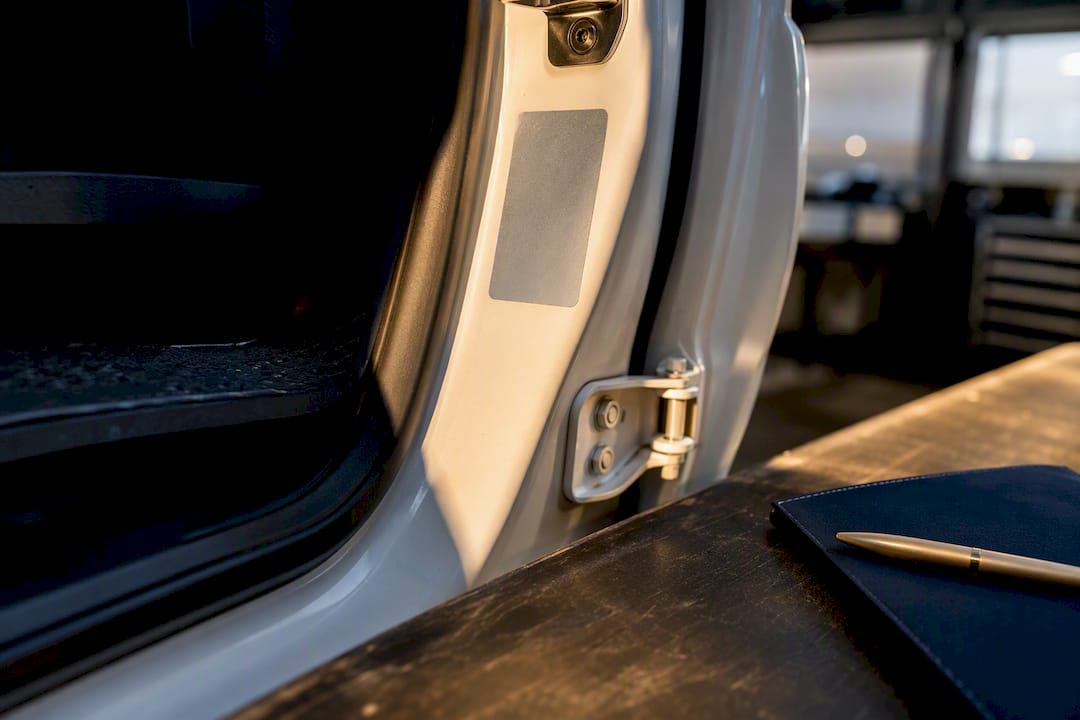
The IRS doesn’t care what you call your vehicle. It cares what the manufacturer says it can weigh when fully loaded, which is the Gross Vehicle Weight Rating, or GVWR. That number is stamped on a metal or paper label inside the driver’s door jamb, and it’s the figure that determines which tax rules apply to your purchase. GVWR, not curb weight, is the number the IRS uses to sort vehicles into three very different tax outcomes.
Curb weight is what the vehicle weighs empty. GVWR includes passengers, cargo, fuel, and towing capacity. A pickup truck might have a curb weight of 5,200 lbs but a GVWR of 7,000 lbs once you factor in its payload rating. That distinction is the difference between a vehicle that’s stuck with restrictive depreciation limits and one that can be written off almost entirely in year one. Photograph that door label the day you take delivery and keep it with your purchase file. It’s the single easiest piece of documentation to lose track of, and auditors ask for it.
Vehicles at 6,000 lbs GVWR or less are treated as ordinary passenger vehicles under Section 280F, no matter how you use them for work. This category traps a lot of small business owners who assume any vehicle with a company logo qualifies for a full write off. Sedans, most crossover SUVs, and many half-ton pickups without upgraded suspension packages fall here. These vehicles face strict first-year depreciation caps regardless of the purchase price, which we’ll walk through in the next section.
Vehicles between 6,001 and 14,000 lbs GVWR are where most owner-operators find real tax leverage. This band covers the vehicles service businesses actually buy: heavy pickup trucks like a Ford F-250 or Ram 2500, full-size SUVs such as a Chevrolet Suburban or Ford Expedition, and many cargo vans. These vehicles escape the Section 280F passenger-car caps entirely, but they run into a different limit: the SUV-specific Section 179 cap, which applies to any vehicle in this weight range not otherwise excluded by design. Trucks with a cargo bed at least six feet long, and vans with no rear seating and no windows behind the driver’s row, are excluded from the SUV cap and can be expensed up to the full Section 179 limit instead.
Vehicles over 14,000 lbs GVWR get the cleanest tax treatment of the three categories. Box trucks, dump trucks, most Class 4 through Class 8 commercial vehicles, and vocational equipment used by contractors and trucking companies generally avoid both the passenger-car caps and the SUV cap.
Here’s how that breaks down for vehicles small business owners commonly buy:
- HVAC and plumbing service vans (6,001 to 10,000 lbs): typically eligible for the SUV cap treatment unless cargo-configured with no rear seats
- Electrical contractor pickup trucks (6,001 to 8,500 lbs): eligible for full expensing up to the general limit if the bed is six feet or longer
- General contractor dump trucks and flatbeds (14,001+ lbs): eligible for full expensing up to the general Section 179 limit
- Trucking company tractors and box trucks (26,000+ lbs): eligible for full expensing, subject to overall business income limits
- Real estate investor SUVs used for property visits (6,001 to 7,000 lbs): subject to the $32,000 SUV cap, with bonus depreciation available on the remainder
What Are the 2026 Section 179 Limits and Caps?
For 2026, the maximum Section 179 deduction is $2,560,000, and that limit starts phasing out dollar for dollar once a business places more than $4,090,000 of qualifying property in service during the year. Most owner-operated service businesses never get close to the phase-out threshold, but it matters if you’re buying a fleet upgrade alongside equipment purchases in the same tax year.
The number that trips up most owner-operators: the SUV-specific Section 179 cap for 2026 sits at $32,000, roughly a fifteenth of the general limit. Buy a $70,000 heavy SUV for client site visits, and only $32,000 of that gets the Section 179 treatment up front.
That SUV cap exists because Congress didn’t want businesses buying luxury SUVs and writing off the entire purchase price as a business expense. It applies specifically to four-wheeled vehicles between 6,000 and 14,000 lbs GVWR that are primarily designed to carry passengers, which is why pickup trucks with long beds and cargo vans without rear seats get excluded from it.
Passenger vehicles at or under 6,000 lbs GVWR face an entirely separate and more restrictive set of caps under Section 280F. For a passenger automobile placed in service in 2026, the first-year combined limit is $20,300 when bonus depreciation applies, combining Section 179, bonus depreciation, and regular depreciation together. Buy a $40,000 sedan for a sales rep, and you’re capped at roughly half that cost in year one no matter how the deduction gets structured.
A few points worth building into your purchase timing:
- The general $2,560,000 cap and the $4,090,000 phase-out threshold apply across all qualifying business property, not just vehicles, so equipment purchases count against the same limit.
- The Section 179 deduction cannot exceed your total taxable business income for the year; any excess carries forward.
- Multiple vehicle purchases in one tax year each draw against the same overall dollar limit, so a fleet replacement plan often makes more sense spread across two tax years than crammed into one.
How Do You Claim Section 179 on a Vehicle?
Claiming the deduction correctly comes down to timing, documentation, and getting the right numbers onto the right lines of one form.
- Confirm the placed in service date. This is the date the vehicle was ready and available for its intended business use, not necessarily the purchase date. A truck bought in December but not registered and used until January of the following year gets claimed in the later year.
- Calculate your business-use percentage. Section 179 requires more than 50% business use, and your deduction scales with that percentage. A $60,000 truck used 80% for business supports a Section 179 basis of $48,000, not the full purchase price.
- Apply Section 179 first, then bonus depreciation. Take the Section 179 deduction up to the applicable cap (general limit or the $32,000 SUV cap), then apply bonus depreciation to whatever business-use basis remains.
- Report the election on Form 4562, Part I. Form 4562 is the required form for electing Section 179 and reporting depreciation, and it attaches directly to your Schedule C, partnership return, or corporate return.
- File before your return’s due date, including extensions. Missing the election on a timely filed return can forfeit the deduction for that vehicle.
Before you file, pull together a documentation folder: the purchase invoice or financing agreement, a photo of the door-jamb GVWR label, a mileage log covering the placed-in-service period forward, and any fleet or dispatch records showing business use. Loan documents alone don’t prove business use. Only usage records do.
Pro Tip: Start your mileage log the same day the vehicle goes into service, not at tax time. Reconstructing six months of trips from memory in March is exactly the kind of shaky documentation that turns a clean deduction into an audit headache.

Section 179 or Bonus Depreciation: Which Should You Use?
You don’t have to pick one. Both apply in the same tax year, and for most vehicle purchases, they work as a team rather than a choice. Section 179 applies first, up to whatever cap governs the vehicle.
The real decision point is how much of the deduction you actually want to use this year. Section 179 has one limitation bonus depreciation doesn’t: it cannot push your business into a loss. Bonus depreciation can, creating a net operating loss you carry forward to future years.
- Use Section 179 up to your taxable income limit when you want the deduction this year and expect similar or higher income next year.
- Lean on bonus depreciation for the remainder on heavy SUVs capped at $32,000, since it covers the rest of the cost without a separate income ceiling.
- Consider spreading the deduction if a large vehicle purchase would create a loss you can’t use efficiently, since standard depreciation schedules might serve a growing business better than an aggressive year-one write-off.
A profitable HVAC company buying a $65,000 service van in a strong year should generally take the full deduction available. A business barely breaking even might get more value stretching it out.
Recordkeeping and Audit Red Flags for Vehicle Deductions
Vehicle deductions draw IRS attention more than almost any other business expense category, mostly because personal use creeps in so easily. Keep purchase documents, GVWR evidence, and contemporaneous mileage logs for at least three years after filing, longer if you claimed a loss carryforward tied to the vehicle.
The most common problems examiners find:
- Mileage logs reconstructed after the fact instead of kept in real time
- Business-use percentage that conveniently lands just above 50%, with no supporting trip detail
- No documentation of the GVWR at all, leaving the vehicle’s category open to challenge
- Personal errands and commuting mixed into logged business miles without separation
If you realize partway through the year that your actual business use came in lower than what you assumed at purchase, don’t wait until filing to address it. Recalculate now, adjust your projected deduction, and talk to your tax preparer before the return goes in. Fixing an estimate in real time costs far less than defending an inflated one later.
Pro Tip: Set a recurring monthly calendar reminder to log odometer readings for every business vehicle. Thirty seconds a month beats a scramble in April, and it gives you contemporaneous proof if the IRS ever asks.
Worked Examples: Real Numbers for Common Vehicle Purchases
Since the truck exceeds 14,000 lbs, it avoids both the SUV cap and the passenger-vehicle caps. Business-use basis: $76,500. The full amount can be expensed under Section 179, assuming sufficient taxable income, with no SUV cap limitation applying.
- Confirm GVWR exceeds 14,000 lbs via the door label
- Multiply purchase price by business-use percentage: $85,000 × 90% = $76,500
- Apply Section 179 to the full $76,500 business-use basis
The SUV cap limits the Section 179 portion to $32,000.
- Apply the $32,000 SUV-specific Section 179 cap first
- Calculate remaining basis: $68,000 minus $32,000 = $36,000
- Apply bonus depreciation to the $36,000 remainder
Section 280F caps the first-year combined deduction at $20,300 when bonus depreciation applies, spreading the remaining $17,700 of basis across future tax years under standard depreciation schedules.
TrueMeasure Perspective: Buying Vehicles for Profit, Not Just Tax Savings
Vehicle decisions ripple into job costing long after the tax return is filed. A truck’s fuel economy, maintenance cost, and financing payment all show up in your cost-per-job math, and a deduction that looks great in April can strain cash flow in July if the financing terms don’t match your revenue timing. Before accelerating a deduction, model the cash-flow impact of the purchase alongside the tax benefit.
If you’re weighing a fleet purchase against equipment upgrades in the same year, or you’re unsure whether accelerating depreciation helps or hurts your multi-year tax position, that’s a conversation for a fractional CFO, not a guess made in December.
How Do Section 179 Vehicle Deductions Affect State Taxes?
Federal Section 179 rules don’t automatically apply at the state level, and this catches business owners off guard every year. Some states conform fully to the federal Section 179 limits, some cap the state deduction well below the federal number, and a handful decouple from bonus depreciation entirely while still allowing Section 179.
A business that fully expenses a $65,000 truck on its federal return might find its state only allows a $25,000 deduction in year one, with the remainder depreciated over several years on the state return. That mismatch creates a separate depreciation schedule you have to track for state purposes alone, and it affects your state estimated tax payments if you don’t plan for it.
If you operate in Georgia, Florida, South Carolina, Alabama, or Tennessee, the conformity rules differ enough between them that a multi-state fleet purchase needs a state-by-state check before you assume the federal number carries through. This is also where a lot of DIY tax software falls short. It handles the federal calculation cleanly but doesn’t always flag the state adjustment, leaving business owners to discover the discrepancy months later when a state notice arrives.
What Happens If Business Use Drops Below 50%?
That means reporting the excess deduction you claimed over what straight-line depreciation would have allowed as income in the year the drop occurs.
This shows up most often when a service business scales back and a vehicle originally dedicated to job sites starts getting used for personal errands, or when a truck gets reassigned to an owner’s spouse for mixed-use driving. The recapture amount depends on how much time remains in the vehicle’s recovery period and how large the original deduction was relative to standard depreciation.
The fix isn’t complicated but it does require discipline: keep tracking mileage every year the vehicle is in service, not just the year you bought it. If business use is trending down, run the recapture math before it happens rather than after, so you’re not blindsided by additional income on a return you weren’t expecting to adjust. A mileage log kept consistently is the only defense that actually holds up.
Should You Lease or Buy for Section 179 Eligibility?
Section 179 only applies to vehicles you own or finance as a purchase, which rules out standard operating leases entirely. If you lease a truck through a traditional lease structure, you generally deduct the lease payments as an ordinary business expense instead, spread across the lease term rather than front-loaded into one tax year.
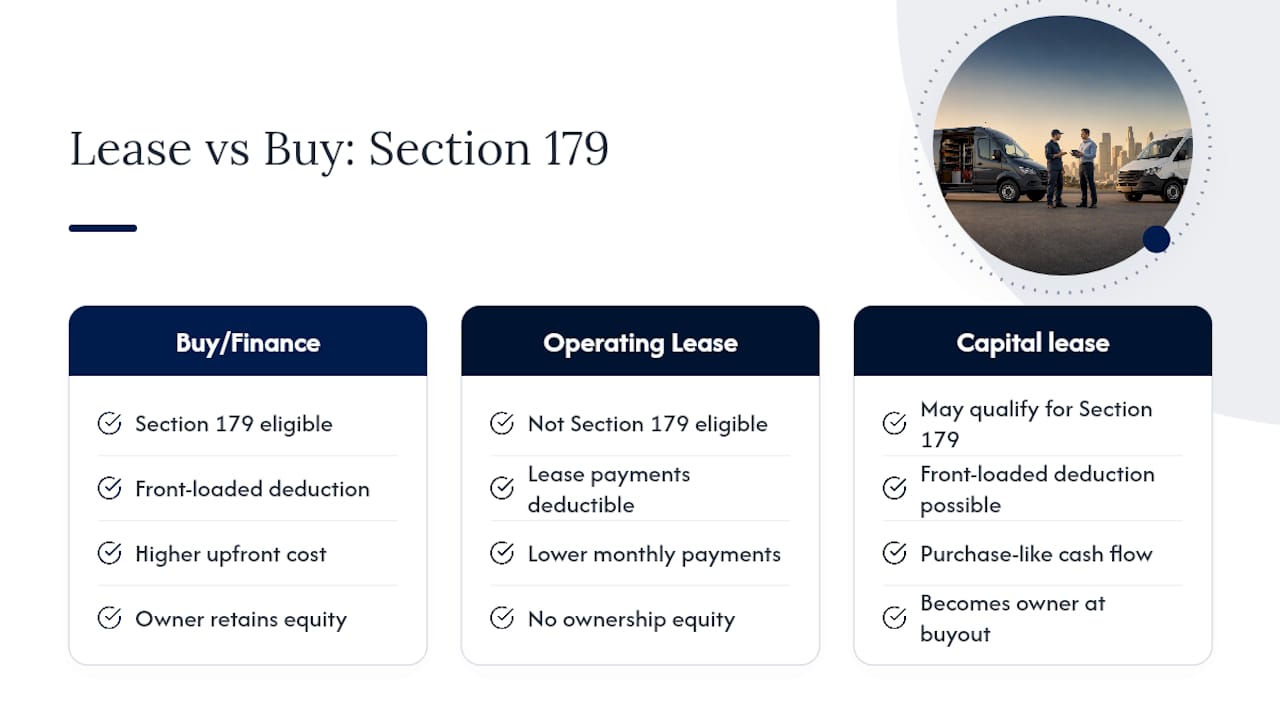
Where this gets confusing is with a capital lease or a lease-to-own arrangement. If the lease is structured so you’re effectively financing a purchase, with terms like a $1 buyout at the end, it can qualify for Section 179 treatment because the IRS treats it as a purchase for tax purposes rather than a true lease.
The decision between leasing and buying shouldn’t be made on tax treatment alone. A business with thin cash reserves might prefer a lower monthly lease payment even without the upfront deduction, especially if vehicle turnover is frequent and residual value uncertainty makes ownership riskier. A contractor planning to keep a truck for eight or ten years generally comes out ahead buying and taking the deduction, since the lease alternative forgoes both the write-off and any equity in the vehicle. Run both scenarios with actual numbers before signing anything. The tax deduction is valuable, but it shouldn’t be the only variable driving a financing decision that affects your cash flow for years.
What Happens to Section 179 When You Trade In or Sell the Vehicle?
Trading in or selling a vehicle you expensed under Section 179 isn’t a clean exit. Because the deduction reduced your basis in the vehicle to near zero, the money you get from a trade-in or sale is generally treated as taxable gain, since you’re recovering value on an asset the tax code already considered fully written off.
This surprises a lot of owner-operators who assume trading in a truck simply rolls value into the next purchase with no tax consequence. If you sell a fully expensed $70,000 truck for $25,000 four years later, that $25,000 is generally recognized as ordinary income in the year of sale, since it represents depreciation recapture on an asset with no remaining basis.
And if you’re trading a business vehicle into a new purchase, the transaction typically needs to be reported as two separate events for tax purposes: a disposal of the old vehicle and a purchase of the new one, rather than a simple even swap. Loop your tax preparer in before finalizing any trade-in on a fully expensed vehicle. The dealership’s numbers on the trade-in worksheet won’t reflect the tax consequence sitting behind them.
Editorial Take: Vehicle Tax Planning Deserves More Than a Year-End Scramble
Most advice on this topic treats Section 179 vehicles as a year-end trick: buy a truck in December, write it off, move on. That framing misses what actually matters for an owner-operated business. The vehicle you buy affects your cost-per-job for years, and the tax deduction is one variable among several, not the whole decision.
Where conventional advice falls short is treating the SUV cap and the general limit as interchangeable. They’re not, and the $32,000 gap between them changes the math on every heavy SUV purchase a real estate investor or field-services owner makes. I’d also push back on the instinct to always take the biggest deduction available. A business with uneven income year to year sometimes gains more from spreading depreciation than front-loading it, especially if a big write-off this year just sets up a weaker deduction next year when income actually needs the offset.
Prioritize the GVWR label and the mileage log before you worry about which cap applies. Get those two things wrong and no amount of tax strategy fixes it later.
— Tony
Get Vehicle Tax Planning Handled Before Year-End
Truemeasureaccounting gives owner-operated businesses something a tax app can’t: someone who models the vehicle purchase against your actual cash flow and job costing before you sign the loan, not after you’ve already filed. A truck deal that looks perfect on a dealership worksheet can still create a state tax mismatch, a recapture trap, or a cash crunch three months later if nobody ran the full picture first.

Our tax planning and preparation services cover the Form 4562 election, the mileage-versus-actual-expense analysis, and the state conformity check most software skips entirely. If you’re evaluating a fleet purchase or a single work vehicle before year-end, schedule a year-end tax planning session with our team and get the numbers modeled against your real books, not a generic calculator.
Where to Verify the Rules Yourself
- IRS Publication 946 covers depreciation and Section 179 guidance in full detail
- Form 4562 and its instructions explain exactly how to report the election
- 26 U.S.C. §179 contains the statutory language itself
This article is general information, not a substitute for advice from a qualified financial advisor. Consult a qualified financial professional about your own circumstances before acting on anything here.
Sources
- Publication 946 (2025), Department of the Treasury — IRS
- 26 U.S.C. §179: Election to expense certain depreciable business assets
- About Form 4562 — IRS
- Section179
FAQ
Which vehicles are eligible for Section 179?
Vehicles used more than 50% for business qualify, with the deduction amount depending on GVWR: vehicles over 14,000 lbs generally get full expensing, 6,001 to 14,000 lbs vehicles face the $32,000 SUV cap unless excluded by design, and vehicles at 6,000 lbs or under face separate passenger-vehicle limits.
Can you write off 100% of a 6,000 lb vehicle?
Not automatically. A vehicle right at 6,000 lbs GVWR or under falls under Section 280F passenger-vehicle caps, limiting the first-year combined deduction to a fraction of the purchase price regardless of business use percentage.
What vehicles are eligible for the Section 179 deduction in 2026?
Heavy pickups, cargo vans, box trucks, and vocational vehicles with a GVWR over 6,000 lbs are the primary candidates, with vehicles over 14,000 lbs seeing the fewest restrictions and the cleanest path to full expensing.
What vehicles are over 6,000 lbs in 2026?
Most full-size pickup trucks (Ford F-250, Ram 2500, Chevrolet Silverado 2500), large SUVs (Chevrolet Suburban, Ford Expedition, GMC Yukon XL), and cargo vans exceed 6,000 lbs GVWR, but the exact figure varies by trim and configuration, so checking the door-jamb label on the specific vehicle remains the only reliable method.