

Most owner-operators run between $1.20 and $1.85 per mile in total operating cost, depending on whether the truck is paid off. The formula behind that number is simple: Total costs ÷ Total miles = cost per mile, using every dollar spent in a month and every mile driven, loaded and deadhead combined. Skip the deadhead miles and your CPM looks better than it actually is, which is how profitable-looking loads turn into break-even trips.
TL;DR:
- Owner-operators running financed trucks typically incur total operating costs between $1.50 and $1.85 per mile, while paid-off trucks cost roughly $1.20 to $1.45 per mile.
- Including deadhead miles in calculations prevents underestimating true costs and helps avoid accepting unprofitable loads that only seem profitable on loaded miles.
- Proper tracking of fixed, variable, and driver pay costs with monthly reconciliation and KPI dashboards ensures accurate CPM calculation and better decision-making.
- Minimizing deadhead miles, managing fuel expenses, and avoiding skipped maintenance reserves can significantly lower the actual cost per mile.
- Raising rates above your calculated break-even CPM by 30% to 40% provides a healthy buffer for real-world variability and profitability.
Table of Contents
- What Counts in Your Trucking Cost Per Mile
- How Do You Calculate Your Trucking Expenses Step by Step?
- What Is the Average Trucking Cost Per Mile in the Industry?
- How Do You Set a Minimum Rate Using CPM?
- Which Levers Actually Lower Your Cost Per Mile?
- What Should You Track to Monitor CPM Over Time?
- How Does Better Bookkeeping Improve Your Trucking Margins?
- An Operator’s Monthly CPM Checklist
- Get Help Turning Your CPM Into Real Profit
- Sources
- FAQ
What Counts in Your Trucking Cost Per Mile
Cost per mile only means something if the inputs are complete. Leave out a category and the number lies to you, quietly, every time you quote a rate.
Break your costs into three buckets: fixed, variable, and driver pay. Fixed costs hit your account whether the truck moves or sits in the yard. Variable costs scale with miles. Driver pay sits in its own category because, for many owner-operators, it functions like a fixed draw even though the tax treatment differs.
Fixed costs typically include:
- Truck payment or lease
- Insurance premiums (liability, cargo, physical damage)
- Permits and licensing (IRP, IFTA base plate, UCR)
- Accounting and bookkeeping fees
- Phone and dispatch software subscriptions
- ELD and telematics fees
Variable costs move with the odometer:
- Fuel
- Tires
- Routine maintenance and repairs
- Tolls
- Lodging and per diem on the road
- A replacement reserve set aside for the next truck purchase
Driver pay, whether it is your own draw or a company driver’s wages, gets tracked separately because it behaves differently depending on your pay structure, something OOIDA’s cost-per-mile guide walks through with real fixed and variable cost breakdowns.
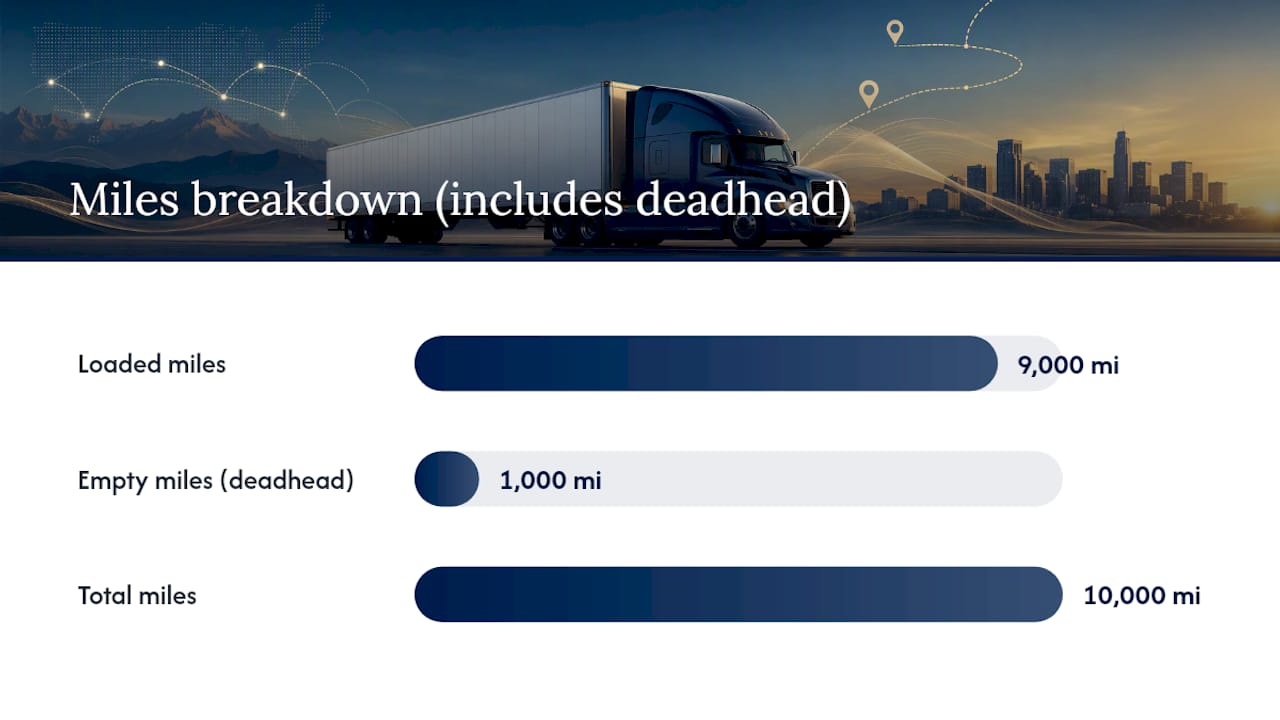
Now the part that trips up almost everyone: the mileage denominator. If you drove 9,000 loaded miles and 1,000 empty miles repositioning for the next load, your denominator is 10,000, not 9,000. Using only loaded miles understates your true cost per mile and pushes you toward accepting loads that lose money once deadhead is factored in. A truck that runs 15% deadhead and calculates CPM on loaded miles alone is quietly underpricing every load by roughly that same margin.
The Trucker Codex breaks this down as a simple break-even formula: total fixed plus total variable costs, divided by total miles including deadhead. That’s your floor. Everything above it is where profit lives.
How Do You Calculate Your Trucking Expenses Step by Step?
You don’t need fancy software to get an accurate cost-per-mile calculator running in a spreadsheet. You need four things: your odometer logs, your fuel receipts, your loan and insurance statements, and one month of complete records.
- Pull your total miles for the month from the odometer or ELD report. Separate loaded from deadhead, but you’ll add them together for the denominator.
- List every fixed cost as a monthly figure. If insurance bills annually, divide by 12. If your permit renewal is $1,200 a year, that’s $100 a month.
- List every variable cost actually paid that month: fuel, tires, repairs, tolls, lodging.
- Add a monthly replacement reserve. Even if you don’t write the check yet, budget for it, because the transmission failure at month 40 doesn’t care that you skipped this step.
- Add fixed, variable, and reserve costs together, then divide by total miles.
Here’s a worked example using round numbers for a single truck, financed, running regional freight:
If that truck ran 9,200 loaded miles and 800 deadhead miles, total miles equal 10,000. Divide $7,300 by 10,000 and you get $0.73 per mile in vehicle costs before driver pay. Add a driver draw of $5,000 for the month and total costs rise to $12,300, pushing CPM to $1.23 per mile, which lands right inside the typical financed-truck range.
Pro Tip: Run this calculation every month for a quarter before you trust it. One month of unusually low fuel prices or a skipped repair can make your CPM look better than reality, and that’s how loads get underpriced.
One common mistake worth flagging here: owner-operators who skip the replacement reserve or exclude deadhead miles routinely underestimate their true CPM by $0.15 to $0.25 per mile. That gap is the difference between a load that looks profitable on paper and one that quietly drains your bank account.
What Is the Average Trucking Cost Per Mile in the Industry?
The American Transportation Research Institute puts the average operational cost of trucking at $2.336 per mile in 2025, or $1.854 per mile excluding fuel. That figure covers large fleets with different cost structures than a single-truck operation, and most line items rose year-over-year in ATRI’s data, driven by higher maintenance, insurance, and driver wage costs.
For owner-operators specifically, the ranges look different:
- Financed truck: roughly $1.50 to $1.85 per mile in total operating cost
- Paid-off truck: roughly $1.20 to $1.45 per mile
- Fuel share: typically 35% to 40% of total costs regardless of financing status
That gap between financed and paid-off numbers, often $0.25 to $0.38 per mile, is the single biggest lever most operators have. It’s also why the ATRI averages, useful as a reference point, shouldn’t be treated as your target. Fleet averages blend equipment ages, lane types, and regions that have nothing to do with your truck running Southeast regional freight on a five-year note.
Your equipment configuration matters too. A reefer unit adds fuel and maintenance cost that a dry van doesn’t carry. A tandem-axle day cab running short-haul has a different cost profile than a sleeper running long-haul. None of that shows up in a national average, which is exactly why calculating your own number matters more than benchmarking against one.
How Do You Set a Minimum Rate Using CPM?
Your cost per mile is the floor. Everything you quote above it is margin, and everything below it is a loss disguised as revenue.
- Calculate your break-even CPM using the formula above, including deadhead.
- Add a margin buffer. The Trucker Codex recommends adding 30% to 40% on top of break-even to absorb real-world variability, not just to pad profit.
- Convert to a trip price. Multiply your target rate per mile by total trip miles, loaded and deadhead, to get your quote.
- Compare against the offered rate. If a broker offers below your floor, walk away, no matter how empty your schedule looks.
On a 500 mile trip, that’s the difference between quoting $740 and $800, money that either builds your reserve or disappears into “close enough” pricing.
Watch for red flags: brokers who won’t share the full mileage including deadhead repositioning, rates quoted only on loaded miles, or lanes that always seem to need “just this once” discounting. Those patterns erode your floor one load at a time.
Which Levers Actually Lower Your Cost Per Mile?
Not every fix moves the needle the same amount. Prioritize the categories that carry the most weight in your cost structure.
Fuel, usually 35% to 40% of total costs, responds to idle reduction, disciplined speed management, fuel card discounts, and route planning that avoids unnecessary miles. Even a 1 mile per gallon improvement on a truck running 100,000 miles a year saves real money.
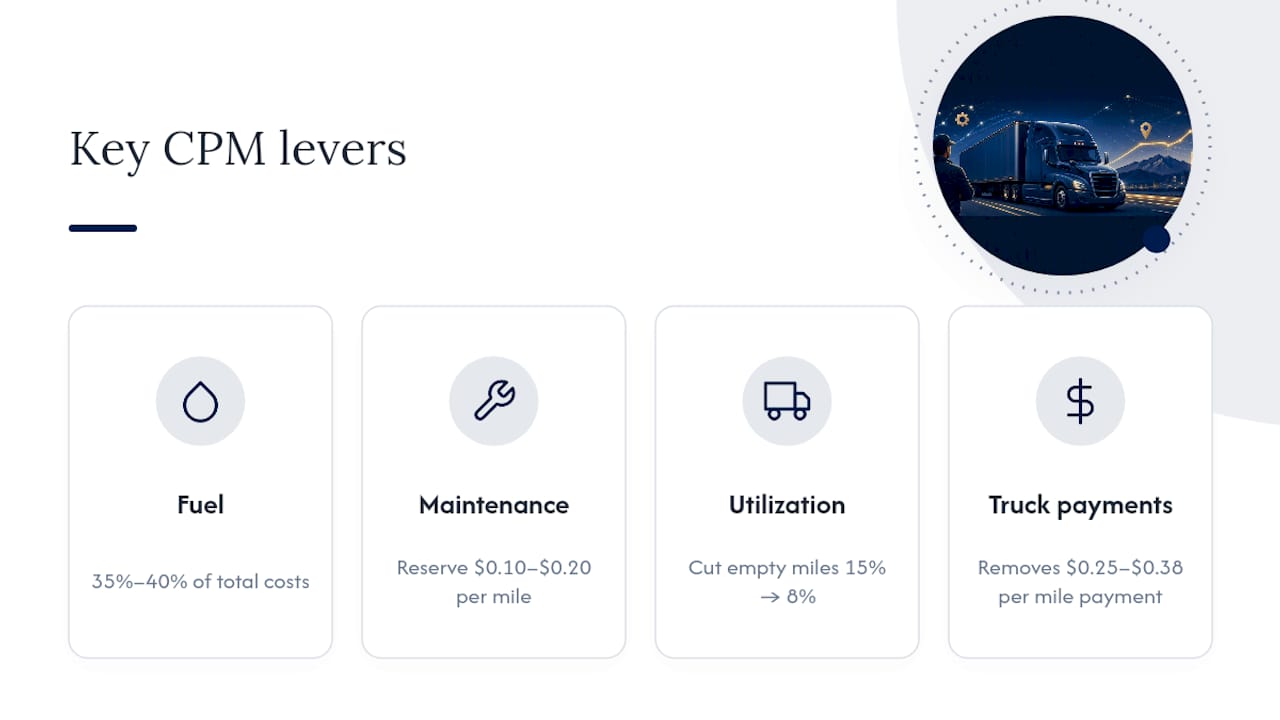
Maintenance and tires benefit from preventive schedules rather than reactive repairs. Budgeting a maintenance reserve of $0.10 to $0.20 per mile smooths out the surprise transmission bill that otherwise wrecks a good month.
Utilization is the quiet killer. Every deadhead mile spreads your fixed costs over fewer productive miles. Lane selection and better dispatch planning to cut empty miles from 15% to 8% can shift your CPM more than any single fuel-saving trick.
Insurance and financing deserve an annual re-shop, not blind renewal. Paying off a truck removes a $0.25 to $0.38 per mile payment, the single biggest long-term lever available, but only if you replace that payment with a disciplined replacement reserve instead of spending the difference.
Bookkeeping matters more than most operators assume. Misclassifying a repair as a capital expense, or mixing personal and business insurance, distorts your CPM and your tax return at the same time. Accurate categorization, tracked through something like proper trucking expense tracking, is what makes the whole calculation trustworthy.
What Should You Track to Monitor CPM Over Time?
A spreadsheet with five columns beats a shoebox of receipts every time. Track fixed costs, variable costs, total miles, loaded miles, and deadhead miles, each month, in the same format.
- Minimum fields: date, category (fixed/variable), amount, loaded miles, deadhead miles
- Reporting cadence: monthly for accuracy, but watch a rolling 3-month and 12-month average
- Why averages matter: a rolling 3 to 12 month average keeps one bad repair month or one fuel spike from skewing your pricing decisions
- Dashboard KPIs: CPM, fuel cost per mile, maintenance reserve per mile, utilization percentage
| KPI | What it tells you |
|---|---|
| Cost per mile | Your break-even floor for pricing |
| Fuel per mile | Efficiency and route discipline |
| Maintenance reserve per mile | Whether you’re prepared for major repairs |
| Utilization % | How much deadhead is eroding your margin |
Reconcile fuel card statements against odometer readings every month. This kind of tracking is exactly what a trucking bookkeeping system is built to catch early.
How Does Better Bookkeeping Improve Your Trucking Margins?
Most owner-operators calculate CPM once, in a panic, when a broker offers a rate that feels too low to trust. TrueMeasure Accounting builds that number into the monthly bookkeeping process instead, so it’s already sitting on your desk when negotiation time comes.
Monthly bookkeeping and reconciliations catch the mislogged miles and misclassified repairs that quietly inflate CPM. KPI dashboards turn that data into a number you check weekly, not once a year. Profitability analysis by truck or job shows which lanes and which equipment are actually making money.
Before reaching out to any provider, gather your odometer logs, fuel and repair invoices, loan schedules, and insurance statements. Having those ready turns a first conversation into an actual improvement plan.
An Operator’s Monthly CPM Checklist
Here’s a checklist worth running every single month, not once a quarter when things feel off. Reconcile the odometer against your fuel logs. Import every fuel receipt and repair invoice before you forget where you put them. Set aside the replacement reserve before the money gets spent elsewhere. Compute cost per mile using total costs divided by total miles, deadhead included. Compare that number against your own trailing average, not just the ATRI headline figure.
If your CPM sits above the typical range for your equipment type, fix the biggest line item first, usually fuel or an oversized truck payment, before chasing smaller savings elsewhere.
— Tony
Get Help Turning Your CPM Into Real Profit
Some accounting firms offer trucking owners fixed-price services as an alternative to hourly billing or relying on a single bookkeeper, providing team coverage built around the operational realities of running trucks, not just entering data.

Monthly bookkeeping catches the mislogged deadhead miles and misclassified repairs that distort your CPM before you quote a bad rate on them. KPI dashboards keep fuel cost per mile, maintenance reserve, and utilization visible without you building a spreadsheet from scratch every month. Fractional CFO support helps you decide whether paying off your next truck early or expanding to a second unit actually improves your margin, based on your real numbers instead of a gut feeling.
The firm’s approach emphasizes operations, not just compliance, reflecting experience in building and operating service businesses. Before reaching out, pull together your odometer logs, fuel receipts, loan schedule, and insurance statements. Check current plans, including the Essentials and Plus options, on the pricing page, or explore bookkeeping services built specifically for owner-operators ready to stop guessing at their cost per mile.
Sources
The ATRI report referenced throughout this article, Analysis of the Operational Costs of Trucking: 2026 Update, remains the most authoritative industry benchmark available. For hands-on calculation help, OOIDA’s cost-per-mile tool and O Trucking’s expense breakdown guide both offer practical worksheets worth bookmarking.
- Break-even rate per mile: Where fixed and variable costs meet — The Trucker Codex (blog)
- Owner Operator Cost Per Mile: Expense Breakdown | O Trucking
- Figuring Cost Per Mile — OOIDA
- Owner-operator expenses and CPM guidance — Truckstop blog
FAQ
What Is a Fair Price to Charge Per Mile?
For a financed truck running $1.23 per mile in break-even costs, that puts a fair quote closer to $1.50 to $1.85 per mile, adjusted for your lane and equipment type.
Is $0.55 a Mile Good for a Truck Driver?
For most owner-operators, $0.55 per mile falls well below even the low end of typical operating costs, which run $1.20 to $1.85 per mile depending on financing. That rate may work for a company driver’s per-mile pay structure, but it does not cover an owner-operator’s full cost of running the truck.
Is $100,000 a Lot of Miles for a Truck?
Not particularly. Many owner-operators run high annual miles, and higher mileage generally lowers your cost per mile by spreading fixed costs like truck payments and insurance across more miles. The OOIDA cost-per-mile guide shows this effect directly: per-mile costs drop as annual mileage increases.
What Is Good Pay Per Mile for Truck Drivers?
Good pay depends on whether you’re an owner-operator covering full operating costs or a company driver paid a per-mile wage. Owner-operators typically need $1.20 to $1.85 per mile just to break even, so any rate offer should be measured against your own calculated cost per mile, not a generic industry number.