

If you operate qualified commercial vehicles in two or more member jurisdictions, you must hold an IFTA license, carry the credentials, and file a quarterly IFTA return, even for zero miles. Your first three moves: confirm your trucks meet the qualified vehicle test, pick your base jurisdiction, and start tying every fuel receipt to a vehicle ID and odometer reading now, before the next deadline catches you unprepared.
TL;DR:
- Vehicles over 26,000 pounds, with three or more axles, or combined over 26,000 pounds trigger IFTA obligations only when they actually operate across multiple jurisdictions.
- Fuel must be tracked with receipts tied to specific vehicles immediately upon purchase to prevent audit issues and ensure accurate quarter-end reporting.
- Filing is mandatory for all quarters, including those with no miles traveled into other jurisdictions, to avoid penalties or license suspension.
- Accurate calculation relies on current quarterly rates, fleet MPG, and proper offsetting of tax-paid gallons to determine whether you owe money or are due a refund.
- Maintaining organized records of receipts, odometer readings, and mileage logs for four years reduces audit risk and streamlines compliance.
Table of Contents
- What Trucking Fuel Tax IFTA Actually Covers
- Who Needs an IFTA License (the Qualified Vehicle Test)
- How to Register and Get Your IFTA Credentials
- Quarterly Filing Schedule and What Happens If You Miss It
- How to Calculate Your IFTA Tax, Step by Step
- Recordkeeping That Keeps You Out of an Audit
- How Better Bookkeeping Prevents IFTA Headaches
- An Operator’s Take on Fuel Tax and Cash Flow
- Let TrueMeasure Accounting Handle Your IFTA-Ready Books
- Sources
- FAQ
What Trucking Fuel Tax IFTA Actually Covers
The International Fuel Tax Agreement is a cooperative arrangement that lets interstate carriers file one quarterly fuel tax return with their base jurisdiction instead of separate returns in every state they drive through. It covers 48 contiguous U.S. states and 10 Canadian provinces, which is why a carrier running Georgia to Ohio and back only deals with one filing, not two.
A few jurisdictions sit outside the agreement, including Alaska, Hawaii, and the Canadian territories, along with Mexican states. Trips into those areas get handled under separate fuel tax rules, not IFTA. The agreement itself runs on two governing documents worth knowing by name:
- The IFTA Articles of Agreement, which set the legal framework member jurisdictions operate under
- The IFTA Procedures Manual, which spells out exactly what your return must include and how audits work
That manual matters more than most operators realize. It’s the rulebook auditors use, and it’s public.
Who Needs an IFTA License (the Qualified Vehicle Test)
Weight and axle count decide this, not what the truck looks like or what you call it. A vehicle qualifies for IFTA if it meets any one of these thresholds:
- Gross vehicle weight or registered weight over 26,000 pounds
- Three or more axles, regardless of weight
- Combination weight over 26,000 pounds when a truck and trailer are hauled together
Interstate operation is the second half of the test. A qualified vehicle only triggers IFTA obligations when it actually travels into a second member jurisdiction, not just when it’s capable of doing so. A dump truck that never leaves Alabama, for instance, doesn’t need an IFTA license even if it clears the weight threshold.
Watch for edge cases. Fleets with vehicles registered in multiple states still file one consolidated IFTA return through their base jurisdiction. Leased units generally follow the lessee’s operational control for IFTA purposes. And trips confined to Mexico or limited to intrastate California hauls carry their own separate rules worth confirming with your base jurisdiction before you assume standard IFTA applies.
How to Register and Get Your IFTA Credentials
Your base jurisdiction is the state where your fleet is registered, where you keep operational records, and where you actually operate, at least part of the time. You apply through that state’s motor vehicle or revenue department, not through IFTA Inc. directly.
Once approved, you’ll receive:
- One IFTA license covering your entire qualified fleet
- Two decals per qualified vehicle, one for each side of the cab
Most base jurisdictions, California’s CDTFA among them, now run online portals where you enter total miles and gallons and the system calculates what you owe or what credit you’re due. Larger fleets or third-party preparers sometimes use EDI file uploads instead. Paper filing still exists in most states, but it’s increasingly reserved for hardship cases and comes with slower processing.
Pro Tip: Save the confirmation receipt from every quarterly filing, not just the return itself. If your license ever gets flagged for a missed or late filing you didn’t actually miss, that confirmation is your proof.
Quarterly Filing Schedule and What Happens If You Miss It
Four deadlines drive your entire IFTA calendar, typically falling near the end of the month following each quarter. If the deadline lands on a weekend or holiday, it shifts to the next business day, but it’s best to plan for the earliest due date possible.
Here’s the detail that catches new operators off guard: you must file even when your fleet didn’t cross a state line all quarter. Zero-mile quarters still require a return, and skipping that filing because “nothing happened” is one of the most common ways fleets end up with penalties or a suspended license.
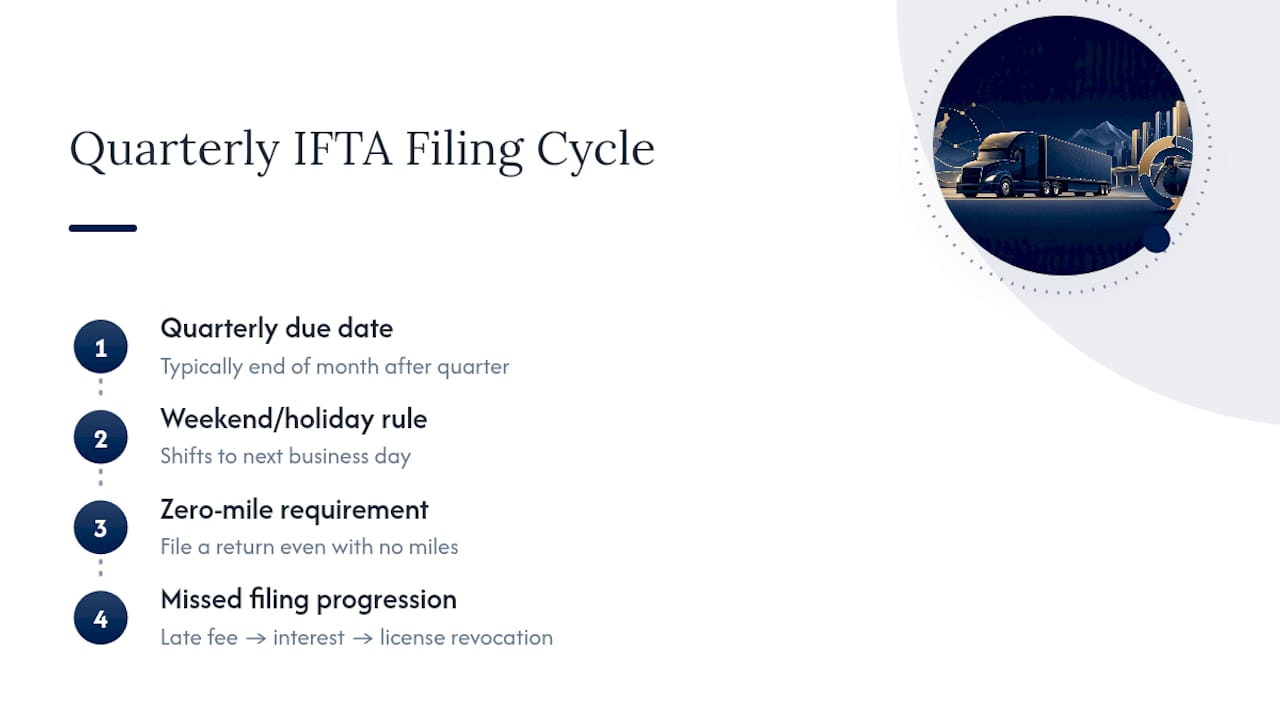
Penalty structures vary by base jurisdiction, but the pattern is consistent: a flat penalty for late filing, interest accruing on any unpaid balance, and repeated failures escalating toward license revocation. Your base jurisdiction’s fuel tax office can give you exact figures, but the safer move is simply never testing the threshold.
How to Calculate Your IFTA Tax, Step by Step
The math isn’t complicated, but it demands clean data. Here’s the sequence:
- Calculate fleet average MPG. Add total miles driven across all qualified vehicles, divide by total gallons burned (including bulk tank withdrawals, not just pump receipts).
- Convert jurisdiction miles to taxable gallons. For each state or province you drove through, divide miles driven there by your fleet MPG.
- Apply that quarter’s tax rate. Multiply taxable gallons by the jurisdiction’s current rate from the official IFTA rate matrix, which changes every quarter.
- Subtract tax-paid gallons. Gallons you already bought and paid tax on in that jurisdiction offset what you owe.
- Sum across all jurisdictions. Some owe you money, some you owe. The net is your quarterly payment or refund.
Here’s a simplified example for one fleet crossing three states in a quarter:
Multiply each net gallon figure by that jurisdiction’s current rate to get dollars owed or credited. One catch worth flagging: some state surcharges are calculated separately and can’t be offset by tax-paid gallons, so they only ever add to your liability. Never hardcode rates into a spreadsheet template. Always pull the current quarter’s matrix before you calculate, since rates shift every quarter and a stale number turns an accurate MPG calculation into a wrong tax bill.
Recordkeeping That Keeps You Out of an Audit
The IFTA Procedures Manual is specific about what it wants to see. Auditors typically request:
- Fuel receipts showing vendor name, date, gallon quantity, and vehicle ID
- Odometer readings and border crossing logs
- ELD or GPS extracts confirming mileage by jurisdiction
- Bulk storage records: delivery receipts, withdrawal logs, and quarterly reconciliations
The most common audit trigger isn’t fraud. It’s an implausible MPG figure that doesn’t match how the truck actually runs, missing receipts, or a mileage swing nobody can explain. When records don’t hold up, auditors apply default MPG assumptions that almost always increase your assessed liability.
Pro Tip: Keep four years of GPS, odometer, and receipt data organized by vehicle, not just by quarter. When an auditor asks for one truck’s history, you want to hand it over in minutes, not rebuild it from scratch.
How Better Bookkeeping Prevents IFTA Headaches
Most IFTA problems aren’t tax problems. They’re bookkeeping problems that surface at filing time. The fix is operational: tie every fuel receipt to a vehicle ID and trip record inside your bookkeeping software the same week the purchase happens, not the week before your return is due.
A few checks worth running monthly instead of quarterly:
- Compare fleet MPG month over month, so a sudden swing gets caught before it becomes a full-quarter mystery
- Reconcile bulk fuel withdrawals against dispatch logs
- Flag any vehicle with missing receipts before the quarter closes, not after
Whether you handle this in house or outsource it usually comes down to fleet size, how many jurisdictions you cross, and how often those cross-border trips happen. A five-truck fleet running one lane weekly can often manage this internally. A twenty-truck fleet running six jurisdictions is a different math problem, and one that organized trucking bookkeeping tends to solve faster than another spreadsheet.
An Operator’s Take on Fuel Tax and Cash Flow
IFTA compliance is really a cash flow problem wearing a tax compliance costume. Buy fuel in a low-tax state and burn it crossing into a high-tax one, and you’ve created a liability that shows up quarters later if nobody’s watching. Fleets that link every receipt to a vehicle the day it’s purchased, rather than the week the return is due, almost never get surprised by what they owe.
The single change worth making this quarter: stop treating fuel receipts as loose paper and start treating them as data tied to a specific truck and trip. That habit alone prevents most of the penalty and audit exposure fleets run into. If your records aren’t there yet, it’s worth a real conversation about what needs to change.
— Tony
Let TrueMeasure Accounting Handle Your IFTA-Ready Books
The company provides bookkeeping services designed to support IFTA audits as well as year-end tax requirements. Where a general bookkeeper tags fuel as one lump expense category, we tie every receipt to a vehicle ID, track fleet MPG monthly, and flag mileage anomalies before they turn into a quarter-end scramble.

That means audit-ready records, fewer late filings, and a cash flow forecast that actually accounts for what you’ll owe across jurisdictions instead of guessing. Our bookkeeping services are built for exactly this kind of operational complexity, and our tax services keep quarterly planning aligned with what your fleet actually spends on fuel. Pricing starts with our Essentials plan at $265 per month, scaling up to Plus at $895 per month for fleets that need deeper reporting and CFO-level insight.
If your fuel receipts and mileage logs aren’t already linked to specific vehicles, that’s the first thing worth fixing. Reach out to TrueMeasure Accounting and get a straight answer on what your books need before your next IFTA deadline.
Sources
- IFTA information — Florida Highway Safety and Motor Vehicles
- IFTA Procedures Manual (2026) — IFTA, Inc.
- International Fuel Tax Agreement (IFTA) and Interstate User Diesel Fuel Tax — CDTFA
- How to calculate IFTA tax: a step-by-step breakdown — LegalClarity
Always pull that quarter’s official rate matrix directly rather than relying on a calculator’s built-in table.
FAQ
What Is IFTA Tax in Trucking?
IFTA tax is the fuel tax interstate carriers report and pay through one quarterly return filed with their base jurisdiction, instead of separate returns in every state they drive through. It applies to qualified motor vehicles operating in two or more member jurisdictions.
Which States Don’t Have IFTA?
Alaska, Hawaii, and the Canadian territories fall outside IFTA’s coverage area, along with jurisdictions in Mexico. The agreement itself spans 48 contiguous U.S. states and 10 Canadian provinces, and trips into non-member areas follow separate fuel tax rules.
How Do I Calculate IFTA Fuel Tax?
Calculate fleet MPG by dividing total miles by total gallons, then convert each jurisdiction’s miles into taxable gallons using that MPG figure. Multiply by the current quarter’s rate, subtract tax-paid gallons, and sum the results across every jurisdiction you drove through.
What Happens if I File My IFTA Return Late?
Late filing typically triggers a flat penalty plus interest on any unpaid balance, and repeated late or missing filings can lead to license suspension. Even quarters with zero miles require a filed return, so skipping a zero-mile quarter carries the same risk.
Does TrueMeasure Accounting Help With IFTA Filing?
TrueMeasure Accounting builds bookkeeping systems that tie fuel receipts and mileage to specific vehicles, which is exactly what IFTA returns and audits require. Current pricing for bookkeeping and advisory plans starts at $265 per month for the Essentials tier.