
What are the best alternatives to goodmeasurefinancial.com for small businesses?
If you run an HVAC company, a trucking operation, a plumbing business, or any owner-operated service firm, you need more than a bookkeeper who enters numbers. You need financial clarity that connects to real decisions. Here are the leading alternatives worth evaluating:
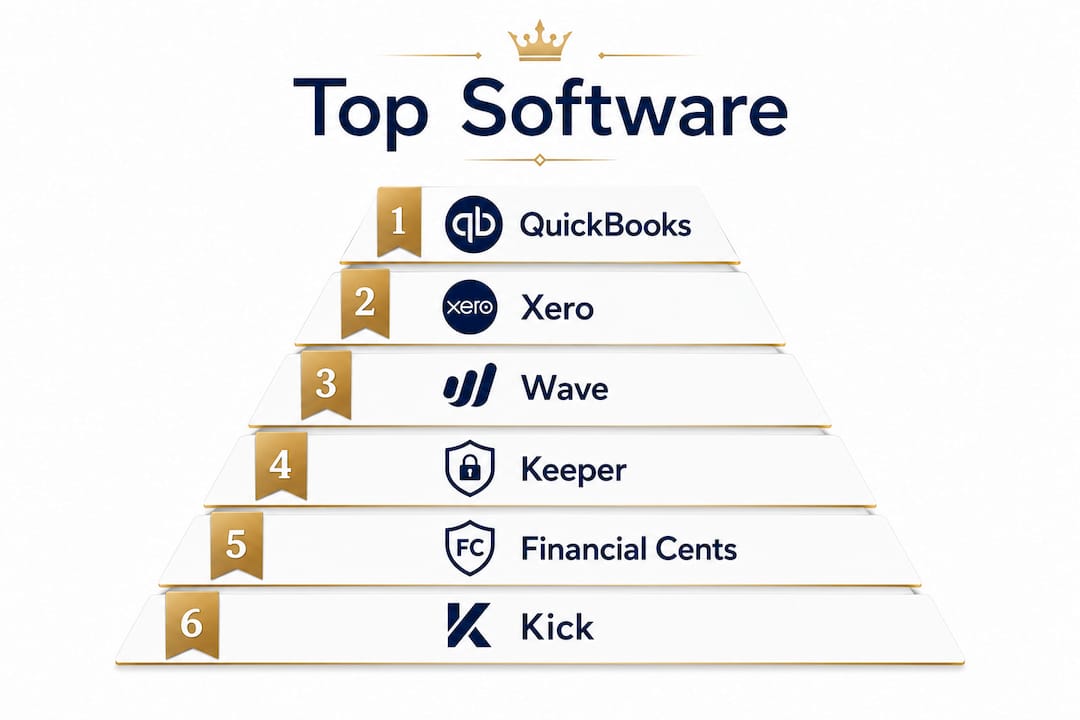
- QuickBooks Online — Cloud-based accounting software with broad integrations; best for small businesses that want flexible, widely supported bookkeeping tools they can manage in-house or with an advisor.
- Xero — Cloud accounting with strong bank feed connections and invoicing; a solid fit for service businesses that prioritize clean reconciliations and real-time cash visibility.
- Wave Accounting — Free core bookkeeping software; best for budget-conscious owner-operators who need basic income and expense tracking without a monthly software fee.
- Keeper — Combines bookkeeping workflow management with client communication tools; designed for boutique bookkeeping firms that manage multiple small business clients.
- Financial Cents — Workflow automation built specifically for bookkeeping firms; best for professional bookkeeping practices that need task management tightly integrated with accounting.
- Kick — AI-driven bookkeeping platform that automates transaction categorization and expense tracking; best for tech-comfortable small business owners who want to reduce manual data entry.
The right choice depends heavily on your business complexity. A general contractor managing job costing across multiple crews has different needs than a solo plumber tracking monthly expenses. Business complexity dictates whether you need specialized human advisors or whether automated tools can carry the load. Software platforms cover the basics well. When your business generates real revenue and your financial decisions carry real consequences, a human-led or hybrid model tends to produce better outcomes.
Geographic availability is a non-issue for most of these options. QuickBooks Online, Xero, Wave, Keeper, Financial Cents, and Kick all serve US businesses nationwide. Pricing ranges from free (Wave) to monthly subscription tiers for the others, with human-advisory services typically priced on fixed monthly fees or hourly rates depending on the provider.
How do goodmeasurefinancial.com alternatives compare by features and fit?
Choosing between software and a full-service firm is not just a pricing decision. It is an operational one. Switching accounting firms can carry hidden costs beyond fees when tech stacks are incompatible, causing disruptions in cash flow forecasting and job costing that linger through data migrations.
| Product | Best For | Pricing | Service Model | Industry Specialization | Geographic Coverage | User Experience |
|---|---|---|---|---|---|---|
| QuickBooks Online | Small businesses needing flexible bookkeeping software | Paid monthly tiers | Automated (software) | Broad; most industries | US nationwide | Widely familiar; large support ecosystem |
| Xero | Service businesses prioritizing bank feeds and invoicing | Paid monthly tiers | Automated (software) | Broad; service-focused | US nationwide | Clean interface; advisor-friendly |
| Wave Accounting | Budget-conscious owner-operators | Free core features | Automated (software) | General small business | US nationwide | Simple; limited advanced features |
| Keeper | Boutique bookkeeping firms managing multiple clients | Paid monthly tiers | Hybrid (software + workflow) | Bookkeeping firms | US nationwide | Workflow-focused; client portal included |
| Financial Cents | Bookkeeping firms needing task and workflow automation | Paid monthly tiers | Automated (workflow software) | Bookkeeping practices | US nationwide | Purpose-built for firm operations |
| Kick | Tech-savvy owners wanting AI-driven automation | Paid tiers | Automated (AI-driven) | General small business | US nationwide | Modern; minimal manual input required |
Trade-offs worth understanding before you choose:
- Software platforms like Wave and QuickBooks Online give you control and low cost, but they do not tell you why your margins are shrinking or whether your pricing covers your true labor cost.
- Keeper and Financial Cents serve bookkeeping firms more than they serve the business owner directly. If you are the end client, not the bookkeeper, these tools are one step removed from your actual problem.
- Kick’s AI automation is genuinely useful for reducing manual entry, but automated platforms lack the personalized, operationally relevant advice that supports critical business decisions like pricing changes or cash flow modeling.
- Onboarding timelines vary. Software platforms can be active within days. Transitioning to a new full-service firm typically takes four to eight weeks when historical data cleanup and system migration are involved.
The automated vs. human bookkeeping question is not binary. The businesses that get the most clarity combine accurate automated data capture with a human who can read what the numbers actually mean for the business.
How do you select the best alternative to goodmeasurefinancial.com?
Start with your business complexity, not your budget. A trucking company with fuel surcharges, driver pay structures, and multiple revenue streams needs a different level of support than a freelance consultant tracking a handful of invoices. Firms with multiple income streams and complex operations benefit from dedicated advisory providers rather than self-serve tools.
Key criteria to evaluate:
- Service personalization: Does the provider understand your industry, or do they treat every client the same way?
- Pricing transparency: Is pricing fixed and predictable, or will you get surprise invoices for every question you ask?
- Industry expertise: Can they speak to job costing for a contractor, or driver settlements for a trucking company?
- Tech integration: Does their software connect to your existing tools, payroll system, or fleet management platform?
- Customer support quality: Is there a real person available when something goes wrong, or are you filing a support ticket?
- Scalability: Can they grow with you from $500,000 in revenue to $3 million without forcing you to switch providers?
Questions to ask any prospective provider:
- What accounting software do you use, and will my historical data migrate cleanly?
- How do you handle job costing or project-level profitability tracking?
- What does your onboarding process look like, and how long before my books are current?
- Who is my primary contact, and how quickly do they respond?
- Do you offer tax planning, or only tax preparation after the fact?
Red flags to watch for:
- Vague onboarding timelines with no written process
- No clear answer on data ownership if you leave
- Pricing that changes based on transaction volume without a cap
- No industry-specific experience for your type of business
- Tax preparation offered, but no proactive tax strategy
Pro Tip: Before you sign with any provider, calculate the true cost of switching. Factor in staff time for data migration, the weeks your books may be incomplete, and the risk of losing historical job costing data. The cheapest monthly fee is rarely the lowest total cost.
What bookkeeping and accounting software do small businesses actually use?
The six platforms most widely adopted by small and owner-operated service businesses each solve a different problem.
QuickBooks Online remains the most widely used cloud accounting software in the US small business market. Its ecosystem of integrations, third-party apps, and ProAdvisor network means you can find local help almost anywhere. For HVAC companies, contractors, and trucking businesses, QuickBooks Online handles job costing, class tracking, and payroll integration reasonably well, especially when set up by someone who knows the industry.
Xero appeals strongly to service businesses that prioritize clean bank reconciliations and professional invoicing. Its bank feed technology is particularly reliable, and many bookkeeping advisors prefer it for clients with high transaction volumes. The interface is cleaner than QuickBooks Online for many users, though the US-based support ecosystem is smaller.
Wave Accounting is genuinely free for core bookkeeping features, which makes it attractive for early-stage owner-operators. The trade-off is limited depth. Wave handles income and expense tracking well, but it does not support job costing or advanced reporting in the way a growing contractor or property manager would need.

Keeper and Financial Cents are primarily tools for bookkeeping firms, not for the business owner directly. Keeper combines client-facing portals with internal workflow management. Financial Cents focuses on task automation within a bookkeeping practice. If you are hiring a bookkeeping firm, ask whether they use one of these platforms, because it signals they run an organized operation.
Kick takes a different approach by applying AI to transaction categorization and expense management. For a small business owner who wants to spend less time on data entry and more time running the business, Kick’s automation layer is genuinely useful. The platform is newer, so its depth for complex industries like construction or trucking is still developing. Choosing the right accounting software for your specific business type matters more than picking the most popular name.
What do small businesses actually experience when switching financial providers?
Real business outcomes from switching financial providers tend to follow a predictable pattern. The businesses that benefit most are those that move from a compliance-only bookkeeper to a provider who connects financial data to operational decisions.
A construction company managing multiple active job sites, for example, often discovers after switching that their previous bookkeeper never set up job costing correctly. Revenue looked fine on paper, but individual jobs were losing money. Without project-level profitability tracking, the owner had no way to know which contracts to pursue and which to avoid.
An HVAC business owner who moves from a basic software-only setup to a firm with fractional CFO support often finds the first real benefit in cash flow forecasting. Seasonal revenue swings are predictable in HVAC, but managing payroll and equipment costs through slow months requires a forward-looking cash plan, not just a monthly bank reconciliation.
Trucking companies face a specific challenge: driver pay, fuel costs, and freight revenue fluctuate constantly. Owners who switch to a provider with transportation industry experience report that the biggest gain is not cleaner books. It is knowing, by lane or by driver, where the business actually makes money.
The pattern across industries is consistent. Accurate books are the starting point, not the finish line. The value of expert advisory over pure automation shows up most clearly when a business owner needs to make a real decision, whether that is hiring a new technician, bidding a large contract, or managing a cash shortfall. Software gives you data. An experienced advisor tells you what to do with it. For small businesses that need strategic accounting to grow, that distinction shapes outcomes.
Truemeasureaccounting: the strategic alternative for owner-operated businesses
Most bookkeeping alternatives give you software or compliance. Truemeasureaccounting gives you financial clarity tied directly to how your business operates.
Founded by Anthony Boncimino, an entrepreneur with more than 20 years of experience running multi-million-dollar service businesses, Truemeasureaccounting was built specifically for owner-operated companies in HVAC, plumbing, electrical, construction, trucking, and related industries. The firm combines accurate monthly bookkeeping with fractional CFO advisory, tax planning, cash flow management, and profitability analysis by job, customer, or service line. That combination is what separates it from a software subscription or a compliance-only bookkeeper.
Truemeasureaccounting operates on fixed pricing, so you know your cost before the month starts. Services are delivered virtually nationwide, with particular depth in Georgia, Florida, South Carolina, Alabama, and Tennessee. If you are generating between $250,000 and $5 million in annual revenue and need more than basic bookkeeping but are not ready for a full-time CFO, this is the firm built for that gap.
Explore small business bookkeeping services or review industry-specific options for HVAC, trucking, construction, and more.
Key Takeaways
The strongest alternative to goodmeasurefinancial.com for an owner-operated service business is one that combines accurate bookkeeping with advisory support tied to real operational decisions, not just software access.
| Point | Details |
|---|---|
| Match service model to complexity | Software works for simple operations; businesses with job costing, multiple revenue streams, or seasonal cash swings need human advisory support. |
| Hidden switching costs are real | Migrating from one provider to another can disrupt cash flow forecasting and job costing for weeks; factor that into any decision. |
| Software alone has limits | Platforms like Wave, Xero, and QuickBooks Online capture data well but do not tell you what the data means for pricing, hiring, or cash planning. |
| Ask the right questions upfront | Confirm onboarding timelines, data ownership, industry experience, and whether tax planning (not just preparation) is included. |
| Truemeasureaccounting fills the advisory gap | For owner-operated businesses in HVAC, trucking, construction, and related sectors, Truemeasureaccounting combines bookkeeping accuracy with fractional CFO guidance at a fixed monthly price. |
If your current reports do not connect financial activity to better operating decisions, schedule a conversation with TrueMeasure Accounting to identify the clearest next step.