
Financial reporting for small businesses is the process of gathering, organizing, and analyzing key financial data on a regular basis to drive better decisions and improve profitability. Most owners treat it as a once-a-year tax chore. That mistake costs them money every single month. Understanding how financial reporting works for your small business means knowing which four core documents to review, how often to review them, and what to do with the numbers you find. Owners who review comprehensive reports monthly make 37% more profitable decisions and catch cash flow problems 2–3 months earlier than those who do not. That gap is the difference between a business that grows and one that constantly scrambles.
What are the key financial reports small businesses must prepare?
The four core financial documents every growing small business needs are the Profit & Loss Statement, the Balance Sheet, the Cash Flow Statement, and the Accounts Receivable Aging report. Each one answers a different question about your business. Together, they give you a complete picture of where you stand financially and where you are headed.

Profit & loss statement
The Profit & Loss Statement, also called the P&L or Income Statement, shows your total revenue, total expenses, and net profit for a specific period. It tells you whether the business is making money or losing it. For a plumbing company or HVAC contractor, the P&L reveals whether your labor costs are eating your margins or whether a specific service line is dragging down overall profitability. Review it monthly, not quarterly.
Balance sheet
The Balance Sheet is a snapshot of your business at a single point in time. It lists everything you own (assets), everything you owe (liabilities), and the difference between the two (equity). A general contractor carrying heavy equipment debt will see that pressure clearly on the Balance Sheet. It is the document lenders and investors look at first when evaluating your business health.
Cash flow statement
The Cash Flow Statement tracks actual cash moving in and out of your business. Profit on paper does not mean cash in the bank. A trucking company can show a profitable P&L while running out of cash because customers pay 60 days late. The Cash Flow Statement exposes that gap before it becomes a crisis.
Accounts receivable aging report
The A/R Aging report organizes your outstanding invoices by how long they have been unpaid: 0–30 days, 31–60 days, 61–90 days, and over 90 days. For service businesses like electrical contractors or property managers, this report identifies which customers are slow payers and how much revenue is sitting uncollected. Left unmonitored, aging receivables quietly destroy cash flow.
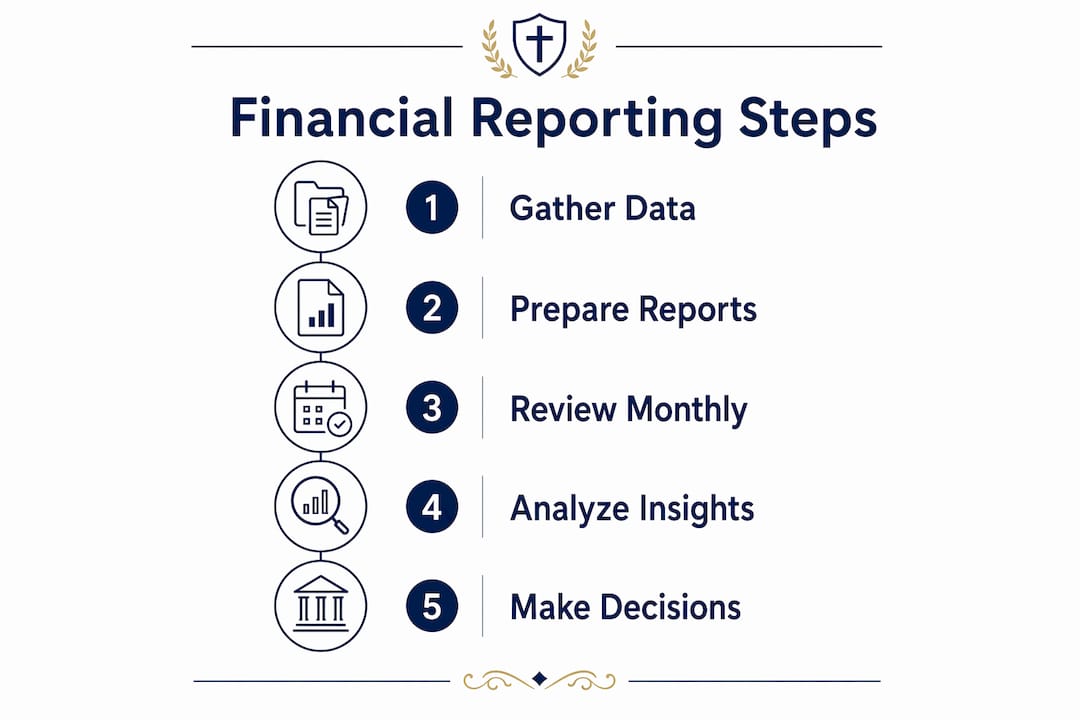
Here is a quick comparison of all four reports:
| Report | Primary Question Answered | Review Frequency | Key Decision It Drives |
|---|---|---|---|
| Profit & Loss | Am I making money? | Monthly | Pricing, cost control, service line cuts |
| Balance Sheet | What is my business worth right now? | Monthly | Debt management, asset investment |
| Cash Flow Statement | Do I have enough cash to operate? | Monthly | Payroll timing, vendor payments |
| A/R Aging | Who owes me money and for how long? | Weekly or Monthly | Collections, credit terms, customer risk |
Pro Tip: If you only have time to review one report each week, make it the A/R Aging report. Uncollected invoices are the fastest way to run out of cash even when business is booming.
How does small business accounting and compliance shape your reports?
Private U.S. small businesses typically follow Generally Accepted Accounting Principles, known as GAAP, for financial reporting. GAAP adherence reduces IRS audit risk and protects you from financial penalties. You do not need to memorize every GAAP rule, but you do need to apply them consistently. Inconsistent reporting, like mixing cash-basis and accrual-basis records without a clear method, creates errors that compound over time and become expensive to fix.
Many owners confuse bookkeeping with accounting. They are not the same thing. Bookkeeping is the clerical process of recording transactions. Accounting involves classifying, summarizing, and analyzing that data to inform strategy. A bookkeeper records that you paid $4,200 for materials on a job. An accountant tells you whether that job was profitable and whether your material costs are trending in the wrong direction.
The distinction matters because bookkeeping alone cannot drive business strategy without accounting analysis converting raw data into decisions. Many small businesses invest in bookkeeping but skip the accounting layer. The result is clean records that nobody uses to make better decisions.
Here is what proper small business accounting and compliance requires:
- Consistent accounting method: Choose cash-basis or accrual-basis and apply it every period without switching.
- Reconciled accounts: Bank and credit card accounts must be reconciled monthly to catch errors and fraud.
- Accurate expense categorization: Miscategorized expenses distort your P&L and create tax filing errors.
- Timely tax filings: Accurate financial reports reduce tax compliance risks and keep you prepared for any IRS inquiry.
- Separation of personal and business finances: Commingling funds is one of the most common and costly mistakes owner-operators make.
The combination of automated and professional bookkeeping improves data reliability and reduces the risk of errors that trigger audits or produce misleading reports. Tools like QuickBooks handle transaction recording efficiently. A professional accountant adds the analysis layer that turns those records into business intelligence.
What is a practical financial reporting cadence for small business owners?
A consistent reporting cadence is the single most important habit a small business owner can build. Lack of a standardized review process is the primary barrier to effective financial reporting and profitability. Most owners review numbers only when something feels wrong. By then, the problem has usually been building for months.
The solution is a structured monthly review combined with a weekly check-in. Waiting until month-end causes outdated data. A weekly 15-minute “mini-close” keeps your books current and supports near-real-time decisions. During a mini-close, you check your bank balance, clear any unrecorded transactions, and scan your A/R Aging report for overdue invoices. That 15 minutes each week prevents the month-end scramble.
Here is a step-by-step monthly financial review process you can implement starting this month:
- Reconcile all accounts. Confirm that your bank and credit card statements match your QuickBooks or accounting software records exactly.
- Review the Profit & Loss Statement. Compare this month’s numbers to last month and to the same month last year. Look for expense categories that increased without a corresponding revenue increase.
- Analyze the Balance Sheet. Check whether your liabilities are growing faster than your assets. Watch your accounts payable balance for vendor obligations coming due.
- Examine the Cash Flow Statement. Identify whether your cash position improved or declined and why. A profitable month with declining cash usually signals a collections problem or a large capital expenditure.
- Run the A/R Aging report. Flag any invoice over 30 days and assign a follow-up action. Do not let 60-day receivables become 90-day receivables without a conversation.
- Compare actual results to your budget. Standardized “actual vs. budget” variance analysis improves managerial insight and decision consistency. If labor costs ran 15% over budget, you need to know why before the next month begins.
Pro Tip: Schedule your monthly financial review as a recurring calendar appointment on the 10th of each month. This gives your bookkeeper time to close the prior month and gives you a fixed window to review before the current month gets too far along.
Choosing the right software matters too. Selecting proper accounting software directly supports how efficiently you can run this review process. QuickBooks Online, for example, generates all four core reports in minutes once your books are clean and current.
How do financial reports drive better business decisions?
Financial reporting is not just an annual tax chore. It is a strategic tool for detecting profit leaks and forecasting business outcomes. The owners who use it that way grow faster and with less financial stress than those who treat it as a compliance requirement.
The key distinction is between financial statements and management reporting. Financial statements show historical data. Management reporting layers analysis, dashboards, and KPIs on top of that history to guide operational improvements. A P&L tells you what happened. A management report tells you why it happened and what to do about it.
For owner-operated service businesses, the most valuable decisions financial reports can drive include:
- Pricing corrections: If your P&L shows gross margins declining over three consecutive months, your pricing is not keeping up with your costs. A 5% price increase on your most common service can recover thousands of dollars in annual profit.
- Job costing analysis: For contractors, HVAC companies, and plumbers, comparing estimated job costs to actual job costs reveals which types of work are profitable and which are not. Many owners discover that their highest-revenue jobs are actually their least profitable.
- Cash flow forecasting: Using your Cash Flow Statement alongside your A/R Aging report, you can project your cash position 60–90 days out. Predictive financial analysis allows you to plan for slow seasons, schedule equipment purchases, and avoid payroll shortfalls.
- Labor efficiency tracking: Tracking labor cost as a percentage of revenue each month shows whether your team is producing at the right rate. A trucking company that sees driver cost per mile creeping up has a problem to address before it compounds.
- Customer profitability: Not every customer is a good customer. Financial reporting by customer or service line reveals which relationships generate real profit and which ones consume resources without adequate return.
The shift from reactive to proactive financial management starts with one question: “What does this report tell me I should do differently next month?” That question transforms a compliance document into a growth tool.
Key takeaways
Small business financial reporting works best when it combines four core reports, a consistent monthly review cadence, and management-level analysis that converts data into decisions.
| Point | Details |
|---|---|
| Four core reports | Review the P&L, Balance Sheet, Cash Flow Statement, and A/R Aging every month without exception. |
| Monthly cadence drives profit | Owners who review full reports monthly make 37% more profitable decisions and catch cash flow issues earlier. |
| Bookkeeping is not accounting | Recording transactions is only the first step; accounting analysis turns that data into business strategy. |
| Weekly mini-closes prevent surprises | A 15-minute weekly check-in keeps books current and eliminates the month-end scramble. |
| Management reporting is the upgrade | Layering KPIs and variance analysis on top of financial statements is what separates growing businesses from stagnant ones. |
What i’ve learned after 20 years of running service businesses
Most small business owners I work with are not failing because they lack ambition or work ethic. They are failing to grow because they are making decisions without reliable financial data. I spent more than two decades building and operating multi-million-dollar service businesses before founding Truemeasureaccounting. The lesson I learned the hard way is this: the numbers always tell the truth before the business does.
I have watched profitable-looking businesses run out of cash in 90 days because nobody was reading the Cash Flow Statement. I have seen HVAC owners underprice their most popular service for years because they never ran a job costing analysis. The P&L showed revenue growing, so everything felt fine. It was not fine.
The conventional advice is to “hire a bookkeeper and review your financials.” That is incomplete. Bookkeeping without accounting analysis is like getting a lab report without a doctor to interpret it. You have data, but you do not have answers. What you actually need is someone who understands your operations well enough to connect a number on a report to a decision you should make on Monday morning.
The other mistake I see constantly is waiting for a problem to force a financial review. By the time cash gets tight or a tax bill arrives unexpectedly, the window to course-correct has already closed. The owners who build wealth from their businesses are the ones who review their numbers every single month, whether things feel good or not. That discipline is not natural for most operators. It has to be built deliberately, with the right systems and the right support.
— Tony
See your business clearly with Truemeasureaccounting
If your financial reports are sitting unreviewed or your books are months behind, you are making decisions without the information you need. Truemeasureaccounting works with owner-operated businesses generating $250,000 to $5 million annually to deliver clean books, monthly financial reports, and the analysis that turns numbers into decisions.
Our small business bookkeeping services include monthly reconciliations, the four core financial reports, KPI tracking, and cash flow management built specifically for service businesses like yours. We also offer financial reporting services that go beyond data entry to deliver the management-level insights that drive real growth. Schedule a free consultation and find out exactly what your numbers are telling you.
FAQ
What financial reports does a small business need?
Every small business needs four core reports: the Profit & Loss Statement, the Balance Sheet, the Cash Flow Statement, and the Accounts Receivable Aging report. Reviewing all four monthly gives you a complete picture of profitability, financial health, cash position, and collections.
How often should small business owners review their finances?
Small business owners should review their full suite of financial reports monthly and perform a brief 15-minute mini-close each week. Monthly reviews catch trends early, while weekly check-ins keep books current for near-real-time decisions.
What is the difference between bookkeeping and accounting for small businesses?
Bookkeeping is the process of recording financial transactions. Accounting classifies, summarizes, and analyzes that data to support strategy and decision-making. Small businesses need both: bookkeeping for accurate records and accounting to turn those records into business intelligence.
Does a small business need to follow GAAP?
Private U.S. small businesses are not legally required to follow GAAP, but adherence reduces IRS audit risk and produces more reliable financial reports. Consistent application of GAAP standards also makes it easier to secure financing and prepare accurate tax filings.
How does financial reporting help with cash flow management?
The Cash Flow Statement and A/R Aging report together reveal where cash is coming from, where it is going, and which customers are slowing your collections. Reviewing these reports monthly allows you to forecast cash shortfalls 60–90 days in advance and take corrective action before a crisis develops.