

Profit First works for contractors, but only after you adapt it. The fix starts with one move: treat every deposit as Income, transfer that job’s material and subcontractor costs into a dedicated Materials/Job-Costs account, then allocate what’s left to Profit, Owner’s Pay, Tax, and OpEx. Done right, this protects your margin, steadies your paycheck, and keeps a tax bill from ambushing you in April.
TL;DR:
- Use separate accounts for materials and subcontractor costs immediately after deposits, and allocate percentages only against real revenue after direct job costs.
- Typical starting percentages are 50-60% for materials and subs, 5-10% for profit, 30-35% for owner’s pay, and 15% for taxes, based on real revenue figures.
- Allocate funds on a per-draw basis rather than calendar dates to better handle uneven deposits, retainage, and lump-sum material purchases.
- Track retainage and large material expenses carefully and consider a reserve account to manage slow periods and unexpected costs.
- Fix common issues like allocating from gross revenue, underpricing jobs, or using inaccurate job costing to ensure the system protects your margins effectively.
Table of Contents
- Why the standard Profit First setup needs tweaks for contractors
- Contractor account map: the accounts you should open and what each holds
- How to calculate ‘real revenue’ and set your allocation percentages
- Allocation timing: per-draw allocations, calendar splits, and automation options
- Handling retainage, big material buys, and dry spells
- Common implementation mistakes and how to fix them
- Quick start implementation checklist for the first 30/60/90 days
- How TrueMeasure applies Profit First for contractors
- Get Your Profit First System Built Right the First Time
- Sources
Why the standard Profit First setup needs tweaks for contractors
The original Profit First formula, made popular by Mike Michalowicz, assumes a business collects revenue and keeps most of it. Contractors don’t work that way. A $50,000 draw on a kitchen remodel might include $28,000 earmarked for cabinets, tile, and a subcontracted electrician. Allocate percentages off that full $50,000 and you’ve just told your Profit and Tax accounts they own money that’s already spoken for.
Progress draws make this worse. Money lands in uneven chunks tied to project milestones, not a predictable monthly rhythm. Retainage compounds the problem: a client withholding 10% until final inspection creates cash that shows up on your books as earned but isn’t sitting in your bank account. That’s phantom cash, and it fools a lot of owners into thinking they have more breathing room than they do.

The fix, and the entire reason a contractor-specific version of this system exists, is the concept of real revenue. Real revenue is what’s left after direct job costs come out. It’s the number you should actually be allocating against.
Two structural fixes make this work:
- Separate materials and subcontractor costs into their own account the moment a deposit clears.
- Allocate percentages only against real revenue, never gross deposits.
Relay’s contractor-focused Profit First guide puts this plainly: skipping the Materials/Job-Costs account is the single most common reason contractors abandon the system within a few months. When COGS runs 40 to 70% of gross revenue in most trades, allocating against the wrong base number isn’t a rounding error. It’s the difference between a system that protects your business and one that quietly drains it.
Contractor account map: the accounts you should open and what each holds
A contractor version of Profit First typically runs six accounts, not the four in the original book. The extra two, Materials/Job-Costs and a tax reserve sized for quarterly payments, are what make the system survive contact with a real jobsite.
Here’s the structure that holds up across HVAC, plumbing, electrical, and general contracting businesses:
| Account | Purpose | What goes in / out |
|---|---|---|
| Income | Landing zone for every deposit and payment | All revenue in; swept out within days per allocation percentages |
| Materials/Job-Costs | Holds job-specific material and subcontractor costs | Funded from Income at deposit time; paid out to suppliers and subs |
| Profit | Owner’s reward, quarterly distributions | Small, frequent transfers in; distributed quarterly, untouched otherwise |
| Owner’s Pay | Your salary, paid on a fixed schedule | Regular transfers in; regular payroll draws out |
| Tax | Reserve for quarterly estimated payments | Percentage-based transfers in; paid out only to the IRS or state |
| OpEx | Rent, insurance, fuel, software, overhead | Remainder after other allocations; covers recurring business costs |
Two optional accounts are worth adding once the core six are running smoothly:
- Retainage tracker: a sub-account or even a spreadsheet line that separates withheld retainage from spendable cash until it’s released.
- Buffer/reserve account: cash set aside during strong months to cover slow ones, funded from early Profit distributions.
On naming: use your bank’s sub-account feature if your bank offers it, and label transfers with job numbers in your bookkeeping software. This is the detail most contractors skip and regret. When your Materials/Job-Costs account holds funds for three active jobs simultaneously, you need to know which dollars belong to which project. Job-level bookkeeping and a proper chart of accounts make this traceable instead of a guessing game at tax time.
How to calculate ‘real revenue’ and set your allocation percentages
The formula is straightforward: real revenue = deposit received minus direct job costs tied to that deposit (materials plus subcontractor invoices). That’s the number every percentage in your system applies to, not your gross deposit.
Starting percentages vary by trade, but the ranges below are common across HVAC, plumbing, electrical, and general contracting operations, according to Holdings’ contractor cash flow guide:
- Materials/subs: often 50 to 60% of gross revenue for material-heavy trades, pulled out before you calculate anything else.
- Profit: 5 to 10% of real revenue to start, increasing as the business matures.
- Owner’s Pay: 30 to 35% of real revenue, treated as a non-negotiable paycheck.
- Tax: around 15% of real revenue, sized to cover quarterly estimated payments.
- OpEx: the remainder, covering insurance, fuel, software, and rent.
Quick math: a $40,000 draw on a bathroom renovation
Say your material and subcontractor costs for this draw total $22,000. That leaves $18,000 in real revenue.
- Materials/Job-Costs: $22,000 transferred immediately to cover suppliers and the tile sub.
- Profit (7% of real revenue): $1,260 held for quarterly distribution.
- Owner’s Pay (32% of real revenue): $5,760 paid to you on schedule.
- Tax (15% of real revenue): $2,700 reserved for quarterly filing.
- OpEx (remainder): $8,280 for overhead and recurring costs.
The IRS requires quarterly estimated payments from self-employed business owners, and a Tax account funded at every deposit removes the scramble that hits so many contractors every September and January. Run this math on your last five deposits and you’ll likely find your current percentages are guesswork dressed up as a budget.
Allocation timing: per-draw allocations, calendar splits, and automation options
Per-draw allocation, splitting the moment a deposit clears, outperforms calendar-based splits for most contractors. The original Profit First book recommends the 10/25 rule: allocate on the 10th and 25th of each month. That works fine for businesses with steady, predictable monthly income. It works poorly for a contractor who gets a $30,000 draw on the 3rd and nothing else for three weeks.
Relay’s research on contractor implementations found that per-deposit allocation keeps account balances healthier than calendar-only splits specifically when retainage and lumpy material costs are in play. The 10/25 rule still has a place for smaller, steadier revenue streams like maintenance contracts or recurring service calls, where deposits are frequent and predictable.
Automation makes either approach sustainable:
- Set up bank sub-accounts with automatic percentage-based transfer rules triggered by deposits.
- Route payment-provider deposits (Stripe, QuickBooks Payments) directly into Income, then automate the sweep within 24 to 48 hours.
- Build a simple spreadsheet formula that calculates the Materials/Job-Costs transfer before you touch the rest.
Pro Tip: Tag every deposit with its job ID and pre-calculate expected material costs from your supplier purchase orders before the money even lands. This turns a five-minute manual split into a near-instant transfer and keeps you from accidentally raiding OpEx to cover a job’s materials.
Reconcile weekly, not monthly. A weekly check catches an overdraft risk in your Tax account before it becomes a missed quarterly payment, and it takes ten minutes if your accounts are properly automated.
Handling retainage, big material buys, and dry spells
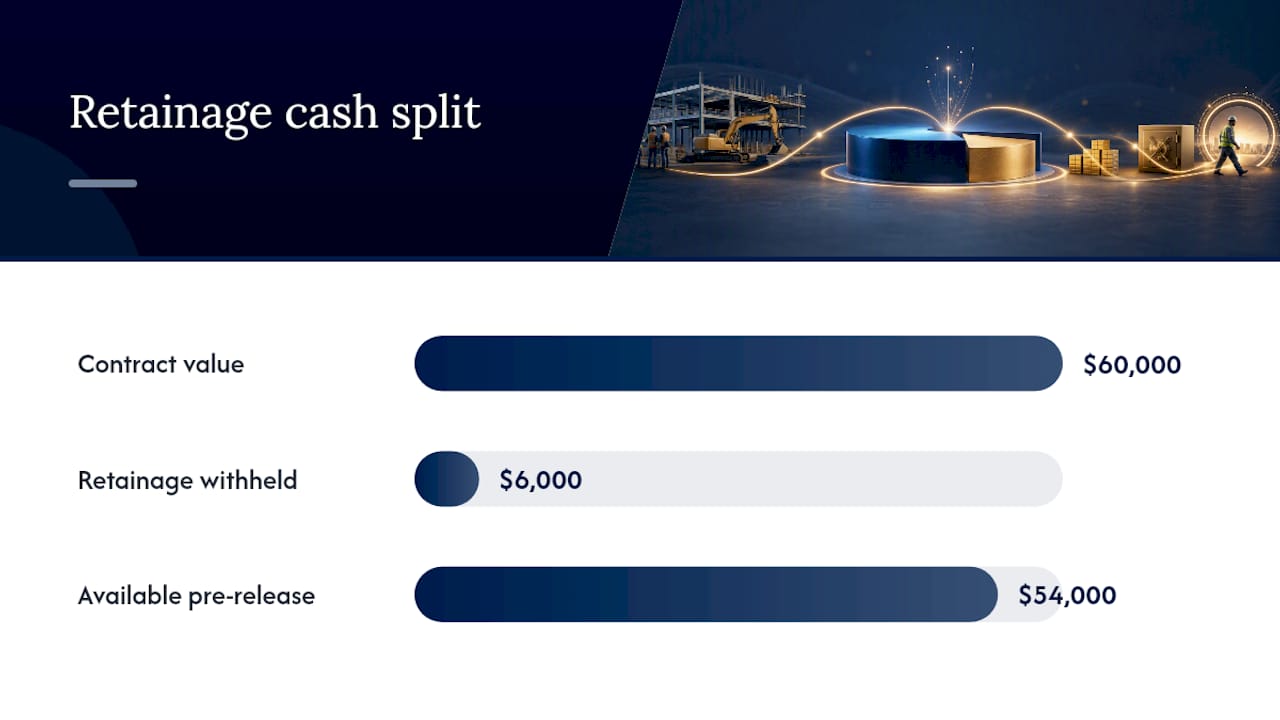
Retainage is the trap that sinks otherwise well-run contractor Profit First systems. If a client withholds 10% of a $60,000 job until final walkthrough, that $6,000 should never enter your allocation math until it actually hits your bank account. Track it on a simple ledger, project name, contract amount, retainage percentage, expected release date, so it never gets counted as available cash prematurely.
SBA guidance on surety bonds is worth understanding if your work requires bonding, since bonded projects often carry their own cash requirements and retention terms that compound the tracking challenge.
For lumpy material purchases, big lumber orders, a full HVAC system, a bulk fixture buy, consider a vendor-prepay or materials buffer sub-account. Size it using a basic runway calculation: average monthly material spend times 1.5, adjusted for your busiest season. Smartsheet’s construction budgeting framework supports building this kind of line-by-line cost visibility, which makes buffer sizing far less of a guess.
Dry spells hit every seasonal trade, roofing in winter, HVAC install slowdowns in shoulder seasons. Fund a rainy-day reserve from your first few Profit distributions rather than waiting until cash is tight to start one:
- Track your slowest historical months and calculate average OpEx and Owner’s Pay needed to cover them.
- Redirect a portion of early Profit distributions into a reserve account instead of taking a full payout.
- Revisit reserve targets annually as revenue grows.
Common implementation mistakes and how to fix them
Most Profit First failures among contractors trace back to a handful of repeatable errors.
- Allocating from gross instead of real revenue. Fix it immediately by recalculating your last month of deposits against actual job costs, then adjusting future allocations.
- Underpricing jobs so there’s no real margin to allocate is a critical issue that professional & trade services marketing can help address by improving pricing and job mix decisions. No percentage split fixes a bid that doesn’t cover true costs. Pricing and job costing discipline has to come first.
- Raiding Tax or Profit accounts to cover payroll or materials shortfalls. Treat these accounts as untouchable. If you’re tempted, that’s a signal your OpEx or Owner’s Pay percentage is set wrong, not that the rule should bend.
- Ignoring how much COGS swings between jobs. A remodel and a new build carry wildly different material ratios. Recalculate percentages by job type if your work varies significantly.
If you’re consistently short in Tax or Profit despite following the math, that’s a red flag worth a fractional CFO review rather than another spreadsheet tweak.
Quick start implementation checklist for the first 30/60/90 days
You don’t need to overhaul everything at once. A phased rollout keeps the system usable while you learn your real numbers.
- Days 1 to 30: Open your six core accounts, configure bank automation for transfers, and pull your last six months of job costs to calculate your actual materials-to-revenue ratio.
- Days 31 to 60: Start per-draw allocations on every new deposit, reconcile weekly, and confirm payroll and tax transfers are landing correctly before you touch percentages again.
- Days 61 to 90: Review actual allocation results against your targets, adjust percentages based on real data, and schedule a recurring monthly report to track trends going forward.
Pro Tip: Run your first month as a parallel test, keep doing things the old way while tracking what Profit First would have allocated. Comparing the two side by side makes the percentage adjustments in month two far more accurate than guessing.
How TrueMeasure applies Profit First for contractors
Professional bookkeeping firms build Profit First allocations on top of clean, job-level bookkeeping, because percentages mean nothing if your job costing is wrong underneath them. That usually means fixing progress-invoicing setups in QuickBooks first, then layering the account structure and automation on top.
Contractors tend to be businesses generating between $250,000 and $5 million that have outgrown spreadsheets but aren’t ready for a full-time CFO. The typical outcome after implementation: a consistent owner paycheck, tax reserves that actually cover the quarterly bill, and far fewer scrambles to cover payroll during a slow month.
— Tony
Get Your Profit First System Built Right the First Time
Reading the math is one thing. Building six connected accounts, automating the transfers, and keeping your job costing accurate enough that the percentages mean something, that’s where most contractors stall out. TrueMeasureaccounting handles the setup end to end: job-cost bookkeeping, progress-invoicing configuration in QuickBooks, cash allocation automation, and ongoing reporting so you’re not the one reconciling six accounts every Friday night.

If you’re running a general contracting, HVAC, plumbing, or electrical business and want this system installed correctly rather than pieced together from a spreadsheet template, our fractional CFO services work directly with your existing books to set target percentages based on your actual job costs, not industry averages. Start with a bookkeeping services consult and we’ll show you exactly where your real revenue is going before recommending a single allocation percentage.
Sources
The Tax account guidance in this article follows IRS rules on quarterly estimated payments. Retainage and bonding context draws on SBA surety bond guidance. Contractor-specific account structures and starting percentages come from Relay’s Profit First adaptation guide and Holdings’ cash flow guide. Budgeting practices reference Smartsheet’s construction budget guide, and readers wanting the full framework should see Shawn Van Dyke’s book, Profit First for Contractors.
This article is general information, not a substitute for advice from a qualified financial advisor. Consult a qualified financial professional about your own circumstances before acting on anything here.
- Estimated Taxes | Internal Revenue Service
- Surety bonds | U.S. Small Business Administration
- Profit First for contractors: everything you need to know | Relay
- Profit First for Contractors: Cash Flow Guide | Holdings