
Most S corp distributions are not taxed a second time. They’re tax-free up to your stock basis, and anything above that basis becomes capital gain. The real audit risk isn’t the distribution itself. It’s paying yourself too little in W-2 wages while calling the rest a “distribution.”
TL;DR:
- Most S corporation distributions are not taxed again unless they exceed your stock basis or are sourced from accumulated earnings and profits from a prior C corporation period.
- Properly tracking your stock basis annually through Form 7203 is crucial to prevent taxable capital gains from overdistributions.
- Distributions sourced from accumulated earnings and profits can be taxed as dividends, especially if the corporation has a history as a C corporation.
- The IRS prioritizes reasonable W-2 wages over distributions; paying unreasonably low salaries increases audit risk and potential penalties.
- Accurate and timely basis reconciliation, separate tracking of payroll and distributions, and an understanding of the distribution ordering are essential to avoid unexpected tax liabilities.
Table of Contents
- How S Corp Distributions Are Taxed: Non-Dividend, Dividend, and Capital Gain
- Stock Basis and Form 7203: What Moves the Number
- What Are AAA, PTI, AE&P, and OAA in S Corp Distribution Rules?
- Reasonable Compensation vs Distributions: The Real Audit Trigger
- Reporting Checklist: Forms, Boxes, and Filings to Track
- Practical Guidance for Owner-Operators: Timing, Basis Checks, and Estimated Taxes
- Why Disciplined Basis Tracking Actually Matters
- How TrueMeasure Accounting Helps You Manage Distributions Without the Guesswork
- Sources
How S Corp Distributions Are Taxed: Non-Dividend, Dividend, and Capital Gain
The confusion around s corp distributions tax usually starts with a simple misunderstanding: owners think the distribution is the taxable event. It isn’t. Your S corp’s profit gets taxed once, on your Schedule K-1, in the year the company earns it, whether you take the cash out or leave it sitting in the business checking account. The distribution itself is typically just you withdrawing money that already went through your tax return.
That’s why most owner-operators pulling money out of an HVAC or plumbing business never see a second tax bill on the withdrawal. IRC §1368 governs this with a two-step test: a distribution is nontaxable up to your adjusted stock basis, and any amount exceeding basis gets taxed as capital gain, usually long-term if you’ve held the stock more than a year.
Here’s where it gets more complicated. If your S corporation carries accumulated earnings and profits, or AE&P, from a prior life as a C corporation, some of that distribution can be taxed as a dividend instead of a tax-free return of capital. If your corporation has leftover AE&P from before the S election, part of a distribution may be sourced as a taxable dividend, with the remainder treated as a nontaxable return of basis. Most S corps that started as S corps from day one never deal with this. Former C corps need to watch it closely.
A few things determine which bucket your distribution falls into:
- Whether the corporation has any AE&P on its books from C corporation years
- Your current stock basis at the close of the tax year
- Whether the distribution exceeds your accumulated adjustments account, or AAA
- State conformity, since most states follow federal S corp rules but not all match perfectly on basis or AE&P treatment
That last point matters more than owners expect. A handful of states tax S corp income differently or impose an entity-level tax, so check with a tax professional licensed in your state before assuming your federal treatment carries over cleanly.
Stock Basis and Form 7203: What Moves the Number
Your stock basis is not a fixed number. It moves every year, and tracking it wrong is the single most common reason a “tax-free” distribution turns into a taxable one. Basis starts with what you paid for your shares, then gets recalculated annually based on what happened inside the business.
The IRS treats basis as a running account calculated as of the last day of the S corporation’s tax year, not the moment you take a distribution. That timing detail trips up a lot of owners who assume they can check basis mid-year and distribute freely.
Here’s the basic sequence for tracking it:
- Start with your initial capital contribution or the price you paid for your shares.
- Add your share of the corporation’s income, including tax-exempt income and capital gains passed through on your K-1.
- Add any additional capital you contribute during the year.
- Subtract distributions taken during the year.
- Subtract your share of nondeductible expenses and losses.
- What’s left is your basis going into next year.
Debt basis works differently and trips people up constantly. If you’ve personally loaned money to your S corp, that loan can create basis that lets you deduct losses beyond your stock basis. But debt basis doesn’t make distributions tax-free. Only stock basis does that. Owners sometimes assume a shareholder loan gives them room to pull out extra cash tax-free. It doesn’t work that way.
Form 7203 is where all of this gets documented. You’re required to attach it to your personal return when you take a distribution, claim a loss, or dispose of stock. Skipping it doesn’t make the basis rules disappear. It just means you have no paper trail if the IRS questions your numbers later, and reconstructing years of basis history during an audit is far more painful than tracking it annually from the start.
What Are AAA, PTI, AE&P, and OAA in S Corp Distribution Rules?
Four accounts determine how a distribution gets sourced, and most owners have never heard of three of them. Here’s the plain-English version:
- AAA (Accumulated Adjustments Account): Tracks post-1982 S corp earnings that haven’t yet been distributed. This is usually where your distributions come from first.
- PTI (Previously Taxed Income): A legacy account from pre-1983 S corp rules. Rare in practice today, but still technically part of the ordering.
- AE&P (Accumulated Earnings and Profits): Leftover earnings from years the corporation operated as a C corp. This is the account that can create dividend taxation.
- OAA (Other Adjustments Account): Holds items like tax-exempt income that aren’t part of AAA.
The IRS practice unit on distribution sourcing lays out the order: distributions come out of AAA first, then PTI, then AE&P, then OAA. Only the AE&P layer creates dividend income. Everything sourced from AAA, PTI, or OAA follows the standard §1368 basis rules instead.
For S corps that converted from C corp status, this ordering is not a formality. A trucking company that operated as a C corp for a decade before electing S status can carry AE&P for years, and every large distribution risks dipping into that account once AAA runs dry. When multiple distributions happen in the same year and exceed AAA, the IRS allocates AAA proportionally across them and applies AE&P to the remainder, which can shift the timing of taxable income and occasionally require an amended return.
Certain elections can reorder this sequence, including elections to bypass AAA and distribute AE&P first in specific circumstances. Never make that election without a tax professional walking you through the consequences first.
Reasonable Compensation vs Distributions: The Real Audit Trigger
Here’s the truth most tax guides bury: the IRS cares far less about your distribution amount than about your salary. If you work in the business, the IRS requires you to pay yourself reasonable compensation through W-2 wages before taking any distributions at all.
There’s no fixed percentage or formula. “Reasonable” is determined by facts and circumstances, meaning what someone doing your job, with your experience, in your market, would typically earn. A general contractor pulling $180,000 in profit while paying himself a $24,000 salary and calling the rest “distributions” is exactly the pattern that draws scrutiny. Courts have consistently sided with the IRS when compensation looks unreasonably low relative to services performed, treating substance over form and reclassifying distributions as wages.
The consequences of reclassification are severe: back FICA taxes for both the employer and employee share, interest, accuracy-related penalties, and in some cases trust-fund recovery penalties assessed personally against the responsible party. This isn’t a paperwork inconvenience. It’s a cash event that can wipe out a year’s tax savings in one audit adjustment.
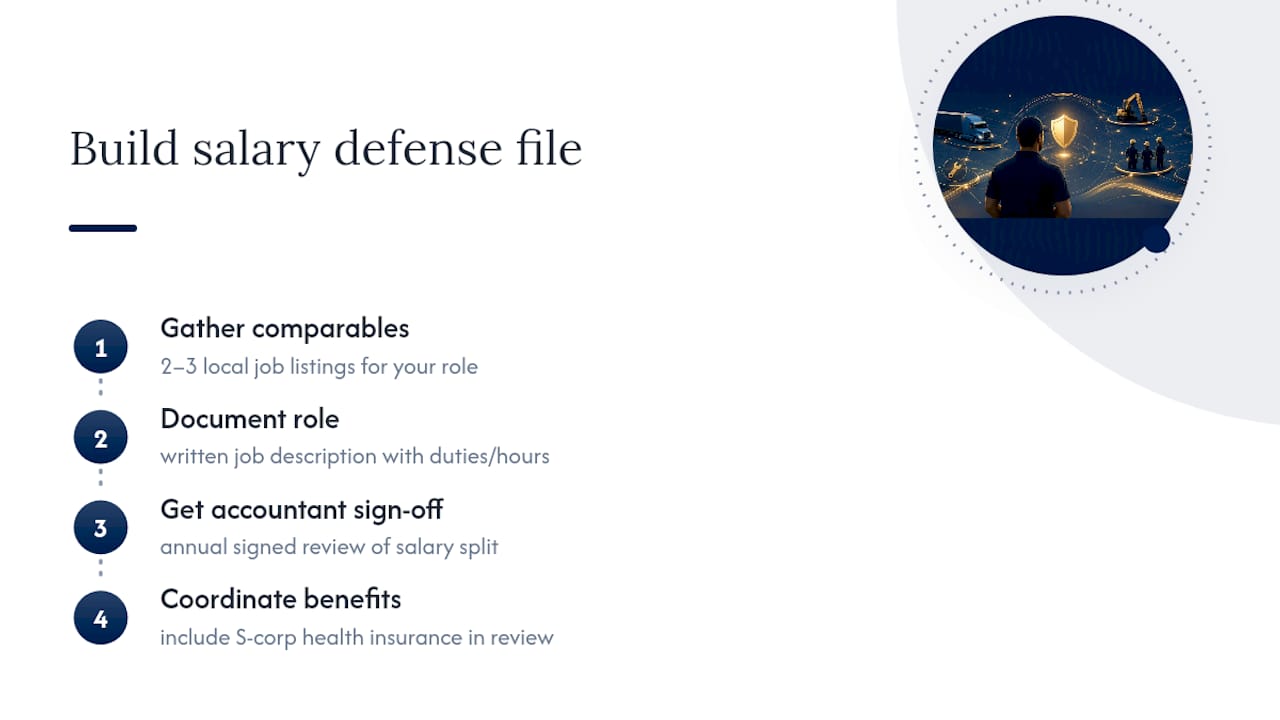
Pro Tip: Build your salary defense before the IRS asks for it. Pull two or three comparable job listings for your role in your market, keep a written job description, and have your accountant sign off annually on the salary-to-distribution split. That file costs an hour to build and can save you tens of thousands in a reclassification dispute.
Owners running S corp health insurance through payroll should coordinate that setup with the same compensation review, since health insurance treatment ties directly into how W-2 wages get reported.
Reporting Checklist: Forms, Boxes, and Filings to Track
Distributions show up in a few specific places on your tax paperwork, and knowing where to look prevents year-end scrambling.
- Form 1120S: The corporation reports total distributions on Schedule K, and each shareholder’s portion flows to their individual Schedule K-1, box 16 (or the applicable code for distributions).
- Schedule K-1: Shows your share of income, separately from any distribution amount, so your CPA can apply the basis ordering rules correctly.
- Form 1099-DIV: Only issued when a distribution is taxed as a dividend because it’s sourced to AE&P. Most nondividend distributions never generate a 1099-DIV at all.
- Payroll filings: If wages get reclassified after an audit, expect amended Form 941 filings, corrected W-2s, and back withholding responsibilities for the employer.
- Form 7203: Attached to your personal Form 1040 whenever you take a distribution, deduct a loss, or dispose of S corp stock, documenting the basis math behind each transaction.
Missing any of these doesn’t just create a compliance gap. It creates the exact kind of inconsistency that flags a return for review.
Practical Guidance for Owner-Operators: Timing, Basis Checks, and Estimated Taxes
Before you take a distribution, run this worksheet: opening basis, plus current-year income and capital contributions, minus prior distributions this year, minus your share of losses. If the result is negative, you’ve overdistributed and created capital gain exposure. This takes five minutes with clean books and saves a nasty surprise in April.
Distribution timing matters more than most owners realize. Monthly or quarterly draws tied to actual profitability tend to work better than one large year-end distribution, especially in businesses with seasonal cash flow like HVAC or construction. If you’re in a loss year, pause distributions until you know your actual basis position. Taking money out during a downturn is one of the fastest ways to convert what should be a tax-free withdrawal into a taxable gain.
Estimated taxes are the piece owners forget most often. You owe tax on your share of S corp income whether or not you distribute the cash. If the business retains earnings to fund growth or cover a slow season, you still need to pay quarterly estimated taxes on income allocated to you through the K-1. Waiting until the money is distributed to think about taxes is a scheduling mistake, not a strategy.
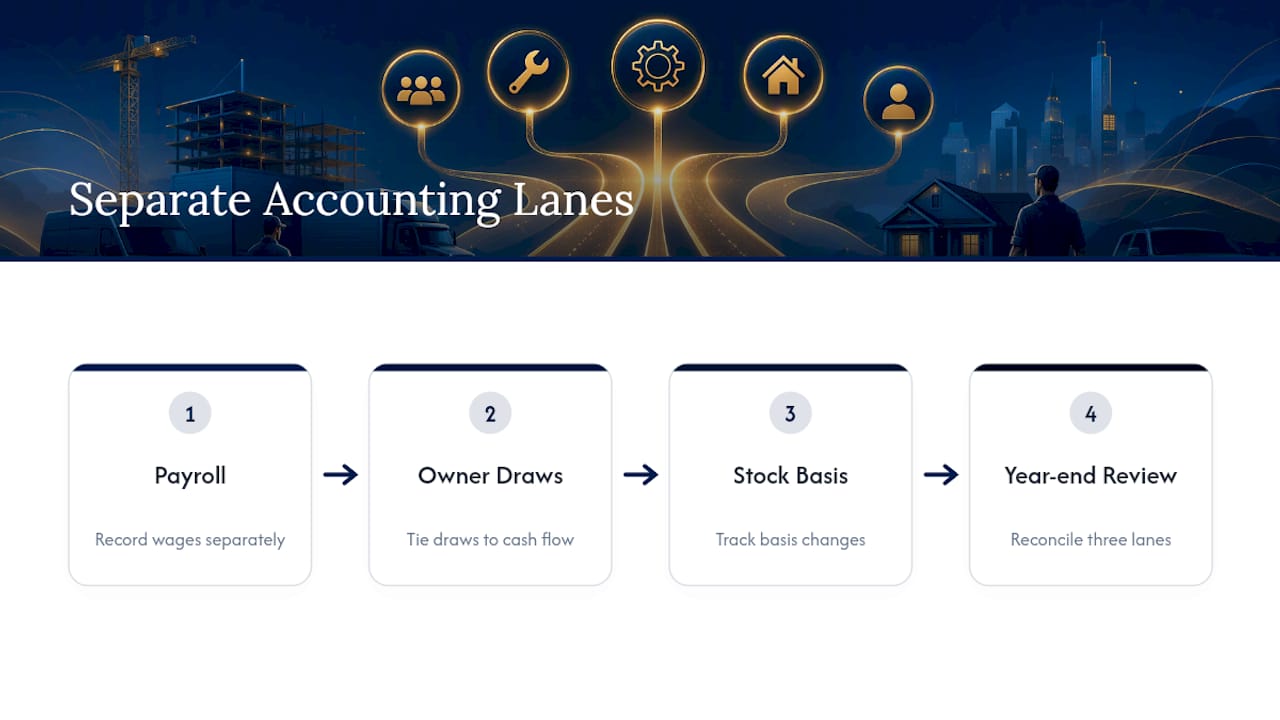
Pro Tip: Keep payroll, distributions, and basis tracking in three separate lanes in your books. When they blend together, you lose the ability to reconstruct what happened at year-end, and your CPA ends up guessing instead of calculating.
Coordinating distribution decisions with your cash-flow forecast and job costing data turns a tax question into a business decision. A trucking company deciding whether to distribute $80,000 or reinvest it in a new trailer needs both numbers side by side, not in separate spreadsheets nobody reconciles. Reviewing your year-end tax planning checklist alongside your basis worksheet before December closes that gap.
Why Disciplined Basis Tracking Actually Matters
I’ve seen the pattern play out the same way more than once: a contractor has a strong year, distributes heavily, then hits a slow season and keeps distributing at the same pace out of habit. Basis runs negative without anyone noticing until tax season, and a supposedly tax-free withdrawal turns into a capital gain bill nobody budgeted for.
Regular basis reconciliation, clean payroll separation, and a second set of eyes before you change your salary-to-distribution split prevent nearly every version of this story. If it’s been a while since anyone reviewed your basis position, that review is worth scheduling before your next distribution, not after.
— Tony
How TrueMeasure Accounting Helps You Manage Distributions Without the Guesswork
Running basis calculations, payroll compliance, and distribution timing on your own, on top of running the business, is where most owner-operators lose the thread. Professional bookkeeping, payroll setup, and tax planning can help keep your stock basis accurate year-round, reducing the risk of surprise capital gain issues at tax time.
Our team builds Form 7203 documentation as part of your regular tax preparation, structures reasonable compensation reviews so your salary holds up under scrutiny, and layers in fractional CFO oversight when you need distribution decisions tied to real cash-flow forecasting instead of guesswork. For owner-operated service businesses, such a combination can mean fewer surprises at tax time and clearer answers to questions about distributions.
If your basis tracking, payroll setup, or distribution timing hasn’t been reviewed in a while, start with a bookkeeping services consultation and get a basis review scheduled before your next tax season.
This article is general information, not a substitute for advice from a qualified financial advisor. Consult a qualified financial professional about your own circumstances before acting on anything here.