

Tracking profit per truck owner-operator means knowing exactly how much each truck earns after every cost is paid, giving you the financial clarity to make smarter decisions about loads, pricing, and growth. 73% of owner-operators do not know their true cost per mile. That blind spot costs the average driver roughly $12,847 per year in profit leakage. The industry term for this discipline is per-asset profit tracking, and it goes well beyond simply checking your bank balance at the end of the month. When you know what each truck actually earns, you stop guessing and start managing your business like the operator you are.
How to track profit per truck owner-operator: what it really means
Per-asset profit tracking is the practice of isolating every dollar of revenue and every dollar of cost to a single truck, then calculating net profit for that truck over a defined period. Most owner-operators look at their total revenue and assume they are doing fine. The problem is that fleet-level numbers hide what is actually happening at the truck level.
Many operators track profitability at the fleet level, which masks trucks losing $500–$800 per month. A truck running marginally unprofitable loads can drain your cash for months before you notice. Per-truck tracking surfaces that problem immediately.
The standard output you want from this process is a monthly profit and loss statement (P&L) for each truck. That statement shows total revenue, total costs broken into fixed and variable categories, and net profit. With that number in hand, you can compare trucks, evaluate loads, and negotiate rates from a position of knowledge rather than instinct.
What costs and revenues should you include when calculating truck profits?
Accurate owner-operator profit tracking starts with capturing every cost, not just the obvious ones. Missing even one category distorts your margin and leads to bad decisions.
Fixed costs to capture every month
Fixed costs stay roughly the same regardless of how many miles you run. They include:
- Truck payment or lease: Your monthly note or lease obligation.
- Insurance: Commercial auto, cargo, and liability premiums.
- Permits and registration: Base plate, IFTA registration, and state operating permits.
- ELD and compliance fees: Electronic logging device subscriptions and drug testing program costs.
- Occupational accident or health insurance: Often overlooked but real.
Fixed costs must be normalized for accurate weekly or per-load analysis. Divide your monthly total by 4.33 to get a weekly figure, or divide your annual total by 52. That normalized number becomes your baseline cost before you turn a wheel.
Variable costs to track per mile
Variable costs change with miles driven and load activity. They include fuel, maintenance, tires, tolls, and factoring fees. Fuel is typically the largest variable cost and the one most operators track reasonably well. Tires and maintenance are the ones that get ignored until a big bill arrives.
Deadhead miles inflate estimated profitability because they burn fuel and create wear without generating revenue. Every empty mile you drive has a real cost. If you ran 200 deadhead miles to pick up a load, those miles belong in that load’s cost calculation.
Factoring fees deserve special attention. If you use a freight factoring company, their fee (typically 2%–5% of the invoice) reduces your actual take-home on every load. Many operators forget to subtract this when calculating load profit.
Revenue components to record
Revenue is not just the line-haul rate. Record the base load rate, any fuel surcharge, detention pay, and accessorial charges separately. This breakdown matters because fuel surcharges fluctuate and can mask changes in your base rate over time.
Pro Tip: Set up a simple load sheet for every trip. Record the load rate, fuel surcharge, detention pay, total loaded miles, and total deadhead miles before you close out the load. Doing it in real time takes two minutes and saves hours of reconstruction later.
What tools do you need to track expenses for truck drivers accurately?
The right tools determine whether your profit data is reliable or just an estimate. You have two main categories to choose from: spreadsheets and bookkeeping software.
Spreadsheets vs. bookkeeping software
| Feature | Spreadsheet (Excel, Google Sheets) | Bookkeeping software (QuickBooks Plus/Advanced) |
|---|---|---|
| Cost | Free or low cost | Monthly subscription required |
| Per-truck isolation | Manual setup required | Built-in with Class Tracking |
| Automation | None | Bank feeds, auto-categorization |
| Reporting | Custom built | Standard P&L, balance sheet |
| Scalability | Breaks down with volume | Scales with your business |
| Error risk | High (manual entry) | Lower (automated feeds) |
Spreadsheets work when you are running one truck and have the discipline to update them daily. They break down fast when volume increases or when you miss a week of entries.
QuickBooks Class Tracking, available in the Plus and Advanced tiers, lets you tag every transaction to a specific truck. That single feature makes per-truck P&L reports possible without manual sorting. Lower QuickBooks tiers do not include this feature, so the tier you choose matters.
Building a driver and truck profile
Every truck needs a profile that captures its fixed cost baseline, average fuel economy, typical lane and load type, and maintenance history. You update this profile monthly. Over time, it becomes a performance record that tells you whether a truck is getting more or less profitable as it ages.

Gather accurate mileage data from your ELD system. Pull fuel prices from your fuel card reports, not from memory. Use your bank statements and receipts to capture maintenance and repair costs. The data is only as good as the inputs, so build the habit of pulling these numbers weekly.
Pro Tip: If you use QuickBooks, set up a separate Class for each truck from day one. Retroactively adding Class Tracking to months of transactions is time-consuming. Starting clean costs nothing and saves significant work later. Truemeasureaccounting can handle the QuickBooks setup for you if the software feels unfamiliar.
Step-by-step process to calculate and analyze profit per truck
This six-step process gives you a repeatable method to calculate net profit per truck each month. Run it at the end of every month without exception.
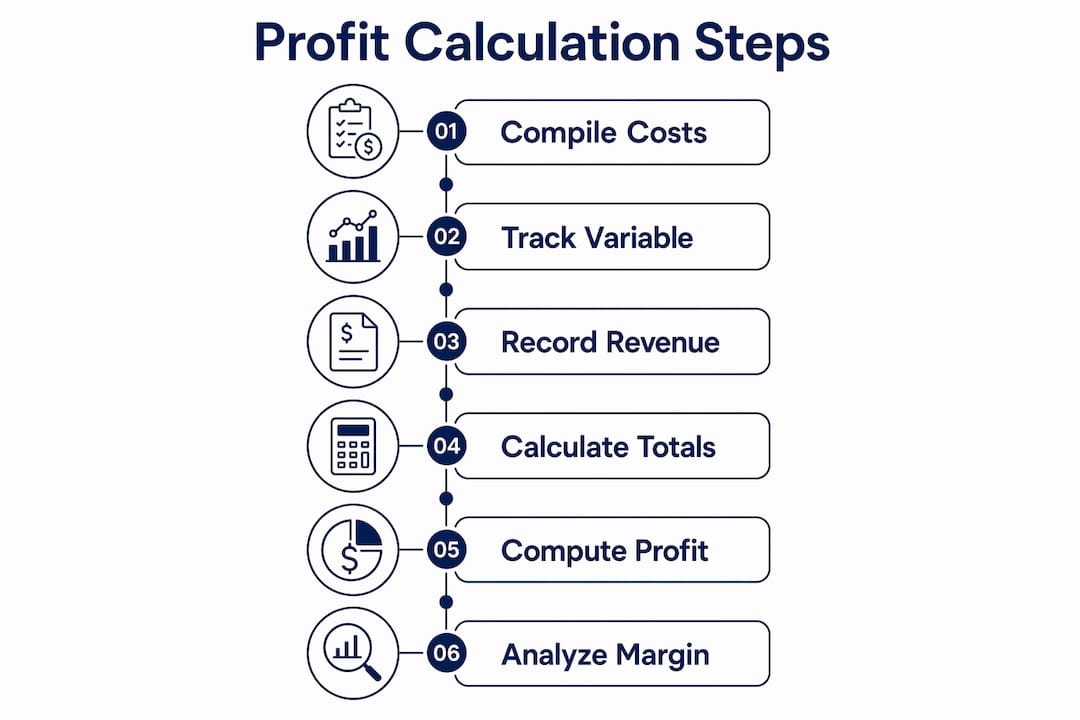
Step 1: Compile and normalize your fixed costs.
Add up all fixed costs for the truck: payment, insurance, permits, ELD, and compliance fees. Divide the monthly total by 4.33 if you want a weekly breakeven figure. This is your floor before you earn a dollar.
Step 2: Track variable costs per mile for every trip, including deadhead.
For each load, record total miles driven (loaded plus deadhead), fuel cost for those miles, tolls, and any maintenance costs incurred. Divide total variable costs by total miles to get your variable cost per mile for that trip.
Step 3: Record all revenue from each load.
Log the base rate, fuel surcharge, and any detention or accessorial pay. Subtract the factoring fee if applicable. This is your net revenue for the load.
Step 4: Calculate total cost per mile and total revenue per trip.
Add your normalized fixed cost per mile to your variable cost per mile. That sum is your total cost per mile. Multiply by total miles (loaded plus deadhead) to get total cost for the trip.
Step 5: Compute net profit per load and per truck over the month.
Subtract total trip cost from net trip revenue. That is your load-level profit. Sum all load profits for the month to get your monthly net profit for that truck.
Step 6: Analyze your profit margin and compare trucks.
Divide net profit by total revenue to get your profit margin percentage. A healthy load generates at least a 20%–30% profit margin after all costs. Below 20% leaves you with insufficient cushion for unexpected repairs or slow weeks.
Example monthly P&L for one truck
| Category | Amount |
|---|---|
| Total revenue (loads + surcharges) | $14,200 |
| Fixed costs (normalized monthly) | $3,800 |
| Variable costs (fuel, tires, maintenance, tolls) | $5,100 |
| Factoring fees (3% of revenue) | $426 |
| Total costs | $9,326 |
| Net profit | $4,874 |
| Profit margin | 34.3% |
This example truck is performing well. A margin above 30% means you have room to absorb a bad week or a repair bill without going negative. If your margin is sitting at 12%, you need to either raise your rates or cut costs before a single breakdown wipes out your month.
When negotiating rates, target a margin 30%–40% above your base cost per mile. That buffer accounts for deadhead miles, time spent sourcing loads, and the unpredictable nature of trucking costs. Knowing your exact cost per mile makes that negotiation concrete rather than a gut feeling.
You can also learn more about load profitability reporting to take this analysis further.
Common mistakes that destroy accurate profit tracking
Most profit tracking failures come from a small set of repeatable mistakes. Knowing them in advance keeps your numbers clean.
- Ignoring deadhead miles. Deadhead miles burn fuel and create wear without generating revenue. Leaving them out of your cost calculation inflates your margin and makes bad loads look profitable.
- Confusing gross revenue with take-home pay. Mixing gross revenue with take-home pay without normalizing fixed costs causes cash flow crises when large bills arrive. The money looks like profit until insurance renewal or a truck payment hits.
- Skipping factoring fees. A 3% factoring fee on $14,000 per month is $420 gone. Over a year, that is more than $5,000 that never shows up in your pocket if you do not track it.
- Tracking at the fleet level only. Per-truck isolation is the entire point. Without it, a truck losing $600 per month hides inside your total numbers until the damage is done.
- Inconsistent data entry. Missing one week of fuel receipts or forgetting a repair bill corrupts the entire month’s analysis. Build a weekly data entry habit, not a monthly scramble.
Tracking expenses for truck drivers at the fleet level feels easier in the short term. The cost of that shortcut shows up when you discover one truck has been losing money for six months and you had no idea. Per-truck tracking is not extra work. It is the work that actually protects your income.
Pro Tip: Do a monthly audit of your three largest expense categories: fuel, maintenance, and insurance. If any category is more than 10% higher than the prior month without a clear reason, investigate before closing the books. Catching errors early is far less painful than reconstructing three months of transactions.
Reviewing common bookkeeping mistakes that trucking companies make can also help you build cleaner habits from the start.
Key takeaways
Per-truck profit tracking is the single most effective method for owner-operators to protect earnings, identify underperforming assets, and negotiate rates with confidence.
| Point | Details |
|---|---|
| Normalize fixed costs | Divide monthly fixed costs by 4.33 to get a weekly breakeven figure for each truck. |
| Include deadhead miles | Count every empty mile in your cost calculation to avoid inflated profit margins. |
| Target 20%–30% margin | Any load below 20% profit margin leaves insufficient cushion for repairs or slow weeks. |
| Use Class Tracking | QuickBooks Plus or Advanced Class Tracking isolates financials by truck for accurate P&L reports. |
| Audit monthly | Review your three largest expense categories every month to catch errors before they compound. |
What I have learned from watching operators get this wrong
I have worked with owner-operators who were grossing $200,000 a year and genuinely believed they were profitable. When we built out per-truck P&Ls, the picture changed fast. One truck was consistently losing money on short regional loads because the deadhead miles were never counted. Another operator was netting far less than expected because factoring fees had never been subtracted from revenue. Neither of these operators was careless. They just did not have the right structure in place.
The operators who grow sustainably share one habit: they treat their truck like a business unit, not just a vehicle. They know their cost per mile. They know their breakeven load rate. They use that data to say no to bad freight and yes to better lanes. That discipline compounds over time.
Independent owner-operators earn roughly $19,700 more annually than leased operators, but they also pay over $10,000 more in insurance and compliance costs. That gap only works in your favor if you are tracking it. If you are not watching those costs per truck, the independence premium disappears quietly.
My honest advice: do not wait until tax season to look at your numbers. Build a monthly review into your schedule. Thirty minutes at the end of each month reviewing your per-truck P&L will tell you more about your business than any annual tax return ever will. Use the data to negotiate better rates, drop unprofitable lanes, and decide when a truck has aged past its productive life. That is how you use financial management for truckers as a real business tool, not just a compliance exercise.
— Tony
Truemeasureaccounting helps owner-operators see profit clearly
Owner-operators running one truck or a small fleet need more than a spreadsheet. They need clean books, per-truck reporting, and a financial partner who understands the operational side of trucking.

Truemeasureaccounting specializes in trucking bookkeeping services built around per-asset profit tracking, QuickBooks Class Tracking setup, and monthly P&L reporting by truck. The firm was founded by Anthony Boncimino, an operator with more than 20 years of experience running service businesses, which means the advice you get is grounded in how businesses actually work. If you want to know exactly what each truck earns and where your money is going, Truemeasureaccounting’s small business bookkeeping services give you that clarity at a fixed monthly price. Schedule a free consultation to see what per-truck profit tracking looks like when it is done right.
FAQ
What is the best way to track profit per truck as an owner-operator?
The most reliable method is to build a monthly P&L for each truck using bookkeeping software with Class Tracking, capturing all fixed costs, variable costs, deadhead miles, and net revenue per load. QuickBooks Plus and Advanced both support this feature.
How do I calculate my true cost per mile?
Add your normalized fixed costs per mile to your variable costs per mile, including fuel, maintenance, tires, tolls, and factoring fees, then divide the total by all miles driven including deadhead. This gives you the full cost of operating that truck for every mile it moves.
What profit margin should an owner-operator target per load?
A healthy load should generate a profit margin of at least 20%–30% after all costs. Margins below 20% leave too little cushion for repairs, slow weeks, or rate fluctuations.
Why do deadhead miles matter so much in profit calculations?
Deadhead miles consume fuel and create mechanical wear without generating any revenue. Leaving them out of your cost calculation makes loads appear more profitable than they are, which leads to accepting freight that actually loses money.
How does QuickBooks Class Tracking help with per-truck profit analysis?
Class Tracking in QuickBooks Plus and Advanced lets you tag every transaction to a specific truck. This creates separate P&L reports by truck without manual sorting, making it the most practical bookkeeping method for owner-operators managing multiple assets.
Recommended
- Load Profitability Reporting for Trucking: 2026 Guide
- Types of Trucking Business Expenses to Track in 2026
- Trucking P&L Made Simple: What Numbers Actually Matter for Profit – TrueMeasure Accounting LLC-Small Business Accounting Services
- Are You Pricing Your Trucking and Moving Services Right in 2025? – TrueMeasure Accounting LLC-Small Business Accounting Services