
Financial reports go unread in small businesses primarily because they arrive too late, use language designed for accountants, and fail to connect numbers to real business decisions. Only 42% of small business owners feel confident reading their financial statements. That confidence gap costs real money. A $1M revenue business can lose $30,000–$50,000 annually from decisions made without solid financial understanding. The good news is that the problem is fixable. Better delivery, plain-language translation, and the right advisory support turn ignored reports into the most useful tool you have.
Why financial reports go unread in small business
Financial statements are designed for compliance, not for running a business. Standard GAAP-based reports serve a regulatory function. They satisfy the IRS, lenders, and auditors. They do not answer the questions a plumbing contractor or HVAC owner actually asks: Did we make money this month? Can we cover payroll next week? Which jobs are dragging us down?
The result is a document that looks authoritative but feels useless. Owners glance at the bottom line, set the report aside, and go back to checking their bank balance. That habit is understandable. It is also dangerous.

The core problem is a communication gap, not a math problem. Financial statements feel like a foreign language to most owners because they were built by accountants for accountants. The terminology, the format, and the structure all reflect accounting logic, not business logic. Until that gap closes, reports will keep piling up unread.
What are the main barriers preventing owners from reading financial reports?
Several distinct barriers drive report avoidance. Understanding each one makes it easier to fix them.
Timing kills relevance. Receiving December financials in February makes those reports obsolete for any decision you need to make today. By the time the numbers arrive, you have already hired or fired, taken on new jobs, or spent money you cannot take back. Late reports do not inform decisions. They just confirm what already happened.
Jargon creates friction. Terms like “accrued liabilities,” “deferred revenue,” and “amortization of intangibles” mean nothing to an electrical contractor managing 12 crews. When owners cannot decode the language, they disengage. The report becomes a compliance artifact rather than a management tool.
Cash flow confusion is widespread. Fewer than 38% of small business owners understand the statement of cash flows well. Many owners confuse profit with cash. A construction company can show strong net income on paper while running out of money to pay suppliers. That disconnect breeds distrust in the numbers.
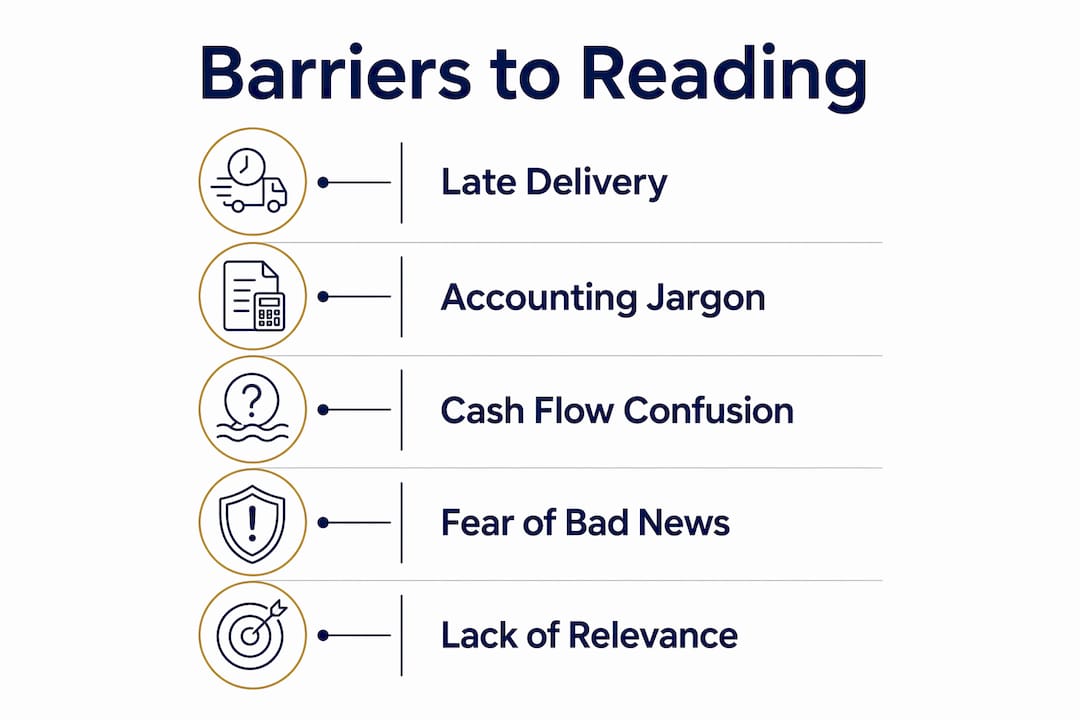
Fear of bad news is real. Owners who suspect their business is underperforming often avoid reports because they do not want confirmation. This is a psychological barrier, not a literacy one. It is also self-defeating. Ignoring a problem does not make it smaller.
Reports lack context and direction. A page of numbers with no explanation of what changed, why it changed, or what to do about it gives owners nothing to act on. Owners don’t connect isolated numbers to business decisions, which reduces the practical value of even accurate reports.
Here is a quick summary of the most common barriers:
- Reports arrive weeks or months after the period they cover
- Accounting terminology replaces plain business language
- No narrative explains what the numbers mean or what changed
- Profit and cash flow are presented separately with no bridge between them
- No prioritized list of actions or warnings draws the owner’s attention
Pro Tip: If you are checking your bank balance every morning instead of reviewing a monthly report, that is a signal your reports are not working for you. The fix is not more discipline. It is better reports.
How does financial literacy affect report engagement and business success?
Financial literacy is defined as knowing enough to run your business confidently, including understanding the difference between cash flow and profit and recognizing the tax impact of financial decisions. It does not require memorizing accounting jargon. It requires understanding the concepts that drive your business forward or hold it back.
The business case for improving financial literacy is direct. Owners who close financial literacy gaps through 20–30 hours of structured learning grow revenue twice as fast as those who do not. That is not a marginal improvement. That is the difference between a business that scales and one that stays stuck.
The cost of financial illiteracy is equally concrete. Poor decisions driven by misunderstood financials result in 3–5% of total annual revenue lost each year. For a trucking company doing $2M annually, that is $60,000–$100,000 walking out the door. Most of those losses are invisible because owners never connect the decision to the financial outcome.
Financial literacy also changes how owners relate to their reports. An owner who understands gross margin reads the income statement differently than one who does not. They spot the warning signs. They ask better questions. They stop reacting to crises and start managing proactively. That shift from reactive to proactive management is where real profitability gains happen.
The importance of financial reports only materializes when the owner can interpret them. Literacy is the bridge between data and decision.
What alternatives improve how owners use financial reports?
The solution is not to make owners into accountants. The solution is to make reports work for owners. That requires a different approach to how reports are built, delivered, and explained.
1. Add a translation layer
A translation layer converts GAAP-formatted statements into plain-English business summaries. Structured advisory reports with clear verdicts and prioritized action plans transform compliance documents into decision-support tools. This is not a simplified version of the report. It is a separate document that answers the questions owners actually ask.
2. Use one-page executive summaries
One-page financial summaries that answer “How much did we make?”, “Do we have enough cash?”, and “What should we do next?” significantly increase owner engagement. A single page with three clear answers beats a 10-page GAAP report every time for a busy HVAC owner between service calls.
3. Deliver reports on time
Monthly financials delivered within 10–15 days after month-end retain enough relevance to drive decisions. Reports that arrive six weeks late are historical documents. Reports that arrive within two weeks are management tools. The difference in delivery timing changes how owners treat the information.
4. Add visual trend charts
Charts showing revenue, gross margin, and cash flow over a rolling 12-month period give owners immediate context. A single number means little. A trend line tells a story. Visual aids reduce the cognitive load of interpreting raw data and focus attention on what is actually changing.
5. Build a watch list
A short list of three to five metrics that matter most to your specific business gives owners a focal point. For a general contractor, that might be job cost variance, accounts receivable aging, and gross margin by project type. For a property management company, it might be occupancy rate, maintenance cost per unit, and net operating income. The watch list replaces the overwhelming full report as the starting point for every monthly review.
The table below compares the standard compliance report format with the owner-focused advisory format:
| Feature | Compliance report | Advisory report |
|---|---|---|
| Primary audience | Accountants, lenders, IRS | Business owner |
| Language | GAAP terminology | Plain English |
| Format | Multi-page financial statements | One-page summary plus detail |
| Delivery timing | 4–8 weeks after month-end | 10–15 days after month-end |
| Action guidance | None | Prioritized recommendations |
| Visual aids | Rarely included | Charts and trend lines standard |
Pro Tip: Ask your accountant for a one-page summary with every monthly report. If they cannot provide one, that is a signal you need a different kind of financial partner.
How can small businesses build better financial reporting habits?
Better habits start with a clear process. The goal is to make reviewing financials a regular, low-friction part of running the business, not an annual event driven by tax season.
- Schedule a monthly review meeting. Block 30 minutes each month to review financials with your accountant or financial advisor. Consistency builds the habit. The meeting forces delivery accountability and creates a dedicated space for questions.
- Require plain-language narratives. Every monthly report should include a short written summary explaining what changed, why it changed, and what it means for the next 30 days. This narrative is the most valuable part of the report for most owners.
- Use technology to close the timing gap. Cloud-based accounting platforms reduce the lag between transactions and reporting. Monthly financials delivered with short explainer videos or walkthroughs build habits and improve financial literacy over time. The walkthrough format works especially well for owners who learn by listening rather than reading.
- Focus on three to five key metrics. Revenue, gross margin, cash on hand, accounts receivable aging, and net profit cover most of what a small business owner needs to track. Start there before expanding to more detailed analysis.
- Build financial curiosity into your culture. Share key numbers with your team leads. Discuss job profitability after each project closes. When financial awareness spreads beyond the owner, the whole business makes better decisions.
- Work with an advisor who speaks your language. A financial advisor for small businesses who understands your industry translates numbers into operational recommendations. That context is what separates useful advice from generic accounting output.
The importance of monthly financials compounds over time. Owners who review reports consistently develop pattern recognition. They spot problems earlier, respond faster, and make fewer expensive mistakes.
Key Takeaways
Financial reports go unread in small businesses because they arrive too late, use accounting language owners cannot act on, and fail to connect numbers to real decisions. Fixing the delivery, format, and advisory layer turns reports into the most powerful management tool a small business owner has.
| Point | Details |
|---|---|
| Timing destroys relevance | Reports delivered more than two weeks after month-end lose their decision-making value. |
| Jargon blocks engagement | GAAP-formatted statements need a plain-English translation layer to be useful for owners. |
| Financial literacy drives growth | Owners who invest 20–30 hours in structured learning grow revenue twice as fast. |
| One-page summaries increase use | A summary answering three key questions outperforms a full GAAP report for owner engagement. |
| Regular review builds the habit | Monthly 30-minute reviews with an advisor turn financials from a chore into a management tool. |
What I’ve learned from 20 years on the owner’s side of the table
Most accounting firms hand over a set of financial statements and consider the job done. I spent more than two decades running multi-million-dollar service businesses before I ever sat on the advisor side of this conversation. I know exactly what happens to those reports. They land in an inbox, get skimmed for the bottom line, and get filed away.
The problem is not that owners are lazy or financially irresponsible. The problem is that standard GAAP reports answer questions nobody in operations is actually asking. An HVAC owner running 20 technicians does not need a formatted income statement. They need to know which service lines are making money, whether their labor costs are in line, and whether they have enough cash to cover the next payroll cycle. A compliance document does not answer any of those questions directly.
What changed my perspective was watching how quickly owners engaged when we started delivering translated summaries alongside the standard reports. The same numbers, presented in plain English with a short narrative and three recommended actions, produced completely different behavior. Owners started calling with questions. They started pushing back on their own spending. They started asking about pricing changes. The data had not changed. The presentation had.
The other thing I have seen consistently is that financial literacy coaching pays for itself fast. An owner who understands gross margin will catch a pricing problem before it becomes a cash flow crisis. An owner who understands accounts receivable aging will follow up on slow-paying customers before they become bad debt. These are not accounting skills. They are business survival skills.
My honest view is that if your reports are going unread, that is not your failure. It is a service delivery failure. You deserve reports that work for you, not reports that work for your accountant’s filing system.
— Tony
How Truemeasureaccounting turns reports into real business tools
Financial clarity does not happen by accident. It takes the right reports, delivered on time, with the context to act on them.
Truemeasureaccounting works with owner-operated businesses across HVAC, construction, plumbing, trucking, and other service industries to deliver monthly financial reporting that actually gets read and used. Every engagement includes plain-English summaries, KPI tracking, and advisory conversations that connect your numbers to your next decision. Our bookkeeping services are built around your business operations, not just your tax return. If your reports are sitting unread in your inbox, reach out to Truemeasureaccounting and find out what financial clarity looks like when it is built for an owner, not an auditor.
FAQ
Why do small business owners ignore financial reports?
Financial reports go unread primarily because they arrive too late to influence decisions and use accounting terminology that most owners cannot easily interpret. The lack of plain-language context and prioritized recommendations removes the practical value from even accurate reports.
What is the cost of not reading financial reports?
Poor financial literacy costs small businesses 3–5% of total annual revenue each year through poor decisions and missed opportunities. For a $1M business, that translates to $30,000–$50,000 in preventable losses annually.
How often should small businesses review their financial reports?
Monthly review is the standard best practice. Monthly financials delivered within 10–15 days after month-end retain enough relevance to drive active management decisions rather than just historical review.
What is a financial report translation layer?
A translation layer is a plain-English summary that converts GAAP-formatted statements into business-focused answers covering profitability, cash position, and recommended actions. It sits alongside the standard report and answers the questions owners actually ask.
How does financial literacy affect business growth?
Owners who close financial literacy gaps through 20–30 hours of structured learning grow revenue twice as fast as those who do not. Financial literacy improves decision quality across pricing, hiring, cash flow management, and capital investment.