
Specialized accounting for law firms is the practice of applying accounting methods designed specifically to meet the regulatory and operational demands of managing client trust funds, IOLTA accounts, and legal practice finances. General bookkeeping cannot address these requirements. ABA Model Rule 1.15 mandates that attorneys keep client funds strictly separate from operating funds and maintain detailed records at the client and matter level. That single rule creates an entire accounting discipline. Understanding why law firms need specialized accounting starts with recognizing that compliance failures here are not just financial errors. They are ethics violations that can end a legal career.
Why law firms need specialized accounting: the core challenges
Law firm accounting differs from standard business accounting in ways that make general-purpose solutions genuinely dangerous. The differences are structural, not cosmetic.
The most fundamental challenge is trust account segregation. Client funds held in advance of earned fees must never commingle with the firm’s operating funds. This is not a best practice. It is a bar rule enforced in every U.S. jurisdiction. A general bookkeeper unfamiliar with Rule 1.15 requirements will not naturally track deposits and disbursements at the individual client and matter level. That gap creates risk immediately.

The second major challenge is income recognition. Law firms handle retainers, contingency fees, flat fees, and hourly billing simultaneously. Each type has different rules for when income is considered earned and can be transferred from trust to operating accounts. Misapplying these rules, even unintentionally, constitutes misappropriation of client funds under most state bar rules.
The third challenge is reconciliation complexity. Most jurisdictions require monthly three-way IOLTA reconciliations comparing the bank statement, the trust ledger, and individual client and matter ledgers. A discrepancy in the aggregate total is serious. A discrepancy at the client level that is hidden by offsetting errors is worse, because it means one client’s funds are covering another’s. Standard accounting software like QuickBooks tracks transactions but cannot perform trust reconciliation without significant customization.
Here is where accounting challenges in law firms concentrate:
- Trust account segregation at the client and matter level, not just the account level
- Three-way monthly reconciliation comparing bank, book, and client ledgers simultaneously
- Earned fee authorization before any transfer from trust to operating accounts
- Client notification requirements tied to specific timing rules that vary by state
- Documentation retention of reconciliation records for state bar audits
Pro Tip: If your current bookkeeper cannot define three-way trust reconciliation without looking it up, that is your signal to find someone with legal accounting expertise before a bar complaint does it for you.
How does specialized accounting ensure compliance with bar trust rules?
Compliance in legal accounting is not a one-time setup. It is a monthly discipline with documented evidence that must survive a bar audit years after the fact.
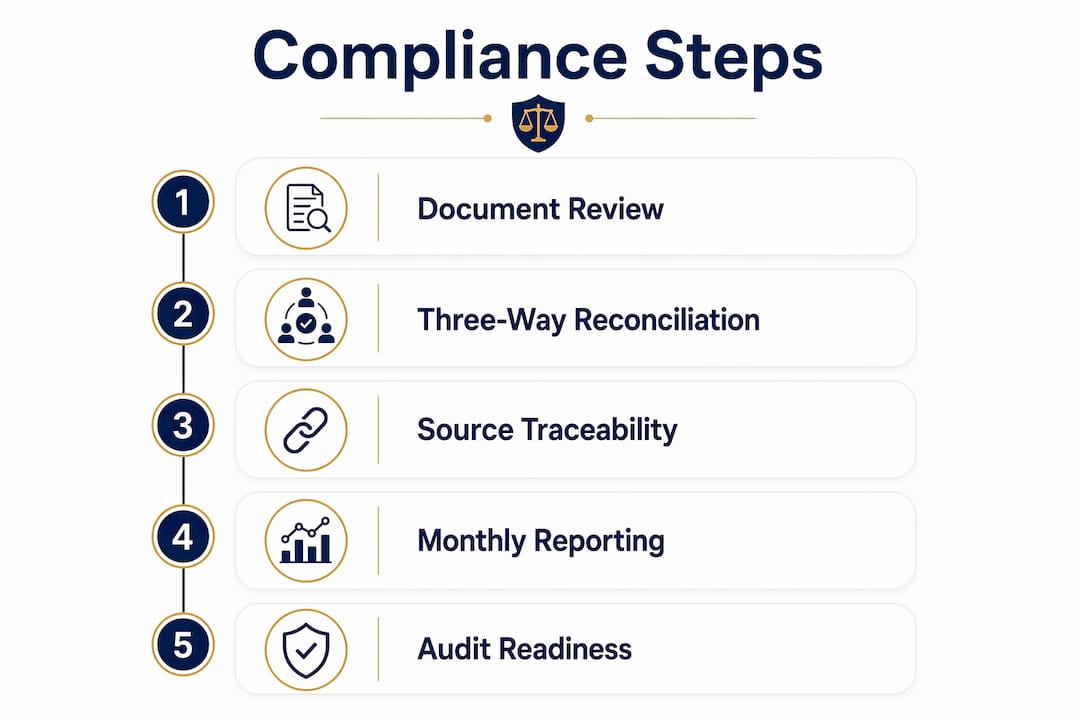
The IOLTA trust account is the center of that discipline. Every client deposit, disbursement, and earned fee transfer must be recorded at the matter level with a corresponding entry in the client ledger. State bars may request reconciliation documentation for 5 to 7 years, meaning a 2026 audit can reach back to 2019. Firms that rely on informal recordkeeping or spreadsheets rarely survive that kind of scrutiny intact.
The three-way reconciliation is the compliance cornerstone. It works like this:
- Reconcile the bank statement to the trust account book balance, confirming all deposits and disbursements are recorded.
- Reconcile the trust account book balance to the sum of all individual client ledger balances.
- Confirm the sum of client ledgers matches the bank statement balance.
All three figures must agree. Most reconciliation failures originate in client ledger inaccuracies such as misapplied deposits or missing disbursements, even when aggregate totals appear to balance. That is the hidden danger. A firm can pass a surface-level review and still have a serious client-level problem.
The trust-to-operating transfer process is where many firms fail. In a State Bar of California CTAPP pilot, 56% of firms failed timely client notification and 44% delayed fund distribution. These are not small firms with no accounting support. They are firms using manual processes that lack built-in controls. Specialized accounting systems enforce the correct sequence: invoice authorization, client notification, ledger update, and reconciliation, all before the transfer posts.
Audit readiness also requires traceability. Every entry must connect to a source document. Every transfer must connect to an invoice and a client notification. Specialized accounting transforms trust transfers from clerical tasks into controlled workflows that leave a complete audit trail. That trail is what protects your firm when a bar investigator asks for documentation.
What operational efficiencies does specialized accounting bring?
Compliance is the floor, not the ceiling. The benefits of specialized accounting for law firms extend well into daily operations and firm profitability.
The most immediate gain is time. When trust-to-operating transfers follow a structured workflow with automation, attorneys and administrators stop managing the process manually. Dual approval controls flag large transfers for review before they post. Aging reports surface earned fees sitting in trust past their transfer date. These controls reduce bar audit findings while also reducing the administrative burden on staff.
The second gain is financial clarity at the matter level. General accounting gives you a firm-wide profit and loss statement. Specialized legal accounting gives you profitability by client, by matter, by practice area, and by attorney. That data changes how partners make decisions about pricing, staffing, and case selection.
Here is a direct comparison of what general versus specialized accounting delivers for a law firm:
| Capability | General accounting | Specialized legal accounting |
|---|---|---|
| Trust account segregation | Manual workaround required | Built-in by design |
| Three-way reconciliation | Not supported natively | Automated monthly workflow |
| Client and matter ledgers | Not standard | Core feature |
| Earned fee transfer controls | None | Invoice authorization required |
| Audit trail for bar review | Incomplete | Complete and traceable |
| Financial reporting by matter | Not available | Standard output |
The third gain is contingency case management. Contingency matters involve no billing until settlement, which creates cash flow complexity that general accounting software handles poorly. Specialized legal accounting tracks costs advanced, anticipated recovery, and matter-level profitability across a portfolio of contingency cases without distorting the firm’s operating financials.
Pro Tip: Ask your accounting provider to show you a matter-level profitability report before you sign any engagement. If they cannot produce one, they are not equipped for legal practice accounting solutions.
In-house vs. outsourced: how do law firms decide?
The decision between in-house and outsourced specialized accounting services for attorneys is not primarily about cost. It is about expertise and risk.
An in-house bookkeeper with general accounting training is a liability in a law firm environment. General bookkeepers lack knowledge of Rule 1.15, client confidentiality requirements, matter-level posting, and three-way reconciliation. Training a general bookkeeper to perform legal accounting correctly takes months and requires ongoing supervision by someone who already knows the rules. Most small and mid-size firms do not have that supervisory capacity.
Outsourced specialized accounting providers bring the expertise pre-built. The key considerations when evaluating them include:
- Demonstrated experience with IOLTA trust accounting and state bar compliance rules
- Technology compatibility with your practice management software, whether that is Clio, MyCase, or another platform
- Scalability to handle increased matter volume without adding headcount
- Documented workflows for trust transfers, reconciliations, and client notifications
- Clear data access so your firm retains full visibility and control at all times
The cost argument for outsourcing is straightforward. A full-time legal bookkeeper with the right credentials commands a salary that most firms under $2 million in revenue cannot justify. An outsourced provider delivers the same expertise at a fraction of that cost, with no benefits, no turnover risk, and no training burden. For growing firms, the accounting tech consultation question is equally important: the right provider integrates with your existing systems rather than forcing a workflow change.
Best practices for ongoing financial and ethical compliance
Compliance is not a project with an end date. It is a set of monthly habits that protect your firm continuously.
- Perform three-way reconciliation every month without exception. The most dangerous period is the lag between trust activity and reconciliation. Small discrepancies compound quickly. Monthly reconciliation catches errors before they become bar complaints.
- Maintain client and matter ledger accuracy in real time. Every deposit and disbursement should post to the correct matter code on the day it occurs. Batch entry at month-end creates the exact conditions for the mispostings and missing disbursements that cause reconciliation failures.
- Document every trust-to-operating transfer completely. The documentation package for each transfer should include the invoice, proof of client notification, the ledger entry, and the reconciliation confirming the transfer. This is your audit file.
- Retain all compliance documentation for at least 5 to 7 years. State bars audit on long timelines. Your audit-proof documentation practices need to match that timeline.
- Assign clear roles for trust accounting tasks. Every person who touches trust account data should have a defined role, defined permissions, and defined review responsibilities. Ambiguity in roles is how errors go undetected.
- Use accounting software built for legal trust compliance. Tools like Clio Accounting, CosmoLex, and LawAccounting include trust accounting workflows by design. Retrofitting QuickBooks is possible but requires ongoing maintenance to stay compliant.
Pro Tip: Schedule your three-way reconciliation as a fixed calendar event on the first business day after month-end bank statements are available. Treat it with the same urgency as a filing deadline.
Key takeaways
Law firms require specialized accounting because trust accounting compliance, client fund integrity, and matter-level financial clarity cannot be achieved with general bookkeeping tools or untrained staff.
| Point | Details |
|---|---|
| Trust segregation is mandatory | ABA Model Rule 1.15 requires client funds to be tracked separately at the matter level, not just the account level. |
| Three-way reconciliation is the compliance standard | Monthly reconciliation of bank, book, and client ledgers is required in most jurisdictions and must be documented. |
| Manual transfer processes create bar risk | Over half of firms in a California pilot failed timely client notification using manual trust-to-operating workflows. |
| Specialized software closes the compliance gap | Tools like LawAccounting and CosmoLex enforce authorization, notification, and reconciliation in a single workflow. |
| Outsourced expertise reduces cost and risk | Outsourced legal accounting providers deliver bar-compliant workflows without the cost of a full-time credentialed hire. |
What I’ve learned from watching law firms get this wrong
I have worked with professional service firms across a wide range of industries, and the pattern I see most often in legal practices is the same: a firm grows, the trust account activity increases, and the accounting process does not keep pace. Nobody makes a deliberate decision to cut corners. The firm just never upgraded from the informal system that worked when there were five active matters to the structured system needed when there are fifty.
The uncomfortable truth is that the risk is not proportional to the size of the firm. A solo practitioner with one IOLTA account and ten active clients faces the same bar rules as a fifty-attorney firm. The bar does not grade on a curve. What I find is that firms that invest early in proper legal accounting workflows spend less time on compliance anxiety and more time on client work. That is the real return on this investment. It is not just avoiding discipline. It is reclaiming the mental bandwidth that manual, error-prone accounting quietly consumes.
The other thing I want to say directly: do not assume your current bookkeeper knows what they do not know. Ask them to walk you through your last three-way reconciliation. Ask them to show you the client notification documentation for your last trust transfer. The answers will tell you everything you need to know about your actual compliance posture.
— Tony
How TrueMeasure Accounting supports law firms with specialized bookkeeping
Law firm partners and administrators deserve accounting support that understands the operational reality of legal practice, not just the numbers on a spreadsheet. TrueMeasure Accounting works with professional service firms to build bookkeeping workflows that address trust account compliance, matter-level reporting, and audit-ready documentation from day one.
Our team brings the same operational depth to legal accounting that we apply across every industry we serve. We build clean, traceable financial records that give you confidence in your compliance posture and clarity on your firm’s profitability. Whether you need a complete bookkeeping services setup or a review of your existing trust accounting workflows, we are ready to help. Reach out to TrueMeasure Accounting to schedule a consultation and find out exactly where your firm stands.
FAQ
What is specialized accounting for law firms?
Specialized accounting for law firms is the practice of managing client trust funds, IOLTA accounts, and matter-level financial records in compliance with ABA Model Rule 1.15 and state bar rules. It requires different workflows, software, and expertise than standard business accounting.
Why can’t law firms use standard QuickBooks for trust accounting?
QuickBooks tracks transactions but cannot natively allocate client funds at the matter level or perform three-way trust reconciliations without significant customization. Legal accounting software like CosmoLex or LawAccounting includes these controls by design.
How often must law firms reconcile their IOLTA trust accounts?
Most jurisdictions require monthly three-way reconciliation comparing the bank statement, the trust account book balance, and the sum of all individual client and matter ledgers. All three figures must agree.
What happens if a law firm’s trust account is short?
A trust account shortage means one client’s funds are being used to cover another client’s balance. This constitutes misappropriation under most state bar rules and can result in suspension or disbarment, regardless of whether the shortage was intentional.
What should law firms look for in an outsourced accounting provider?
Look for demonstrated experience with IOLTA trust accounting, documented workflows for trust-to-operating transfers, compatibility with your practice management software, and the ability to produce matter-level financial reports on demand.