
Disorganized financial records are the single most preventable source of profit loss for small businesses. The industry term for this problem is poor bookkeeping hygiene, and its consequences go far beyond a messy spreadsheet. Professional cleanup projects for one year of disorganized records cost between $4,000 and $18,000, based on hourly rates of $100–$150 and project lengths of 40–120 hours. Add missed tax deductions, IRS penalties, and the cash flow decisions you made on bad data, and the real cost climbs much higher. Understanding why messy books cost small businesses money is the first step toward stopping the drain.
Why messy books cost small businesses money: the cleanup bill
The most visible cost of disorganized bookkeeping is the professional cleanup fee. When records fall behind, a bookkeeper cannot simply enter missing transactions. They must reconcile every account, track down receipts, identify duplicate entries, and match everything to your filed tax returns.

Cleanup rates run $100–$150 per hour, and most projects take 40–120 hours depending on how far behind the records are. A six-month backlog alone can cost $900–$3,000 before rush fees are added. A full year of messy records regularly reaches $10,000 or more.
Several factors drive cleanup complexity higher:
- Missing receipts and invoices that require reconstruction from bank statements and vendor calls
- Multiple bank and credit card accounts that were never reconciled against each other
- Mixed personal and business expenses that create director loan account issues and require manual separation
- Uncategorized transactions that force the bookkeeper to make judgment calls or request owner clarification on every line
The last item on that list is where owner time becomes a hidden cost. Small business owners spend dozens of hours during peak business weeks locating old receipts and reconstructing transaction details. That time has a real opportunity cost. Every hour you spend digging through bank statements is an hour you did not spend closing a new job, managing your crew, or building your next service contract.
Pro Tip: Set a recurring monthly calendar block of two hours to reconcile accounts and file receipts. Doing this consistently costs almost nothing. Skipping it for six months can cost thousands.
The table below shows how cleanup costs scale with the length of the backlog.
| Backlog length | Estimated hours | Estimated cost at $125/hr |
|---|---|---|
| 1–3 months | 10–25 hours | $1,250–$3,125 |
| 3–6 months | 25–50 hours | $3,125–$6,250 |
| 6–12 months | 50–120 hours | $6,250–$15,000 |
| Full year (complex) | 100–120+ hours | $12,500–$18,000+ |
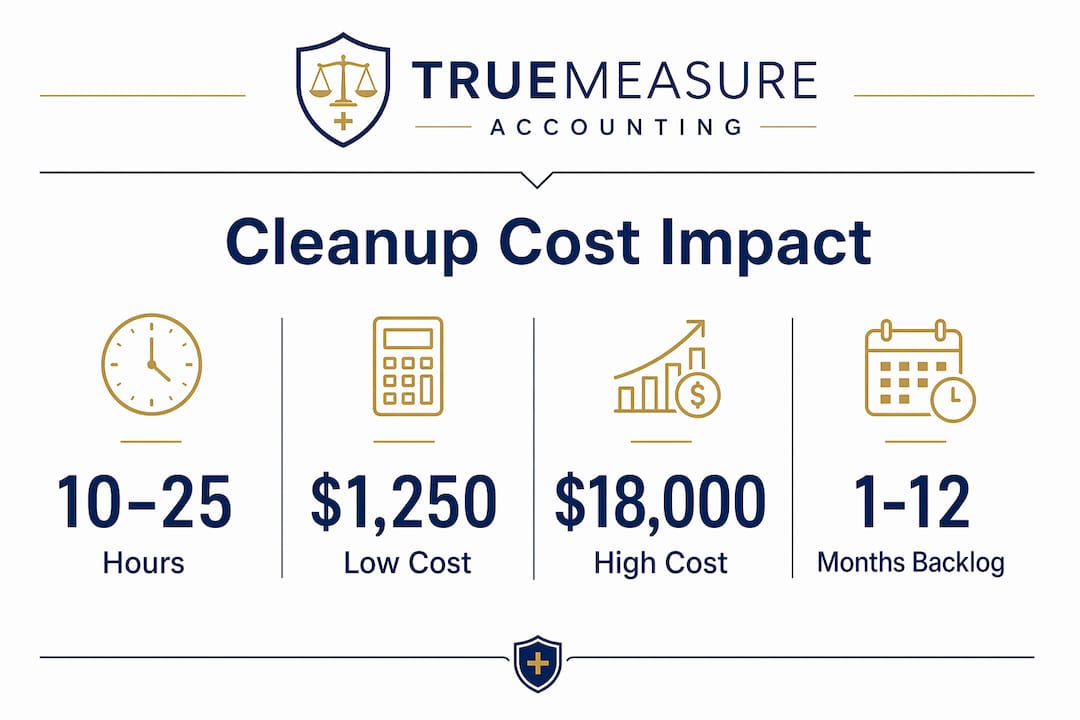
These figures assume a single entity with moderate transaction volume. HVAC companies, general contractors, and trucking businesses with multiple vehicles, job sites, or subcontractors will sit at the higher end of every range.
How disorganized records destroy your tax position
The tax cost of messy bookkeeping is often larger than the cleanup fee itself. Lack of documentation turns valid expenses into taxable income during an audit. If you cannot produce an invoice or a clear explanation for a transaction, the IRS can disallow it. That means you pay income tax on money you already spent.
The most common deductions lost to poor records include:
- Vehicle and mileage expenses with no mileage log or fuel receipts
- Subcontractor payments with no W-9 on file and no 1099 issued
- Materials and supplies purchased with personal cards and never entered into the books
- Home office and equipment deductions with no documentation of business use percentage
- Meals and entertainment with no record of the business purpose or attendees
Beyond lost deductions, messy books increase your CPA fees. When your accountant receives a disorganized file at tax time, they spend billable hours sorting transactions instead of planning strategy. That extra time comes directly out of your pocket.
Cleanup projects frequently trigger amended tax returns when the corrected books reveal that original filings were inaccurate. Amended returns cost additional CPA time, and they can attract IRS scrutiny. The documentation best practices that protect your deductions are not complicated. They just require consistency.
Sales tax and payroll tax carry their own risks. VAT-registered and sales-tax-liable businesses that incorrectly code transactions risk filing errors, penalties, and interest charges. A plumbing company that misclassifies taxable labor versus non-taxable materials can face a significant back-tax bill after a state audit.
What poor bookkeeping does to your cash flow and decisions
Inaccurate books do not just cost money at tax time. They cost money every single day you run your business on bad data. The most dangerous version of this is bank-balance accounting.
Business owners who rely on bank-balance accounting ignore outstanding checks, unpaid invoices, and upcoming obligations. The bank balance looks healthy, so they hire a new technician, buy a truck, or take on a large material order. Then payroll hits, a supplier invoice clears, and the account is suddenly short. This is not a cash flow problem. It is a data problem.
Here is how disorganized financial records create operational errors in sequence:
- Inaccurate revenue recognition causes you to believe a job was profitable when it was not, leading you to price the next similar job the same way.
- Unrecorded liabilities make your balance sheet look stronger than it is, which can lead to premature equipment purchases or expansion decisions.
- Missing accounts receivable tracking means you do not follow up on overdue invoices, and cash that should have arrived in 30 days sits uncollected for 90.
- No job costing data leaves you unable to identify which customers, service lines, or crew members are actually making you money.
- Unreliable financials make you ineligible for a bank line of credit, an SBA loan, or a favorable acquisition offer when the opportunity arrives.
The fifth point deserves emphasis. Lenders, investors, and buyers require clean, accurate financials. A contractor generating $2 million in revenue with two years of messy books cannot get a bank loan to buy a second truck. The same contractor with clean monthly financials and a clear profit and loss statement is a fundable business. The role of bookkeeping in profitability is not abstract. It determines whether you can act when opportunity shows up.
Pro Tip: Review a profit and loss statement and a balance sheet every month, not just at year-end. If your books are not clean enough to produce those reports monthly, that is the problem to fix first.
How to avoid costly bookkeeping problems before they start
Prevention costs a fraction of what cleanup costs. The goal is not perfection. The goal is consistency. Clean books are the result of small habits done regularly, not a heroic effort done once a year.
Separate personal and business finances completely
Mixing personal and business expenses is one of the most common and costly bookkeeping mistakes. Open a dedicated business checking account and a business credit card. Use them exclusively for business transactions. This single habit eliminates a large percentage of the manual sorting that drives cleanup costs up.
Reconcile accounts every month
Monthly reconciliation catches errors, duplicate charges, and missing transactions before they compound. It also gives you an accurate picture of where your business stands financially. Monthly financial reviews are the foundation of sound cash flow management.
Use accounting software consistently
QuickBooks, for example, connects directly to your bank accounts and categorizes transactions automatically. The key word is consistently. Software that is set up and then ignored for three months creates the same backlog problem as no software at all. Assign someone to review and approve categorizations weekly.
Document every transaction at the point of sale
Photograph receipts immediately using a mobile app. Record the business purpose of every meal, travel expense, or equipment purchase at the time it happens. Memory is unreliable. Documentation created six months later during a cleanup is far less credible than documentation created the same day.
Hire a bookkeeper before you think you need one
Most small business owners wait until the books are already a mess before they seek help. Regular bookkeeping attention reduces accountant hours, captures all allowable deductions, and prevents expensive cleanup fees. The monthly cost of a professional bookkeeper is almost always less than the annual cost of a cleanup project.
The table below compares the two approaches on total annual cost.
| Approach | Typical annual cost | Tax deductions captured | Lender-ready financials |
|---|---|---|---|
| Monthly bookkeeping service | $3,000–$7,200/year | Yes, consistently | Yes |
| Year-end cleanup only | $4,000–$18,000/year | Partial, at best | Rarely |
| DIY with no reconciliation | Unpredictable | Often missed | No |
The math is straightforward. Ongoing bookkeeping costs less, captures more deductions, and keeps your business ready for growth opportunities.
Key takeaways
Disorganized bookkeeping costs small businesses far more than the cleanup fee alone. It erodes tax savings, distorts cash flow decisions, and blocks access to financing.
| Point | Details |
|---|---|
| Cleanup fees are steep | One year of messy records costs $4,000–$18,000 in professional cleanup fees. |
| Lost deductions add up | Missing documentation turns legitimate business expenses into taxable income. |
| Bank-balance accounting misleads | Relying on your bank balance instead of accurate books causes premature and costly decisions. |
| Prevention beats cleanup | Monthly bookkeeping costs less annually than a single year-end cleanup project. |
| Clean books open doors | Lenders, investors, and buyers require accurate financials before they will act. |
What I have seen after 20 years on the operator side
I did not come to accounting from a classroom. I built and ran multi-million-dollar service businesses before I ever advised anyone on their books. That experience taught me something most accountants never see: the real cost of messy books is not the cleanup invoice. It is the decisions you made while flying blind.
I have watched HVAC owners hire a third technician because the bank account looked full, only to discover two months later that three large jobs were still unbilled and a supplier payment was overdue. I have seen contractors underprice entire service lines for years because their job costing was nonexistent. The profit and loss statement said they were making money. The actual job data said they were losing it on every large project.
The pattern I see most often is this: owners treat bookkeeping as a compliance task, something to hand off to a tax preparer in april. That mindset is expensive. Clean books are not a compliance tool. They are a decision-making tool. When your financials are accurate and current, you can see which customers are profitable, which jobs are bleeding margin, and where your cash is actually going.
The owners who grow consistently are the ones who treat their financial data the way a contractor treats a blueprint. You would not build a house without accurate measurements. You should not run a business without accurate numbers.
At Truemeasureaccounting, we work with owner-operators who are done guessing. The shift from reactive cleanup to proactive financial clarity is not complicated. It just requires the right system and someone who understands both the numbers and the business behind them.
— Tony
Truemeasureaccounting can help you get ahead of the cost
Disorganized records are fixable. The key is addressing them before they compound into a five-figure cleanup project and a tax filing you have to amend.
Truemeasureaccounting works with small businesses in contracting, HVAC, plumbing, trucking, real estate, and professional services to build clean, accurate books from the ground up. Whether you need a QuickBooks cleanup, ongoing monthly bookkeeping, or a full financial reporting system, the process starts with getting your numbers right. From there, every business decision you make gets sharper. Explore our small business bookkeeping services to see how we structure cleanup and ongoing support, or schedule a free consultation to talk through where your books stand today.
FAQ
How much does bookkeeping cleanup cost for a small business?
Professional bookkeeping cleanup costs between $4,000 and $18,000 for one year of disorganized records, based on hourly rates of $100–$150 and project lengths of 40–120 hours.
What tax deductions do you lose with messy books?
Missing documentation makes expenses disallowable during an audit, turning legitimate costs like vehicle mileage, subcontractor payments, and materials into taxable income.
Why is bank-balance accounting risky for small businesses?
Bank-balance accounting ignores outstanding checks, unpaid invoices, and upcoming obligations, which causes owners to make hiring and investment decisions based on inflated cash availability.
How often should a small business reconcile its accounts?
Monthly reconciliation is the standard practice. It catches errors before they compound and produces the accurate financial statements lenders and tax preparers require.
Is monthly bookkeeping cheaper than year-end cleanup?
Yes. Monthly bookkeeping typically costs $3,000–$7,200 per year, while a single year-end cleanup project for messy records can reach $18,000 or more, not counting amended tax return fees.
Recommended
- The Role of Bookkeeping in Profitability for Small Businesses
- Fixed-Price Bookkeeping vs. Hourly Services: Why $265/Month Wins – TrueMeasure Accounting LLC-Small Business Accounting Services
- Automated vs. Human Bookkeeping: Why Your Business Need Both? – TrueMeasure Accounting LLC-Small Business Accounting Services
- Digital Bookkeeping Transformation: A Complete Guide – TrueMeasure Accounting LLC-Small Business Accounting Services