
Strategic accounting is defined as a forward-looking approach to financial management that connects your numbers to real business decisions, not just tax filings. Most small business owners treat accounting as a year-end obligation. That mindset costs real money. Businesses generating between $100,000 and $10 million annually lose an average of $73,000 per year due to missed tax strategies, poor cash flow management, and reactive financial decisions. Understanding why small businesses need strategic accounting starts with recognizing that your financials are not just a record of what happened. They are a tool for deciding what happens next.
Why small businesses need strategic accounting
Strategic accounting is not bookkeeping with a fancier name. The industry term is management accounting, and it refers to the practice of using financial data to guide business strategy rather than simply report on past activity. Bookkeeping records transactions. Strategic accounting interprets them, forecasts ahead, and tells you what to do about what you find.
The gap between the two is where most small businesses bleed money. An HVAC company might show $800,000 in annual revenue and feel profitable. But without job costing and margin analysis, that owner has no idea which service calls make money and which ones eat it. A plumbing contractor might have a strong month in march and assume the business is healthy, not realizing that a cash spike is masking a margin problem that will surface in 60 days.

Management accounting has evolved from internal reporting into a forward-looking strategic partner role that supports long-term planning and decision-making. That shift matters for owner-operated businesses because the financial decisions you make today, on pricing, hiring, and equipment, determine whether you grow or stall.
What specific benefits does strategic accounting offer small businesses?
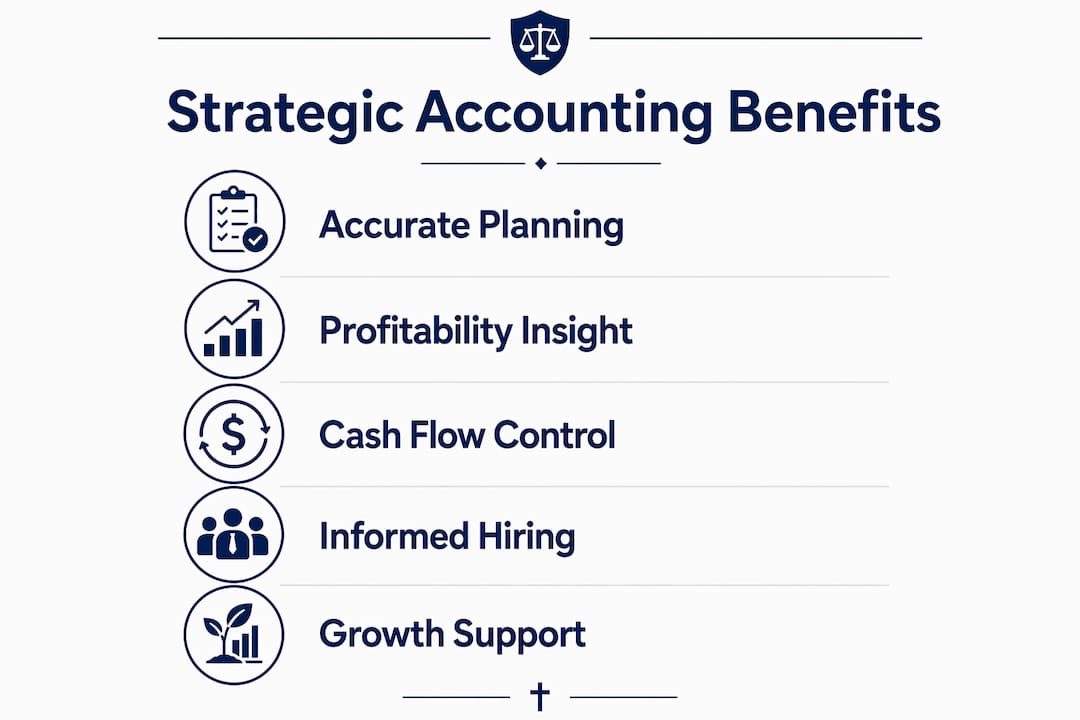
The most direct benefit is cash flow visibility. Cash flow forecasting tells you not just what is in your account today, but what will be there in 30, 60, and 90 days. For a general contractor managing multiple jobs, that visibility is the difference between making payroll and scrambling for a line of credit.
Beyond cash flow, strategic accounting delivers:
- Profitability by job, client, or service line. Job costing and margin analysis reveal which customers and projects actually make you money. Many service businesses discover that their highest-revenue clients are their least profitable ones.
- Tax planning throughout the year. Proactive tax strategy reduces liability before december arrives. Waiting until tax season means leaving deductions and timing strategies on the table.
- KPI tracking that flags problems early. Metrics like gross margin by service line, accounts receivable aging, and labor efficiency ratios give you early warning before a small issue becomes a cash crisis.
- Pricing confidence. When you know your true cost per job, you can price with confidence instead of guessing and hoping the margin works out.
- Informed hiring and expansion decisions. Adding a technician or opening a second location is a major financial commitment. Strategic accounting lets you model the impact before you sign anything.
Strategic accounting turns financial data into an executive-level support system, helping business owners plan with confidence and act with intention. That is the shift from compliance to leadership.
Pro Tip: Track gross margin by service line every month, not just total revenue. A trucking company that runs both local delivery and long-haul routes often finds one is significantly more profitable than the other. You cannot see that without the breakdown.
When should a small business move beyond basic bookkeeping?
The transition point is clearer than most owners expect. Businesses approaching $1 million in annual revenue typically need to shift from cash-basis bookkeeping to accrual accounting, cash flow forecasting, and KPI tracking. Cash-basis accounting records money when it moves. Accrual accounting records it when it is earned or owed. That difference matters enormously when you have outstanding invoices, prepaid expenses, or multi-month projects.
Here are the clearest signals that basic bookkeeping is no longer enough:
- You have multiple jobs or projects running at once. When revenue comes from several sources simultaneously, you need job-level profitability data, not just a total income figure.
- You are making hiring or equipment decisions without financial modeling. Gut-feel decisions at this revenue level carry real risk.
- Your cash balance and your profit do not seem to match. This is a classic sign of accrual accounting gaps or untracked liabilities.
- You are paying taxes reactively. If your CPA surprises you with a tax bill every april, you are not doing proactive tax planning.
- You cannot answer basic questions about your business. Questions like “which customer is most profitable?” or “what is my break-even on this job?” should have fast, data-backed answers.
Accrual accounting reflects true economic reality, preventing decisions based on temporary cash spikes that mask margin problems. A construction company that invoices $200,000 in march but has $180,000 in costs hitting in april looks healthy on a cash basis. On an accrual basis, the picture is very different.
Fractional finance models give growing companies access to bookkeeping, operational control, and CFO-level guidance at a fraction of the cost of a full-time hire. For businesses in the $500,000 to $5 million range, this model is often the most practical path to getting strategic financial support without the overhead.
Pro Tip: If you are running QuickBooks on cash basis and your revenue has crossed $750,000, ask your accountant about switching to accrual. The setup takes effort, but the clarity you gain is worth it every single month.
How does strategic accounting support better decision-making?
Strategic accounting treats cost accounting as a flexible tool. Cost allocation can be structured to support specific decisions, like evaluating a new service line, reallocating labor, or assessing whether a piece of equipment pays for itself. That flexibility is what separates a strategic accountant from a bookkeeper who records what already happened.
The table below shows how the same financial question gets answered differently depending on the accounting approach:
| Business Decision | Basic Bookkeeping Answer | Strategic Accounting Answer |
|---|---|---|
| Should I hire another technician? | “We made money last quarter.” | “Adding one tech increases fixed costs by $X. Break-even requires Y additional jobs per month.” |
| Is this client worth keeping? | “They pay on time.” | “Their jobs run 12% below average margin after labor and materials.” |
| Can we expand to a second location? | “Revenue is up this year.” | “Cash flow supports expansion in Q3 based on current receivables and projected demand.” |
| Are we pricing correctly? | “We’re competitive in the market.” | “Our current pricing covers costs but leaves only 8% net margin, below the industry target.” |
Strong CPAs bring scenario planning and disciplined financial analysis that turns uncertain strategic planning into a structured, credible process. That means you can stress-test a pricing change or a new service offering before committing real money to it.
The most underused benefit of strategic accounting is the ongoing advisory relationship. Most small business owners only talk to their accountant at tax time. That is like only checking your truck’s oil once a year. Year-round advisory helps owners navigate complex regulations and turns accounting into an executive-level asset rather than a seasonal chore. Decisions about pricing, staffing, and capital investment happen throughout the year. Your financial advisor should be part of those conversations when they happen, not 10 months later.
What practical steps should small business owners take?
Moving from basic bookkeeping to strategic financial management does not require a complete overhaul overnight. It requires a clear sequence.
- Audit your current financial data first. Clean, accurate books are the foundation. If your QuickBooks file has years of uncategorized transactions, start with a cleanup before expecting useful reports. Truemeasureaccounting offers QuickBooks cleanup as a starting point for businesses in exactly this position.
- Switch to accrual accounting if you have not already. This is non-negotiable once your revenue and project complexity reach a certain level. Work with your accountant to make the transition correctly.
- Set up monthly financial reporting. A monthly financial review covering your profit and loss, balance sheet, and cash flow statement gives you a consistent picture of business health. Monthly reporting catches problems in weeks, not quarters.
- Identify your top five KPIs. For an HVAC company, these might include average revenue per job, labor cost as a percentage of revenue, gross margin by service type, accounts receivable aging, and monthly cash flow. Pick metrics that connect directly to decisions you make.
- Partner with a financial advisor who understands your industry. A CPA who specializes in service businesses thinks differently than one who primarily serves retail or manufacturing clients. Successful owner-operated businesses treat their accounting teams as leadership extensions, using them as financial sounding boards to stress-test pricing and hiring decisions.
- Use a fractional CFO model if a full-time hire is not feasible. This gives you strategic financial guidance, cash flow forecasting, and profitability analysis without the $150,000-plus annual salary of a full-time CFO.
The goal is not to become an accountant. The goal is to make better decisions faster, with financial data you can actually trust.
Key Takeaways
Small businesses that treat accounting as a strategic management tool, not just a compliance requirement, consistently make better decisions, protect cash flow, and grow with less financial risk.
| Point | Details |
|---|---|
| Strategic accounting vs. bookkeeping | Bookkeeping records transactions; strategic accounting interprets them and guides decisions. |
| The $1M revenue threshold | Businesses near $1 million in revenue need accrual accounting, KPI tracking, and cash flow forecasting. |
| Job costing reveals true profit | Margin analysis by job or client exposes hidden losses that top-line revenue numbers conceal. |
| Year-round advisory matters | Talking to your accountant only at tax time means missing decisions that happen all year long. |
| Fractional CFO is a practical option | Growing businesses can access CFO-level guidance without the cost of a full-time hire. |
What I’ve learned from 20 years of running service businesses
Most small business owners I talk to think they have an accounting problem when they actually have a visibility problem. They are not missing information because they are bad at business. They are missing it because nobody set up their financial systems to answer the questions that actually matter.
I built and operated multi-million-dollar service businesses before I ever worked in accounting. What I saw repeatedly was this: the businesses that grew confidently were not necessarily the ones with the most revenue. They were the ones where the owner knew their numbers cold. They knew which jobs made money. They knew when cash would be tight. They made pricing decisions based on data, not instinct.
The HVAC and plumbing contractors I work with now often come in thinking they are profitable because their bank account looks okay. Then we run job costing and find that two or three service lines are dragging the whole business down. That discovery does not require a complicated financial model. It requires clean books, the right categories, and someone who knows what to look for.
My honest recommendation: do not wait until you are in a cash crisis to get serious about your financials. The businesses that call me when things are already bad have far fewer options than the ones that build good financial systems while things are going well. Proactive financial management is not a luxury for bigger companies. It is the reason some small businesses become bigger companies and others stay stuck.
— Tony
How Truemeasureaccounting helps you build a stronger financial foundation
Running a service business is hard enough without trying to figure out your financials alone. Truemeasureaccounting works with owner-operated businesses generating $250,000 to $5 million annually, providing the financial clarity and guidance that most small businesses never get from a traditional bookkeeper.
From monthly bookkeeping and financial reporting to fractional CFO advisory, Truemeasureaccounting connects your numbers to the decisions that actually move your business forward. Whether you need a QuickBooks cleanup, a proactive tax planning strategy, or job-level profitability analysis, the firm brings 20-plus years of real business operating experience to every engagement. Schedule a free consultation at truemeasureaccounting.com/free-consultation and find out exactly where your financials stand.
FAQ
What is strategic accounting for small businesses?
Strategic accounting is the practice of using financial data to guide business decisions, not just record transactions. It includes cash flow forecasting, KPI tracking, profitability analysis, and proactive tax planning.
When does a small business need more than basic bookkeeping?
Businesses approaching $1 million in annual revenue typically need accrual accounting, job costing, and cash flow forecasting to avoid operational blind spots and make informed decisions.
How does strategic accounting improve profitability?
Job costing and margin analysis reveal which clients, jobs, or service lines are actually profitable. Many service businesses find that their busiest work is not their most profitable work.
Do small businesses need accounting services year-round?
Year-round advisory is far more valuable than annual tax-time consultations. Business decisions on pricing, hiring, and expansion happen throughout the year and require current financial data to make well.
What is a fractional CFO and does my business need one?
A fractional CFO provides CFO-level financial guidance on a part-time basis, giving growing businesses access to scenario planning, cash flow management, and financial strategy without the cost of a full-time executive hire.