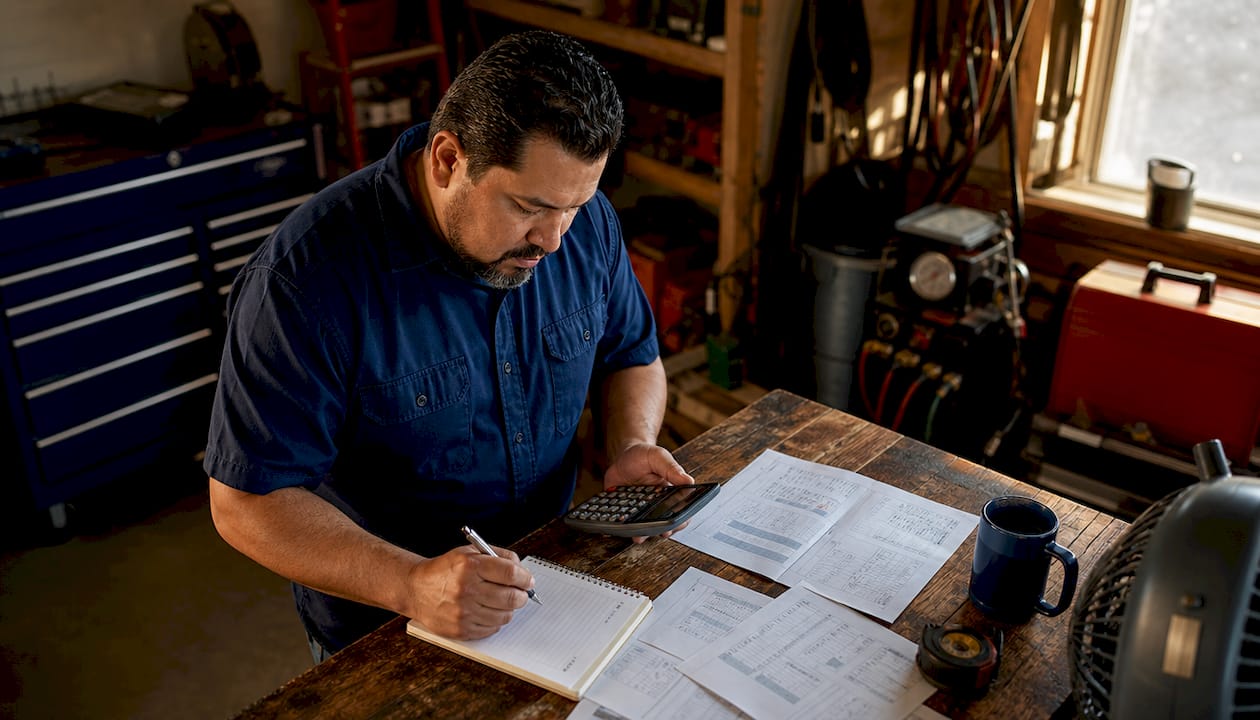
Owner underpayment is defined as the practice of a business owner paying themselves less than the fair market value of their labor, often to the point of financial self-harm. This is one of the most common and least discussed reasons why small businesses underpay themselves into fragility. Poor cash flow management drives most small business failures, with 2,700 businesses closing every day not because they lacked revenue, but because they ran out of cash. That number tells you the problem is structural, not situational. The IRS compounds the risk: S-Corp owners who skip a reasonable salary face 15.3% FICA tax reclassification plus penalties that can reach 20% of unpaid amounts. Underpaying yourself does not protect your business. It quietly destabilizes it.
Why small businesses underpay themselves: the cash flow trap
The most common reason owners skip or minimize their pay is a misreading of cash flow. Profit on a profit and loss statement is not the same as cash in the bank. A business can show $80,000 in net income for the quarter while the owner struggles to cover payroll because three large clients are 45 days past due on invoices.
Managing pay by bank balance instead of actual financial statements is one of the most damaging habits in small business finance. When the bank account looks thin, the owner skips their draw. When it looks healthy, they take a little extra. This is “financial vibes” replacing a real payroll plan, and it produces erratic, insufficient compensation over time.
Several cash flow mechanics make this worse:
- Prepaid expenses pull cash out before the expense shows on the P&L, making the business look more profitable than it feels.
- Working capital requirements grow as the business grows, meaning more revenue often means less available cash in the short term.
- Late-paying clients create a gap between earned revenue and collected cash that can last weeks or months.
- Seasonal revenue swings cause owners to underpay during slow periods and forget to normalize pay during strong ones.
Pro Tip: Set your owner pay as a fixed monthly transfer on a scheduled date, just like rent. Treat it as a non-negotiable operating expense, not a reward for a good month.
The connection to business failure is direct. When owners have no consistent pay structure, they have no baseline to measure whether the business is actually viable. A business that cannot afford to pay its owner a market-rate salary is not profitable. It is subsidized by unpaid labor, and that subsidy has a ceiling.
What psychology drives underpaid entrepreneurs to stay stuck?
Fear is the primary driver of small business salary issues, and it operates in ways most owners do not recognize. The most common fear is what financial advisors call the “permanence problem.” Committing to a real salary feels like locking in an obligation the business might not be able to meet next month. So owners stay in survival mode indefinitely, treating their pay as optional.
Avoiding a real salary is often rooted in fear of permanence and survival mode. Owners frame underpayment as a sacrificial commitment to the business, but that framing is a defensive story, not a financial strategy. The business does not benefit from the owner’s sacrifice. It simply becomes dependent on it.
This mindset produces a specific set of behaviors that compound the problem:
- Owners delay pay reviews for months or years, allowing the gap between their draw and market value to widen.
- They frame low pay as discipline or dedication, which makes it harder to change without feeling like they are abandoning their values.
- They avoid looking at their own compensation relative to what they would pay a hired manager doing the same job.
- They make short-term decisions, cutting expenses or chasing quick revenue, instead of addressing the underlying pay structure.
Financial strain reduces cognitive bandwidth, pushing owners toward reactive decisions rather than strategic ones. This is not a character flaw. It is a documented effect of scarcity on decision-making. When you are worried about making payroll, you cannot think clearly about pricing strategy or long-term growth.
The signal this sends to the team is also damaging. When employees see an owner who cannot pay themselves, they read it as a sign of instability. Retention suffers. Hiring becomes harder. Small businesses slow to adjust initial low wages create persistent pay gaps that affect both staff and the owner, reinforcing a culture where underpayment feels normal.
Pro Tip: Calculate what you would pay a qualified outside hire to do your job. That number is your minimum salary target. If the business cannot support it, that is a pricing problem, not a cash flow problem.
The emotional toll is real and cumulative. Owners who underpay themselves for years report higher rates of burnout, resentment toward the business, and difficulty making clear decisions. The business suffers because the owner suffers. These are not separate problems.
What are the IRS rules on owner compensation in 2026?
The IRS requires S-Corp owners who perform services for the business to pay themselves a reasonable salary before taking distributions. “Reasonable” is not a number you choose. It is defined by a multi-factor test that compares your compensation to what similar businesses pay for similar work in your market.
The factors the IRS examines include the owner’s qualifications, the nature and scope of the work performed, the size and complexity of the business, and comparable salaries in the industry. No single factor controls the outcome. The IRS looks at the full picture, and so should you.
The tax risks of getting this wrong are significant:
- FICA reclassification. If the IRS determines your salary is unreasonably low, it can reclassify distributions as wages. You then owe 15.3% in FICA taxes on the reclassified amount.
- Accuracy penalties. The IRS can add accuracy-related penalties of up to 20% of the underpaid tax.
- Failure-to-deposit penalties. These range from 2% to 15% of the unpaid payroll tax, depending on how late the deposit is.
- Accrued interest. Interest runs from the original due date of the tax, compounding the total cost of the error.
The informal “60/40 rule,” where owners pay 60% of their total take as salary and 40% as distributions, is a myth. The IRS does not recognize this ratio as a safe harbor. Using it without market-rate documentation exposes you to full reclassification risk.
| Compensation approach | IRS risk level | Documentation needed |
|---|---|---|
| Token salary with large distributions | High | Market salary analysis required |
| Salary based on 60/40 rule | High | No formal IRS recognition |
| Market-rate salary with distributions | Low | Industry comp data, job description |
| No salary, distributions only | Very high | Immediate reclassification risk |
Documenting your salary decision is the best defense. Keep records of industry salary surveys, a written job description for your role, and the rationale for your compensation amount. Truemeasureaccounting works with owners to build this documentation as part of its tax planning services, so the number is defensible before an audit ever happens.
How low owner pay hides broken pricing and margin problems
Underpayment hides structural pricing failures. If a business cannot pay the owner a market-rate salary, the pricing model is almost certainly wrong. The owner’s labor is a real cost. When it is not priced in, the business appears more profitable than it actually is.

Consider an HVAC contractor billing $1.2 million annually. The owner works 50 hours a week managing jobs, handling customer calls, and running the back office. If that owner pays themselves $40,000 a year but would need to pay a replacement manager $120,000, the business has an $80,000 annual cost that is invisible in the financials. Every job is underpriced by that margin.
Owner labor cost must be part of pricing to avoid building a fragile business model. A business that only works because the owner works for free is not a business. It is a job with overhead.
The indicators that growth is subsidized by unpaid owner labor include:
- Gross margins that look healthy but leave nothing after owner draw
- Revenue growing while the owner’s personal income stays flat
- Inability to hire a manager without the business going negative
- Pricing that was set years ago and never adjusted for owner compensation
Pro Tip: Run a “replacement cost test” on your pricing. Add your full market-rate salary to your operating expenses and recalculate your margins. If the business goes negative, your prices need to increase before anything else changes.
Many small businesses fail not because of rising labor costs themselves but because those costs expose fragile operational systems. The same is true for owner pay. When you finally try to pay yourself properly, the business model breaks. That is the signal to fix pricing, not to keep deferring your salary.
Transparent pricing that accounts for all costs, including owner compensation, is the only model that produces a sustainable business. Anything else is a slow drain on the owner’s personal finances and long-term health.
How to fix the cycle: practical steps for sustainable owner pay
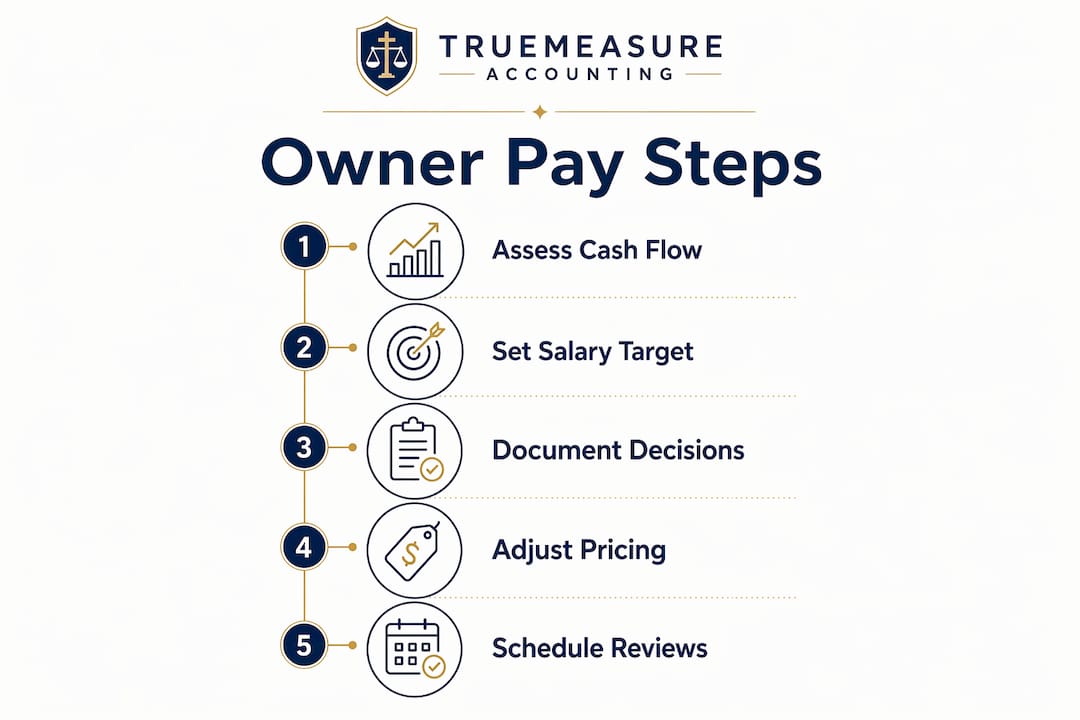
Breaking the underpayment cycle requires accurate financial data first, then a structured approach to setting and protecting owner compensation. These steps work for HVAC companies, plumbing contractors, general contractors, trucking businesses, and any owner-operated service firm.
- Get accurate monthly financials. You cannot make good pay decisions without clean books. Monthly financial statements give you the real picture of profitability and cash position, not a guess based on your bank balance.
- Build a 13-week cash flow forecast. Map out your expected cash inflows and outflows for the next 13 weeks. This shows you exactly when cash will be available and lets you schedule owner pay with confidence instead of anxiety.
- Calculate your market-rate salary. Research what a qualified manager in your role earns in your market. Use that number as your salary target. Start there and build toward it if the business cannot support it immediately.
- Review and adjust your pricing. Use your full cost structure, including your market-rate salary, to recalculate job costs and service prices. If prices need to increase, build a plan to implement that over the next 90 days.
- Set owner pay as a fixed payroll line. Schedule your salary as a recurring payroll entry, not a discretionary draw. This creates accountability and makes the business’s true profitability visible.
- Seek expert financial guidance. A fractional CFO or strategic accountant can help you set a defensible salary, build a cash flow plan, and identify where pricing or margin issues are hiding.
Pro Tip: If you cannot afford your full market-rate salary today, set a written schedule to reach it within 12 months. Document each increase. This shows the IRS a good-faith effort and gives you a clear financial goal to work toward.
Accurate bookkeeping enables sound salary decisions and sustainable pricing models. Without it, every pay decision is a guess, and guesses compound into years of underpayment.
Key takeaways
Small businesses underpay their owners primarily because of cash flow misreading, fear-driven avoidance, IRS misunderstanding, and pricing models that exclude owner labor as a real cost.
| Point | Details |
|---|---|
| Cash flow confusion drives underpayment | Profit on paper does not equal cash available; manage pay from financial statements, not bank balance. |
| Fear keeps owners stuck | Scarcity mindset and fear of permanence cause owners to frame underpayment as sacrifice rather than a structural problem. |
| IRS requires a reasonable salary | S-Corp owners who skip a market-rate salary risk 15.3% FICA reclassification plus penalties up to 20%. |
| Low owner pay masks pricing failures | If the business cannot fund a market-rate owner salary, the pricing model is broken, not the cash flow. |
| Fix starts with accurate financials | Monthly bookkeeping, cash flow forecasting, and a fixed payroll schedule are the foundation for sustainable owner pay. |
What I’ve learned from watching owners underpay themselves for years
I have worked with dozens of owner-operated businesses across HVAC, plumbing, construction, and trucking. The pattern is almost always the same. The owner is the hardest-working person in the company, and they are the last one to get paid. They tell themselves it is temporary. It rarely is.
What I have found is that the owners who finally commit to paying themselves properly do not hurt their businesses. They clarify them. When you put a real salary on the books, you force the business to be honest about whether it is actually profitable. That honesty is uncomfortable at first. But it is the only way to build something that lasts.
The emotional cost of prolonged underpayment is something most financial articles skip over. I have seen owners who have run successful businesses for a decade and still feel financial anxiety every month because they never built a stable personal income from the company. That anxiety bleeds into every decision they make. It makes them risk-averse when they should be growing, and reactive when they should be planning.
The owners who break this cycle share one thing in common. They stopped treating their pay as the last priority and started treating it as a measure of business health. If the business cannot pay you, the business has a problem that needs to be solved, not deferred.
— Tony
How Truemeasureaccounting helps you get paid what you deserve
If you have been running your business for years without a consistent, market-rate salary, you are not alone. And the fix is more straightforward than most owners expect.
Truemeasureaccounting works with owner-operated businesses generating $250,000 to $5 million annually to build the financial clarity that makes fair owner pay possible. Our small business bookkeeping services give you accurate monthly financials, cash flow visibility, and the data you need to set a defensible, sustainable salary. We also help you align your pricing with your real cost structure, so the business funds your income instead of consuming it. Schedule a consultation and find out exactly what your business should be paying you.
FAQ
Why do small business owners underpay themselves?
Small business owners underpay themselves primarily because of cash flow misreading, fear of financial permanence, and pricing models that exclude owner labor as a cost. Financial strain reduces decision quality, pushing owners toward reactive choices rather than structured pay planning.
What is a reasonable salary for an S-Corp owner?
A reasonable salary is defined by the IRS as what a comparable business would pay for similar services in the same market. It is determined by a multi-factor test, not a fixed ratio, and must be documented with industry compensation data.
What happens if an S-Corp owner pays themselves too little?
The IRS can reclassify distributions as wages, triggering 15.3% FICA taxes plus accuracy penalties up to 20% and failure-to-deposit penalties ranging from 2% to 15%. Interest accrues from the original due date of the unpaid tax.
How does underpaying yourself affect business growth?
Underpaying yourself masks broken pricing, reduces your cognitive capacity for strategic decisions, and signals financial instability to employees and stakeholders. A business that cannot fund a market-rate owner salary is not yet sustainably profitable.
How do I calculate what to pay myself as a small business owner?
Start with the market rate for a qualified manager performing your role in your region. Add that number to your operating expenses and recalculate your margins. If the business cannot support it, that gap reveals a pricing problem that must be addressed before sustainable growth is possible.