
Your realized gain on the relinquished property is tax-deferred unless you receive boot, and your replacement property’s basis carries over from the old asset rather than resetting to the new purchase price. File Form 8824 for the tax year you transferred the relinquished property. Confirm your Qualified Intermediary is under contract before closing, and keep every settlement statement. Miss either step and you risk losing the deferral your CPA promised you.
TL;DR:
- Investors must file Form 8824 in the year of relinquished property transfer and keep all documents to avoid losing tax deferral benefits.
- Proper bookkeeping involves removing the old asset, recording proceeds at the Qualified Intermediary, and adjusting basis through a precise sequence to prevent phantom gains.
- Recognized gain is limited to the lesser of realized gain or boot received, with cash, mortgage, and non-like-kind assets all potentially triggering taxable income.
- Basis carryover continues on a split depreciation schedule, requiring separate ledger subaccounts for accurate IRS proof and future depreciation calculations.
- Missed deadlines, incomplete identification letters, commingling funds, or related-party sales within two years can trigger costly audit issues and retroactive gain recognition.
Table of Contents
- What Are the Journal Entries for a 1031 Exchange?
- How Does Boot Trigger Recognized Gain?
- How Do You Calculate Basis Carryover and Depreciation?
- What Goes on Form 8824 and How Do You Reconcile It?
- What Are the 45-Day and 180-Day Deadlines?
- What Mistakes Trigger Audit Attention?
- How Do Related-Party Rules Change the Accounting?
- How Do You Account for a Reverse 1031 Exchange?
- How Do You Handle Multiple Properties in One Exchange?
- What Happens With Partial Exchanges and Multiple Boot Types?
- When Should You Bring in a Fractional CFO for an Exchange?
- How TrueMeasure Accounting Supports Your 1031 Exchange Bookkeeping
- Sources
What Are the Journal Entries for a 1031 Exchange?
A 1031 exchange runs through three bookkeeping moments: the relinquished sale, the holding period with your Qualified Intermediary (QI), and the replacement purchase. Get the sequence wrong and your balance sheet will show a phantom gain that doesn’t exist for tax purposes.
At the sale of the relinquished property, you need four moves happening simultaneously:
- Remove the property asset from the books at its original cost.
- Clear out accumulated depreciation tied to that asset.
- Record the net sale proceeds as an asset held by the QI, not as cash in your operating account.
- Book a deferred gain liability for the difference between what you’d normally recognize and what qualifies for deferral under Treas. Reg. §1.1031(k)-1-1).
Any existing mortgage gets paid off directly from QI-held funds at closing, and selling costs (commissions, escrow fees) reduce the net proceeds landing in that QI account. When the replacement property closes, you record the purchase at its full contract price, then reduce the recorded asset value by the deferred gain and clear both the deferred gain liability and the QI holding account. This exact sequence, removing the old asset, holding proceeds at the QI, then adjusting the new asset’s basis downward, mirrors the standard practitioner pattern used across 1031 exchange accounting workflows.
Here’s a simplified numeric walkthrough for a property sold at $500,000 with $150,000 in accumulated depreciation and a deferred gain:
Your books never show the $50,000 as income. It rides silently into the new asset’s basis, which is exactly the point of accounting for real estate exchanges done correctly.
How Does Boot Trigger Recognized Gain?
Realized gain is the full economic profit on the sale: sale price minus adjusted basis. Recognized gain is the portion of that profit you actually pay tax on this year, and it’s limited to the lesser of realized gain or the boot you received.
Boot shows up in three common forms:
- Cash boot — you pocket leftover exchange funds instead of reinvesting all of them.
- Mortgage boot — your replacement property carries less debt than the relinquished one, calculated as debt relieved minus debt assumed, per the modeling framework used to project boot and basis outcomes.
- Non-like-kind property boot — you receive personal property, furniture, or other assets that don’t qualify as real property in the exchange.
Quick example: you realize a $200,000 gain but receive $30,000 in cash boot at closing. You recognize $30,000 as taxable gain this year and defer the remaining $170,000. That $30,000 gets journaled out of the deferred gain liability account into a recognized gain account, which flows to your current-year income statement and creates a matching tax liability entry. Many investors intentionally size replacement financing to match or exceed relinquished debt specifically to avoid triggering mortgage boot they didn’t plan for.
How Do You Calculate Basis Carryover and Depreciation?
Replacement basis equals the purchase price of the new property minus the deferred gain. That figure then splits into two pieces for depreciation purposes, and this is where most bookkeepers make errors that surface years later.
- Carryover basis — the portion equal to your old adjusted basis, which continues depreciating on the remaining life of the original schedule.
- Excess basis — any additional amount you paid above the carryover basis, which starts a fresh depreciation schedule using the new recovery period.
If your relinquished property had $300,000 of carryover basis with 12 years left on a 27.5-year schedule, and you paid an extra $150,000 for the replacement, you’re now running two parallel schedules on one asset. The $300,000 keeps depreciating over the remaining 12 years; the $150,000 starts its own 27.5-year (or applicable) clock.
Pro Tip: Set up separate general ledger subaccounts for carryover basis and excess basis under each replacement property from day one. Trying to reconstruct the split two years later, after your depreciation software has already lumped everything into one asset, is one of the more expensive cleanup projects we see in real estate accounting setups.
This structure isn’t optional bookkeeping preference. It’s what lets you prove your basis to the IRS if the exchange is ever questioned.
What Goes on Form 8824 and How Do You Reconcile It?
Form 8824 gets filed for the tax year you transferred the relinquished property, regardless of when the replacement closing happened (as long as it falls within the 180-day window). The form calculates realized gain, recognized gain from boot, and your new replacement basis, per IRS instructions for Form 8824.
- Reconcile your GL’s recorded sale price and adjusted basis to the figures on Form 8824’s realized gain calculation.
- Match your recognized gain journal entry (from boot) to the recognized gain line on the form.
- Confirm your new replacement basis in the fixed asset ledger equals the basis Form 8824 calculates.
- File within 30 days of exchange closing rather than waiting until tax season, since reconciliation errors here are a frequent source of audit adjustments.
Keep your QI settlement statements, the exchange agreement, written identification letters, and both closing statements together. You’ll need all of them if a reviewer asks how you arrived at these numbers.
What Are the 45-Day and 180-Day Deadlines?
The 45-day identification clock and the 180-day closing clock both start on the day you close the relinquished property sale, not when you sign the exchange agreement. Miss either deadline and the entire exchange collapses into a taxable sale, per IRS guidance on like-kind exchanges.
Before you sell, line up your QI agreement, confirm the funds will be properly segregated, and pull your current depreciation and basis figures so you know your numbers before the clock starts running.
- Sign the QI agreement before the relinquished sale closes, never after.
- Have your CPA confirm the adjusted basis and any suspended passive losses in advance.
- Get preliminary payoff figures from your lender so mortgage boot risk is known early.
At closing, reconcile the QI’s final settlement statement against your books immediately, update mortgage and liability accounts the same week, and post the basis-adjustment entry before you close the books for that period.
Pro Tip: Treat the 45-day window as an active identification pipeline, not a deadline you’re racing toward. Identify three to four backup properties in writing on day one, so a financing hiccup on your top choice doesn’t blow the entire exchange.
What Mistakes Trigger Audit Attention?
The most expensive mistakes happen quietly and surface months later. Failing to reduce the replacement asset’s basis by the deferred gain is the most common one we see, followed closely by improperly removing (or forgetting to remove) accumulated depreciation from the relinquished asset.
- Commingling exchange proceeds with operating cash, even briefly, can jeopardize the entire deferral.
- Missing or incomplete written identification letters within the 45-day window is a hard deadline failure, not a paperwork nuance.
- Inconsistent vesting or title between the relinquished and replacement property raises questions during review.
- Skipping immediate GL-to-8824 reconciliation lets small errors compound across multiple depreciation cycles.
Build a dedicated 1031 Exchange Binder for every transaction: exchange agreement, QI written confirmations, identification letters, both closing statements, and your basis reconciliation worksheet. This is exactly the kind of gap we flag when cleaning up common real estate bookkeeping mistakes for new clients.
How Do Related-Party Rules Change the Accounting?
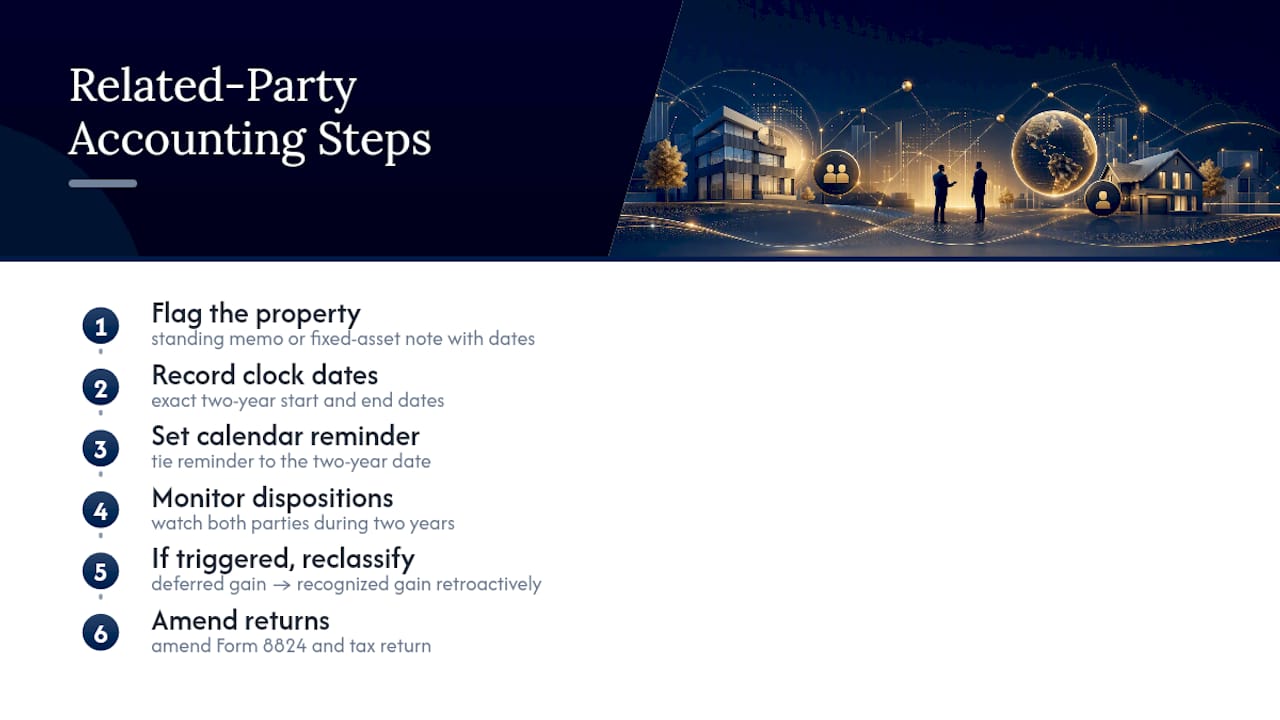
Exchanging with a related party (a family member, or an entity you control) doesn’t disqualify the exchange, but it adds a two-year holding requirement that your books need to track independently. If either party disposes of their respective property within two years of the exchange, the deferred gain gets triggered retroactively for both sides, according to practitioner guidance from the American Bar Association.
From an accounting standpoint, this means you can’t simply post the deferred gain liability and close the books. You need a standing memo entry, or a note field in your fixed asset system, flagging the property as subject to the two-year related-party clock, with the exact date the clock started and ends.
Set a calendar reminder tied to that two-year date, not just a note in the file. If the related party sells early and triggers the gain, you’ll need to reclassify the deferred gain to recognized gain retroactively, which means amending the original Form 8824 and potentially the tax return for that year. This is one of the few 1031 exchange requirements where the accounting risk sits dormant for years before it surfaces, and it catches investors off guard specifically because the exchange itself looked completely clean at closing.
Related-party exchanges between entities under common control (say, two LLCs you own) get scrutinized even harder, since the IRS looks past the entity structure to the underlying ownership. If you’re structuring any exchange involving family members or commonly controlled entities, get the related-party analysis done before you sign the exchange agreement, not after.
How Do You Account for a Reverse 1031 Exchange?
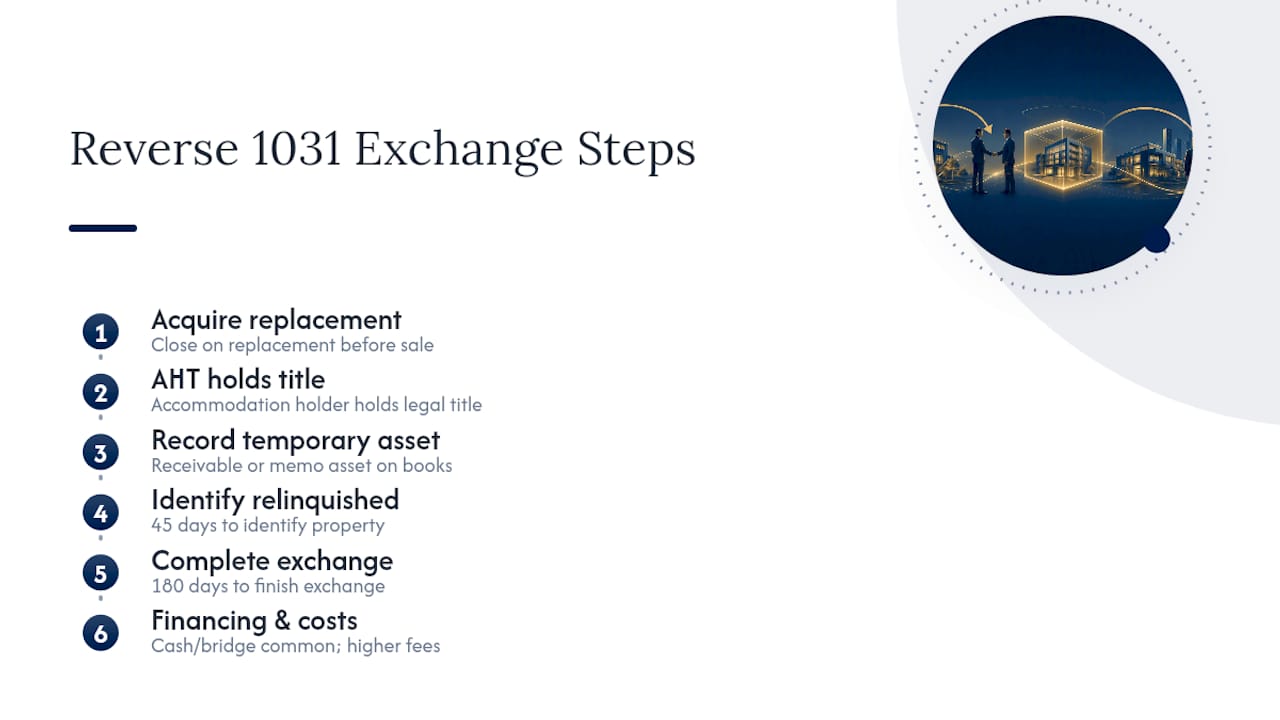
A reverse exchange flips the normal sequence: you close on the replacement property before you sell the relinquished one, which means your QI (or an exchange accommodation titleholder) holds title to the replacement property temporarily while you find a buyer for the old asset.
The accounting gets more complex because you’re now tracking an asset your books don’t technically own yet during the parking period. The exchange accommodation titleholder holds legal title, but for financial reporting purposes you typically record the arrangement as a receivable or a memo asset, depending on how your CPA structures the entity holding title. You still have 45 days to identify which property you’re relinquishing and 180 days total to complete the full exchange, same deadlines, just run in reverse order.
Financing is usually the real obstacle here, since most lenders won’t finance a property held by an accommodation titleholder the same way they’d finance a direct purchase, which is why reverse exchanges often involve all cash or bridge financing on the replacement side. Once the relinquished property sells and the exchange completes, the accounting collapses back into the same standard entries: remove the old asset, clear its depreciation, and adjust the replacement property’s basis by the deferred gain, exactly as in a standard exchange for accounting purposes.
Reverse exchanges cost more to run (accommodation titleholder fees, extra legal work) and carry tighter deadline pressure since you’re often under financing stress from day one. If your business model depends on being able to move fast on acquisitions before a sale is lined up, talk to your CPA about the reverse structure well before you need it, not while you’re already under contract on the replacement.
How Do You Handle Multiple Properties in One Exchange?
You can relinquish multiple properties into one replacement, or sell one property and acquire several replacements, and the accounting treats this as one exchange with aggregated numbers rather than several separate transactions.
When you’re relinquishing multiple properties, each one still needs its own removal entry, its own accumulated depreciation cleared, and its own adjusted basis calculated. But the proceeds pool together in a single QI holding account, and the deferred gain calculation happens on the combined realized gain across all relinquished properties, not property by property.
The identification rules get more complicated with multiple replacements. The IRS caps how many properties you can identify within the 45-day window under the standard “three property rule,” though alternate rules apply if you identify more properties, and your CPA needs to confirm which rule your acquisition strategy falls under before you submit identification letters.
For basis allocation across multiple replacement properties, you’ll need to allocate the total deferred gain proportionally, typically based on relative fair market value of each replacement asset, unless your exchange agreement specifies otherwise. This means your fixed asset ledger needs a clear allocation worksheet showing how the aggregate deferred gain got split across each new property’s basis. Skipping this step is one of the fastest ways to lose track of which portion of basis belongs to which asset, especially two or three years down the road when you’re trying to calculate depreciation or plan a future sale.
What Happens With Partial Exchanges and Multiple Boot Types?
A partial exchange happens when you don’t reinvest all your net proceeds, and it almost always creates boot in more than one form simultaneously. This is where the accounting gets genuinely tricky, because you’re not just calculating one boot number, you’re stacking cash boot and mortgage boot together and recognizing gain up to the total.
Say you sell a property for $800,000 with a $200,000 mortgage payoff and $100,000 of accumulated depreciation, then buy a replacement for $650,000 with only $150,000 in new debt. You’ve got $50,000 of mortgage boot (debt relieved exceeds debt assumed) plus roughly $150,000 of cash boot sitting unreinvested. Both amounts stack toward your total recognized gain, capped at your realized gain, exactly per the boot calculation framework most exchange practitioners use.
Your journal entries need to reflect both boot types separately, even though they combine into one recognized gain figure. Tag each boot component in your working papers, cash boot as unreinvested proceeds and mortgage boot as the debt reduction differential, so if the IRS ever asks how you arrived at the recognized gain number, you can show your math component by component rather than a single unexplained figure.
When Should You Bring in a Fractional CFO for an Exchange?
Straightforward single-property exchanges are often manageable with solid bookkeeping alone. Bring in fractional CFO support once you’re layering serial exchanges, complex acquisition financing, or partnership K-1 allocations, since a misstep there compounds across every future return. We build exchange accounting directly into your cash flow forecast and tax strategy, not as an isolated event.
— Tony
How TrueMeasure Accounting Supports Your 1031 Exchange Bookkeeping
Some firms offer alternatives to piecing this together yourself or hoping your bookkeeper catches the basis adjustment before year end. Basis tracking, dual depreciation schedules, coordination with a Qualified Intermediary, and Form 8824 preparation can be managed as one connected workflow instead of four disconnected tasks nobody owns.
Before a consult, gather your closing statements from the relinquished sale, your QI’s final settlement statement, any identification letters, and your current depreciation schedule. We typically start by reconciling those documents against your general ledger, then set up the carryover and excess basis subaccounts so future depreciation and any eventual sale calculate correctly without a reconstruction project. This is the same discipline behind our broader bookkeeping services, applied specifically to exchange transactions where one missed entry can mean paying tax you didn’t owe. If you’re planning an exchange this year or cleaning up one that already closed, reach out through our contact page and we’ll walk through what your books need before your CPA files.
This article is general information, not a substitute for advice from a qualified financial advisor. Consult a qualified financial professional about your own circumstances before acting on anything here.
Sources
- Form 8824 – Like-Kind Exchanges (IRS)
- How to record 1031 exchange journal entry? – Deferred
- Modeling the 1031: Boot, Basis Carryover, and Deferred Gain | Apers