
Separate books for each investment property are the single most effective way to protect your personal assets, simplify your taxes, and know exactly which properties are making you money. The practice of maintaining distinct financial records per entity or property is called entity-level bookkeeping, and the IRS, courts, and lenders all expect it. Investors who commingle personal and rental funds face three compounding problems: weakened legal protection, messy tax filings, and zero visibility into individual property performance. If you own more than one rental or hold properties inside LLCs, understanding why real estate investors need separate books is not optional. It is the foundation of a professional investment operation.
Why real estate investors need separate books: legal liability protection
Separate books prevent a legal outcome called piercing the corporate veil. This happens when a court decides your LLC is not truly separate from you as an individual, which means creditors can come after your personal assets. Courts look for evidence that each entity operates independently, and commingled funds weaken that defense directly.
The standard courts apply is operational separateness. That means each LLC or property must have its own bank account, its own set of financial records, and its own paper trail. Paying a contractor for one property out of an account that also receives rent from another property is exactly the kind of mixing that creates legal exposure. One lawsuit against a single property can become a claim against your entire portfolio if your records do not show clear separation.
The good news is that the fix is straightforward. Separate bank accounts and accounting records per LLC or property demonstrate that each entity functions on its own. That demonstration is what courts look for when evaluating whether your liability protection holds.
Here are the core practices that strengthen your legal position:
- Open a dedicated checking account for each LLC or property before the first rent check arrives.
- Never pay personal expenses from a property account, even temporarily.
- Record every transaction in the correct entity’s books at the time it occurs.
- Keep separate credit cards for each entity to avoid cross-contamination of expenses.
- Document any transfers between entities as formal loans or capital contributions with written records.
Pro Tip: If you hold multiple properties under a single LLC, use class tracking in your accounting software to assign every transaction to a specific property. This gives you entity-level separation in your records even without multiple legal entities.
The risk of skipping this discipline is not theoretical. Investors lose liability protection every year because they treated their LLC bank account like a personal wallet. The legal cost of losing that protection far exceeds the time it takes to set up clean books from the start.
How separate books simplify tax reporting for investors
The IRS recommends keeping business and personal accounts separate to make tax record-keeping easier and reduce errors. For real estate investors, this recommendation carries real weight because rental income and expenses flow through IRS Schedule E, and every property gets its own column on that form.
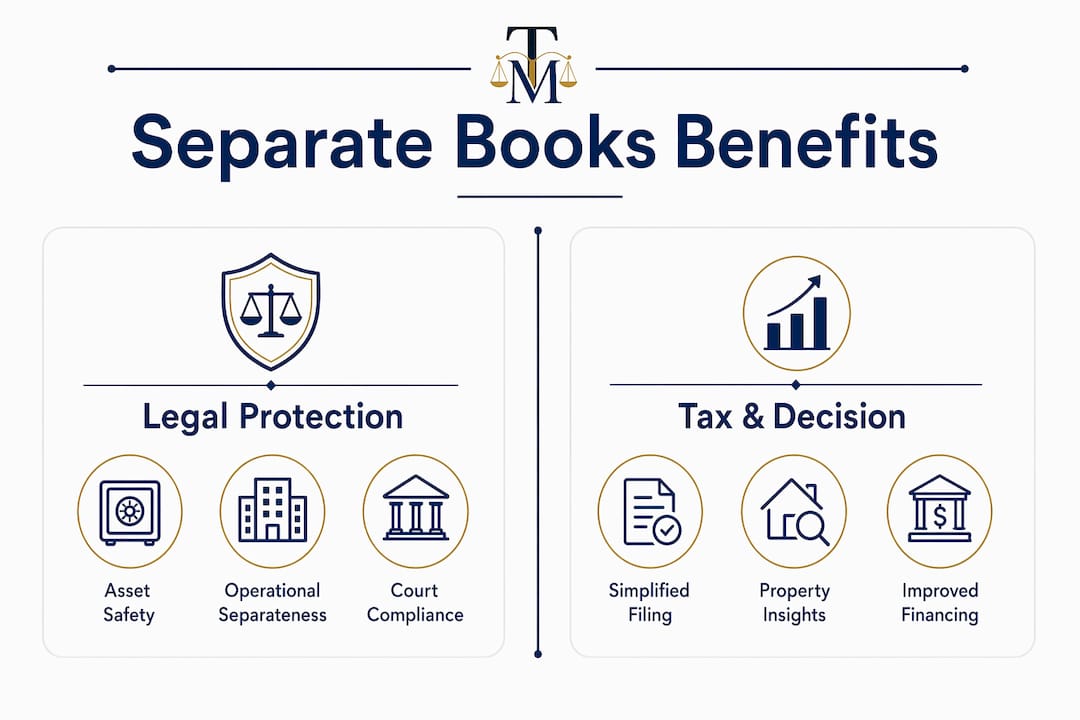
Per-property books align directly with how Schedule E is structured. When your books match the form, tax preparation becomes a matter of pulling numbers rather than reconstructing months of mixed transactions. Separate books avoid the time-consuming and error-prone process of untangling transactions at tax time. That untangling is where mistakes happen and where deductions get missed.
Investors who hold properties inside LLCs or partnerships face an additional layer. Each entity may need its own tax return, either a Form 1065 for a partnership or a separate Schedule E attachment for a single-member LLC. Clean, entity-level books make those filings straightforward. Mixed books make them a project.
The tax advantages for real estate investors multiply when records are clean:
- Depreciation deductions are tracked accurately per property, preventing missed write-offs.
- Repair and maintenance expenses are clearly separated from capital improvements, which have different tax treatments.
- Mortgage interest is assigned to the correct property, avoiding misreporting.
- Passive activity loss rules under IRS Section 469 are easier to apply when income and losses are broken out by property.
- Professional fees, insurance, and property management costs are deductible only when they are clearly tied to a specific rental activity.
A real estate investor with five properties and commingled books faces a tax preparer who must sort through hundreds of mixed transactions before filing can even begin. That sorting costs money and introduces errors. An investor with five clean sets of books hands over organized records and gets an accurate return. The difference in tax preparation fees alone often justifies the cost of proper bookkeeping.
Separate accounts also allow clear classification of reserves for taxes, operating expenses, and owner distributions. When you know exactly how much cash each property holds and owes, you can plan your tax payments without surprises.
How separate books improve investment decision-making
Commingled books hide the truth about your portfolio. When income and expenses from multiple properties flow into one set of records, you see only a blended result. You cannot tell whether Property A is generating strong cash flow while Property B is quietly losing money every month. Lumped-together books show only portfolio-wide profit, with no insight into individual property performance.

Separate books solve this by generating a property-specific profit and loss statement for each asset. You can see gross rent, vacancy losses, maintenance costs, property management fees, mortgage interest, and net operating income for each property individually. That level of detail changes how you make decisions.
Using financial statements to act on real data
A property-level profit and loss statement tells you which assets to hold, which to improve, and which to sell. If one property consistently shows negative cash flow after accounting for all expenses, you have a clear signal. Without separate books, that signal is buried in the average performance of your entire portfolio.
Clean financial statements also matter when you refinance or sell. Lenders and buyers conduct due diligence, and they want to see organized, property-specific financials. Separate books convey credibility beyond internal management benefits. Investors who present clean records close deals faster and negotiate from a stronger position.
Pro Tip: Run a property-level profit and loss statement every quarter. Compare net operating income across properties to identify your top performers and your underperformers. That comparison is where your next buy, sell, or improvement decision comes from.
The investor accounting best practices that generate real returns are built on this kind of visibility. You cannot manage what you cannot measure, and you cannot measure what you have not separated.
Practical methods to set up and maintain separate books
Setting up separate books does not require creating a new LLC for every property. The right structure depends on your portfolio size, risk tolerance, and how your attorney has organized your entities. Here are the most common approaches and how to execute each one.
-
One LLC per property with separate bank accounts. This is the strongest liability protection structure. Each LLC has its own checking account, its own accounting file, and its own tax ID. The administrative burden is higher, but the legal and financial separation is complete.
-
Single LLC with class tracking in accounting software. If you hold multiple properties under one LLC, use the class or location tracking feature in QuickBooks Online or a similar platform. Assign every income and expense transaction to a specific property class. This produces property-level reports without requiring multiple legal entities.
-
Separate bank accounts as a minimum standard. Even if you do not use accounting software with class tracking, opening a dedicated bank account for each property creates a basic level of separation. Every transaction for that property flows through one account, making records easier to reconstruct.
-
Integrate bookkeeping with tax preparation from day one. Set up your chart of accounts to mirror the categories on Schedule E. When your bookkeeping categories match your tax form categories, year-end reporting requires no translation. Your bookkeeper and your tax preparer work from the same structure.
-
Maintain monthly reconciliations. Reconcile each property’s bank account against its books every month. This catches errors, prevents fraud, and keeps records current. Investors who reconcile monthly spend far less time preparing for tax season than those who reconcile once a year.
-
Use a consistent naming convention. Label every account, file, and transaction with the property address or a short code. Consistency prevents confusion when you are managing multiple properties and multiple accounts simultaneously.
Accounting software that supports multi-entity or class-level bookkeeping makes this process manageable at scale. The goal is a system where pulling a report for any single property takes minutes, not hours. You can learn more about structuring this from the ground up in this guide on setting up accounting as a real estate investor.
Disorganized books carry a real cost. The financial impact of messy records shows up in missed deductions, poor decisions, and time spent reconstructing what should have been current all along.
Key Takeaways
Real estate investors who maintain separate books per property protect their personal assets, file accurate taxes, and make better investment decisions based on clear financial data.
| Point | Details |
|---|---|
| Legal protection requires separation | Commingled funds allow courts to pierce the corporate veil and expose personal assets. |
| Schedule E aligns with per-property books | Separate records make tax filing faster and reduce errors in income and expense reporting. |
| Property-level P&L drives decisions | Separate books reveal which properties generate cash flow and which are underperforming. |
| Class tracking works without multiple LLCs | Accounting software with class features produces property-level reports under a single entity. |
| Clean books build lender credibility | Organized, entity-level financials help investors close refinances and sales faster. |
What I’ve learned from watching investors mix their finances
I have worked with a lot of real estate investors over the years, and the ones who struggle most are almost never struggling because of bad properties. They are struggling because they cannot see what is actually happening inside their portfolio.
The most common mistake I see is an investor who buys a second or third property and just keeps depositing rent into the same personal checking account they have always used. It feels fine at first. Then tax season arrives, and they spend three weeks trying to figure out which expenses belong to which property. They miss deductions. They overpay. And they still do not know which property is actually profitable.
The second mistake is treating separate books as a compliance task rather than a management tool. Investors set up an LLC because their attorney told them to, but they never actually separate the finances. The LLC exists on paper, and the commingled bank account exists in reality. That gap is exactly what a plaintiff’s attorney looks for.
What I tell every investor is this: your books are your scoreboard. If the scoreboard only shows a total score and not the score by quarter, you cannot coach the game. Property-level books give you the quarterly breakdown. They tell you when a property’s maintenance costs are trending up before those costs become a cash flow problem. They show you which properties justify a rent increase and which ones need capital investment.
The investors who grow their portfolios consistently are the ones who treat bookkeeping as a business function, not a tax requirement. They review their numbers monthly. They know their net operating income per property. They use that data to decide what to buy next. That discipline starts with separate books, and it compounds over time into a real competitive advantage.
— Tony
Real estate bookkeeping built for investors
Managing separate books across multiple properties takes discipline and the right system. Truemeasureaccounting works with real estate investors to set up property-level bookkeeping that keeps your records clean, your taxes organized, and your portfolio performance visible at all times.
Whether you hold two rentals or twenty, Truemeasureaccounting builds the financial structure your portfolio needs. From monthly reconciliations to Schedule E-ready reporting, the firm connects your books directly to the decisions that grow your investment business. Explore Truemeasureaccounting’s real estate bookkeeping services and see how clean financials change the way you manage your portfolio.
FAQ
Why do real estate investors need separate books?
Separate books protect personal assets by preventing courts from piercing the corporate veil, and they simplify tax filing by aligning records with IRS Schedule E requirements. Investors with separate books also gain clear visibility into individual property performance.
What happens if I commingle personal and rental funds?
Mixing personal and property funds reduces your legal protection and can expose personal assets during litigation. It also creates errors in tax reporting and makes it impossible to measure profitability by property.
Do I need a separate LLC for each property to have separate books?
No. Accounting software with class or location tracking produces property-level financial records under a single LLC. A dedicated bank account per property is the minimum standard, even without multiple legal entities.
How do separate books help at tax time?
Per-property books align directly with Schedule E, which requires income and expense reporting by rental asset. Clean records eliminate the need to untangle mixed transactions before filing, reducing errors and preparation time.
Does having separate books affect my relationship with lenders?
Yes. Separate books signal professionalism to lenders and investors, demonstrating that you operate your portfolio as a business. Organized, entity-level financials help investors qualify for refinancing and close sales more efficiently.