

Setting up bookkeeping for a trucking company means selecting a trucking-focused accounting system and building disciplined daily, weekly, and monthly financial workflows that manage fuel costs, driver expenses, revenue, and compliance obligations like IFTA. Trucking company accounting differs from generic small business bookkeeping because your operational data, including miles by jurisdiction, fuel purchases by location, and per diem status, must feed directly into your financial records. Tools like QuickBooks Online, Rigbooks, and TruckLogics each serve different needs, and receipt capture apps like Dext and Expensify close the gap between the cab and your books. This guide covers software selection, chart of accounts setup, daily routines, IFTA compliance, and the mistakes that derail most trucking owners before they get started.
How to set up bookkeeping for a trucking company: the right foundation
The industry term for what most trucking owners need is trucking company accounting, a specialized branch of small business accounting that aligns financial recordkeeping with operational metrics like cost per mile, revenue per load, and fuel efficiency. When you set up bookkeeping with trucking operations in mind, you create a system that produces clean monthly financials and supports tax compliance without a month-end scramble.
Your first decision is choosing between general-purpose accounting software and trucking-specific platforms. QuickBooks Online is the most widely used general-purpose option and works well when paired with a properly structured chart of accounts and a CPA familiar with transportation. Rigbooks and TruckLogics are built specifically for trucking and include features like IFTA reporting automation, load tracking, and cost-per-mile analysis out of the box. The right choice depends on your fleet size, your comfort with technology, and whether you work with an outside accountant.

Pro Tip: If you plan to work with a CPA or bookkeeping service, confirm which software they support before you buy. Most trucking-focused accountants prefer QuickBooks Online because it integrates with the widest range of tools and allows remote access to your books.
The second foundational decision is committing to a routine. Disciplined bookkeeping cadence outperforms software choice every time. A trucking owner using a basic spreadsheet with daily discipline will have cleaner books than one using TruckLogics who only opens the app at quarter-end.
What are the best bookkeeping software options for trucking companies?
Choosing the best bookkeeping software for trucking companies requires matching features to your specific operational needs. Here is a direct comparison of the most widely used platforms:
| Software | Best For | Trucking-Specific Features | Starting Price |
|---|---|---|---|
| QuickBooks Online | Owner-operators and fleets with a CPA | Customizable chart of accounts, bank feeds, integrations | ~$35/month |
| QuickBooks Self-Employed | Solo owner-operators, Schedule C filers | Mileage tracking, basic expense categorization | ~$15/month |
| Rigbooks | Small fleets, independent truckers | IFTA reporting, cost-per-mile, load tracking | ~$19/month |
| TruckLogics | Growing fleets, dispatch operations | IFTA automation, driver management, ELD integration | ~$16.95/month |
| Spreadsheets | Startups with very limited budgets | None built-in; fully manual | Free |
Trucking-specific tools provide integration for load tracking, IFTA reporting automation, mileage tracking with ELD, and multi-truck profit and loss tracking that generic accounting software simply does not offer. That said, QuickBooks Online remains the preferred platform for trucking companies that want CPA collaboration and scalable reporting.
Beyond accounting software, your setup needs two additional layers. First, a receipt capture app. Dext and Expensify both allow you to photograph fuel receipts, scale tickets, and lumper fee invoices from your phone and automatically push them into your accounting system. This eliminates the shoebox of faded receipts that causes problems at tax time. Second, your ELD system, whether from Samsara, KeepTruckin, or another provider, should be treated as a bookkeeping tool. It generates the jurisdictional mileage data you need for IFTA and the trip logs that support per diem deductions.
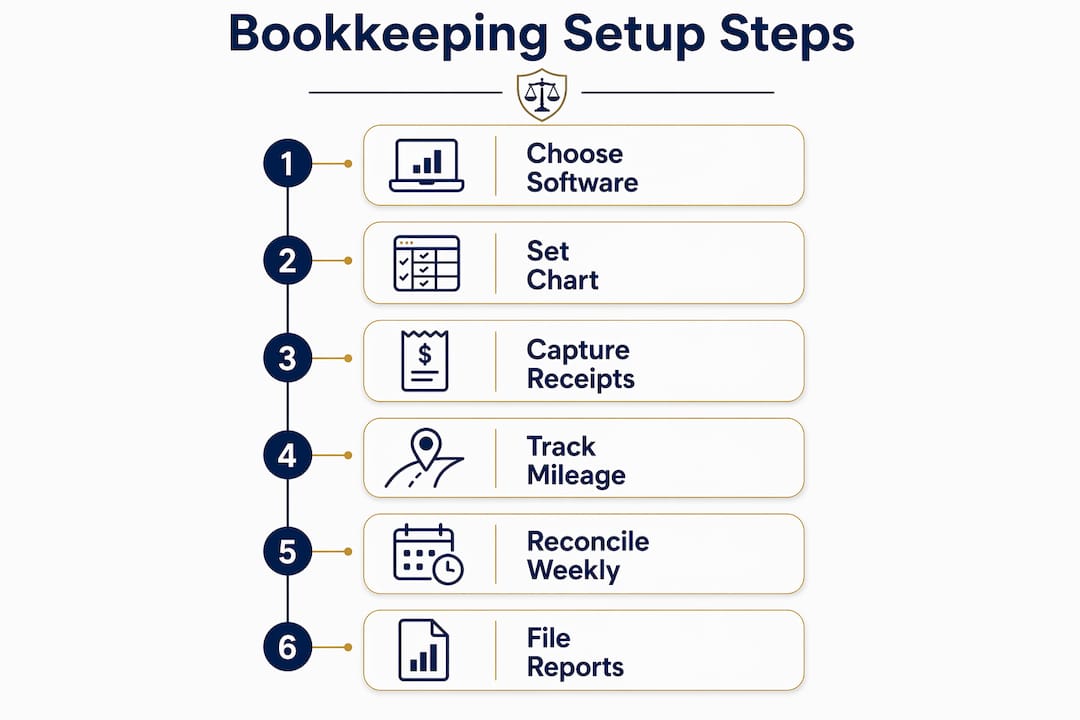
Automating transaction posting through integrated billing, payables, and asset cost management reduces month-end cleanup and improves profitability analysis speed and accuracy. Even a basic bank feed connection in QuickBooks Online, which pulls transactions daily from your business checking account and fuel card, cuts manual data entry by more than half.
How to set up your chart of accounts for trucking bookkeeping
The chart of accounts is the backbone of your trucking company accounting system. It defines every category where money flows in or out, and it must reflect trucking operations rather than generic business accounting. Aim for 20 to 25 categories total. More than that creates categorization paralysis; fewer than that obscures the data you need to manage profitability.
Structuring accounts to reflect trucking-specific operational data allows for quick detection of profitability and control issues that a generic chart of accounts would bury inside broad categories like “operating expenses.”
Revenue categories to set up from day one:
- Line-haul revenue (your base freight income)
- Fuel surcharge revenue (tracked separately from base rate)
- Accessorial charges (detention, layover, TONU fees)
- Other income (load board bonuses, equipment rental)
Fixed expense categories that belong in every trucking chart of accounts:
- Truck payment, split into principal and interest (critical for tax accuracy)
- Commercial truck insurance and cargo insurance
- Permits, licenses, and registration fees
- ELD subscription and communication tools
Variable expense categories tied directly to operations:
- Fuel (record gallons, price per gallon, and purchase location for IFTA)
- Maintenance and repairs, split by truck if you run a fleet
- Tires
- Tolls and scales
- Parking and lumper fees
Operating expense categories for back-office costs:
- Driver wages or owner-operator draws
- Meals and per diem (tracked separately from general meals)
- Lodging
- Professional services, including accounting and legal fees
- Office and communication expenses
Pro Tip: Separate fuel surcharge revenue from line-haul revenue from the start. Many trucking owners combine them, which makes it impossible to see whether your fuel surcharge is actually covering your fuel costs. That single insight can change how you negotiate rates.
What daily, weekly, and monthly routines maintain clean trucking books?
Predefining which data is captured daily, weekly, and monthly aligns financial management to your real operational cadence and prevents the errors and tax complications that pile up when you try to reconstruct three months of activity at quarter-end.
Here is the routine that works for trucking companies at every scale:
Daily tasks (10 to 15 minutes):
- Photograph and upload all receipts using Dext or Expensify immediately after each fuel stop, scale, or lumper payment
- Record each load: origin, destination, rate, broker, and delivery status
- Log odometer readings and note which states you drove through
- Confirm per diem status: did you spend the night away from your tax home?
Weekly tasks (30 to 45 minutes):
- Categorize all transactions that posted to your bank account and fuel card
- Reconcile your fuel card balance against receipts captured during the week
- Review expected settlements from brokers and flag any discrepancies
- Check cash position: what is coming in this week versus what is due?
Monthly tasks (1 to 2 hours):
- Reconcile all bank and credit card statements to your accounting software
- Review your profit and loss statement by revenue category and expense line
- Calculate cost per mile for the month and compare it to your rate per mile
- Identify any expense categories running higher than prior months
- Confirm all IFTA data is captured: miles by state, fuel by location, and vehicle MPG
| Frequency | Key Task | Why It Matters |
|---|---|---|
| Daily | Receipt capture and load entry | Prevents lost documentation and IFTA data gaps |
| Weekly | Transaction categorization and fuel card reconciliation | Catches errors before they compound |
| Monthly | P&L review and cost-per-mile analysis | Reveals profitability trends and pricing problems |
| Quarterly | IFTA filing and tax estimate review | Keeps you compliant and avoids underpayment penalties |
Daily updates for fuel and expenses, combined with weekly invoicing and cash flow review and monthly financial statements, produce clean year-end records that reduce tax issues significantly. The monthly profit and loss review is where you connect your trucking P&L numbers to real decisions about pricing, routes, and equipment.
Pro Tip: Set a recurring calendar reminder for your weekly bookkeeping session. Treat it like a delivery appointment. Missing it once is fine; missing it three weeks in a row creates a backlog that takes hours to untangle.
How do you handle IFTA and per diem in trucking bookkeeping?
IFTA and per diem are the two compliance areas where trucking bookkeeping setup either pays off or falls apart. Both require deliberate data capture from day one, not a scramble at filing time.
IFTA filing requirements and recordkeeping
Trucking companies operating in more than one IFTA jurisdiction must file quarterly fuel tax reports, which require collection of miles and fuel purchased by state, plus vehicle MPG data before filing. The four quarterly deadlines fall on April 30, July 31, October 31, and January 31. Missing them triggers penalties and interest.
IFTA filing accuracy depends on continuous capture of miles driven by jurisdiction, fuel purchases recorded with location and gallons, and vehicle MPG data integrated from your ELD or fuel card. Your bookkeeping setup must make this data collection automatic, not an afterthought. The best approach is to connect your ELD system to your accounting software so jurisdictional miles post automatically, and to use a fuel card like Comdata or EFS that generates a transaction report by state.
IFTA records including mileage logs and fuel purchase receipts must be retained for at least four years to comply with audits. Missing or poor-quality records cause estimated assessments that are often higher than your actual liability. Receipt quality and detailed fuel purchase information directly affect your ability to claim IFTA credits. A blurry or incomplete receipt can cost you a credit you legitimately earned.
Per diem tracking for owner-operators
Per diem is one of the most valuable deductions available to trucking owner-operators, and it is also one of the most misunderstood. Per diem deductions depend on proving overnight travel status through logs or ELDs, not meal receipts. You do not need to save every restaurant receipt. You need to prove you were away from your tax home overnight.
Your ELD is your best per diem documentation tool. It records exactly where you were, when you stopped, and how long you stayed. That data, combined with your trip logs, is what survives an IRS audit. A folder of Subway receipts does not.
Maintaining organized ELD trip records is critical for valid per diem deductions. Scattered documentation weakens your audit defense. Your bookkeeping setup should include a monthly habit of downloading and saving your ELD reports alongside your financial records. For more detail on maximizing these deductions, the truck driver tax deductions guide from TrueMeasure Accounting covers the full picture.
What are the most common trucking bookkeeping setup mistakes?
Owners frequently implement accounting software but fail by not aligning bookkeeping tasks with trucking’s operational cadence, causing month-end backlog and errors in critical compliance reporting like IFTA. These are the mistakes that show up most often, and how to avoid each one:
- No daily receipt capture. Fuel receipts fade within weeks. A receipt photographed at the pump is worth ten times more than one you find crumpled in your visor three months later. Use Dext or Expensify and make it a refueling habit.
- Using generic software without trucking features. QuickBooks Self-Employed tracks mileage but does not support IFTA reporting or multi-truck analysis. If you operate in multiple states or run more than one truck, you need QuickBooks Online or a trucking-specific platform.
- Overcomplicating the chart of accounts. A 60-category chart of accounts sounds thorough but creates categorization paralysis. Keep it to 20 to 25 categories and you will actually use it consistently.
- Ignoring IFTA data until quarter-end. Reconstructing three months of jurisdictional miles from memory is not bookkeeping. It is guesswork, and it invites penalties.
- Mixing personal and business finances. A dedicated business checking account and fuel card are non-negotiable. Commingled funds create tax problems and make your books unreliable.
- Skipping the monthly P&L review. Your profit and loss statement tells you whether you are actually making money after fuel, insurance, and truck payments. Skipping it means you are flying blind on pricing and route decisions.
Pro Tip: Open a dedicated business checking account before you record your first transaction. It is the single most impactful structural decision you can make for clean trucking bookkeeping, and it costs nothing.
Key takeaways
Effective trucking bookkeeping requires a trucking-specific accounting system, a structured chart of accounts with 20 to 25 categories, and consistent daily, weekly, and monthly routines that capture IFTA data and per diem documentation automatically.
| Point | Details |
|---|---|
| Choose the right software | Match your platform to fleet size and CPA compatibility; QuickBooks Online, Rigbooks, and TruckLogics each serve different needs. |
| Structure your chart of accounts | Use 20 to 25 trucking-specific categories to track fuel surcharge, line-haul, and variable costs separately. |
| Build a daily routine | Capture receipts and log loads daily to prevent IFTA data gaps and lost documentation. |
| Prioritize IFTA recordkeeping | Record miles by jurisdiction and fuel by location continuously; retain all records for at least four years. |
| Use ELD data for per diem | Prove overnight travel with ELD trip logs, not meal receipts, to protect your per diem deduction in an audit. |
What I’ve learned from working with trucking companies on bookkeeping setup
Most trucking owners I work with come to us after a painful experience: a tax bill they did not see coming, an IFTA audit they were not prepared for, or a year-end cleanup project that cost them thousands in accounting fees. Almost every one of those situations traces back to the same root cause. They set up software and assumed the work was done.
Software is not a bookkeeping system. It is a tool. The system is the routine you build around it. I have seen owner-operators with a basic QuickBooks Online setup and a 15-minute daily habit produce cleaner books than fleet operators running expensive trucking platforms they only open when their accountant asks for something. The discipline is the differentiator.
The other thing I tell every trucking client is this: your books should tell you whether you are making money on each load, not just at year-end. If you cannot look at your cost per mile and your rate per mile side by side every month, you are not managing your business. You are reacting to it. A well-structured chart of accounts and a monthly P&L review give you that visibility. They turn your bookkeeping from a compliance exercise into a decision-making tool.
For owners scaling from one truck to five or more, the bookkeeping setup you build at truck one either supports that growth or fights it. Separate profit and loss tracking by truck, separate fuel tracking by vehicle, and a clear view of which trucks are profitable and which are not. That data is what lets you make smart decisions about equipment, drivers, and routes as you grow. The fleet growth roadmap we put together at TrueMeasure Accounting walks through exactly how that financial structure evolves from a single truck to a small fleet.
My honest recommendation: get your chart of accounts right before you enter a single transaction. Fixing it later means recategorizing months of data, and that is a project no one enjoys.
— Tony
How TrueMeasure Accounting helps trucking companies get their books right
If you are ready to set up bookkeeping for your trucking company the right way, TrueMeasure Accounting builds the system for you.

TrueMeasure Accounting specializes in trucking bookkeeping services designed for owner-operators and growing fleets. The team sets up a trucking-specific chart of accounts, establishes your monthly reconciliation and reporting routine, and handles IFTA documentation support so you are always audit-ready. Whether you run one truck or ten, the service scales with your operation. You focus on the road. TrueMeasure Accounting handles the numbers. Contact the team today to get your books set up correctly from day one.
FAQ
What software is best for trucking company bookkeeping?
QuickBooks Online is the best general-purpose option for trucking companies working with a CPA, while Rigbooks and TruckLogics offer trucking-specific features like IFTA automation and cost-per-mile tracking for owner-operators who manage their own books.
How often should a trucking company update its books?
Receipts and load data should be recorded daily, transactions categorized and reconciled weekly, and a full profit and loss review completed monthly to maintain accurate and compliant trucking company accounting.
What records do I need to keep for IFTA?
You must retain mileage logs by jurisdiction, fuel purchase receipts with location and gallons, and vehicle MPG data for at least four years per IFTA rules to defend against estimated audit assessments.
How does per diem work for owner-operators in bookkeeping?
Per diem is a Schedule C deduction based on proving overnight travel away from your tax home using ELD trip logs, not meal receipts. Your bookkeeping setup should include monthly ELD report downloads saved alongside your financial records.
How many expense categories should a trucking chart of accounts have?
A trucking chart of accounts works best with 20 to 25 categories. Fewer categories obscure profitability data; more categories create confusion and inconsistent entry that makes your books unreliable.
Recommended
- Trucking Bookkeeping Services That Drive Profit | TrueMeasure Accounting LLC – TrueMeasure Accounting LLC-Small Business Accounting Services
- Small Business Accountant Georgia | TrueMeasure Accounting
- Trucking Accounting Company Georgia | TrueMeasure Accounting
- Trucking P&L Made Simple: What Numbers Actually Matter for Profit – TrueMeasure Accounting LLC-Small Business Accounting Services