

The fastest way to manage payroll costs in a healthcare practice is to measure what you’re actually spending, fix the pay rules and system integrations that create errors, and decide which payroll tasks belong in-house versus with a specialist. Most practices lose money not from overpaying staff but from misapplied differentials, manual data-entry mistakes, and unplanned overtime that nobody is tracking in real time.
Three actions you can take right now:
- Quantify payroll leakage. Pull your last three pay periods and count off-cycle checks, retroactive adjustments, and manual corrections. That number is your baseline.
- Enforce job-code-driven pay rules. Every pay rate should trigger from a credential and job code, not a supervisor’s manual override.
- Evaluate a hybrid model. Keep time collection and approvals internal. Offload tax filings, garnishments, and W-2s to a specialist.
Table of Contents
- What actually drives payroll costs in a healthcare practice
- Fix the systems that let payroll errors keep recurring
- Should your practice outsource payroll, keep it in-house, or use a hybrid model?
- Metrics to track so payroll stays under control
- Key Takeaways
- The payroll problem most practices are solving backward
- How Truemeasureaccounting helps healthcare practices cut payroll costs
- Useful sources and further reading
What actually drives payroll costs in a healthcare practice
Labor is typically the largest line item in any clinic’s budget, often representing a significant portion of total revenue. The visible costs are wages, overtime, and benefits. The hidden ones are where practices bleed.
Primary cost drivers:
- Base wages and salary bands by role (RN, MA, front desk, provider)
- Overtime under FLSA rules, including the 8/80 alternative workweek option for qualifying healthcare employers
- Shift differentials for nights, weekends, and on-call coverage
- Benefits: health insurance premiums, retirement contributions, PTO accruals
- Holiday and call pay, which often carry multipliers that compound quickly
- Turnover costs: recruiting, onboarding, and temporary agency or locum fees
Hidden leakage sources:
- Manual data-entry errors between scheduling, time-tracking, and payroll systems
- Misapplied shift differentials (paying a weekend rate for a shift that started Friday night)
- Worker misclassification: treating a 1099 contractor as a W-2 employee or vice versa
- Multi-state tax misfilings when staff work across state lines
Symplr’s guidance on automating pay rules identifies manual corrections and retroactive adjustments as the most common and costly payroll errors in healthcare settings. These aren’t one-time mistakes. Without a rules engine, they recur every pay period.
Fix the systems that let payroll errors keep recurring
One-time fixes don’t hold without the right infrastructure. The goal is to make correct payroll the path of least resistance.

Should your practice outsource payroll, keep it in-house, or use a hybrid model?
The answer depends on complexity, not cost per check. MGMA recommends evaluating payroll complexity, including turnover rate, off-cycle check frequency, incentive structures, and multi-state exposure, before comparing vendor pricing.
Questions to ask before deciding:
- In-house or outsourced payroll: What’s the right fit?
- Automating Pay Rules in Healthcare: A guide to compliance and efficiency
- Top Payroll Support services in Georgia | TrueMeasure Accounting
- Reduce Taxes as a Healthcare Business Owner: 2026 Guide
- Small Business Bookkeeping Services | TrueMeasure Accounting
The hybrid model
Practices with high shift variability or multi-state staff often get the best results from a mixed approach: keep time collection and approvals internal (where operational context matters), and outsource tax filings, garnishments, and W-2 production to a specialist. This preserves control where you need it and shifts high-risk compliance tasks to people who handle them daily.
Vendor criteria for healthcare payroll partners:
- Native integration with your EHR and scheduling system
- A configurable pay-rules engine that supports credential-gating
- Demonstrated healthcare client experience (not just general small business)
- Audit support and documentation for IRS or state agency inquiries
- A defined escalation path for agency notices and garnishment disputes
For a broader look at outsourcing accounting functions, the decision criteria map closely to payroll: complexity, internal expertise, and integration capability are the three filters that matter most.
Metrics to track so payroll stays under control
You can’t control what you don’t measure. These KPIs give you a real-time read on payroll health.
| KPI | Calculation | Target threshold | Cadence |
|---|---|---|---|
| Labor % of revenue | Total payroll / total revenue | a significant portion of total revenue | Monthly |
| Payroll per visit | Total payroll / patient visits | Benchmark to prior 90 days | Monthly |
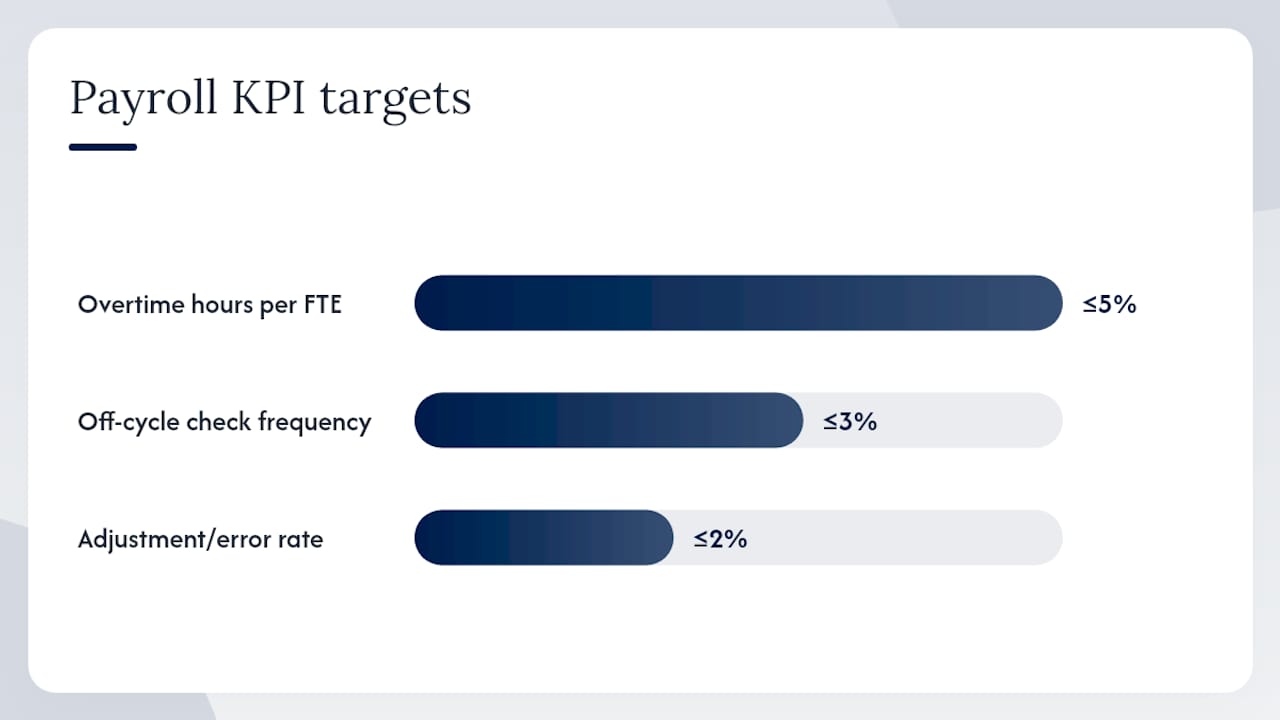
| Overtime hours per FTE | OT hours / total FTEs | Below 5% of total hours | Weekly |
| Adjustment/error rate | Manual corrections / total pay lines | Below 2% per period | Per pay period |
| Off-cycle check frequency | Off-cycle checks / total checks | Below 3% per period | Per pay period |
| Benefit cost per FTE | Total benefits spend / FTE count | Track trend, not absolute | Quarterly |
Accurate financial reporting is what makes these numbers reliable. If your books aren’t clean, labor % of revenue is a guess, not a metric. Bookkeeping cleanup is often the first step before any KPI dashboard is worth trusting.
Key Takeaways
Controlling payroll costs in a healthcare practice requires measuring leakage first, fixing the pay rules and integrations that cause recurring errors, and choosing the right operating model for your complexity level.
| Point | Details |
|---|---|
| Measure before you cut | Audit three months of payroll data to find your actual error rate and off-cycle check frequency before making changes. |
| Job-code-driven pay rules | Tying every pay calculation to a credential and job code eliminates manual overrides and retroactive corrections. |
| Hybrid model for complex practices | Keep time collection internal; outsource tax filings, garnishments, and W-2s to reduce compliance risk. |
| Six KPIs to track | Labor % of revenue, payroll per visit, OT per FTE, error rate, off-cycle frequency, and benefit cost per FTE give you a complete picture. |
| Truemeasureaccounting | Provides fractional CFO and payroll support services to implement this roadmap, clean up books, and make KPIs reliable and actionable. |
The payroll problem most practices are solving backward
Most administrators I talk to are trying to cut payroll costs by reducing headcount or freezing wages. That’s the last lever to pull, not the first. The real money is in the errors, the manual corrections, and the untracked overtime that compounds quietly every pay period. Fix the data and the rules first. The savings show up before you touch a single salary.
The practices that get this right share one habit: they treat payroll as a financial reporting function, not just an HR task. When labor costs are visible in real time, tied to patient volume and revenue, decisions get clearer. You stop reacting and start managing.
How Truemeasureaccounting helps healthcare practices cut payroll costs
Payroll cleanup and cost control are exactly the kind of operational problems Truemeasureaccounting was built to solve. Rather than handing you a report and walking away, the team works alongside you to implement the plan: cleaning up your books so KPIs are accurate, setting up the reporting routines that flag problems before they compound, and providing payroll support that reduces adjustment rates and off-cycle checks.
Engagements typically run as a 90-day project (aligned to the roadmap above) or a monthly retainer for ongoing monitoring and advisory. Healthcare owners also benefit from Truemeasureaccounting’s tax and cost-management guidance, which covers payroll-adjacent strategies including retirement contributions and benefit-cost planning. Truemeasureaccounting does not replace employment counsel for labor law questions, but the fractional CFO team flags the issues that need legal review before they become liabilities.
Ready to see where your payroll is leaking? Schedule a call and get a clear picture of what’s fixable in 90 days.
Useful sources and further reading
- In-house or outsourced payroll: What’s the right fit? — MGMA’s decision framework for evaluating payroll complexity and choosing the right operating model for medical practices.
- Automating Pay Rules in Healthcare — Symplr’s guide to pay-rules engines, credential-gating, and governance for healthcare payroll operations.
- TrueMeasure Payroll Support — Service overview for payroll cleanup, ongoing monitoring, and fractional CFO advisory for healthcare and service businesses.
- Reduce Taxes as a Healthcare Business Owner — Practical checklists covering payroll-adjacent tax strategies, benefit-cost planning, and healthcare-specific deductions.
- Small Business Bookkeeping Services — Details on how accurate books make payroll KPIs reliable and support real financial decision-making.