
Preparing your business for tax season means building an organized, compliant, and proactive financial system that reduces your tax liability and eliminates year-end chaos. For owner-operated service businesses, whether you run an HVAC company, a plumbing operation, a general contracting firm, or a trucking fleet, tax season is not just a filing exercise. It is a direct reflection of how well your finances were managed all year. The businesses that come through tax season with the least stress and the lowest bills are the ones that treated financial organization as an ongoing practice, not a once-a-year scramble. Tools like QuickBooks and IRS resources from the Taxpayer Advocate Service exist to support you, but the real work starts with your systems.
What are the essential financial organization steps to prepare your business for tax season?
The foundation of every clean tax filing is accurate, up-to-date bookkeeping. Updating your bookkeeping early in January and February, then reviewing your profit and loss statement and balance sheet, prevents errors and last-minute scrambling when deadlines arrive. This is not optional. A P&L with miscategorized expenses or unreconciled accounts will produce a tax return with mistakes, and mistakes cost money.
Start with these core financial organization steps:
- Update and reconcile all accounts. Every bank account and credit card needs to be reconciled against your actual statements. Reconciling every account confirms that all deposits and charges are justified and accounted for.
- Review accounts receivable and payable. Outstanding invoices affect your taxable income depending on your accounting method. Unresolved payables can distort your expense picture.
- Reconcile payroll records. Confirm that wages, payroll taxes, and benefits paid match your payroll reports. Discrepancies here trigger IRS questions.
- Separate business and personal finances. Commingled accounts are one of the most common audit triggers for small businesses. If you have been running personal expenses through your business account, fix it now and document the corrections.
- Organize receipts and expense documentation. Use a scanning app like Dext or simply a dedicated folder in Google Drive. Paper or digital both work. What matters is that every expense has a record attached to it.
- Run a sanity check on your financial reports. Pull your P&L and balance sheet and look for anything that does not make sense. A $40,000 “miscellaneous expense” line is a red flag. Fix categorization errors before your accountant sees them.
The Taxpayer Advocate Service confirms that solid recordkeeping throughout the year turns tax preparation into a verification step rather than a reconstruction project. That distinction matters enormously for service businesses with high transaction volumes, like contractors billing multiple jobs per week or trucking companies managing fuel, maintenance, and driver pay simultaneously.
Pro Tip: Schedule a 30-minute financial review at the end of every month. Catching one miscategorized expense in February costs you five minutes. Catching 12 months of them in April costs you hours and potentially money.

Which tax forms and deadlines should small businesses know?
Tax form requirements depend on your business structure, and getting this wrong causes cascading problems. Here are the forms most relevant to small and mid-sized service businesses:
- Schedule C (Form 1040): Used by sole proprietors and single-member LLCs to report business income and expenses. Filed with your personal return.
- Form 1065: Filed by partnerships and multi-member LLCs. The partnership itself does not pay tax, but the form must be filed to generate Schedule K-1s for each partner.
- Schedule K-1: Issued to each partner or S-Corp shareholder. Partners and shareholders need their K-1 to complete their personal returns.
- Form 1120-S: Filed by S-Corporations to report income, deductions, and credits passed through to shareholders.
- Form 1120: Filed by C-Corporations. Unlike pass-through entities, C-Corps pay tax at the entity level.
- 1099-NEC: Reports nonemployee compensation paid to contractors. You must issue this to any contractor you paid $600 or more during the year.
- 1099-K: Reports payment card and third-party network transactions. Relevant if you accept payments through platforms like Stripe or PayPal.
Key filing deadlines for 2026
| Entity Type | Form | 2026 Deadline |
|---|---|---|
| S-Corporations | Form 1120-S | March 16, 2026 |
| Partnerships | Form 1065 | March 16, 2026 |
| Sole Proprietors / Single-Member LLCs | Schedule C | April 15, 2026 |
| C-Corporations | Form 1120 | April 15, 2026 |
| Extension (Partnerships / S-Corps) | Form 7004 | September 15, 2026 |
The March 15 deadline shifted to March 16 in 2026 because March 15 falls on a Sunday. That one-day shift matters less than the downstream effect. If your S-Corp or partnership return is late, your K-1s are late. If your K-1s are late, your partners or shareholders cannot file their personal returns on time. One missed deadline creates a chain reaction.
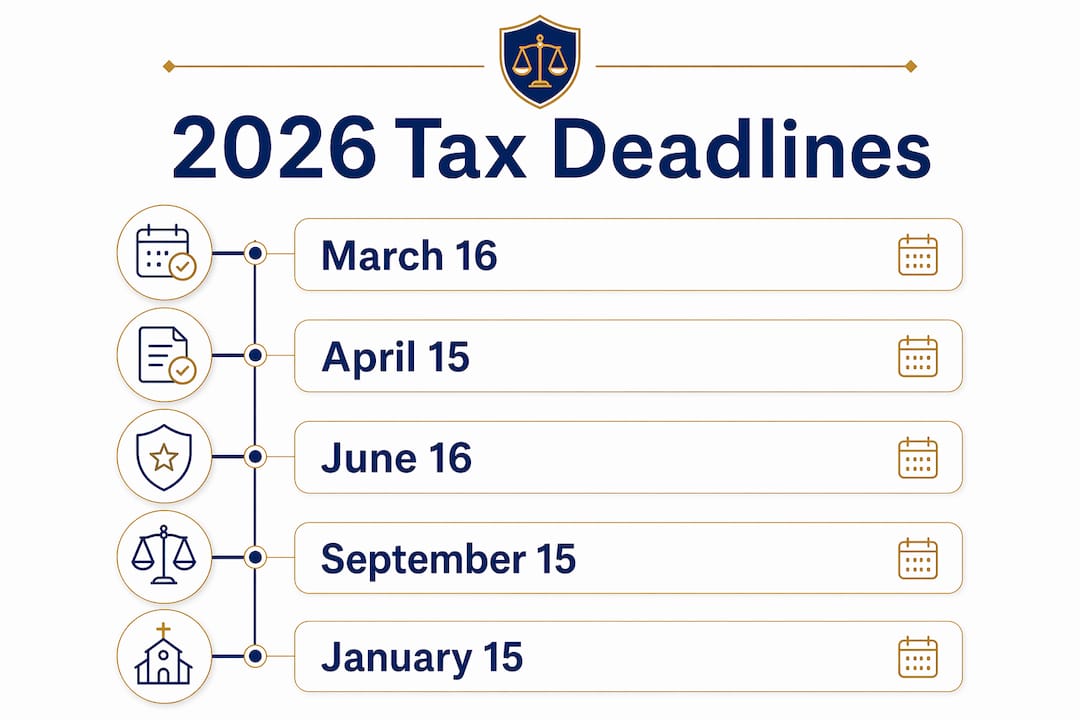
Quarterly estimated tax payments follow their own schedule: April 15, June 16, September 15, and January 15. Businesses owing $1,000 or more in federal taxes must make these payments to avoid IRS underpayment penalties. The IRS Safe Harbor rule lets you avoid the penalty by paying either 90% of your current year tax liability or 100% of your prior year liability, whichever is smaller.
Pro Tip: Mark every deadline on your calendar in January, not March. Set a reminder two weeks before each one. If you need an extension, file Form 7004 before the original deadline. An extension gives you more time to file, not more time to pay.
How can business owners maximize deductions during tax preparation?
Deductions reduce your taxable income dollar for dollar, and most service business owners leave money on the table simply because they did not document expenses properly. The IRS does not reward good intentions. It rewards documentation.
Here is how the most commonly missed deductions compare for service businesses:
| Deduction Category | What Qualifies | Documentation Required |
|---|---|---|
| Vehicle and mileage | Business driving, job site visits, supply runs | Mileage log with dates, destinations, and purpose |
| Home office | Dedicated space used exclusively for business | Square footage calculation, utility bills |
| Qualified Business Income (QBI) | Up to 20% deduction for pass-through entities | Accurate net income figure from your books |
| Equipment and tools | Machinery, computers, job-specific tools | Receipts, purchase dates, business use percentage |
| Subcontractor labor | Payments to 1099 contractors | Signed contracts, invoices, 1099-NEC forms issued |
| Advertising and marketing | Website costs, ads, business cards | Invoices and receipts tied to business promotion |
The Qualified Business Income deduction is one of the most valuable and most overlooked. Eligible pass-through business owners, including sole proprietors, S-Corp shareholders, and partners, can deduct up to 20% of qualified business income. The calculation has income thresholds and limitations, so accurate books are the prerequisite. You cannot claim a deduction you cannot calculate.
For vehicle expenses, you have two options: the standard mileage rate or actual expenses. The standard mileage rate for 2025 was 70 cents per mile for business use. Whichever method you choose, a mileage log is non-negotiable. The IRS requires contemporaneous records, meaning you document trips as they happen, not at year-end from memory.
The IRS advises using IRS Publication 535 and professional guidance for complex deductions. For HVAC contractors, plumbers, and electricians managing vehicle fleets, equipment depreciation under Section 179, and subcontractor payments, professional review is not a luxury. It is the difference between a clean return and an audit.
- Verify every income document, including 1099-NEC and 1099-K forms, against your own records before filing.
- Categorize expenses by type before handing anything to your accountant. Uncategorized expenses get generic treatment.
- Keep receipts for every business purchase over $75. The IRS requires receipts for meals, travel, and entertainment regardless of amount.
- Use a dedicated business credit card for all business expenses. This creates an automatic paper trail and simplifies expense management at year-end.
Pro Tip: Update your mileage log weekly, not annually. A contractor driving 25,000 business miles per year at the standard rate generates a deduction worth thousands of dollars. Losing that deduction because you cannot reconstruct your driving history is an expensive mistake.
What are the most common tax season mistakes to avoid?
The most damaging tax season mistakes are not math errors. They are structural problems that build up over 12 months and explode in April.
- Mixing personal and business finances. Running personal expenses through your business account creates a compliance nightmare. It inflates your apparent business expenses, triggers IRS scrutiny, and forces your accountant to spend hours sorting transactions you should have separated from day one.
- Skipping quarterly estimated tax payments. Missing estimated payments triggers an IRS penalty currently calculated at 7% per year, compounded daily for 2026. That penalty applies even if you pay your full tax bill by April 15. The quarterly schedule exists for a reason.
- Not verifying 1099 income. The IRS receives copies of every 1099 issued to your business. If a client reports paying you $85,000 and your return shows $72,000 in revenue, you will hear from the IRS. Cross-check every 1099 against your own records before filing.
- Filing entity returns late and delaying personal returns. If you own an S-Corp or partnership, your personal return depends on receiving your K-1. A late entity return means a late K-1, which means a late personal return, which means penalties stacking up for you and every other owner in the business.
- Ignoring first-time penalty abatement. If you have a clean compliance history and miss a deadline or underpay, the IRS First-Time Penalty Abatement program can eliminate the penalty. Most business owners do not know it exists. Ask your tax professional about it before paying any penalty automatically.
The IRS recommends adequate records and receipts as the primary defense against audit risk. Businesses with organized, categorized records are far less likely to face IRS questions, and far better positioned to respond if they do.
Pro Tip: Reconcile your accounts every single month. A 30-minute monthly reconciliation prevents the four-hour year-end reconstruction project that leads to errors, missed deductions, and unnecessary stress.
Key takeaways
Businesses that prepare for tax season year-round, through consistent bookkeeping, accurate documentation, and proactive deadline management, pay less, file faster, and face fewer compliance risks.
| Point | Details |
|---|---|
| Organize books early | Reconcile accounts and review financial reports in January and February to prevent last-minute errors. |
| Know your deadlines | S-Corps and partnerships file by March 16, 2026; sole proprietors and C-Corps file by April 15, 2026. |
| Document every deduction | Vehicle logs, receipts, and categorized expenses are required to substantiate deductions under IRS standards. |
| Pay quarterly estimates | Businesses owing $1,000 or more must pay quarterly to avoid a 7% compounded daily penalty in 2026. |
| Separate finances always | Commingled personal and business accounts trigger audits and inflate apparent expenses. |
What I have learned from watching businesses go through tax season every year
After more than 20 years building and operating service businesses, and now working alongside HVAC companies, contractors, trucking operations, and property managers through their financials every month, I have seen the same pattern repeat itself. The businesses that dread tax season are almost always the ones that treated bookkeeping as a once-a-year task. The ones that sail through it are the ones that treated their books like a management tool.
The most expensive mistake I see is not a missed deduction or a late filing. It is the business owner who spent 11 months making decisions based on bad financial data. Misclassified expenses do not just create tax problems. They distort your profit picture, hide cash flow issues, and make it impossible to know which jobs, customers, or service lines are actually making you money. I have worked with contractors who thought they were profitable on a specific service line, only to discover after a proper cleanup that they were losing money on every job in that category.
The conventional wisdom says “get organized before tax season.” My experience says that framing is backwards. Get organized so that tax season becomes a non-event. Monthly financial check-ins, clean categorization, and reconciled accounts mean your accountant spends time on strategy, not reconstruction. That shift alone can reduce your tax preparation costs and, more importantly, give you financial clarity that actually improves your business decisions throughout the year.
Technology helps, but it does not replace judgment. QuickBooks can categorize transactions automatically, but it will also confidently miscategorize a truck repair as office supplies if you let it. The tool is only as good as the person reviewing the output. That is why the businesses I work with at TrueMeasure Accounting get monthly reviews, not just year-end cleanups.
— Tony
How TrueMeasure Accounting helps you take control of tax season
Tax season does not have to be a source of stress. TrueMeasure Accounting works with owner-operated service businesses, from HVAC and plumbing companies to contractors and trucking operations, to keep their books clean, compliant, and audit-ready all year long.
Our bookkeeping and tax preparation services are built around fixed pricing, so you always know what you are paying. We use technology to keep your records organized and your reports accurate, and we connect your financial data to real business decisions, not just compliance checkboxes. Whether you need a full-year cleanup, monthly bookkeeping support, or a proactive tax strategy that reduces your liability before December 31, we are ready to help. Schedule a free consultation with TrueMeasure Accounting today and go into tax season with confidence.
FAQ
What documents do I need to prepare my business for tax season?
Gather income records including 1099-NEC and 1099-K forms, bank and credit card statements, payroll records, receipts for business expenses, and prior year tax returns. Organized documentation by category speeds up filing and reduces the risk of missed deductions.
When are the key tax deadlines for small businesses in 2026?
S-Corporations and partnerships must file by March 16, 2026. Sole proprietors and C-Corporations have until April 15, 2026. Quarterly estimated tax payments are due April 15, June 16, September 15, and January 15.
How do I avoid IRS penalties on estimated taxes?
Pay at least 90% of your current year tax liability or 100% of your prior year liability in quarterly installments. Missing these payments triggers a penalty currently set at 7% per year, compounded daily.
What is the best way to organize business finances for taxes?
Reconcile every bank and credit card account monthly, categorize expenses by type, separate personal and business transactions, and keep receipts for all business purchases. Consistent monthly bookkeeping turns year-end filing into a straightforward verification process.
Can I deduct home office expenses as a small business owner?
Yes, if you use a dedicated space exclusively and regularly for business. You can calculate the deduction using either the simplified method ($5 per square foot, up to 300 square feet) or the actual expense method based on the percentage of your home used for business.
Recommended
- Free Consultation – TrueMeasure Accounting LLC-Small Business Accounting Services
- Audit-Proof Your Business: Essential Documentation Best Practices – TrueMeasure Accounting LLC-Small Business Accounting Services
- Small Business Tax Preparation Georgia | TrueMeasure Accounting
- How to Choose the Right Accounting Software for Your Business