
A financial reporting consulting firm is defined as a professional services business that delivers structured financial analysis, management reporting, and decision-support data to client organizations in exchange for a fee. If you want to set up a financial reporting consulting firm, the decisions you make in the first 90 days, covering legal structure, service design, technology, and pricing, will determine whether you build a scalable practice or a chaotic freelance grind. The industry term for the core work is financial planning and analysis (FP&A) advisory, and understanding that distinction matters both for how you position your firm and how you stay on the right side of licensing requirements.
What legal and business prerequisites must you complete before launching your firm?
The legal foundation of your consulting firm is not a formality. It is the structure that protects your personal assets, defines your tax obligations, and signals professionalism to prospective clients.
The first decision is your business entity. Sole proprietorships expose owners to unlimited personal liability, which means a client dispute or contract claim can reach your personal bank accounts and property. Forming an LLC or S-corporation creates a legal wall between your business obligations and your personal finances. For most solo consultants launching a financial reporting practice, an LLC is the preferred starting point because it combines liability protection with pass-through taxation and relatively low administrative overhead.

Registration requirements vary by state. If you are forming an LLC in a state like Illinois, a step-by-step LLC formation guide can walk you through the exact filing sequence, fees, and registered agent requirements. Most states charge between $50 and $500 to register a new business entity, and you will also need a federal Employer Identification Number (EIN) from the IRS before opening a business bank account.
Here is what your pre-launch legal checklist should include:
- Business entity formation: File your LLC or corporation articles with your state’s Secretary of State office.
- EIN registration: Apply at IRS.gov at no cost. You need this before opening any business accounts.
- Local business license: Most cities and counties require a general business operating license, typically $25 to $150 annually.
- Business bank account: Keep business and personal finances completely separate from day one.
- Professional liability insurance: Also called errors and omissions (E&O) insurance, this protects you if a client claims your reporting caused a financial loss.
- Client contracts: Your engagement agreements should explicitly limit liability, clarify intellectual property rights, and set clear expectations to reduce disputes before they start.
One area that trips up new consultants is the licensing question. Non-attest financial consulting firms generally do not require CPA licensure or specific firm registration, but regulations vary by jurisdiction. If your services stay within management reporting, budgeting, variance analysis, and cash flow forecasting, you are typically operating outside the regulated attest and investment advisory space. The moment you cross into investment advice or credit product recommendations, SEC or state securities licensing may apply.
Pro Tip: Before you sign your first client, have an attorney review your engagement agreement template. A one-time legal review costs $300 to $800 and can prevent disputes that cost ten times that amount.
How do you define and design your financial reporting consulting services?
The most common mistake when launching a financial analysis consulting startup is trying to offer everything at once. Variance analysis, cash flow forecasting, management reporting, KPI dashboards, budgeting, scenario modeling, and FP&A advisory are all distinct services. Attempting to deliver all of them from day one without repeatable systems produces inconsistent work and makes pricing nearly impossible.
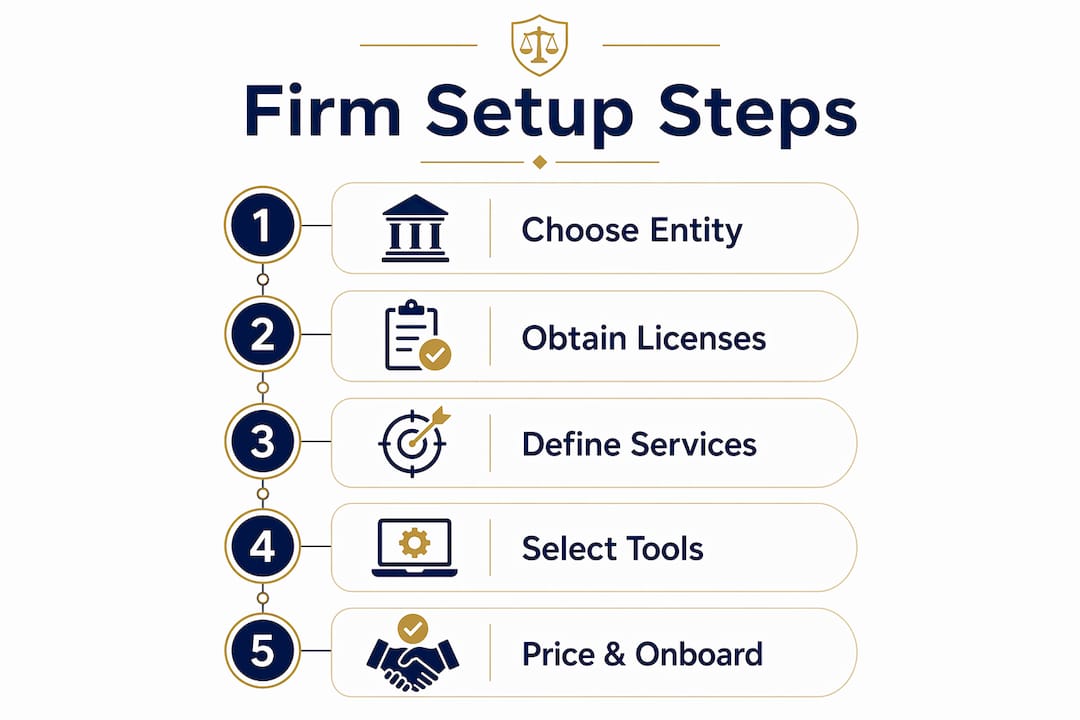
Successful consulting firms start with a narrow service definition and invest in repeatable delivery systems before expanding. This is not a limitation. It is the strategy that lets you price confidently, deliver consistently, and scale without hiring a team prematurely.
Here is a practical sequence for designing your service offerings:
- Choose one or two core deliverables. Cash flow forecasting and monthly management reporting are the highest-demand entry points for owner-operated businesses. Start there.
- Define what each deliverable includes. A monthly management report might include a profit and loss summary, a cash flow statement, three KPIs specific to the client’s industry, and a one-page narrative. Write this down before you sell it.
- Distinguish your work from FP&A advisory and CFO services. Clarity on the distinction between FP&A advisory and CFO services prevents scope creep and preserves pricing integrity. Reporting consultants deliver data and analysis. CFOs make strategic recommendations and own financial decisions. Know which role you are filling.
- Build a delivery template for each service. Standardize your report formats in Excel, Google Sheets, or a BI tool. Clients should receive a consistent product every month, not a custom creation each time.
- Integrate with bookkeeping and accounting. Most small business clients need bookkeeping services as the data foundation before any reporting is possible. Either offer this yourself, partner with a bookkeeping firm, or require that clients maintain clean books as a condition of engagement.
Pro Tip: Successful firms standardize deliverables like variance reports and scenario updates while minimizing customization to protect margins. Build your templates before you onboard your first client, not after.
The integration between bookkeeping and reporting is where many consulting firms find their strongest value proposition. A client who receives accurate books plus a monthly performance dashboard from the same provider has no reason to shop around. That stickiness is worth designing into your service model from the start.
Which technology tools are essential for financial reporting consulting?
Your technology stack determines how fast you can deliver, how accurate your outputs are, and how professional your client experience feels. The right tools also determine your margins. Manual reporting in spreadsheets is time-consuming and error-prone. Automated data pulls from cloud accounting platforms like QuickBooks Online, Xero, and NetSuite cut reporting time dramatically.
Here is a comparison of the core tool categories and what each one does for your practice:
| Tool Category | Examples | Primary Function |
|---|---|---|
| Cloud accounting | QuickBooks Online, Xero, NetSuite | Source of financial data; client bookkeeping platform |
| FP&A and forecasting | Adaptive Insights, Prophix | Budgeting, scenario modeling, multi-entity consolidation |
| BI and dashboards | Power BI, Tableau | Visual reporting, KPI tracking, client-facing dashboards |
| Workflow management | Asana, Monday.com | Task tracking, deadline management, team coordination |
| Client communication | Slack, Loom | Async updates, report walkthroughs, quick client Q&A |
| Data security | LastPass, 1Password | Credential management, client data protection |
QuickBooks Online is the dominant platform for owner-operated businesses in the United States, which means most of your clients will already use it. Proficiency in QuickBooks is not optional. It is the baseline. You can explore accounting tech consulting to understand how technology selection connects to service delivery quality.
For reporting and dashboards, Power BI integrates directly with QuickBooks and Excel, making it a practical choice for consultants who want to deliver visual dashboards without paying for enterprise software. Tableau offers more advanced visualization but carries a higher cost and learning curve that is harder to justify at the early stage of a practice.
Data security deserves specific attention. Privacy policies, NDAs, and data handling processes reduce legal risks and build client trust. You are handling sensitive financial data. Clients need to know their information is protected. Include a data handling policy in your engagement agreement and use encrypted file sharing rather than email attachments for financial documents.
What are best practices for pricing, packaging, and onboarding clients?
Pricing is where most new consulting firms leave money on the table. Pricing FP&A advisory services at hourly compliance rates often undermines profitability. Retainer pricing aligns with strategic service value rather than time-spent billing, and it creates the predictable revenue that makes a consulting firm financially stable.
The structure that works best for financial reporting consulting is a two-tier model:
- One-time setup fee: Covers chart of accounts mapping, technology configuration, historical data review, and delivery template creation. This work is intensive and should be priced accordingly. A setup fee of $1,500 to $5,000 is reasonable depending on client complexity.
- Monthly retainer: Covers ongoing report delivery, monthly review meetings, and model updates. Retainers typically range from $500 to $3,000 per month based on service scope and client size.
Separating setup and ongoing fees helps ensure profitability and predictable revenue. When you bundle setup into the first month’s retainer, you almost always underprice the work. Clients who pay a setup fee also tend to take the onboarding process more seriously, which means cleaner data and better outcomes for everyone.
Here is what a well-structured client onboarding process looks like:
- Week 1: Signed engagement agreement, setup fee collected, access to accounting software granted.
- Week 2: Chart of accounts review, data cleanup checklist sent to client, KPI selection meeting.
- Week 3: Reporting templates built, historical data imported, first draft dashboard or report delivered for review.
- Week 4: Client training session, feedback incorporated, first official report delivered.
Effective onboarding requires technical setup plus process mapping and client training. Skipping the training component is a common mistake. Clients who do not understand how to read their reports disengage within three months. A 30-minute walkthrough of the first report dramatically improves retention.
Pro Tip: Review your fixed-price vs. hourly pricing model before you set your rates. Fixed-price retainers protect your margins and give clients budget certainty, which makes the sale easier.
Monthly financial review meetings and transparent communication improve client engagement and retention. Schedule these calls at the same time each month. Clients who see their numbers regularly and understand what they mean become long-term partners, not one-time engagements.
What challenges and pitfalls should you anticipate when scaling your firm?
Every consulting firm that grows past the solo stage runs into the same set of problems. Knowing them in advance does not make them disappear, but it does mean you can build systems that reduce their impact before they cost you clients or revenue.
The most dangerous early mistake is crossing into regulated financial services without realizing it. Providing advice on investments or credit products may require SEC authorization. If a client asks you to recommend where to invest their cash reserves or evaluate a financing structure, you are moving outside the scope of reporting consulting. Know your boundaries and refer out when appropriate.
Scope creep is the second major threat. It starts small. A client asks for one extra report. Then they want you to attend a board meeting. Then they need a custom analysis that takes eight hours. None of this is in the original agreement, and none of it is being billed.
“The consulting firms that fail are not the ones that lose clients. They are the ones that keep clients at rates that do not cover the actual work being done.”
Maintaining consistent quality as you add clients requires documented processes. Every deliverable should have a checklist. Every client should have a file that documents their chart of accounts, their KPIs, their reporting preferences, and their communication style. When you eventually bring on a contractor or employee to help, that documentation is what allows them to deliver the same quality you do.
Planning for team growth also means planning for operational support systems that handle scheduling, client communication, and workflow management so you can focus on the analytical work that actually generates revenue. Firms that grow without these systems end up with the founder doing administrative work instead of billable consulting.
Key takeaways
A financial reporting consulting firm succeeds when it combines a narrow service focus, a two-tier pricing structure, and repeatable delivery systems built before the first client is onboarded.
| Point | Details |
|---|---|
| Form an LLC before client work | Sole proprietorships expose personal assets; an LLC separates business and personal liability from day one. |
| Start with one or two core services | Focused offerings like cash flow forecasting are easier to price, deliver, and scale than broad service menus. |
| Use a setup fee plus monthly retainer | Separating intensive setup work from ongoing advisory protects margins and creates predictable revenue. |
| Standardize your deliverables | Template-driven reports reduce delivery time and protect margins as your client base grows. |
| Invest in onboarding and client training | Clients who understand their reports stay longer; a 30-minute monthly review call is your best retention tool. |
What I have learned from building financial practices that actually work
The consultants I have seen struggle most are the ones who launched with a broad service menu and no delivery system. They won clients on the strength of their credentials and then spent every month reinventing the wheel. The ones who built durable practices did the opposite. They picked two deliverables, built a template for each, priced them clearly, and then sold the same thing to every client until they had enough volume to expand.
The pricing conversation is where I see the most self-inflicted damage. Consultants who came from accounting or bookkeeping backgrounds are conditioned to think in hourly rates. When you charge by the hour for strategic financial reporting, you are penalized for getting faster and more efficient. Retainer pricing rewards your expertise. A client paying $1,500 per month for a monthly management report and a 45-minute review call is paying for the clarity that report creates, not for the three hours it took you to build it.
The other thing I would tell anyone starting this kind of practice is to take the legal setup seriously from day one. Not because you expect problems, but because the contract you sign with your first client sets the tone for every client relationship that follows. Vague scope, no liability limits, and no IP clause are not just legal risks. They are signals to clients that you are not running a professional operation.
Financial reporting consulting is genuinely valuable work. Owner-operated businesses in construction, HVAC, trucking, and property management are making six-figure decisions every month without reliable financial data. The consultant who can deliver clear, accurate, timely reports and explain what the numbers mean is not a vendor. They are a trusted advisor. Build your practice like one.
— Tony
How TrueMeasureAccounting supports your financial consulting journey
If you are building a financial reporting practice or looking to strengthen the financial clarity you offer your clients, TrueMeasureAccounting has the infrastructure to support you. From financial reporting services built for owner-operated businesses to bookkeeping services that create the clean data foundation every reporting engagement requires, TrueMeasureAccounting delivers the kind of organized, technology-enabled financial work that makes consulting relationships stick.
Founded by Anthony Boncimino, an entrepreneur with over 20 years of experience running multi-million-dollar service businesses, TrueMeasureAccounting understands what financial data needs to do in the real world. If you want to see how a structured financial reporting practice actually operates, reach out and let’s talk about what that looks like for your business.
FAQ
What is a financial reporting consulting firm?
A financial reporting consulting firm delivers structured financial analysis, management reports, and decision-support data to business clients on a fee basis. It differs from a CPA firm in that it typically does not perform attest services like audits or tax preparation.
Do I need a CPA license to set up a financial reporting consulting firm?
Non-attest financial consulting firms generally do not require CPA licensure, but regulations vary by state. If your services include investment advice or credit product recommendations, additional licensing from the SEC or state regulators may apply.
What is the best pricing model for a financial reporting consulting firm?
A two-tier model works best: a one-time setup fee covering data mapping and template creation, followed by a fixed monthly retainer for ongoing reporting and review meetings. This structure protects your margins and gives clients predictable costs.
Which software do financial reporting consultants use most?
QuickBooks Online is the dominant platform for small business clients in the United States. Power BI and Tableau handle dashboards and visualization. Adaptive Insights and Prophix support forecasting and scenario modeling for more complex engagements.
How do I prevent scope creep in a consulting engagement?
Define your deliverables in writing before the engagement starts, including exactly what each report contains, how many review meetings are included, and what falls outside the scope. Charge a setup fee to establish the value of the initial work and revisit scope formally at each renewal.
Recommended
- Financial Reporting Services in Georgia | TrueMeasure Accounting
- Comprehensive Financial Support for Growing Moving Companies – TrueMeasure Accounting LLC-Small Business Accounting Services
- Marketing Agency Bookkeeping Services | TrueMeasure Accounting
- Financial Coaching for Movers for Smarter Government Contracts – TrueMeasure Accounting LLC-Small Business Accounting Services