
Monthly financials are the core reporting package small businesses use to track profitability, cash flow, and financial health on a regular basis. For an HVAC company, a general contractor, or a trucking operation, waiting until year-end to review the numbers is like driving without a dashboard. By the time you see the problem, you have already blown past it. Monthly financial statements, including the profit and loss statement, balance sheet, cash flow statement, and key performance indicators, give you a real-time view of where your business stands. Tools like QuickBooks make generating these reports faster than ever, but the discipline of reviewing them monthly is what separates businesses that grow from those that just survive.
Why small businesses need monthly financials more than annual reports
Small businesses have less financial cushion than large corporations, which means a cash flow gap or shrinking margin can become a crisis within weeks rather than months. Monthly reviews catch issues early while they are still manageable, rather than surfacing them at year-end when your options are limited. That is the core reason why the importance of monthly financials is not just an accounting best practice. It is a survival strategy for owner-operated businesses.
Annual reports tell you what happened. Monthly financial statements tell you what is happening. A plumbing company that reviews its numbers every month can spot a labor cost spike in March and correct pricing in April. The same company relying on annual data discovers the same problem in January of the following year, after losing margin on dozens of jobs. The difference in outcome is significant.

Forecasting based on monthly financials helps avoid liquidity crises and supports budget planning grounded in real evidence rather than guesswork. For service businesses with seasonal revenue patterns, like HVAC companies that peak in summer and slow in winter, monthly data makes cash flow forecasting possible. Without it, you are managing by feel.
The benefits of financial reporting on a monthly cadence also extend to tax planning. When your books are current and your financials are reviewed regularly, your accountant can make proactive tax decisions throughout the year. Businesses that only look at their numbers at tax time consistently miss legal deductions and pay more than necessary. Regular bookkeeping and tax planning work together to reduce that burden.
What are the key monthly financial statements small businesses should review?
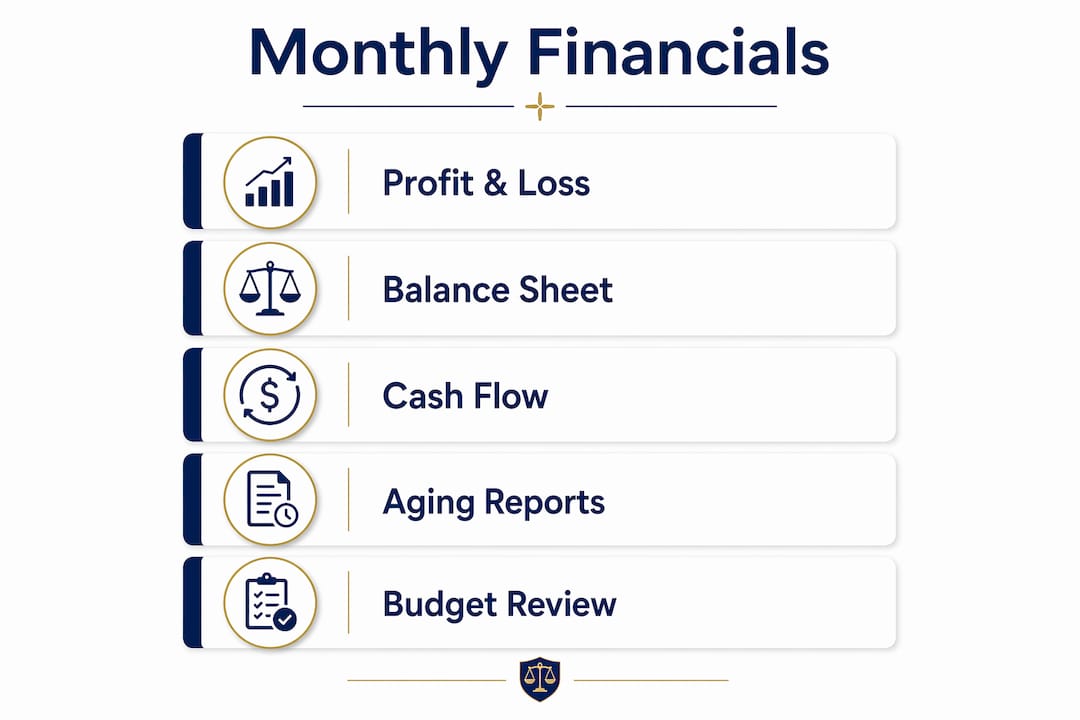
Monthly reporting includes five core reports that together give a complete picture of financial health: the profit and loss statement, balance sheet, cash flow statement, accounts receivable and payable aging reports, and a budget versus actual comparison. Each report answers a different question about your business. Reviewing only one of them is like reading only one chapter of a book and thinking you understand the whole story.
Here is what each report tells you and what numbers to watch:
| Statement | Primary focus | Key numbers to watch |
|---|---|---|
| Profit and Loss (P&L) | Revenue, expenses, and net profit | Gross margin %, net profit %, labor cost % |
| Balance Sheet | Assets, liabilities, and owner equity | Working capital, current ratio, total debt |
| Cash Flow Statement | Actual cash in and out | Operating cash flow, net cash change |
| AR/AP Aging | Outstanding invoices and bills | Invoices over 30/60/90 days |
| Budget vs. Actual | Variance from planned numbers | Expense overruns, revenue shortfalls |
The profit and loss statement is the most reviewed report, but it is also the most misunderstood. Profit and cash are different metrics. A construction company can show a profitable month on the P&L while simultaneously running out of cash because a large client has not paid yet. The P&L shows what you earned. The cash flow statement shows what you actually received.
The balance sheet is the report most small business owners skip, and that is a costly mistake. It shows your working capital, which is the difference between current assets and current liabilities. A general contractor with $200,000 in receivables and $190,000 in payables due this month has a liquidity problem that the P&L will never reveal. The balance sheet catches it immediately.
Accounts receivable and payable aging reports are the operational early-warning system. If a trucking company has three clients with invoices over 60 days past due, that information needs to surface in the monthly review so collections can happen before cash runs dry. Budget versus actual comparisons close the loop by showing whether your spending and revenue match the plan you set at the start of the year.
How to implement a practical monthly financial review process
Monthly review meetings go beyond what happened to analyze why events occurred and plan the next steps. That shift from passive reporting to active decision-making is what makes monthly financial reviews worth the time. The goal is not to produce reports. The goal is to use them.
A practical review cadence looks like this:
- Weekly: Check your bank balance, outstanding invoices, and upcoming bills. This keeps you aware of short-term cash position without requiring a full review.
- Monthly: Review the full P&L, balance sheet, cash flow statement, aging reports, and budget versus actual comparison. Identify variances and decide on responses.
- Quarterly: Conduct a deeper analysis of trends, update your annual forecast, and review pricing and job costing data.
For the monthly review meeting itself, follow this structure:
- Open with cash position. Start with your current bank balance and a 30-day cash forecast. This grounds the conversation in reality before you look at any other numbers.
- Review the P&L. Compare this month to last month and to the same month last year. Look for margin changes, unexpected expense increases, and revenue trends.
- Check the balance sheet. Confirm working capital is healthy and that debt levels have not crept up without a clear reason.
- Work through aging reports. Identify any receivables over 30 days and assign follow-up actions before the meeting ends.
- Compare budget to actual. Note where you are over or under plan and decide whether to adjust spending or revise the forecast.
- Update your 90-day forecast. Use what you just learned to project the next three months of cash flow and profitability.
The right people in the room matter. The business owner, the bookkeeper, and ideally an accountant or fractional CFO should all participate. The owner brings operational context. The bookkeeper brings data accuracy. The accountant brings interpretation and forward-looking guidance. When all three are aligned, the monthly review becomes a decision-making session rather than a reporting exercise.
Choosing the right software also matters. Accounting software selection directly affects the accuracy and speed of your monthly reports. QuickBooks, for example, can generate a full P&L, balance sheet, and cash flow statement in minutes when the books are clean and current. Messy books produce misleading reports, which is why clean bookkeeping is the foundation of every useful monthly review.
Pro Tip: Pick three to five KPIs that are specific to your business and track them every single month. An HVAC company might track revenue per technician, gross margin by service type, and average invoice value. A trucking company might track revenue per mile, fuel cost as a percentage of revenue, and days sales outstanding. Consistency matters more than comprehensiveness. Tracking the same numbers month after month reveals trends that sporadic reporting never will.
What are common pitfalls when managing monthly financials?
Consistent reporting reduces delays and data gaps that undermine reliable decision-making. The most common reason monthly financials fail to deliver value is not a lack of data. It is a lack of discipline and process. Here are the pitfalls that cost small business owners the most:
- Confusing cash with profit. Many owners check their bank balance and assume the business is doing well. A healthy bank balance can mask poor profitability if you have collected deposits on jobs you have not yet completed or if payables are building up unpaid.
- Skipping the balance sheet. The balance sheet reveals liquidity risks, growing debt, and equity erosion that the P&L will never show. Skipping it means you are only seeing half the picture.
- Delaying the monthly review. Reviewing February’s numbers in May is not a monthly review. It is a historical exercise with no practical value. The power of monthly financials comes from reviewing them within the first two weeks of the following month.
- Tracking too many KPIs. A dashboard with 20 metrics is as useless as no dashboard at all. When everything is a priority, nothing is. Pick the metrics that directly connect to your biggest profit drivers and ignore the rest.
- Ignoring aging receivables. Reviewing the P&L without checking the AR aging report is a common mistake. A profitable month means nothing if the cash from that month is sitting uncollected in a 90-day-past-due invoice.
- Failing to act on the data. The most expensive pitfall is reviewing the numbers, identifying a problem, and doing nothing. Monthly financials are only valuable when they drive decisions.
Pro Tip: Set a hard deadline for your monthly close. Commit to having your books reconciled and reports ready by the 10th of the following month. This creates a rhythm that your bookkeeper, accountant, and team can all plan around. Businesses that close their books on time consistently make better decisions than those that let the process drift.
Data quality is the foundation of all of this. If your QuickBooks file has uncategorized transactions, duplicate entries, or unreconciled accounts, every report it produces is unreliable. Clean books are not optional. They are the prerequisite for every useful financial insight. A mid-year financial check is a practical way to catch data quality issues before they compound.
Key takeaways
Monthly financial reporting gives small businesses the visibility they need to catch problems early, manage cash flow, and make decisions based on facts rather than assumptions.
| Point | Details |
|---|---|
| Five reports, not one | Review P&L, balance sheet, cash flow, aging reports, and budget vs. actual every month. |
| Cash and profit differ | A profitable P&L does not guarantee positive cash flow; reconcile both every month. |
| Timing is everything | Close books by the 10th and review within two weeks to keep insights relevant. |
| Fewer KPIs, more focus | Track three to five consistent metrics monthly rather than many metrics sporadically. |
| Act on what you find | Monthly reviews only create value when they lead to specific decisions and follow-up actions. |
What I have learned from 20 years of watching businesses manage their numbers
Most small business owners I have worked with did not start their company to become financial analysts. They started it because they were great at HVAC, or construction, or running trucks. The financial side felt like a necessary burden rather than a useful tool. I understand that completely. I built multi-million-dollar service businesses myself, and there were years early on where I was too focused on the work to pay close attention to the numbers.
Here is what I learned the hard way: the businesses that struggle are almost always the ones reacting to financial problems after the fact. The businesses that grow consistently are the ones that see problems coming and adjust before the damage is done. Monthly financials are what make that possible. They are not a compliance exercise. They are the management rhythm of a well-run business.
Technology has made this easier than it has ever been. QuickBooks, when set up correctly and maintained with clean data, can produce a full monthly reporting package in a fraction of the time it took a decade ago. The barrier is not the software. The barrier is the discipline to review the reports and the knowledge to interpret what they mean.
The owners who get the most value from monthly financials are the ones who treat the review as a non-negotiable monthly appointment. They show up, they look at the numbers honestly, and they make decisions based on what they see. Over time, that discipline compounds. Margins improve. Cash flow becomes predictable. Tax surprises disappear. The business becomes something you can actually manage rather than something that manages you.
If you are not yet doing monthly reviews, start simple. Pull your P&L, check your bank balance against your cash flow statement, and look at your aging receivables. Do that every month for 90 days and you will already be ahead of most small business owners. Then build from there with the help of a financial reporting partner who understands your industry and your operations.
— Tony
How TrueMeasure Accounting helps you stay on top of your monthly numbers
Getting monthly financials right requires clean books, timely reporting, and someone who can translate the numbers into decisions. That is exactly what TrueMeasure Accounting delivers for owner-operated businesses in HVAC, construction, trucking, plumbing, and other service industries.
TrueMeasure Accounting provides monthly bookkeeping services that go beyond data entry. Every month, you receive accurate, organized financial statements with the context you need to act on them. No surprises at tax time. No guessing about cash flow. Just clear numbers and the guidance to use them. Founded by Anthony Boncimino, a business operator with more than 20 years of experience, TrueMeasure Accounting connects your financial data to real business decisions. Schedule a free consultation today and find out what your numbers are actually telling you.
FAQ
What financial statements should a small business review monthly?
Small businesses should review five reports every month: the profit and loss statement, balance sheet, cash flow statement, accounts receivable and payable aging reports, and a budget versus actual comparison. Together, these reports provide a complete picture of profitability, liquidity, and financial health.
How is a monthly P&L different from an annual report?
A monthly P&L shows current profitability trends and allows you to catch margin problems or expense increases in near real time. An annual report only confirms what already happened, leaving no time to correct course during the year.
Why do small businesses need monthly financials more than larger companies?
Small businesses carry less financial cushion, so a cash flow gap or margin problem can become a crisis within weeks. Monthly reviews allow small business owners to identify and address issues while they are still manageable, rather than discovering them too late to act.
How often should a small business close its books?
Books should be reconciled and reports ready by the 10th of the following month. This cadence keeps financial data current and gives the business owner enough time to act on insights before the next month is underway.
Can QuickBooks generate all the monthly reports a small business needs?
QuickBooks can generate a P&L, balance sheet, cash flow statement, and aging reports automatically when the books are clean and current. The accuracy of those reports depends entirely on the quality of the underlying bookkeeping data.
Recommended
- Predictive Analytics in Small Business: Financial Forecasting – TrueMeasure Accounting LLC-Small Business Accounting Services
- Financial Reporting Services in Georgia | TrueMeasure Accounting
- Bookkeeping Services for Entrepreneurs | TrueMeasure Accounting
- Fixed-Price Bookkeeping vs. Hourly Services: Why $265/Month Wins – TrueMeasure Accounting LLC-Small Business Accounting Services