
The role of bookkeeping in profitability is to convert every transaction your business processes into financial data that reveals where you are making money, where you are losing it, and what decisions will move the needle. For owner-operated service businesses, whether you run an HVAC company, a plumbing operation, or a general contracting firm, bookkeeping is the financial foundation that makes every other business decision possible. Without accurate books, you are pricing jobs by instinct, managing cash flow by checking your bank balance, and discovering profit problems only after tax season. Management accounts built on accurate bookkeeping deliver the KPIs and margin insights you need monthly to price correctly and perform consistently.
How does bookkeeping directly affect cash flow and profitability?
Cash flow and profitability are related but not the same thing. Your bank account can look healthy while your business is quietly losing money on three out of five jobs. Accurate bookkeeping separates those two realities and gives you the data to act on both.
Invoice accuracy is the first cash flow lever
7% of invoices contain errors that delay cash collection, and those delays compound across dozens of jobs each month. That means for every 100 invoices you send, seven are creating friction in your cash conversion cycle before your collections team ever gets involved. The fix starts upstream, with accurate data entry and invoice validation at the bookkeeping level, not at the collections stage.

Many service business owners focus on chasing payments when the real problem is that invoices go out with wrong amounts, missing line items, or incorrect client details. Invoice accuracy and reconciliation upstream prevents the delays that erode your working capital. Fixing the source of the error is faster and cheaper than managing the fallout.
How automated reconciliation changes the math
Manual bank reconciliations are time-consuming and error-prone. Automated reconciliation workflows reduced reconciliation time by 75% and cut errors by 92% within 60 days in a documented mid-size accounting firm case study. That same case study recorded a 455% first-year return on investment from the automation alone.
For a service business owner, this matters because faster reconciliations mean faster financial closes, which means you get accurate profit-and-loss reports sooner. Waiting until the 25th of the month to know how last month performed is too slow for real decisions. The faster your books close, the faster you can respond to margin problems, overspending, or pricing gaps.
Here is what better bookkeeping does for your cash position:
- Reduces invoice errors that delay payment by weeks
- Shortens the time between job completion and cash receipt
- Catches duplicate charges and vendor billing errors before they compound
- Gives you accurate accounts receivable aging so you know exactly who owes what
- Prevents overdrafts caused by unrecorded expenses hitting your account unexpectedly
Pro Tip: Set a hard rule that your books close by the 5th of each following month. If you are using QuickBooks, connect your bank feeds and set up automated reconciliation rules for recurring transactions. This alone can cut your monthly close time in half.
| Cash flow problem | Bookkeeping fix |
|---|---|
| Invoices sent with errors | Validate line items and client data before sending |
| Slow cash conversion | Reconcile weekly, not monthly |
| Unrecorded expenses | Automate bank feed imports daily |
| Unknown receivables aging | Run AR aging reports every two weeks |
How does bookkeeping help with pricing and cost management?
Pricing is the single highest-leverage decision in a service business, and most owners get it wrong because they do not have job-level cost data. They price based on what competitors charge or what feels right, not on what their own numbers say. Accurate bookkeeping fixes that.
Bookkeeping systems that capture job-level costs allow service businesses to track project profitability reliably. This means you can identify which clients, jobs, or service lines are actually profitable and which ones are consuming resources without delivering returns. A plumbing company running 40 service calls a month may find that residential drain calls generate a 45% gross margin while commercial maintenance contracts run at 18%. Without job-level bookkeeping, both look like revenue.
The three profit numbers every service business owner needs
-
Gross profit margin tells you what percentage of each dollar of revenue remains after direct job costs. Labor, materials, and subcontractors all belong here. If your gross margin is below 30% in a service business, your pricing or your cost structure needs attention.
-
Net profit margin tells you what remains after overhead, including office costs, insurance, vehicle expenses, and your own salary. This is the number that determines whether the business is actually building wealth or just generating activity.
-
Contribution margin by job or client tells you which specific work is worth doing and which is dragging down your overall performance. This number is only available when your bookkeeping captures costs at the job level, not just at the company level.
Turning monthly P&L reports into pricing decisions
A monthly profit and loss report reviewed with discipline becomes a pricing tool. If your labor costs on HVAC installations are running 10% higher than your estimate, your pricing model is broken and your bookkeeping is the first place that shows it. Management accounts, which extend raw bookkeeping data into structured reports with KPIs, turn that monthly P&L into a decision-making instrument rather than a compliance document.
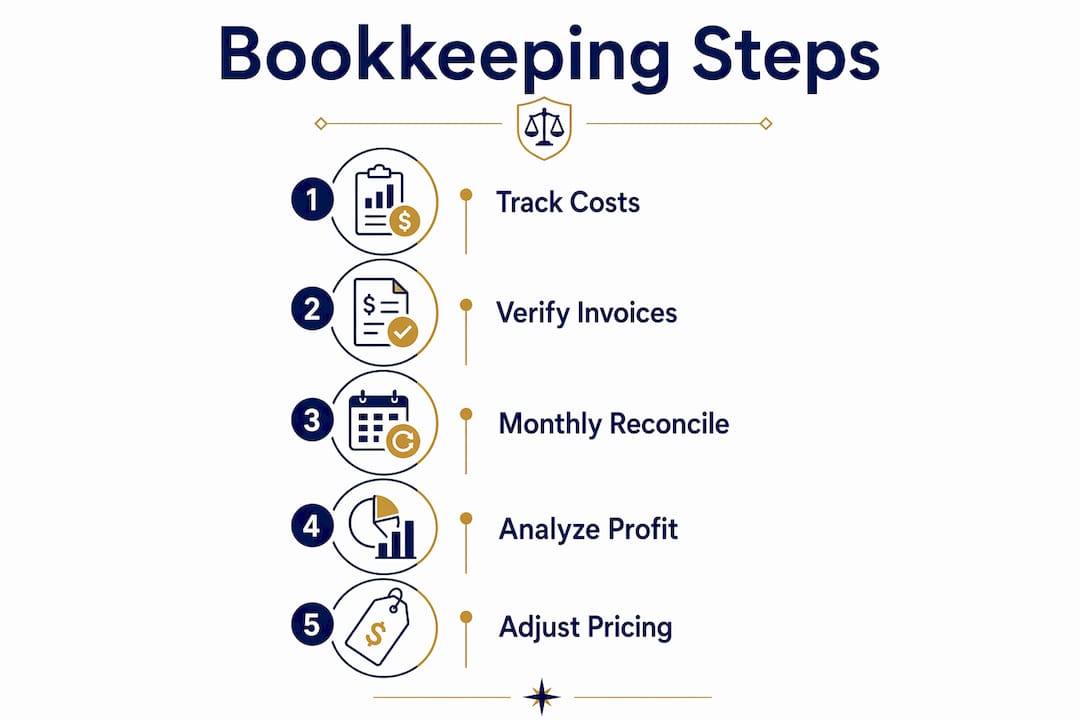
Pro Tip: Break your QuickBooks chart of accounts by service line or job type. If you run both installation and maintenance work, track costs separately for each. After 90 days, you will have the data to know which service line deserves more of your time and marketing budget.
Consider the difference between two approaches to pricing a recurring HVAC maintenance contract:
| Approach | Data used | Outcome |
|---|---|---|
| Gut-feel pricing | Competitor rates, rough labor estimate | Margin unknown, often underpriced |
| Bookkeeping-driven pricing | Actual job costs, labor hours, overhead allocation | Margin visible, pricing adjusted to target |
The second approach requires nothing more than accurate books and a monthly review. It is not complicated. It is just disciplined.
What are the best bookkeeping practices for service business profitability?
Bookkeeping best practices for profits are not about doing more work. They are about doing the right work consistently. Most profitability problems in small service businesses trace back to three root causes: books that are months behind, costs coded to the wrong categories, and no regular review of what the numbers are saying.
Build a monthly bookkeeping cadence
The most important bookkeeping practice is consistency. Monthly reconciliations, monthly P&L reviews, and monthly cash flow projections create a rhythm that catches problems early. Accurate bookkeeping significantly impacts decision quality in small businesses, and that impact compounds when the data is current rather than three months stale.
A reliable monthly cadence looks like this:
- Reconcile all bank and credit card accounts by the 5th of each month
- Categorize all transactions correctly before closing the books
- Run a profit and loss report and compare it to the prior month and prior year
- Review accounts receivable aging and follow up on anything over 30 days
- Check cash flow projections against actual results and update the forecast
Use digital tools to maintain accuracy
Digital transformation in bookkeeping improves accuracy independent of the owner’s financial background. QuickBooks Online, for example, connects directly to your bank accounts, automates transaction imports, and flags duplicates before they distort your reports. Tools like Hubdoc or Dext capture receipts digitally and match them to transactions automatically, eliminating the shoebox problem that causes so many small business books to fall apart.
The goal is not to replace judgment with software. The goal is to remove the manual friction that causes bookkeeping to fall behind, because books that are behind are books that cannot help you make decisions.
- Connect all bank accounts and credit cards to your accounting software
- Use receipt capture apps to eliminate paper-based expense tracking
- Set up recurring transaction rules for predictable expenses like rent and insurance
- Schedule a weekly 20-minute bookkeeping review to catch errors before they pile up
Pro Tip: If your books are more than two months behind, do not try to catch up yourself. A QuickBooks cleanup project with a professional will cost less than the tax penalties and missed deductions that come from disorganized records. You can explore fixed-price bookkeeping options that make ongoing costs predictable.
What bookkeeping mistakes are quietly killing your profits?
Poor bookkeeping does not just create compliance problems. It actively distorts your view of profitability and leads to decisions that cost you money. The damage is often invisible until it is significant.
Timing and classification errors mask true profitability in ways that mislead even experienced owners. An owner who looks only at the bank balance on the 15th of the month may feel confident about performance, while the actual P&L for that period shows a loss. Cash timing and profit are two different measurements, and confusing them leads to overspending, under-saving for taxes, and missed warning signs.
Here are the most common bookkeeping mistakes that erode profitability in service businesses:
- Misclassifying expenses by coding job costs as overhead, or vice versa, which distorts gross margin and makes pricing decisions unreliable
- Recording revenue in the wrong period by booking a large job payment in the month it was received rather than the month the work was completed, which inflates one month and deflates another
- Ignoring accounts payable aging and missing early payment discounts or incurring late fees that reduce net profit quietly over time
- Mixing personal and business expenses in the same accounts, which creates tax problems and makes it impossible to read your true business performance
- Skipping monthly reconciliations and allowing unrecorded transactions to accumulate, which means your P&L is fiction until someone cleans it up
Cash flow control and financial resilience mediated 44.7% of variance in SME financial performance in published research. That number tells you that how well you manage the mechanics of your finances, including your bookkeeping, accounts for nearly half of the difference between businesses that perform well and those that struggle. This is not a minor administrative function. It is a core driver of business outcomes.
The hidden tax surprise is worth calling out specifically. When bookkeeping is disorganized, owners often underestimate taxable income throughout the year and face a large, unexpected tax bill in April. That bill then creates a cash flow crisis that forces bad decisions, like delaying payroll, skipping equipment maintenance, or drawing down a line of credit unnecessarily. Clean books prevent that chain reaction.
Key takeaways
Accurate, current bookkeeping is the single most direct lever service business owners control to improve profitability, cash flow, and pricing decisions.
| Point | Details |
|---|---|
| Bookkeeping drives profitability | Accurate books reveal margin by job, client, and service line so you can price and cut costs with confidence. |
| Invoice accuracy speeds cash flow | Fixing invoice errors upstream shortens the cash conversion cycle faster than any collections strategy. |
| Monthly close cadence is non-negotiable | Books closed by the 5th of each month give you current data to catch problems before they compound. |
| Job-level cost capture changes pricing | Tracking costs by job or service line exposes which work is profitable and which is not worth doing. |
| Poor bookkeeping creates hidden losses | Misclassification, timing errors, and missed reconciliations distort profit and generate tax surprises. |
Why I think most service businesses are leaving money on the table
I have spent more than 20 years building and operating service businesses, and the pattern I see most often is this: a business owner works incredibly hard, generates solid revenue, and still cannot figure out why there is never enough money at the end of the month. The answer is almost always in the books, or more accurately, in the absence of good books.
Most owners treat bookkeeping as something that happens after the real work is done. It is the task you hand off to a part-time bookkeeper or a family member with a QuickBooks login, and you check in once a year when taxes are due. That approach is not just inefficient. It is expensive. I have seen HVAC companies discover they were losing money on their most popular service call type only after we rebuilt their books and ran a proper job cost analysis. They had been doing that work for two years at a loss while their bank balance stayed positive because other jobs were subsidizing it.
The businesses that grow profitably are the ones where the owner reviews a clean P&L every month, knows their gross margin by service line, and uses that data to make pricing and hiring decisions. That is not a CFO-level skill. It requires accurate books and a monthly habit of reading them. Industry-specific bookkeeping makes this easier because the chart of accounts and reporting structure are built for how your business actually operates, not for a generic small business template.
My recommendation is simple. Get your books current, set up job-level cost tracking, and commit to a monthly review. If you do not have time for that, outsource it to someone who treats your numbers as a business tool, not a tax form.
— Tony
See what clean books can do for your bottom line
If your books are behind, your costs are not tracked by job, or you are not sure where your profits are actually coming from, TrueMeasure Accounting can help you get clear fast.
TrueMeasure Accounting works with owner-operated service businesses across the country, from HVAC and plumbing companies to contractors and property managers, providing expert bookkeeping services that go beyond data entry. We connect your financial data to real business decisions: pricing, hiring, cash flow, and growth. Our clients get accurate monthly financials, job-level cost reporting, and a financial partner who understands how service businesses actually operate. Contact TrueMeasure Accounting today for a free profitability assessment and find out exactly where your numbers stand.
FAQ
What is the role of bookkeeping in profitability?
Bookkeeping converts daily financial transactions into accurate profit-and-loss data that reveals margins, cash flow gaps, and cost problems. Without it, pricing and spending decisions are based on guesswork rather than facts.
How does bookkeeping boost profitability in a service business?
Bookkeeping boosts profitability by tracking job-level costs, catching invoice errors that delay cash, and producing monthly reports that show which service lines are generating returns and which are not.
How often should a small business reconcile its books?
Monthly reconciliation is the minimum standard, with weekly transaction reviews recommended for businesses processing high invoice volumes. Closing books by the 5th of each month gives owners current data for real decisions.
Can poor bookkeeping cause a profitable business to fail?
Yes. Timing and classification errors can make a losing business look profitable on paper, leading owners to overspend, underprice, and miss tax obligations until the damage is severe.
What bookkeeping tools work best for service businesses?
QuickBooks Online is the most widely used platform for service businesses, with tools like Hubdoc and Dext handling receipt capture and expense matching. The right setup depends on your volume, service lines, and reporting needs.
Recommended
- Small Business Bookkeeping Services | TrueMeasure Accounting
- Automated vs. Human Bookkeeping: Why Your Business Need Both? – TrueMeasure Accounting LLC-Small Business Accounting Services
- Industries-specific bookkeeping services | TrueMeasure Accounting
- How to Set Up Bookkeeping for a Trucking Company