
Reducing tax liability for a service company is defined as the process of legally minimizing the federal and state taxes your business owes through proactive planning, not reactive filing. Most service business owners earning between $250,000 and $5 million annually pay far more in taxes than they should. The reason is simple: they rely on default accountant recommendations that made sense at $150,000 in revenue but become expensive habits at $500,000 and above. The real opportunity lies in retirement plan design, income timing, entity structure, and owner compensation. These are the four levers that separate businesses that reduce tax liability from those that simply report it.
What does it take to reduce tax liability in a service company?
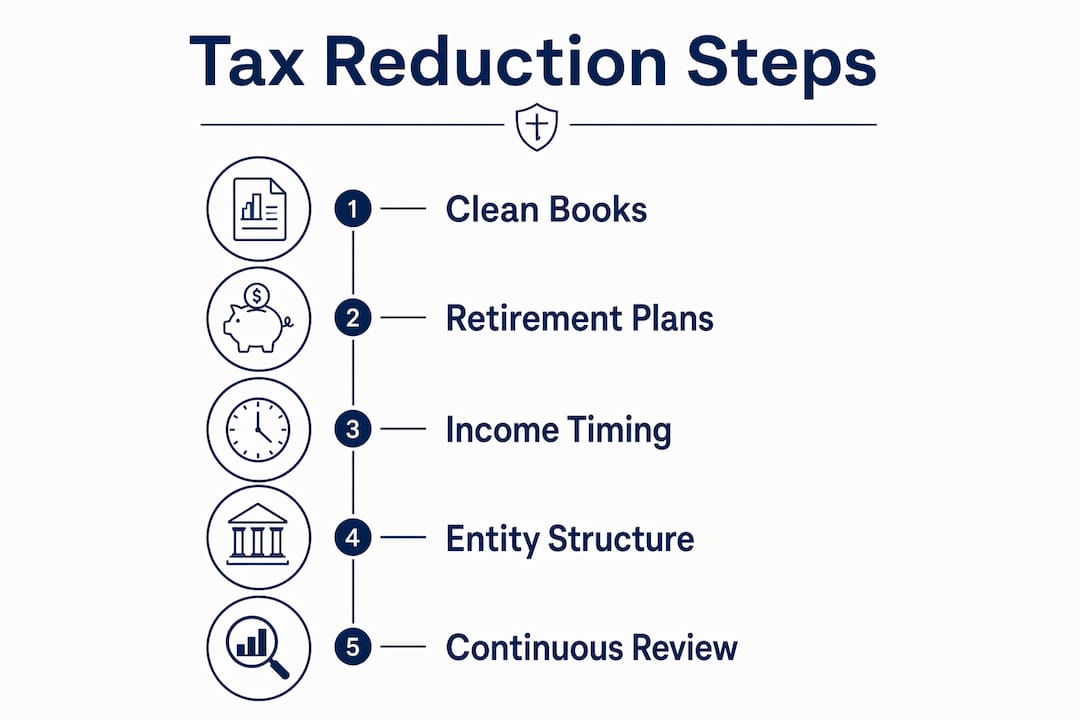
Effective tax liability management starts with one thing: clean, detailed financial data. You cannot plan around numbers you do not trust. If your books are messy, your tax advisor is guessing, and guessing costs you money.
The foundation is a financial reporting system that gives you a real-time view of revenue, expenses, and net income by month. This means accurate monthly bookkeeping, reconciled accounts, and categorized expenses. Without this, identifying deductions like home office costs, equipment purchases, and retirement contributions becomes a manual scramble at year-end instead of a year-round practice. The qualified business income deduction alone can allow eligible owners to deduct up to 20% of qualified business income. Missing it because your books were not ready is an expensive oversight.
Beyond clean books, you need a tax advisor who understands service businesses specifically. A general CPA who handles personal returns and a few small businesses is not the same as a tax strategist who works with HVAC companies, contractors, or trucking operations. The difference shows up in the strategies they recommend and the questions they ask.
Here is what a solid tax reduction foundation looks like for a service company:
- Accurate monthly bookkeeping with expense categories aligned to IRS deduction categories
- Quarterly financial reviews to identify income trends and plan deductions before year-end
- A tax advisor relationship that involves proactive conversations, not just annual filing
- Entity structure review at least once per year as income grows
- Retirement plan selection matched to your income level and cash flow needs
- Tracking of all business-use assets for depreciation and Section 179 deduction eligibility
Pro Tip: Set a recurring calendar reminder every quarter to review your year-to-date income with your tax advisor. Tax decisions made in october and november are far more powerful than anything you can do in april.
How retirement plan design can reduce your taxable income
Retirement plans are the single most underused tax reduction tool available to profitable service business owners. Most owners default to a SEP-IRA or a basic 401(k) because their accountant set it up years ago and nobody revisited it. That default costs them tens of thousands of dollars annually.

Defined benefit plans can shelter $70,000 to over $300,000 annually from federal taxable income for profitable businesses. That is not a typo. A service business owner earning $600,000 in net profit could potentially shelter a significant portion of that income from federal taxes entirely through a well-structured defined benefit plan. That number dwarfs what a SEP-IRA or solo 401(k) can offer.
Here is how the main retirement plan options compare for service business owners:
| Plan Type | 2026 Contribution Limit | Best For | Complexity |
|---|---|---|---|
| SEP-IRA | Up to 25% of compensation | Solo owners with variable income | Low |
| Solo 401(k) | Up to $70,000 (employee + employer) | Self-employed with no employees | Moderate |
| Defined Benefit Plan | $70,000 to $300,000+ depending on income and age | High-income owners over 45 | High |
| SIMPLE IRA | Up to $16,500 | Small teams, lower income | Low |
The defined benefit plan requires actuarial work each year to calculate the exact contribution amount. That adds cost and complexity. But for a business owner in their 50s earning $400,000 or more, the tax savings dwarf the administrative cost by a wide margin. The IRS increased contribution limits for 2026, which creates even more room to shelter income through retirement vehicles.
The mistake most owners make is treating retirement plans as a personal finance decision rather than a business tax strategy. They are both. Every dollar you contribute to a qualified retirement plan reduces your taxable business income dollar for dollar.
Pro Tip: If your net business income has grown past $300,000 and you are still using a SEP-IRA, ask your advisor to model a defined benefit plan. The numbers often surprise people.
How does income and expense timing lower your tax bill?
Timing is one of the most direct and legal ways to control how much tax you owe in a given year. Cash-basis businesses, which include most service companies, have significant flexibility here. Accelerating deductions into the current year and deferring income to the next is straightforward, legal, and often overlooked.
The mechanics are not complicated. The strategy requires discipline and planning throughout the year.
-
Accelerate deductible expenses. If you plan to buy equipment, vehicles, or software in the first quarter of next year, consider purchasing before december 31 instead. Section 179 allows you to deduct the full cost of qualifying equipment in the year of purchase rather than depreciating it over several years.
-
Defer invoicing when appropriate. A cash-basis service company that completes a large job in late december can choose to invoice in january. The revenue then falls into the next tax year. This is legal and common. Do not abuse it, but use it deliberately.
-
Prepay deductible expenses. Prepaying up to 12 months of business insurance, software subscriptions, or rent can pull those deductions into the current year.
-
Use tax-loss harvesting on investments. Selling losing investments before year-end to realize losses offsets capital gains and reduces overall taxable income. This applies to business owners who hold investments personally or through the business.
-
Review accounts payable timing. Pay outstanding vendor invoices before year-end if you are on a cash basis. Those payments become deductions in the current year.
The biggest mistake service business owners make with timing is waiting until january to think about it. By then, the year is closed. The tax deductions available to service businesses are most powerful when planned months in advance, not discovered after the fact.
What role does entity structure play in reducing taxes?
Your business entity is not just a legal formality. It is one of the most direct drivers of how much self-employment and payroll tax you pay every year. For service companies, the difference between a single-member LLC and an S-corporation can mean tens of thousands of dollars annually.
S-corp election reduces self-employment taxes by converting part of your income from salary to distributions. Here is how it works in practice:
- A single-member LLC owner who earns $300,000 in net profit pays self-employment tax on the entire $300,000. At 15.3% on the first $168,600 and 2.9% above that, the tax bill is substantial.
- An S-corp owner who earns $300,000 can pay themselves a reasonable salary of, say, $120,000 and take the remaining $180,000 as a distribution. Payroll taxes apply only to the salary portion.
The savings from this structure can be significant. But the word “reasonable” matters. The IRS requires that S-corp owner-employees receive compensation that reflects fair market value for their role. Paying yourself $30,000 while taking $270,000 in distributions on a $300,000 profit is a red flag. Owner compensation classification between salary and distributions impacts payroll and self-employment tax liability significantly, and the IRS scrutinizes it.
Beyond the S-corp question, your entity structure should be reviewed annually as income grows. Most business owners use legacy structures despite income growth over $500,000, leading to unnecessary tax leakage. What worked at $200,000 in revenue may be costing you money at $800,000. A service company that started as a sole proprietorship and grew to $1.5 million in revenue without revisiting its structure is almost certainly overpaying taxes.
The professional service firm tax guide from Truemeasureaccounting covers entity-specific strategies in detail for firms in consulting, healthcare, legal, and other service sectors.
Common pitfalls that cause ongoing tax leakage
The most expensive tax mistakes service business owners make are not dramatic errors. They are quiet, recurring oversights that compound year after year.
The first and most common is treating tax planning as a year-end activity. Tax planning must occur year-round, with meaningful decisions made in Q2 through Q4. Decisions made at the filing deadline are too late to change the outcome. By april, the tax year is already written. The only thing left to do is report it.
The second pitfall is failing to update retirement and entity structures as income grows. A business owner who set up a SEP-IRA at $180,000 in revenue and never revisited it at $700,000 is leaving a substantial deduction on the table every single year. Regular review of retirement and entity structures is critical to avoiding tax inefficiencies as business income grows.
The third pitfall is poor expense documentation. Deductions for home office use, vehicle mileage, meals, and equipment require documentation. Owners who cannot substantiate these deductions lose them in an audit. Clean books and organized receipts are not just good practice. They are the defense that makes your deductions stick.
Pro Tip: Schedule a mid-year tax check-in with your advisor every june or july. Review your year-to-date income, estimate your full-year tax liability, and adjust your strategy while you still have time to act. This single habit eliminates most year-end tax surprises.
The year-end tax planning checklist from Truemeasureaccounting walks through the specific steps service business owners should complete each quarter to stay ahead of their tax liability.
Key Takeaways
Proactive tax liability management through retirement plan design, entity structure, and income timing is the most reliable way for service business owners to reduce what they owe the IRS each year.
| Point | Details |
|---|---|
| Clean books come first | Accurate monthly financials are the prerequisite for every tax reduction strategy. |
| Retirement plans shelter the most income | Defined benefit plans can shelter $70,000 to $300,000+ annually for profitable owners. |
| Entity structure drives payroll tax savings | S-corp election reduces self-employment taxes by splitting income between salary and distributions. |
| Timing controls current-year liability | Cash-basis owners can accelerate deductions and defer income legally to shift tax burden. |
| Year-round planning beats year-end scrambling | Tax decisions made in Q2 through Q4 produce far better outcomes than last-minute filing adjustments. |
What I’ve learned from working with service business owners on taxes
Most service business owners I work with are not bad at running their businesses. They are great at it. What they are missing is a financial partner who connects their operational decisions to their tax outcomes.
The owners who pay the least in taxes are not doing anything exotic. They are doing the basics exceptionally well. They have clean books. They meet with their advisor quarterly. They revisited their entity structure when their income crossed $400,000. They set up a defined benefit plan when the numbers justified it. None of that is complicated. But it requires someone in their corner who is paying attention throughout the year, not just in march.
What I see most often is the opposite. A business owner who has grown from $300,000 to $1.2 million in revenue over five years and is still operating with the same structure, the same retirement plan, and the same tax approach they had at the start. The business grew. The tax strategy did not. That gap is where the money goes.
The mindset shift that matters most is moving from compliance to strategy. Filing your taxes correctly is the floor, not the ceiling. The ceiling is building a financial operation where every major business decision, including when to invoice, what to buy, how to pay yourself, and how to structure your retirement, is made with tax consequences in mind. That is what separates owners who build real wealth from those who work hard and wonder where the money went.
— Tony
How Truemeasureaccounting helps service companies cut their tax bill
Truemeasureaccounting works with owner-operated service businesses across the country to build the financial foundation that makes real tax reduction possible. That starts with accurate bookkeeping services that give you clean, trustworthy numbers every month.
From there, the team connects your financial data to proactive tax strategy, including retirement plan analysis, entity structure review, and income timing planning. These are not one-time conversations. They are built into how Truemeasureaccounting works with clients throughout the year. If you are generating $250,000 to $5 million in revenue and want to know exactly how much you could be saving, schedule a free consultation and get a clear picture of where your tax dollars are going and how to keep more of them.
FAQ
What is the most effective way to reduce tax liability for a service company?
The most effective approach combines retirement plan optimization, S-corp election, and income timing strategies. Each lever reduces taxable income from a different angle, and together they produce the largest savings.
How much can a defined benefit plan reduce my taxable income?
Defined benefit plans can shelter $70,000 to over $300,000 annually from federal taxable income, depending on your income level and age. They offer the highest tax shelter potential of any retirement vehicle available to small business owners.
When should I switch my LLC to an S-corp?
Most tax advisors recommend evaluating an S-corp election when net business profit consistently exceeds $50,000 to $80,000 annually. The payroll tax savings from splitting income between salary and distributions typically outweigh the added administrative costs at that income level.
Is tax planning something I should do once a year?
No. True tax planning is a year-round process, with the most impactful decisions made between Q2 and Q4. Waiting until the filing deadline leaves almost no room to change your tax outcome.
What records do I need to support my business tax deductions?
You need receipts, invoices, mileage logs, and documentation showing the business purpose for each deduction. Clean monthly bookkeeping makes this automatic rather than a last-minute scramble before filing.