

Healthcare business owners can legally reduce their tax liability by tens of thousands of dollars each year through targeted deductions, the right business structure, and proactive retirement planning. The industry term for this process is tax planning, and it goes far beyond filing a return on time. For practices generating between $250,000 and $5 million annually, the difference between reactive and proactive tax planning often equals a full employee’s salary. This guide covers the specific strategies that work in 2026, including updated IRS mileage rates, retirement contribution limits, and the S-Corp election deadline that most healthcare owners miss.
What are the key healthcare-specific tax deductions owners miss?
Healthcare business owners can deduct professional operating costs including malpractice insurance, cyber liability insurance for HIPAA compliance, conference registrations, and continuing education unit (CEU) expenses. These deductions are industry-specific and frequently overlooked, which means they represent real money left on the table every year. A solo physician paying $18,000 annually in malpractice premiums and $3,000 in CEU costs has $21,000 in deductible expenses before touching anything else.
Vehicle use is another area where healthcare owners consistently underreport. The 2026 standard mileage rate for business use is $0.72 per mile. A physician driving 10,000 business miles per year generates a $7,200 deduction from mileage alone. That number compounds quickly for owners who travel between multiple clinic locations or make regular hospital rounds.
The deductions most owners miss entirely fall into three categories:
- Medical equipment and technology. Diagnostic devices, exam tables, and telehealth platforms purchased for business use are deductible. Bonus depreciation rules may allow you to deduct the full cost in the year of purchase rather than spreading it over several years.
- Telehealth home office. If you conduct telehealth visits from a dedicated room at home, that space qualifies for the home office deduction. The IRS requires the space to be used exclusively and regularly for business, and you calculate the deduction using the square footage of that room divided by your home’s total square footage.
- Professional subscriptions and software. Electronic health record (EHR) software subscriptions, medical journal memberships, and billing software fees are all deductible business expenses.
- Employee benefits. Health insurance premiums paid for staff, retirement plan contributions on behalf of employees, and professional development costs for your team all reduce your taxable income.
Pro Tip: Keep a dedicated folder, either physical or digital, for every receipt tied to your practice. Separate your personal and business expenses at the transaction level. The IRS does not accept estimates, and mixed records are the fastest path to a disallowed deduction.
Recordkeeping is not optional here. It is the foundation that makes every deduction defensible. Healthcare owners who treat recordkeeping as an afterthought often lose legitimate deductions during an audit simply because they cannot produce documentation.
How can the right business structure reduce tax liability?
Business structure is one of the highest-leverage decisions a healthcare owner makes. Most solo practitioners start as sole proprietors or single-member LLCs, which means every dollar of profit is subject to self-employment tax at 15.3% on top of income tax. That rate applies to the first $176,100 of net earnings in 2026, with the Medicare portion continuing above that threshold.

The S-Corp election changes this math significantly. S-Corp election saves healthcare practices earning $150,000 or more in profit between $15,000 and $25,000 annually in payroll taxes. That is not a rounding error. That is a meaningful reduction that compounds every year you operate under the right structure.
Here is how the S-Corp election works in practice:
- Form an LLC or corporation. Your practice must be a legal entity before you can elect S-Corp tax treatment.
- File Form 2553 with the IRS. To elect S-Corp status for the 2026 tax year, you must file by march 15, 2026. Missing this deadline pushes the election to 2027.
- Set a reasonable salary. As an S-Corp owner, you must pay yourself a salary that reflects what the market would pay for your role. The IRS scrutinizes this number closely.
- Take remaining profit as a distribution. Distributions are not subject to payroll taxes. This is where the savings come from. If your practice earns $300,000 and you pay yourself a $150,000 salary, the remaining $150,000 in distributions avoids the 15.3% self-employment tax.
- Account for administrative costs. Running payroll adds costs, typically $1,500 to $3,000 per year in payroll processing fees. Factor this into your savings calculation before electing.
Pro Tip: The S-Corp election is not right for every practice. If your net profit is below $80,000 to $100,000, the administrative costs may outweigh the tax savings. Run the numbers with a tax advisor before filing Form 2553.
The LLC structure itself also offers flexibility. A multi-member LLC taxed as a partnership allows profit-sharing arrangements that a sole proprietorship cannot. For group practices with two or more physician owners, this structure can create additional planning opportunities around how income is allocated and taxed.
What role do retirement accounts play in reducing taxable income?
Retirement accounts are the most underused tax reduction tool available to healthcare business owners. The IRS allows self-employed owners to contribute to SEP-IRAs and Solo 401(k) plans, and the 2026 contribution limits are substantial: up to $72,000, or $80,000 if you are age 50 or older. Every dollar contributed reduces your taxable income dollar for dollar.
| Account Type | 2026 Contribution Limit | Key Advantage |
|---|---|---|
| SEP-IRA | Up to $72,000 | Simple to set up, contributions due by tax filing deadline |
| Solo 401(k) | Up to $72,000 ($80,000 age 50+) | Allows both employee and employer contributions |
| HSA (with HDHP) | $4,300 individual / $8,550 family | Triple-tax advantage: pre-tax in, tax-free growth, tax-free out |
Health Savings Accounts deserve special attention. HSAs offer triple-tax advantages: contributions are pre-tax, growth is tax-free, and withdrawals for qualified medical expenses are tax-free. For a healthcare owner enrolled in a high-deductible health plan, an HSA functions as both a tax shelter and a long-term savings vehicle.
The timing of retirement contributions also matters:
- SEP-IRA contributions can be made up to your tax filing deadline, including extensions. This means you can wait until october of the following year to decide how much to contribute.
- Solo 401(k) employee contributions must be made by december 31 of the tax year. Employer contributions can follow the filing deadline.
- Year-end planning should include a projection of your net income so you can maximize contributions without overcontributing.
A healthcare owner earning $400,000 in net profit who maxes out a Solo 401(k) at $72,000 reduces their taxable income to $328,000 before any other deductions. At a combined federal and state marginal rate of 40%, that single move saves roughly $28,800 in taxes. The money does not disappear. It grows tax-deferred until retirement.
How to manage tax payments and avoid IRS penalties
Underpayment of quarterly estimated taxes carries real consequences. Failing to pay quarterly results in IRS penalties of 3–8% even when you pay the full balance at filing. For a practice owing $80,000 in annual taxes, an 8% penalty adds $6,400 in avoidable costs.
The fix is straightforward. Set aside 25–30% of your net income each month into a separate tax account. Make quarterly estimated payments by the IRS deadlines: april 15, june 16, september 15, and january 15 of the following year. Consistent payments protect you from penalties and prevent the cash flow shock of a large year-end bill.
Year-end tax planning creates additional opportunities to cut your bill before december 31:
- Accelerate deductible expenses. Pay your january malpractice premium in december. Prepay professional subscriptions that renew in the first quarter. These payments shift deductions into the current tax year.
- Purchase equipment before year-end. Bonus depreciation on equipment allows you to deduct the full purchase price in the year of purchase rather than depreciating it over several years. A $30,000 ultrasound machine purchased in december generates a $30,000 deduction this year.
- Review the Qualified Business Income deduction. The QBI deduction allows self-employed providers to deduct up to 20% of qualified business income. Healthcare practices classified as Specified Service Trades or Businesses (SSTBs) face phaseouts at higher income levels, so this deduction requires careful income management.
- Max out retirement contributions. Use your year-end income projection to determine how much you can contribute to your SEP-IRA or Solo 401(k) before the deadline.
“The biggest tax mistakes I see healthcare owners make are not aggressive deductions. They are passive ones. Owners who do not track expenses, do not plan quarterly payments, and do not review their structure annually pay far more than they should. Tax reduction is not a year-end activity. It is a year-round discipline.”
Review your year-end tax planning checklist before november to give yourself enough time to act on every opportunity. Decisions made in december often have more impact than anything you do during tax season.
What recordkeeping practices protect your deductions in an audit?
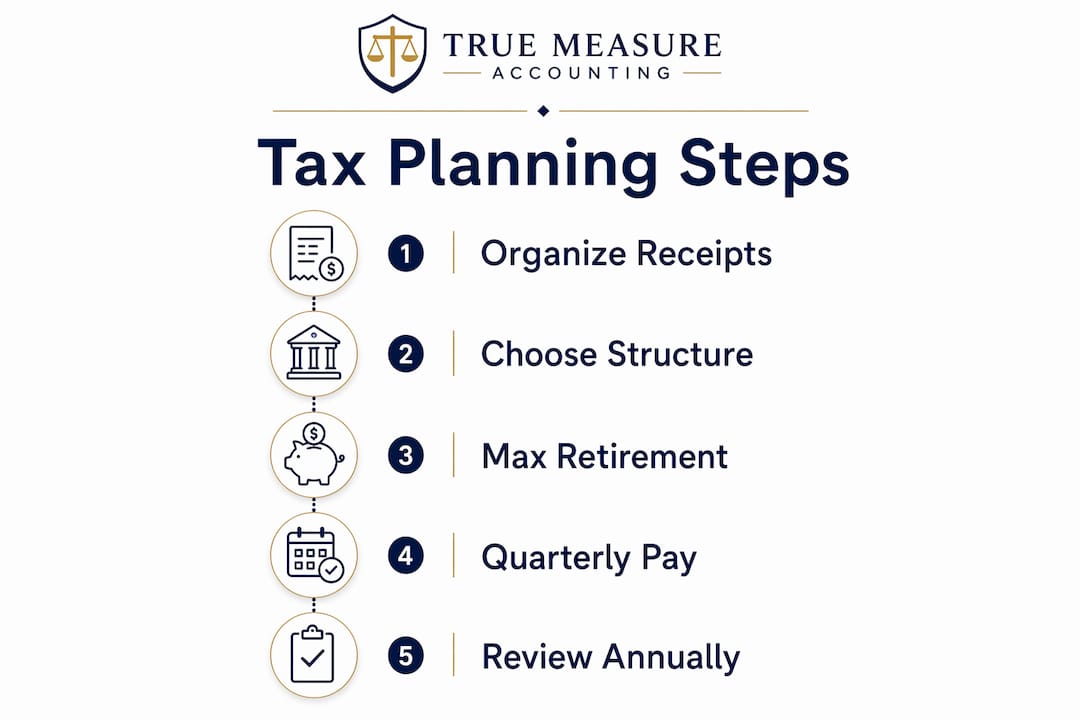
The IRS requires contemporaneous, detailed logs for mileage and home office deductions. Estimated or memory-based records are rejected on audit. This is not a technicality. It is the most common reason legitimate deductions get disallowed.
Strong recordkeeping for a healthcare practice covers these areas:
- Mileage logs. Record the date, destination, business purpose, and miles driven for every business trip. Apps like MileIQ or a simple spreadsheet work. The key is logging in real time, not reconstructing trips at year-end.
- Home office documentation. Measure the square footage of your dedicated workspace. Divide it by your home’s total square footage. That ratio applies to mortgage interest or rent, utilities, and internet costs. Keep a floor plan and photos in your records.
- Receipts for every deduction. Bank statements alone are not sufficient. The IRS wants itemized receipts that show what was purchased, not just the amount paid.
- Payroll records. If you operate as an S-Corp, your reasonable salary must be documented and consistent. Payroll records support your salary determination in an audit.
- Vendor contracts and invoices. For large equipment purchases or professional service fees, keep the original contract alongside the invoice and payment record.
Pro Tip: Set a recurring 15-minute task every Friday to review and file that week’s receipts and mileage. Fifteen minutes weekly prevents a 15-hour scramble in april. The practices that survive audits cleanly are the ones that treat recordkeeping as a weekly habit, not a tax-season event.
Audit risk in healthcare is real. The IRS pays close attention to practices with high deduction-to-revenue ratios, home office claims, and vehicle expenses. Solid documentation does not just protect you in an audit. It also gives your tax advisor the information needed to find every legitimate deduction you are entitled to claim. For more on reducing liability across professional service businesses, the tax strategies for service firms guide covers overlapping principles that apply directly to healthcare owners.
Key Takeaways
Healthcare business owners who plan proactively throughout the year, choose the right business structure, and document every deduction will consistently pay less in taxes than those who treat tax planning as a once-a-year event.
| Point | Details |
|---|---|
| S-Corp election saves real money | Practices earning $150,000+ in profit can save $15,000–$25,000 annually by filing Form 2553 by march 15. |
| Retirement accounts cut taxable income | SEP-IRA and Solo 401(k) contributions up to $72,000 reduce taxable income dollar for dollar. |
| Quarterly payments prevent penalties | Underpayment triggers 3–8% IRS penalties; set aside 25–30% of net income and pay on schedule. |
| Recordkeeping is non-negotiable | Contemporaneous mileage logs and home office documentation are required for deductions to survive an audit. |
| Year-end timing creates deductions | Accelerating expenses and equipment purchases before december 31 shifts deductions into the current tax year. |
What I’ve learned about tax planning for healthcare owners
Running a business for over 20 years taught me one thing about taxes that no accounting textbook covers: most owners overpay not because they lack deductions, but because they lack a system. They wait until march to think about what happened in january. By then, the window to act has already closed.
Healthcare owners face a specific version of this problem. Your practice generates strong revenue, but your overhead is high and your time is limited. Tax planning feels like something you will get to later. Later becomes april 14, and april 14 becomes a check written to the IRS that could have been smaller.
The owners I work with who pay the least in taxes share three habits. They track expenses in real time. They review their financial position quarterly, not annually. And they make structural decisions, like the S-Corp election or retirement account setup, before they need them, not after.
The QBI deduction phaseout is a good example of why timing matters. Healthcare practices classified as SSTBs lose access to this deduction as income rises. Owners who know this plan their income distributions and retirement contributions to stay below the phaseout threshold. Owners who find out in april cannot do anything about it.
Working with an advisor who understands healthcare tax issues specifically, not just general small business tax, makes a measurable difference. The deductions are real. The savings are real. But they require planning, not just filing.
— Tony
How Truemeasureaccounting helps healthcare owners cut their tax bill
Healthcare business owners who want to stop overpaying taxes need more than a bookkeeper. They need a financial partner who understands how a medical practice actually operates.
Truemeasureaccounting works with healthcare practices generating $250,000 to $5 million annually to build tax strategies that fit the real structure of their business. From specialized bookkeeping services that keep your records audit-ready year-round, to proactive tax planning that covers S-Corp elections, retirement account timing, and year-end deduction acceleration, the firm handles the financial side so you can focus on patient care. If you are ready to see what a structured tax plan looks like for your practice, schedule a free consultation and get a clear picture of where your money is going and how much you can keep.
FAQ
What is the most effective way to reduce taxes as a healthcare business owner?
The most effective approach combines S-Corp election, maximum retirement contributions, and consistent deduction tracking throughout the year. Practices earning $150,000 or more in profit typically save $15,000–$25,000 annually through S-Corp status alone.
What tax deductions do healthcare business owners most commonly miss?
Healthcare owners most often miss malpractice insurance premiums, HIPAA cyber liability coverage, CEU expenses, telehealth home office deductions, and the full mileage deduction at $0.72 per mile for 2026.
How much should a healthcare business owner set aside for taxes?
Set aside 25–30% of net income each month into a dedicated tax account. Make quarterly estimated payments by the IRS deadlines to avoid penalties of 3–8% on underpaid amounts.
Can a healthcare owner deduct retirement contributions?
Yes. SEP-IRA and Solo 401(k) contributions up to $72,000 in 2026 ($80,000 if age 50 or older) are fully deductible and reduce taxable income dollar for dollar. Contributions can be made up to the tax filing deadline, including extensions.
What records does the IRS require to support a home office deduction for telehealth?
The IRS requires documentation of the room’s exclusive business use, the square footage of the dedicated space, and the total square footage of the home. Estimated or reconstructed records are rejected on audit; contemporaneous documentation is required.