
A cash flow forecast is a forward-looking estimate of the actual cash coming into and going out of your business over a defined period. Unlike your profit and loss statement, it tracks when money moves, not whether you’re profitable on paper. For small business owners in HVAC, construction, trucking, or any service trade, that timing difference is where businesses get into trouble.
To create a cash flow forecast for your small business, you need six core elements:
- Opening cash balance: Your actual available bank balance today
- Customer collections: Expected deposits by the date they clear, not invoice date
- Other inflows: Financing proceeds, asset sales, owner contributions
- Payroll and payroll taxes: Wages, contractor payments, employer tax deposits on exact dates
- Operating outflows: Rent, materials, insurance, software, debt service, owner draws
- Taxes: Sales tax, estimated income tax, quarterly IRS payments
Most small businesses run two forecast horizons. A 13-week rolling forecast covers one quarter, long enough to catch payroll cycles, tax dates, and seasonal dips while staying close enough to reality for weekly updates. A 12-month monthly forecast serves annual planning and SBA loan applications. Both serve different needs and can run simultaneously.
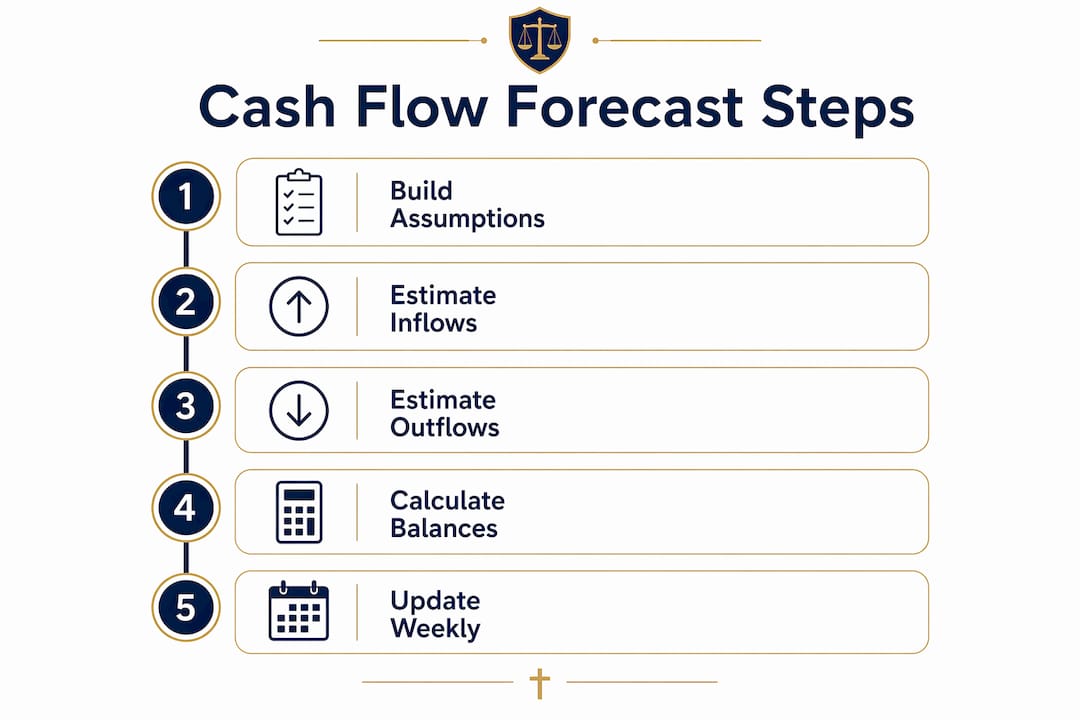
Step 1: Build your assumptions about receivables and payables
Your forecast is only as reliable as the assumptions underneath it. Garbage assumptions produce a false sense of security, and that’s where most cash crises begin.

Start with your receivables. How long do customers actually take to pay? An HVAC contractor billing net-30 may collect in 45 days in practice. A general contractor waiting on a GC draw may wait 60 days or longer. Use your real collection history, not your invoice terms.
On the payables side, separate your obligations into three buckets:
- Fixed and dated: Payroll, rent, loan payments, insurance premiums. These hit on specific dates and cannot move.
- Variable: Materials, subcontractors, fuel. These fluctuate with job volume.
- Irregular: Quarterly estimated taxes (due April 15, June 15, September 15, and January 15), annual renewals, equipment maintenance. Easy to forget, painful when they arrive.
Seasonality matters too. A plumbing company sees emergency call volume spike in winter. A landscaping contractor sees revenue compress in December and January. Build those patterns into your assumptions before you touch a single number. Always lean conservative on inflows and realistic on outflows.
Step 2: List and estimate all your cash inflows
Every dollar you expect to receive needs a date attached to it, and that date is when the cash clears your bank account, not when you sent the invoice.
Common inflow categories for service businesses:
- Customer payments: Open invoices, recurring billing, progress draws on projects
- Milestone or deposit payments: Common in construction and contracting
- Financing proceeds: SBA loan disbursements, equipment financing, line of credit draws
- Asset sales: Equipment disposals, vehicle sales
- Refunds: Tax refunds, vendor credits, insurance reimbursements
For client billing and collections, tracking open invoices by expected payment date is the most critical discipline. A signed proposal is not cash. An invoice is not cash. If a customer routinely pays 15 days late, model that delay every single time.
Use conservative estimates throughout. Planning around optimistic projections and coming up short does far more damage than building in a buffer and finishing ahead. Keep uncertain deals, disputed invoices, or speculative sales in a separate scenario, not your base forecast.

Step 3: List and estimate all your cash outflows
Outflows are where most forecasts fall apart. Business owners list the obvious ones and forget the rest until the bank account takes the hit.
Work through your last three months of bank statements rather than relying on memory. You will almost always find something you missed. Organize outflows by category:
- Payroll and contractor payments: Enter on exact pay dates. Payroll for field crews is typically the least flexible outflow in any service business. It goes in the forecast first.
- Payroll taxes: Federal and state deposits due on specific schedules, not monthly averages.
- Rent and utilities: Fixed amounts, predictable dates.
- Suppliers and materials: Due dates on vendor invoices, not when you receive the goods.
- Loan and equipment payments: Committed regardless of revenue.
- Owner draws: If money leaves the business account, it belongs in the forecast.
- Taxes: Quarterly estimated payments, sales tax remittances, property tax.
- Annual and periodic costs: Software renewals, license fees, professional fees, equipment maintenance.
Pay on the due date, not before. Early payments reduce your liquidity without improving vendor relationships. And never hide payroll inside a monthly average. It’s too time-sensitive to blur.
Step 4: Compile your forecast and calculate running balances
Once you have your inflows and outflows mapped, the math is straightforward. Set up a spreadsheet with time periods across the columns (weeks or months) and cash categories along the rows.
The formula for each period:
Closing Balance = Opening Balance + Total Inflows − Total Outflows
That closing balance rolls forward as the opening balance for the next period. Here’s a simplified three-month example:
| Line Item | January | February | March |
|---|---|---|---|
| Opening Balance | — | — | — |
| Customer Payments | — | — | — |
| Total Inflows | — | — | — |
| Payroll | — | — | — |
| Rent | — | — | — |
| Suppliers | — | — | — |
| Taxes | — | — | — |
| New Equipment | — | — | — |
| Total Outflows | — | — | — |
| Closing Balance | — | — | — |
March shows a significant drop. That’s the forecast doing exactly what it’s supposed to do. You now have weeks to respond: accelerate collections, delay the equipment purchase, or arrange a line of credit before the gap arrives.
Set a minimum cash floor, a specific dollar amount below which you take action. When any projected week falls below that floor, it triggers a decision, not a panic.
Strategies to improve accuracy and keep your forecast current
A forecast you build once and never update is just a spreadsheet. The value comes from treating it as a live management tool.
- Update weekly with actuals. Replace estimates with real bank activity every week. A short-term forecast refreshed weekly stays tied to reality.
- Run variance analysis. Compare what you projected to what actually happened. Did collections arrive late? Did a job require more materials? Understanding why the forecast was wrong sharpens every future assumption.
- Keep the base case conservative. Confirmed receipts go in the main forecast. Uncertain deals stay in a separate scenario tab.
- Segment your risks. Seasonal dips, large project timing, inventory cycles, and customer concentration each deserve their own line of sight in the forecast.
- Establish a non-negotiable cash buffer. Treat reserve cash as operating infrastructure, not leftover money. Before approving non-essential spending, confirm you’re above your floor.
- Build a downside scenario. Model what happens if your two largest customers pay 30 days late. If the business survives that scenario, you can make decisions with real confidence.
Pro Tip: Enter payroll first, before any other outflow. It’s the least flexible obligation in your business, and every other spending decision should be made with payroll already accounted for.
The financial visibility that comes from a weekly updated forecast changes how you run the business. You stop reacting to bank balance surprises and start making decisions from a position of clarity.
What experienced operators know about cash flow that the numbers don’t show
A large majority of small business failures are caused by cash flow problems, not lack of profitability. That number shows up repeatedly in business failure research, and it reflects a reality every contractor, trucking operator, and service business owner eventually faces: you can be busy, profitable on paper, and still miss payroll.
The gap between profit and cash is a timing problem. Revenue recognized in your P&L and cash deposited in your bank account are two different events, often separated by weeks.
The most common cash flow mistakes experienced operators see:
- Using invoice dates instead of payment dates for inflows. This creates false security and leads directly to cash crises.
- Ignoring irregular outflows like quarterly taxes or annual insurance renewals until they hit.
- Treating the owner’s draw as flexible when the business hasn’t actually generated the cash yet.
- Skipping the weekly review because things “seem fine,” then getting blindsided by a slow collection week colliding with a payroll date.
- Modeling one scenario only. A single base case with no downside view leaves you unprepared for the week that actually matters.
Delays in collections, high discretionary spending, and poor timing are the main drivers of cash shortfalls identified by forecast analysis. The fix isn’t complicated. It’s discipline: update the forecast weekly, review it in your management meeting, and assign a named owner to every corrective action.
At Truemeasureaccounting, we work with owner-operated businesses across construction, HVAC, trucking, and professional services who are profitable but cash-stressed. The forecast is always the starting point. It turns vague financial anxiety into a specific dated decision. Which week gets tight? Which receipt matters most? Which payment can move? Those are answerable questions once the numbers are in front of you.
Key Takeaways
A cash flow forecast built on real payment dates, conservative inflow estimates, and weekly updates is the single most effective tool for keeping a small business solvent through growth, seasonality, and unexpected delays.
| Point | Details |
|---|---|
| Use payment dates, not invoice dates | Forecasting inflows by invoice date creates false security; use the date cash clears your bank. |
| Payroll enters the forecast first | Payroll is the least flexible outflow and should anchor every period before other spending decisions. |
| Update weekly with actual data | Replacing estimates with real bank activity each week keeps the forecast tied to operating reality. |
| Set a minimum cash floor | Establish a specific balance that triggers action before you approach a shortfall. |
| 82% of failures trace to cash flow | Most small business failures stem from cash timing problems, not unprofitability. |
Ready to get your cash flow under control?
Truemeasureaccounting works with service businesses, contractors, and owner-operators who need more than basic bookkeeping. We build accurate financials, maintain rolling forecasts, and connect the numbers to real business decisions. Whether you need monthly bookkeeping services or fractional CFO support, we help you see what’s coming before it hits your bank account.
Explore how we work with businesses like yours and take the first step toward financial clarity.