
Profitability measures what a business earns over time. Cash flow measures what it actually has on hand right now. That gap between those two realities is the core reason why profitable businesses run out of cash, and it catches more business owners off guard than almost any other financial problem. Your income statement can show strong margins while your bank account sits near zero. Understanding this distinction is not just reassuring. It is the first step toward doing something about it.
Why profitable businesses run out of cash
A profitable business and a cash-rich business are not the same thing. Profit is an accounting concept. It records revenue when it is earned and expenses when they are incurred, regardless of when money actually moves. Cash flow is a timing concept. It records money only when it physically enters or leaves your account.
The industry term for this gap is the cash conversion cycle, which measures how long it takes to turn your spending into collected cash. A business can show a healthy net profit on paper while its cash conversion cycle stretches so far that payroll comes due before a single customer payment arrives.
Consider a general contractor who completes a $200,000 job in march. The profit shows up immediately on the income statement. But the customer pays on a 60-day net term, and the crew, subcontractors, and materials were paid weeks before the job finished. That contractor is profitable and cash-strapped at the same time.

The bookkeeping and profitability connection is often misunderstood because most business owners only see their P&L. The P&L tells you if the business model works. The cash flow statement tells you if the business survives.
How does timing between revenue and cash collection create problems?
Cash collection often lags 30–90 days behind revenue recognition. That lag is the single most common source of cash shortages in otherwise healthy businesses. It means you have already done the work, paid your people, and covered your overhead before a dollar of that revenue hits your account.
The problem compounds during growth. Growth forces upfront spending before revenue arrives, which stretches the cash conversion cycle further at exactly the moment a business feels most confident. An HVAC company that lands three large commercial contracts in one quarter needs to hire technicians, buy equipment, and cover fuel costs immediately. The invoices go out weeks later. The payments arrive weeks after that.
Here is where the timing mismatch becomes dangerous:
- Payroll runs every week or every two weeks, with no flexibility.
- Rent and lease payments are due on a fixed date, regardless of your receivables balance.
- Material suppliers often require payment within 30 days, sometimes less.
- Tax obligations arrive quarterly and annually, whether or not customers have paid you.
- Insurance premiums and loan payments follow their own fixed schedules.
Every one of those outflows is time-locked. Your customer payments are not. That asymmetry is what creates cash stress in profitable companies.
Pro Tip: Track your cash conversion cycle every month, not just your profit margin. If your cycle is lengthening, your cash position will tighten within 60–90 days, even if revenue is growing.
What are the most common operational causes of cash shortages?
Cash flow problems result from predictable timing breakdowns in receivables, inventory, expenses, or debt obligations. They are not random events. Knowing the specific cause in your business is the difference between fixing the problem and managing the symptoms.
The most common operational causes, ranked by frequency in owner-operated service businesses, are:
- Extended customer payment terms. Payments average 63 days despite 43-day terms in many industries. That 20-day gap compounds across every open invoice on your books.
- Excess inventory. Buying materials or stocking parts ahead of demand ties up capital that could cover payroll or overhead. Plumbing and electrical contractors are especially vulnerable to this pattern.
- Rapid growth without cash planning. Winning more work is good. Funding that work before customers pay is the challenge. Growth is the most significant trigger of cash flow pressure because expansion increases upfront expenses without immediate cash returns.
- High fixed overhead. Operating without cash reserves or accurate financial forecasts creates liquidity crises when unexpected costs arrive. Fixed costs do not flex when revenue timing shifts.
- Unplanned tax liabilities. Business owners who do not set aside estimated taxes quarterly face large lump-sum payments that drain cash at the worst possible moment.
- Owner draws misaligned with cash flow. Taking distributions based on profit rather than available cash is one of the fastest ways to create a cash crisis in a profitable company.
- Financing costs on growth debt. Loans taken to fund equipment or expansion carry fixed monthly payments that add to the fixed-cost base, regardless of how receivables are performing.
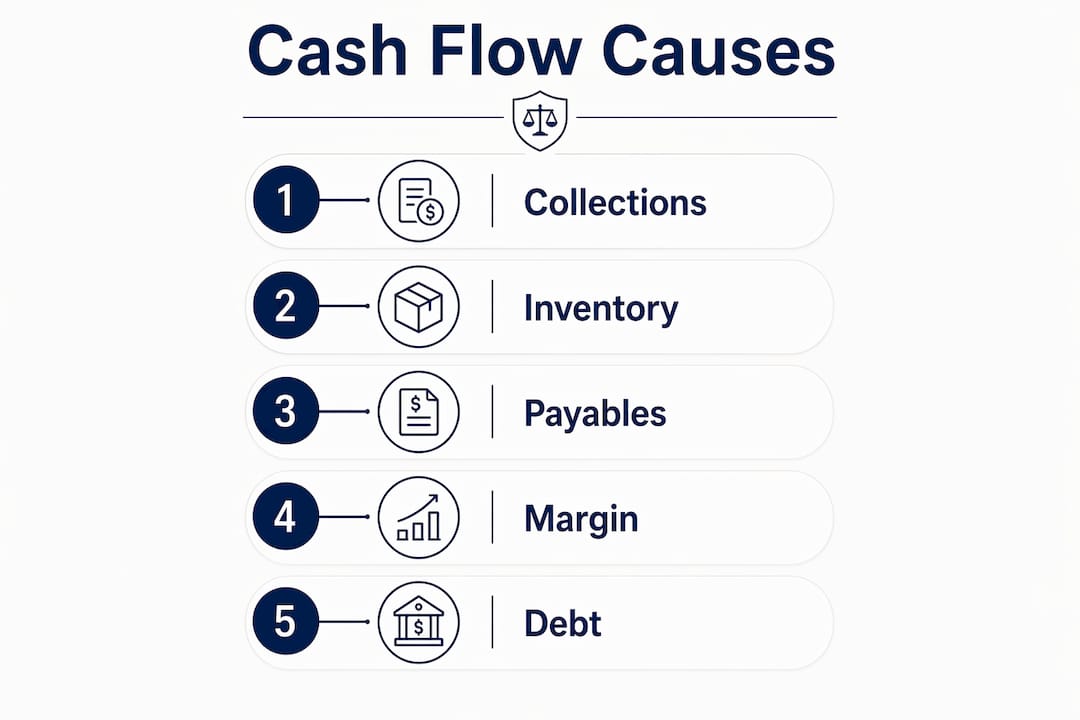
Pro Tip: Map your cash drivers into five categories: collections, inventory, payables, margin, and debt. Diagnosing which category is causing your shortage tells you exactly where to apply pressure first.
Each of these causes has a specific fix. The mistake most business owners make is treating cash shortages as a single problem requiring a single solution, when in reality each driver requires a targeted response.
What are the early warning signs of a cash flow problem?
Early warning signs like rising overdue accounts receivable and shrinking cash buffers appear weeks before a cash crisis becomes critical. Catching them early gives you time to respond without panic.
The metrics that matter most are:
- Days Sales Outstanding (DSO). This measures how long it takes to collect payment after invoicing. A rising DSO means customers are paying slower, which directly reduces your available cash. If your DSO climbs above your payment terms by more than 10 days, treat it as a red flag.
- Overdue accounts receivable percentage. Track what portion of your total AR is past due. When that number climbs above 20%, your collections process needs immediate attention.
- Cash buffer weeks. Divide your current cash balance by your average weekly operating expenses. A buffer below four weeks means you have very little room for a slow payment month or an unexpected cost.
- Credit line utilization. Increasing reliance on a line of credit to cover routine operating expenses signals that cash inflows are not keeping pace with outflows.
- Vendor communication urgency. When your team starts fielding calls from suppliers about overdue payables, the cash problem has already moved from warning to crisis.
Cash flow issues often show up in behavior first, such as delayed hiring decisions, slowed purchasing, and urgent vendor negotiations, before they appear clearly in financial statements. If you find yourself hesitating on decisions that should be straightforward, your cash position may already be tighter than your P&L suggests.
Regular weekly cash flow monitoring with consistent review of these metrics prevents emergency situations and supports stable growth. Weekly monitoring is not overkill. For businesses with thin cash buffers, it is the minimum standard.
Financial forecasting tools built around your specific payment cycles give you a 4–8 week forward view of your cash position. That window is enough time to accelerate collections, delay discretionary spending, or arrange short-term financing before a shortage becomes a crisis.
What strategies prevent cash shortages in profitable companies?
Proactive forecasting and working capital management allow businesses to act before cash shortfalls become critical. The goal is not to eliminate timing gaps entirely. The goal is to manage them deliberately so they never become emergencies.
Accelerate receivables
Send invoices the day work is completed, not at the end of the month. Offer a 1–2% early payment discount for customers who pay within 10 days. For large projects, require a deposit of 25–50% upfront and milestone payments tied to project phases rather than project completion. Trucking companies and construction contractors who shift to milestone billing consistently reduce their DSO by two to three weeks.
Negotiate supplier terms
Tighter invoicing, accelerated receivables follow-up, and negotiating supplier terms are the most effective levers for closing the cash gap. Ask your key suppliers for net-45 or net-60 terms instead of net-30. Most suppliers will negotiate, especially with customers who have a strong payment history. Extending your payables by even 15 days can meaningfully improve your cash position without borrowing a dollar.
Right-size your inventory
Excess inventory is frozen cash. Conduct a quarterly review of your parts and materials inventory. Identify slow-moving items and stop reordering them until existing stock is consumed. For HVAC and plumbing businesses, this single step often frees up thousands of dollars in working capital.
Build and protect a cash buffer
Set a minimum cash balance target based on your fixed monthly costs. A target of four to six weeks of operating expenses is a practical starting point. Treat that buffer as untouchable except for genuine emergencies. When the buffer drops below the target, trigger a collections push before drawing on credit.
Use a cash waterfall for payment decisions
Implementing a cash waterfall and payment priority logic stabilizes cash flow by creating consistent decision-making during tight liquidity periods. The waterfall assigns a fixed priority order to your obligations: payroll first, then taxes, then rent, then supplier payments, then discretionary spending. When cash is tight, the waterfall removes the guesswork and prevents costly mistakes like missing payroll.
Use financing strategically, not reactively
A business line of credit is a cash flow management tool, not a rescue device. Set it up when your financials are strong, and use it to bridge predictable timing gaps rather than to cover operational shortfalls. Reactive borrowing during a crisis costs more and signals deeper problems to lenders.
| Strategy | Primary benefit | Best for |
|---|---|---|
| Upfront deposits and milestone billing | Reduces receivables lag | Contractors, project-based businesses |
| Supplier term negotiation | Extends payables window | All service businesses |
| Inventory right-sizing | Frees frozen working capital | HVAC, plumbing, electrical |
| Minimum cash buffer rule | Prevents reactive borrowing | All owner-operated businesses |
| Cash waterfall priority logic | Stabilizes decisions under pressure | Businesses with tight margins |
| Proactive line of credit | Bridges predictable timing gaps | Growing businesses |
Pro Tip: Run a 13-week rolling cash flow forecast every week. Update it with actual collections and payments as they occur. This single habit gives you more financial control than any other tool available to a small business owner.
Key takeaways
Profitable businesses run out of cash because profit and cash flow measure different things, and timing gaps in receivables, inventory, and fixed expenses create liquidity shortages that no income statement can prevent on its own.
| Point | Details |
|---|---|
| Profit does not equal cash | Revenue recognized on paper may not arrive in your account for 30–90 days. |
| Timing gaps are the core problem | Fixed expenses are time-locked; customer payments are not, creating a structural mismatch. |
| Growth intensifies cash pressure | Expansion requires upfront spending before new revenue is collected, stretching the cash cycle. |
| Early warning signs are measurable | Rising DSO, shrinking cash buffer weeks, and growing overdue AR signal trouble weeks in advance. |
| Prevention requires active management | Weekly forecasting, milestone billing, supplier negotiations, and a cash waterfall prevent most cash crises. |
What I have learned about cash flow in growing businesses
The most expensive mistake I see profitable business owners make is treating a cash shortage as a sign that something is fundamentally wrong with their business. It is almost never that. Cash flow problems reflect timing management challenges, not underlying profitability failures. That distinction matters because it changes how you respond.
When I was building and operating service businesses, the months that felt most financially stressful were often the months with the strongest revenue. We were growing fast, winning new work, and hiring ahead of demand. The income statement looked great. The bank account told a different story. That experience taught me that growth is the biggest catalyst for cash flow mismatch, and the businesses that handle it best are the ones that plan for it before it happens.
The owners who struggle most are the ones who wait for the bank balance to drop before they look at their cash position. By then, the options are limited and expensive. The owners who stay in control are the ones who watch their DSO, their cash buffer, and their 13-week forecast every single week, not just when things feel tight.
One more thing I want to be direct about: mismanaged business finances are rarely the result of ignorance. They are usually the result of not having the right systems and visibility in place. Most business owners are excellent at their trade. They are not trained to read a cash flow statement or build a working capital model. That is not a character flaw. It is a gap that the right financial support can close quickly.
The businesses I have seen recover fastest from cash flow problems are the ones that got accurate books, a forward-looking forecast, and a clear picture of their working capital cycle. Once you can see the timing gaps clearly, fixing them is straightforward.
— Tony
How Truemeasureaccounting helps profitable businesses stay liquid
Running a profitable business while managing cash flow stress is one of the most common and solvable problems in owner-operated companies. Truemeasureaccounting works directly with businesses generating $250,000 to $5 million annually to close the gap between what the income statement shows and what the bank account holds.
Through professional bookkeeping services, monthly financial reporting, and fractional CFO support, Truemeasureaccounting builds the financial visibility you need to manage cash proactively. That includes cash flow forecasting, accounts receivable tracking, working capital analysis, and the kind of forward-looking guidance that keeps profitable businesses from running dry. If your books are accurate and your cash position is visible, the decisions get easier. Reach out to Truemeasureaccounting to find out what your numbers are actually telling you.
FAQ
Why does a profitable business run out of cash?
A profitable business runs out of cash when the timing of cash inflows does not match the timing of cash outflows. Revenue may be earned weeks or months before it is collected, while expenses like payroll and rent require immediate payment.
What is the cash conversion cycle?
The cash conversion cycle measures how long it takes a business to turn its spending into collected cash. A longer cycle means more time passes between paying expenses and receiving customer payments, which increases cash pressure even when profits are strong.
What is days sales outstanding and why does it matter?
Days sales outstanding (DSO) measures the average number of days it takes to collect payment after invoicing. A rising DSO directly reduces available cash and is one of the earliest measurable warning signs of an impending cash flow problem.
How much cash reserve should a business keep?
A practical minimum cash buffer is four to six weeks of total operating expenses. This buffer provides enough runway to handle slow payment months, unexpected costs, or short-term revenue gaps without triggering a financial crisis.
Can a business be profitable and still fail from cash flow problems?
Yes. A business can show consistent net profit on its income statement and still become insolvent if it cannot meet its short-term cash obligations. Cash flow problems are the leading operational cause of business failure in otherwise viable companies.