
Real estate investors overpay taxes not because the tax code is unfair, but because specific, repeatable planning and documentation gaps compound quietly across the year. The fix is operational, not magical.
Here are the highest-impact causes and what to do first:
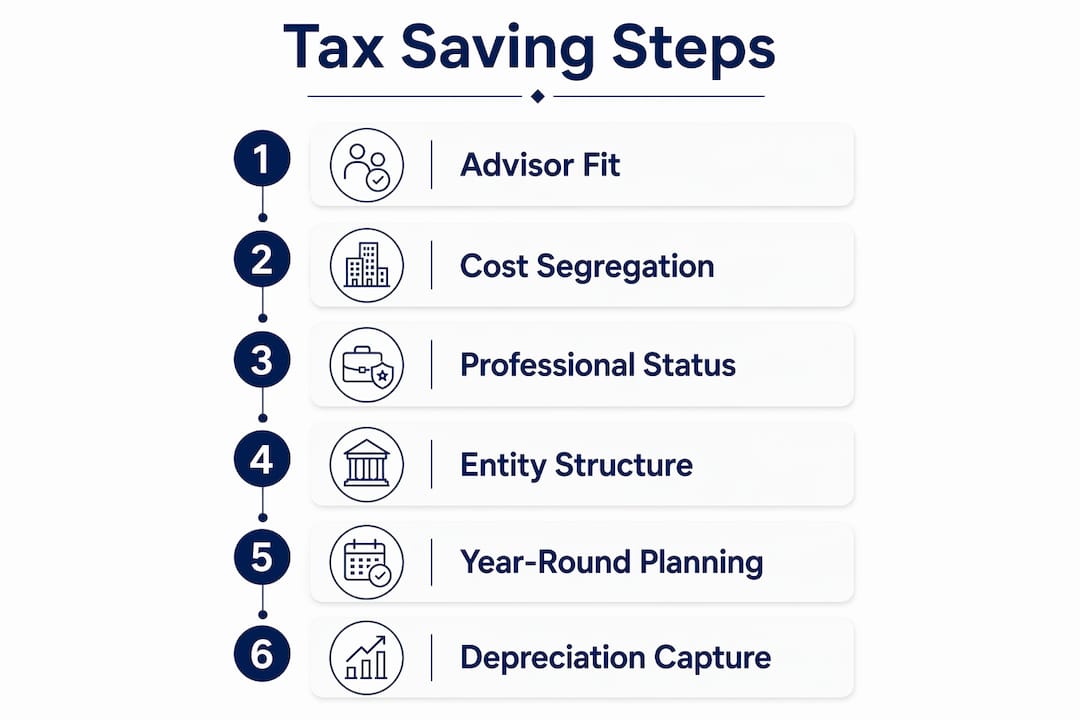
- Switch to a real estate tax specialist. A generalist CPA misses cost segregation, REPS qualification, and multi-state coordination.
- Run a cost segregation study early. Cost segregation can reclassify 20–40% of building costs into shorter-life categories, creating large first-year deductions.
- Document material participation now. IRS Section 469 suspends rental losses unless you qualify as a Real Estate Professional or meet material participation tests.
- Align your entity structure to your portfolio. A single-member LLC that made sense at one property often creates tax drag at five.
- Model depreciation recapture before you list. Under Section 1250, recaptured depreciation is taxed at up to 25%. A 1031 exchange defers that liability, but only if you plan before the sale closes.
- Move tax planning off the April calendar. Cumulative overpayment comes from dozens of small, uncoordinated decisions across the year.
Your 15-minute next step: Pull your last two tax returns, your depreciation schedule, and your sale or renovation calendar. Look for suspended losses, missing cost segregation, and unplanned sale timing. If anything looks off, contact Truemeasureaccounting for a short tax-leak review before your next transaction closes.
Pro Tip: The investors who save the most are not the ones with the most complex strategies. They are the ones who catch the same five or six mistakes before they repeat.
Table of Contents
- 1. Your CPA may be costing you more than their fee
- 2. Skipping a cost segregation study is one of the most expensive timing mistakes
- 3. Real Estate Professional Status is the most underused tax position in residential portfolios
- 4. Suspended passive losses are money sitting in a locked box
- 5. Entity structure problems compound quietly as your portfolio grows
- 6. Depreciation recapture at sale catches investors off guard every time
- 7. Year-round tax planning prevents the bracket creep that April planning cannot fix
- 8. What these fixes actually cost and what they realistically save
- 9. The operational checklist that closes the gaps creating cumulative overpayments
- Key Takeaways
- Why operations, not just tax rules, determine what you actually pay
- Truemeasureaccounting helps real estate investors stop overpaying
- Useful sources and primary references
1. Your CPA may be costing you more than their fee
Most real estate investors use the same CPA who handles their personal return or their operating business. That advisor is often excellent at what they do. The problem is that real estate taxation is a specialty, and a generalist CPA who files a Schedule E once a year is not the same as a specialist who coordinates cost segregation engineers, tracks REPS hour logs, manages 1031 qualified intermediaries, and files composite returns across multiple states.
The practical gap shows up in your returns. Missed cost segregation on a $1.2M commercial property can mean $80,000–$120,000 in deferred depreciation that never gets claimed in year one. Passive losses that sit suspended for years because nobody modeled a REPS qualification path. A sale that closes in December when it should have closed in January, pushing a six-figure gain into a higher-bracket year.
Ask your CPA these four questions at your next meeting:
- Have you coordinated a cost segregation study on any of my properties?
- Do you track my hours for Real Estate Professional Status qualification?
- How do you handle multi-state nexus and composite filings for my entities?
- What is your process for modeling depreciation recapture before a sale?
If the answers are vague or unfamiliar, you have a mismatch.
Signs of an advisor mismatch: Your depreciation schedule shows only straight-line 27.5-year or 39-year lives across every asset. Your passive losses grow year over year with no recovery plan. Your entity structure has not been reviewed since you bought your first property. You learned about 1031 exchanges from a podcast, not your CPA.
When to add a specialist versus replace your current advisor: if your generalist handles your personal return well and coordinates with a real estate specialist, that team model works. If they resist coordination or lack the vocabulary, replacement is the cleaner path.
Pro Tip: A real estate tax specialist will ask for contemporaneous time logs, property-level P&Ls, and a vesting or sale calendar at the first meeting. If they don’t, keep looking.

2. Skipping a cost segregation study is one of the most expensive timing mistakes
Cost segregation is an engineering-based analysis that reclassifies building components from 27.5-year (residential) or 39-year (commercial) depreciation into 5-year, 7-year, or 15-year categories. Land improvements, specialty electrical, plumbing fixtures, and flooring often qualify. The result is a much larger depreciation deduction in the early years of ownership rather than spread evenly over decades.
NAR reports that cost segregation can reclassify 20–40% or more of building costs into shorter-life categories. On a $2M property, that can mean $400,000–$800,000 in accelerated depreciation. Stacked with bonus depreciation provisions under current law, the first-year tax impact can be substantial.
Who benefits most: investors with properties above roughly $500,000 in basis, those who qualify as Real Estate Professionals (where losses are immediately usable), and anyone completing a significant renovation. Below $500,000, the study cost often does not justify the benefit unless other strategies are stacked alongside it.
Timing matters. Studies done soon after acquisition or renovation capture the most components and carry the cleanest documentation trail. Waiting years creates reconstruction problems and reduces the defensible basis for reclassification. Under OBBBA provisions, bonus depreciation windows and Section 179D energy efficiency deductions have specific eligibility timelines, so acting early preserves options.
| Property Basis | Typical Study Cost | Expected First-Year Incremental Depreciation | Break-Even Threshold |
|---|---|---|---|
| Under $500K | $5,000 | Modest without stacking | Often does not pay alone |
| $500K–$1M | — | Significant with bonus depreciation | Typically pays in year one |
| $1M–$3M | — | Large; stacks well with REPS | Strong ROI in most brackets |
| Over $3M | — | Very large; multi-year benefit | Highly favorable |
Study cost ranges sourced from proinvestorhub.com.
Pro Tip: Keep the engineering report, the property acquisition file, and the depreciation schedule snapshot together in a single folder per property. The IRS will ask for all three if the study is ever questioned.
3. Real Estate Professional Status is the most underused tax position in residential portfolios
Real Estate Professional Status (REPS) converts rental losses from passive to non-passive under IRS rules. That distinction matters enormously for high-income households where passive losses would otherwise sit suspended indefinitely. A W-2 earner with $150,000 in salary and $60,000 in rental losses gets no current benefit from those losses under passive activity rules. A qualifying Real Estate Professional can use those same losses against all income.
Qualification checklist (numbered for your review):
- You spend more than 750 hours per year in real property trades or businesses in which you materially participate.
- More than 50% of your total personal services for the year are in those real property trades or businesses.
- You materially participate in each rental activity (or make a valid grouping election to treat all rentals as one activity).
- You maintain contemporaneous records, including daily time logs, calendars, and activity descriptions.
Common edge cases: A spouse who manages properties full-time can qualify the household if they meet the hour and percentage tests independently. Short-term rentals (average stay of 7 days or fewer) are not classified as rental activities under Section 469 and can qualify as active businesses with lower participation thresholds. That is a meaningful distinction for Airbnb-style operators.
The IRS will not accept reconstructed time records after the fact. Logs must be kept in real time. A calendar entry, a mileage log, a project management app with timestamps — all are acceptable. A spreadsheet built in March covering the prior year is not.
Pro Tip: Pairing REPS with a cost segregation study can create large, immediately usable losses. That combination is one of the most powerful tax positions available to active real estate investors — but only with ironclad, contemporaneous records.
4. Suspended passive losses are money sitting in a locked box
Under IRS Section 469, rental activities are generally passive. Losses from passive activities can only offset passive income. When passive losses exceed passive income, the excess is suspended and carried forward. For many investors, this means years of accumulated losses that produce no current tax benefit.
The $25,000 active participation exception: Taxpayers who actively participate in rental activities (a lower bar than REPS) can deduct up to $25,000 in rental losses against ordinary income. That offset phases out between $100,000 and $150,000 in adjusted gross income. Above $150,000 AGI, it disappears entirely for most investors.
If you earn above $150,000 and do not qualify as a Real Estate Professional, your rental losses are likely suspended. Here is how to recover them:
- Qualify as a Real Estate Professional. This is the most direct path and unlocks all suspended losses going forward.
- Generate passive income. Passive losses offset passive income from other sources, including limited partnership interests or passive business income.
- Sell the property. A full disposition of a passive activity releases all suspended losses in the year of sale, which can offset the gain.
- Bundle activities. A valid grouping election under Treasury Regulation 1.469-4 can combine multiple rental properties into a single activity, making material participation easier to achieve.
Operationally, the fix starts with your books. Separate passive and active income by entity and activity. Tag hours correctly. If your bookkeeping mixes passive rental income with active management fees or operating business income, your tax preparer cannot accurately model your passive activity position. Separate books by property or entity is not just good practice — it is the foundation for every passive activity strategy.
5. Entity structure problems compound quietly as your portfolio grows
Most investors start with a single-member LLC. It is simple, it provides liability protection, and it is easy to open. The tax treatment is pass-through by default, which works fine at one or two properties. As the portfolio grows, the original structure often stops fitting — and nobody notices until the tax bill arrives.
Entity shapes and their tradeoffs for investors:
Single-member LLCs are transparent for tax purposes and simple to operate. Multi-property LLCs allow grouping elections but can complicate financing. Partnerships (multi-member LLCs taxed as partnerships) allow flexible allocations and are often preferred for joint ventures. S corp elections can reduce self-employment taxes on active management income but create complications for real estate holding because S corps cannot hold real property in certain structures without losing favorable treatment.
Multi-state issues are where coordination breaks down most often. Owning property in Georgia, Florida, and Tennessee means three state tax filings, potentially three sets of nexus rules, and three sets of withholding requirements. A composite return election or a pass-through entity tax (PTET) election in one state may not be available or beneficial in another. Missing a state filing triggers penalties and interest that wipe out planning gains.
Red flags that your structure needs a review: your tax preparer files different states inconsistently, your distributions do not match your ownership agreements, or your effective tax rate has climbed even as your portfolio has grown. Those are signals that entity coordination has fallen behind portfolio growth.
6. Depreciation recapture at sale catches investors off guard every time
When you sell a property, the IRS recaptures the depreciation you took during ownership and taxes it at up to 25% on unrecaptured Section 1250 gain. On a property where you claimed $200,000 in depreciation over ten years, that is up to $50,000 in recapture tax — on top of any capital gains tax on appreciation. Investors who did not model this before listing are often surprised at closing.
Run a sale model at least 90–180 days before you list. That window gives you time to consult a qualified intermediary, confirm your 1031 identification and closing windows, and decide whether deferral makes financial sense for your situation.
Deferral options worth knowing:
- 1031 like-kind exchange. You must identify replacement property within 45 days and close within 180 days of the sale. Missing either deadline typically invalidates the deferral and creates immediate tax liability. A qualified intermediary must hold the proceeds — you cannot touch the funds.
- Qualified Opportunity Funds. Investing capital gains into a Qualified Opportunity Zone fund defers and potentially reduces the gain, with additional exclusions for long-term holds.
- Installment sales. Spreading proceeds over multiple years can reduce the annual tax impact, though recapture must still be recognized in the year of sale.
- Hold to death. A stepped-up basis at death eliminates both the capital gain and the recapture for heirs. For long-term holders, this is a legitimate planning consideration.
Practical 1031 traps to avoid: receiving any cash from the sale (called “boot”) triggers immediate tax on that portion. Failing to use a qualified intermediary from the start of the transaction disqualifies the exchange. Identifying more than three replacement properties without meeting the 200% rule creates compliance risk.
Pro Tip: A sale model is not a complex document. It is a one-page projection showing your adjusted basis, accumulated depreciation, estimated recapture tax, capital gains tax, and net proceeds under three scenarios: sell outright, 1031 exchange, and installment sale. Build it before you call a broker.
7. Year-round tax planning prevents the bracket creep that April planning cannot fix
Year-round coordination reduces tax surprises and prevents bracket creep and missed offsets. The reason is simple: most of the decisions that determine your tax bill happen throughout the year, not in April. By the time you sit down with your CPA in March, the renovation is already capitalized, the property already sold, and the RSU vesting already triggered.
A short before/after example: An investor completes a $180,000 renovation in December and capitalizes it as an improvement. If the work had been completed and invoiced in January of the following year, the deduction timing shifts by one full year. In a year with a large capital gain, that shift can mean the difference between a 22% and a 32% marginal rate on a portion of income.
Quarterly operational checklist:
- Q1: Reconcile prior-year books, confirm depreciation schedules are current, review any property sales modeled for the year.
- Q2: Review improvement vs. repair classifications on any ongoing renovations. Check estimated tax payments against projected income.
- Q3: Update vesting and bonus income calendar. Model any planned property sales against current-year income. Confirm cost segregation studies are ordered for recent acquisitions.
- Q4: Time renovation completions, property closings, and income recognition to manage brackets. Confirm 1031 exchange timelines if any sales are in progress.
Practical timing rules: Repairs are deductible in the year incurred. Improvements must be capitalized and depreciated. The distinction turns on whether the work restores, adapts, or betters the property — and misclassifying renovation costs either inflates audit risk or reduces first-year deductions and increases taxable gain at sale. Schedule property closings with your tax bracket in mind, not just your financing timeline.
Pro Tip: Put three calendar items in your phone right now: a Q2 estimated tax check-in, a Q3 sale-timing review, and a Q4 renovation-completion deadline. Those three reminders prevent the most common timing errors.
8. What these fixes actually cost and what they realistically save
The honest answer is that the ROI on tax planning varies by portfolio size, tax bracket, and which strategies you stack. Small fixes — correcting repair vs. improvement classifications, separating entity books — cost almost nothing and prevent compounding errors. Big strategic moves require upfront investment but pay back in multiples for the right investor.
| Strategy | Typical Cost | Expected First-Year Benefit | Break-Even |
|---|---|---|---|
| Cost segregation study ($1M+ property) | — | Large accelerated depreciation deduction | Year one for most investors |
| Cost segregation study (under $500K) | $5,000 | Modest without stacking | Often does not pay alone |
| Qualified intermediary (1031 exchange) | — | Defers full recapture + capital gains tax | Immediate if gain exists |
| Entity restructuring (attorney + CPA) | — | Reduced SE tax, better loss utilization | 1–3 years depending on structure |
| REPS documentation system | Minimal (time investment) | Unlocks all suspended passive losses | Immediate if losses exist |
Cost segregation cost ranges sourced from proinvestorhub.com.
Prioritization by portfolio size: A single rental under $500,000 should focus first on REPS documentation, passive loss recovery, and repair vs. improvement classification. A portfolio above $1M should add cost segregation and entity coordination. Above $3M, stacking strategies — depreciation, cost segregation, REPS, QBI deductions, and 1031 exchanges — require coordinated year-round planning to avoid audit exposure and cashflow problems.
Timeline expectations: Cost segregation takes 2–8 weeks from engagement to completed report. A 1031 exchange runs on the 45/180-day statutory clock from the day of sale. REPS documentation is ongoing from day one of the tax year. Entity restructuring typically takes 4–12 weeks depending on state filings and financing coordination.
9. The operational checklist that closes the gaps creating cumulative overpayments
Practical bookkeeping and workflows are where most tax savings are actually captured. Tax software does not save you money. Clean, organized, property-level books that your CPA can read and act on — that is what saves you money.
Here is a 30/90/180-day action plan you can hand to your bookkeeper today:
- Days 1–30: Set up a separate QuickBooks file (or sub-ledger) for each property or entity. Separate passive rental income from active management income. Create a depreciation schedule snapshot for every property you own.
- Days 1–30: Start a contemporaneous time log. Use a simple spreadsheet or a time-tracking app. Record date, activity, property, and hours. Do this daily — not weekly, not monthly.
- Days 31–90: Build an improvement capital costs worksheet. Every renovation invoice goes into this sheet with a classification: repair (deductible now) or improvement (capitalize and depreciate). Review with your CPA quarterly.
- Days 31–90: Create an acquisition file checklist for every property. Include the purchase contract, closing disclosure, cost segregation report (if applicable), and initial depreciation schedule.
- Days 91–180: Add a sale and vesting calendar to your books. Every planned property sale, RSU vest, or bonus income event goes on this calendar with a projected tax impact.
- Days 91–180: Run a cost segregation pre-renovation on any property where you plan significant capital work. Doing the study before construction begins captures more components and produces cleaner documentation.
- Ongoing: Tag every transaction as passive or active at the time of entry. Do not leave this for year-end cleanup. Mixed books are the single most common reason passive losses go unused.
Templates to create now: a daily time log (date, property, activity, hours), an improvement capital costs worksheet (invoice date, vendor, description, amount, classification), an acquisition file checklist, and a depreciation schedule snapshot updated annually.
Truemeasureaccounting approaches this with a monthly review cadence. KPI signals that flag tax leaks include growing suspended loss balances with no recovery plan, improvement costs coded as repairs (or vice versa), and entity distributions that do not match ownership agreements. Catching those signals monthly costs far less than correcting them at year-end. For a step-by-step setup guide, see how to set up accounting as a real estate investor.
Pro Tip: The bookkeeper’s job is not to make tax decisions. It is to keep the records clean enough that the tax specialist can make good ones. Give your bookkeeper a written classification guide for repairs vs. improvements and a passive/active tagging protocol. That one-page document prevents months of cleanup.
Key Takeaways
Real estate investors who overpay taxes almost always share the same root cause: operational gaps in bookkeeping, documentation, and timing that compound quietly across the year until the bill arrives.
| Point | Details |
|---|---|
| Advisor fit matters first | A real estate tax specialist coordinates cost segregation, REPS, and multi-state filings that a generalist CPA typically misses. |
| Cost segregation timing is critical | Studies done soon after acquisition or renovation capture the most components; cost segregation can reclassify 20–40% of building costs into shorter-life categories. |
| REPS documentation must be contemporaneous | The IRS rejects reconstructed time records; daily logs are required to sustain Real Estate Professional Status in an audit. |
| Model recapture before you list | Depreciation recapture is taxed at up to 25%; a 1031 exchange requires identifying replacement property within 45 days and closing within 180 days. |
| Truemeasureaccounting closes the operational gap | Truemeasureaccounting provides property-level bookkeeping, cost segregation coordination, entity and state filing coordination, and year-round tax planning for real estate investors nationwide. |
Pro Tip: The two fastest wins for most investors: order a cost segregation study on your largest property (if eligible) and move your tax planning to a quarterly cadence. Both can be in place within 90 days.
Why operations, not just tax rules, determine what you actually pay
The conventional wisdom in real estate tax planning is that the rules are the savings. Learn the right code sections, apply them correctly, and the bill goes down. That framing is incomplete, and it is why so many investors leave money on the table year after year.
The rules are the ceiling. Operations determine whether you reach it.
A cost segregation study is worth nothing if the engineering report sits in a folder nobody reviews before the property sells. REPS qualification is worth nothing if the time logs were never kept. A 1031 exchange is worth nothing if the investor called the qualified intermediary after the closing instead of before. Every one of those failures is an operational failure, not a tax knowledge failure.
What I see consistently is that investors who work with advisors who understand operations — not just tax code — capture far more of the available savings. The advisor who asks for your renovation calendar, your vesting schedule, and your sale timeline in January is doing something fundamentally different from the one who asks for your documents in March. The first advisor is modeling decisions before they are made. The second is recording decisions that are already locked in.
The six-figure tax bill that gets prevented is almost always the result of a conversation that happened 90 days before the transaction, not 90 days after. That is the operational lens Truemeasureaccounting brings to every real estate investor client — connecting the books, the calendar, and the tax model into one coordinated picture before the decisions are made.
Truemeasureaccounting helps real estate investors stop overpaying
Investors who overpay taxes usually do not need more tax knowledge. They need cleaner books, better timing, and an advisor who coordinates all three.

Truemeasureaccounting provides bookkeeping services built specifically for real estate investors: property-level P&Ls, passive and active income separation, improvement vs. repair classification, and depreciation schedule maintenance. Beyond the books, the firm coordinates cost segregation studies, manages entity and multi-state filing coordination, and provides ongoing tax planning and fractional CFO services for owner-operators who need more than a once-a-year CPA conversation.
Investors who work with Truemeasureaccounting typically see better depreciation capture in year one, coordinated sale modeling before transactions close, and fewer overlooked deductions across their portfolio. The firm serves real estate investors nationwide, with particular depth in Georgia, Florida, South Carolina, Alabama, and Tennessee.
Ready to find out where your tax leaks are? Schedule a consultation or review the investor accounting setup guide to see what a clean operational foundation looks like before your next transaction.
Useful sources and primary references
Depreciation, cost segregation, and bonus depreciation
- IRS Publication 946 — How to Depreciate Property: Primary IRS guidance on depreciation methods, MACRS classes, and Section 179 elections. Use this to verify asset class lives and bonus depreciation eligibility.
- NAR: Tax-Smart Strategies for Real Estate Investors in 2026: Covers cost segregation reclassification ranges (20–40%), OBBBA bonus depreciation windows, and Section 179D phaseout timelines.
- ProInvestorHub: Real Estate Tax Strategies Guide: Covers cost segregation study costs ($5,000–$15,000), 1031 exchange deadlines (45/180 days), and bonus depreciation phase-down timeline.
REPS, passive activity rules, and material participation
- IRS Topic 425 — Passive Activities: IRS plain-language explanation of passive activity rules, material participation tests, and the $25,000 rental loss allowance.
- 26 U.S.C. § 469 — Passive Activity Losses and Credits: The statutory text for passive activity loss rules, including the REPS exception and material participation definitions.
- Treasury Regulation 1.469-5T — Material Participation: The seven tests for material participation, including the 500-hour and 100-hour tests. Authoritative for REPS documentation standards.
- Eric Ravenscroft: Real Estate Tax Savings Guide 2026: Covers contemporaneous documentation requirements, depreciation recapture at 25%, and repair vs. improvement classification.
- Sharper.tax: Real Estate Investor Tax Playbook: Explains passive loss suspension, REPS qualification, and stacking strategies including QBI and 1031 coordination.
1031 exchanges, deferral, and sale timing
- IRS Tax Tips: Real Estate: IRS guidance on deductible expenses, mortgage interest, property taxes, and points for real estate investors.
- BiggerPockets: Are You Accidentally Overpaying Taxes?: Explains how cumulative, uncoordinated decisions across income types produce large tax bills and why integrated year-round planning is the solution.
For implementation help: Truemeasureaccounting provides the operational workflows, bookkeeping setup, and tax coordination that translate these rules into actual savings. The common real estate bookkeeping mistakes guide is a practical starting point for investors who want to audit their current setup.
This article is general information for educational purposes. Tax rules change and individual circumstances vary. Confirm the current rules and their application to your specific situation with a qualified tax professional before making decisions.