
Federal bonus depreciation rules now permit a permanent 100% deduction for qualified property acquired after January 19, 2025, under interim guidance in Notice 2026-11. That is good news if you’re buying trucks, HVAC equipment, or shop machinery this year. Before you count the deduction, confirm two things: whether your state conforms to the federal rule, and whether the asset is actually placed in service before your tax year closes.
TL;DR:
- Bonus depreciation now offers a permanent 100% deduction for qualifying property acquired after January 19, 2025, but state conformity varies and may limit or alter its benefits.
- Assets with a MACRS recovery period of 20 years or less, off-the-shelf software, and certain building components qualify for this accelerated deduction.
- Section 179 has an income cap of around $2.56 million, and it applies before bonus depreciation, making it more flexible for income-limited deductions.
- Proper timing of acquisition and placement in service is critical, as the deduction follows the placed-in-service date, not the purchase date or invoice.
- Careful planning involving modeling federal and state tax impacts is essential before making large equipment purchases to maximize tax benefits and avoid future reconciliation issues.
Table of Contents
- What Qualifies for Bonus Depreciation Under IRC Section 168(k)
- Section 179 Vs Bonus Depreciation: Which Should You Use First?
- How State Conformity Affects Your Bonus Depreciation Deduction
- Timing Rules: Acquisition Dates, Placed-In-Service, and Elections
- A Step-By-Step Planning Process for Equipment Purchases
- Records You Need to Substantiate the Deduction
- How We Approach Bonus Depreciation Planning for Trade Businesses
- Balancing Current Expensing Against Future Tax Planning
- Let TrueMeasure Turn These Rules Into a Real Tax Strategy
- Sources
- FAQ
What Qualifies for Bonus Depreciation Under IRC Section 168(k)
Bonus depreciation under IRC Section 168(k) covers property with a recovery period of 20 years or less, off-the-shelf software, and certain qualified improvement property. The IRS FAQ lays out four core requirements: the property must be depreciable under MACRS, meet a specific recovery-period test, be acquired after the applicable date, and be placed in service during the tax year you’re claiming it. For service businesses, that translates into a fairly wide net.
Assets that typically qualify:
- Trucks, vans, trailers, and most equipment used in HVAC, plumbing, electrical, and construction work
- Off-the-shelf software and computer systems
- Machinery, tools, and shop equipment with a MACRS life of 20 years or less
- Building components reclassified through cost segregation, such as electrical subsystems, specialty plumbing, or parking lot improvements
Passenger vehicles and light trucks fall under separate luxury-auto limits tied to gross vehicle weight rating, so a work truck over 6,000 pounds GVWR behaves very differently at tax time than a sedan added to the fleet. Notice 2026-11 also addresses niche categories like specified sound recording productions and certain plants, which rarely apply to trades businesses but matter if you’re in a mixed-industry portfolio.
Section 179 Vs Bonus Depreciation: Which Should You Use First?
The tax code applies Section 179 before bonus depreciation, and that ordering isn’t a technicality. It determines whether your deduction can push you into a net operating loss.
- Section 179 has an income limitation. You can’t deduct more than your business’s net taxable income for the year, and the Section 179 election caps out around $2.56 million with a $4.09 million phase-out threshold for 2026.
- Bonus depreciation has no income cap, and it can create or increase a net operating loss you carry forward.
- If your state decouples from bonus depreciation but conforms to Section 179, lean on Section 179 for assets under the cap and use bonus for the overflow.
- If you’re managing taxable income for a loan application or partnership distribution, Section 179’s flexibility (you can elect it asset by asset) beats bonus depreciation’s all-or-nothing class treatment.
Pro Tip: Section 179 elections apply asset by asset, while bonus depreciation elections apply at the entire asset class level. That granularity lets you dial in exactly how much current-year deduction you want, then let bonus depreciation absorb everything else in that class automatically.
How State Conformity Affects Your Bonus Depreciation Deduction
Federal bonus depreciation rules mean nothing to your state return if your state has decoupled. Many states never adopted 100% bonus depreciation and require you to add back the federal deduction, then depreciate the asset on a separate state schedule over its normal MACRS life, according to state conformity analysis from Bloomberg Tax. That mismatch creates a multiyear reconciliation headache if you’re not tracking it from day one.
Steps that keep this manageable:
- Model combined federal and state tax liability before finalizing any large equipment purchase, not just the federal side
- Where your state decouples from bonus but still allows Section 179, prioritize Section 179 on assets under the cap
- Keep a separate depreciation schedule for state purposes so book-to-state and federal-to-state differences don’t pile up unnoticed
- Flag multistate filings early. If you operate trucks or crews across state lines, conformity differences compound fast
Timing Rules: Acquisition Dates, Placed-In-Service, and Elections
The acquisition date matters as much as the purchase price. Property acquired under a binding contract signed before January 19, 2025, may not qualify for the new 100% rate even if it’s placed in service later, so check your contract dates against that cutoff before assuming eligibility.
- Acquired vs. placed in service: you can buy an asset in December and not place it in service until January. The deduction follows the placed-in-service date, not the invoice date
- Class-level opt-out: Notice 2026-11 confirms you can elect out of bonus depreciation for an entire asset class, and the notice also describes interim elective alternatives, including a 40% deduction option for certain property, in place of the full 100%
- Self-constructed property and specified plants follow their own placed-in-service timing rules under the notice, which matters if you’re building out a shop or facility rather than buying finished equipment
- Report everything on Form 4562, attaching any required election statements in the year you claim the deduction
A Step-By-Step Planning Process for Equipment Purchases
Run this sequence before you sign a purchase order, not wait until after your tax preparer sees the invoice in March.
- Project taxable income for the year, including any planned bonus or profit distributions.
- Classify every asset by recovery period and confirm it meets Section 168(k)’s requirements.
- Apply Section 179 first to assets where you want a targeted, income-limited deduction.
- Apply bonus depreciation to the remainder of the qualifying class.
- Model the state addback separately so you know your real combined tax bill, not just the federal number.
Example A: An HVAC company buys $200,000 in service trucks and diagnostic equipment. Electing Section 179 first on $150,000 keeps taxable income near zero without triggering a loss, then applying bonus depreciation to the remaining $50,000 finishes the write-off without creating a carryforward the owner doesn’t need this year.
Example B: A general contractor replaces a $60,000 roof and HVAC system on an owned building. Roofs and HVAC systems on commercial buildings are typically 39-year property and don’t qualify for bonus depreciation at all unless treated as qualified improvement property. Section 179 becomes the only route to accelerate that deduction, and only up to the annual cap.
Pro Tip: Before December 31, confirm the vendor’s installation completion date in writing. “Delivered” and “placed in service” are not the same thing, and an asset sitting in a warehouse doesn’t count no matter what the invoice date says.

Year-end checklist: confirm installation and placed-in-service dates, get vendor sign-off in writing, and pull together purchase contracts before your bookkeeper closes the year. Our year-end tax planning checklist walks through the full sequence.
Records You Need to Substantiate the Deduction
An IRS auditor examining a bonus depreciation claim wants to see the paper trail, not just the number on Form 4562.
- Original invoices and purchase contracts showing the acquisition date
- Installation or inspection sign-off documenting the placed-in-service date, especially for staged or partial installs
- Business-use logs for any asset with mixed personal and business use, particularly vehicles
- Cost segregation studies, when used, showing how building components were reclassified into shorter recovery periods
Track fixed assets inside QuickBooks with a dedicated subledger, and keep state depreciation schedules separate from your federal books from the start. Retroactively rebuilding two years of state addbacks because nobody flagged the decoupling issue in year one is a miserable use of anyone’s time. Retain all of this documentation for at least the standard audit window, longer if you’ve claimed cost segregation on real property.
How We Approach Bonus Depreciation Planning for Trade Businesses
We run a Section 179 versus bonus depreciation simulation for every client considering a major equipment purchase, because the right answer depends on that year’s income, not a blanket rule. For real estate investors and contractors who own their buildings, we evaluate whether a cost segregation study pays for itself by reclassifying building components into 5, 7, or 15 year property that unlocks bonus depreciation. That single move is often the highest value planning step available to real-estate-heavy owners.
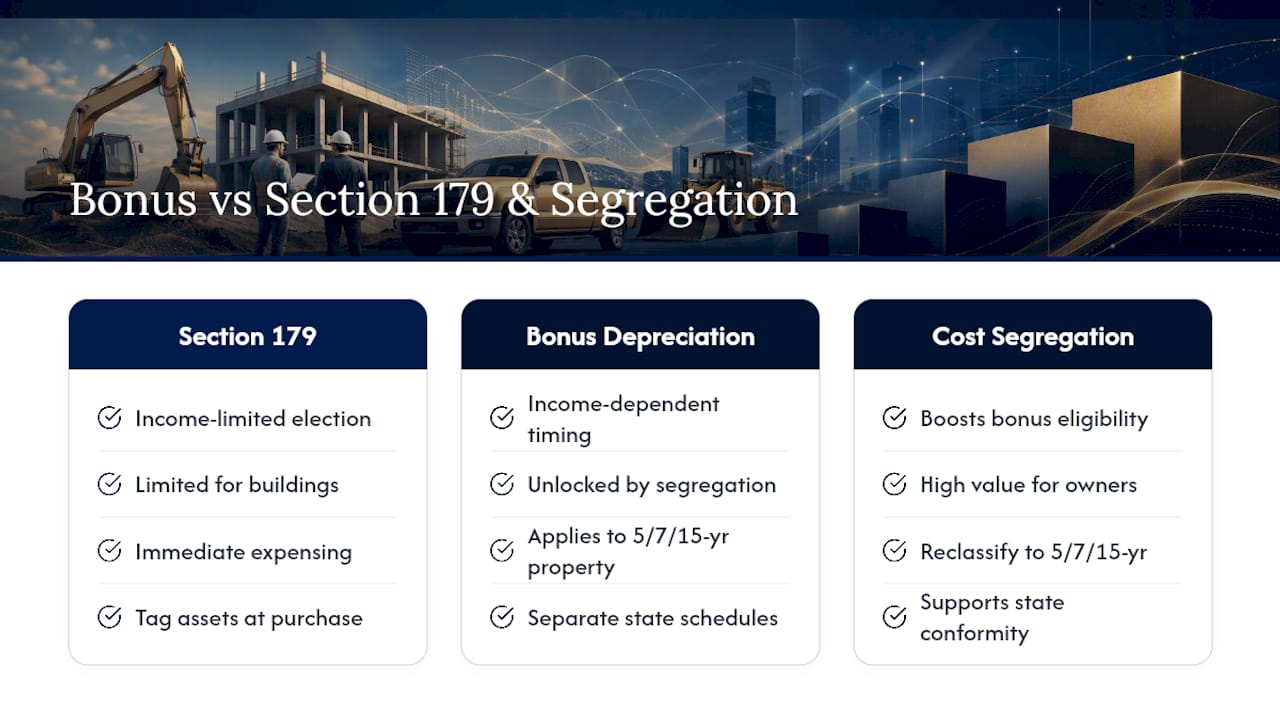
On the bookkeeping side, we tag fixed assets at the time of purchase, build separate state depreciation schedules where conformity differs, and maintain a clean fixed-asset subledger so nothing gets missed at filing time. Owner-operators in HVAC, plumbing, trucking, and construction depend on this because equipment purchases hit their cash flow immediately, long before any tax benefit shows up.
Balancing Current Expensing Against Future Tax Planning
Aggressive expensing makes sense when you have income to shelter this year and expect similar or lower rates ahead. It makes less sense if you’re planning a sale, need clean financials for a loan, or expect a much higher-income year soon where the deduction would do more work.
Run the combined federal and state projection before December 31, not after. Bonus depreciation and Section 179 are both powerful, but the right sequence depends entirely on your specific numbers. Talk to a tax advisor before you finalize a large purchase, and keep every document that proves when the asset was placed in service.
— Tony
Let TrueMeasure Turn These Rules Into a Real Tax Strategy
Reading the rules is one thing. Running the actual Section 179 versus bonus depreciation math against your specific income, state, and equipment list is another, and that’s where most owner-operators lose money without realizing it. TrueMeasure Accounting builds that simulation for you, coordinates cost segregation studies when they pay off, and cleans up the bookkeeping so your fixed-asset records hold up if the IRS asks questions later.
This work fits HVAC companies, plumbing and electrical contractors, general contractors, trucking fleets, and small real estate investors who need more than a once-a-year tax preparer. Our tax planning services cover exactly this kind of year-end equipment decision, backed by bookkeeping services that keep state and federal schedules separate from day one. Plans start at $265 a month with Essentials, scaling up to Plus and Premium as your business grows. If you’re planning a purchase before year-end, book a planning call now so the numbers are settled before your books close.
This article is general information, not a substitute for advice from a qualified financial advisor. Consult a qualified financial professional about your own circumstances before acting on anything here.
Sources
- Treasury, IRS issue guidance on the additional first year depreciation deduction amended as part of the One, Big, Beautiful Bill | Internal Revenue Service
- §179. Election to expense certain depreciable business assets
- State Conformity to Federal Bonus Depreciation
FAQ
What Is Bonus Depreciation and How Does It Work?
Bonus depreciation lets a business deduct the full cost of qualifying property in the year it’s placed in service, instead of spreading the deduction over several years. Under Notice 2026-11, the deduction is permanently set at 100% for qualified property acquired after January 19, 2025.
What Items Qualify for 100% Bonus Depreciation?
Qualified property generally includes equipment, machinery, off-the-shelf software, and assets with a MACRS recovery period of 20 years or less, per the IRS bonus depreciation FAQ. Building components reclassified through a cost segregation study can also qualify, though the building shell itself typically does not.
Do All States Allow Bonus Depreciation?
No. Many states decouple from the federal bonus depreciation rules and require you to add the deduction back, then depreciate the asset on a separate state schedule, according to Bloomberg Tax’s state conformity analysis. Check your specific state’s treatment before assuming your federal deduction carries over.
Will 100% Bonus Depreciation Still Be Available in 2026?
Yes. Notice 2026-11 confirms the 100% rate is now permanent for qualified property acquired after January 19, 2025, rather than the temporary phase-down schedule that applied under prior law. Confirm your acquisition date against that cutoff, since assets under earlier binding contracts may not qualify at the full rate.
Should I Use Section 179 or Bonus Depreciation First?
The tax code applies Section 179 before bonus depreciation, and Section 179 carries an income limitation that bonus depreciation does not. TrueMeasure Accounting’s tax planning services run this comparison against your actual numbers so the ordering works in your favor instead of creating an unplanned loss.