

HVAC maintenance contract accounting is defined as the process of recognizing recurring service revenue over the contract period while tracking all associated labor, material, and overhead costs to measure true profitability. Most HVAC contractors understand how to sell a maintenance agreement. Far fewer understand how to account for one correctly. That gap costs real money. When you collect $300 upfront for an annual plan and book it all as income on day one, your profit and loss statement looks great in January and misleading by July. Getting this right requires applying accrual accounting principles, specifically deferred revenue recognition and job costing, to every contract you carry. This article breaks down how HVAC maintenance contract accounting works from first principles to practical workflows.
How HVAC maintenance contract accounting works: core principles
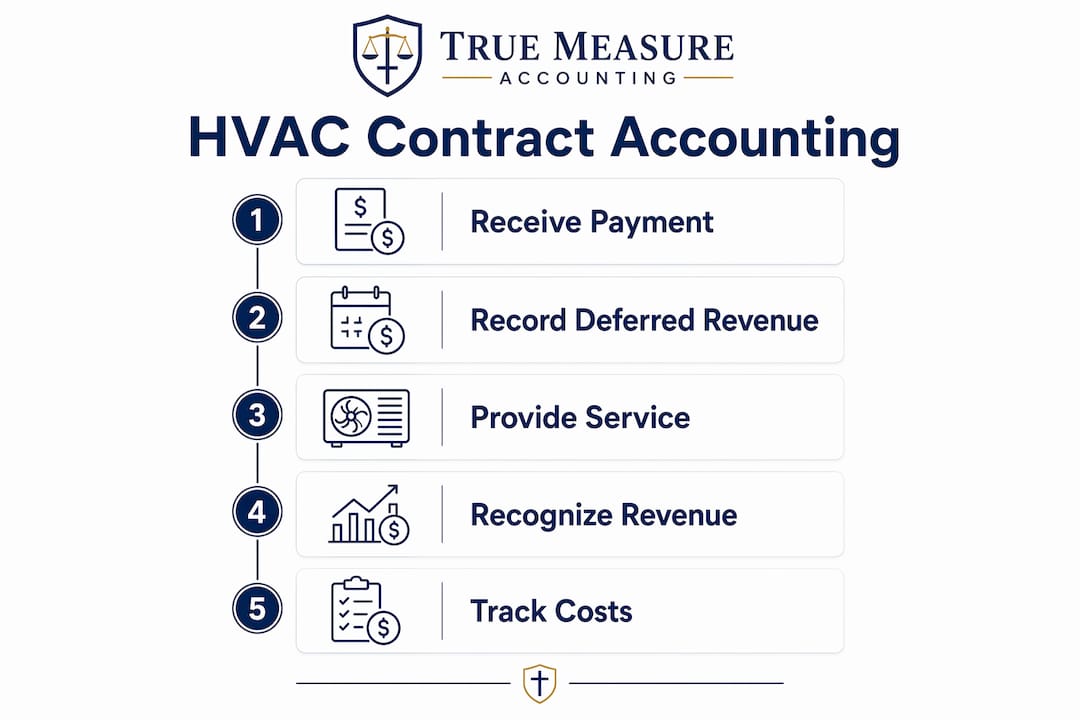
The formal accounting term for the method that governs maintenance agreements is accrual accounting. Under accrual accounting, revenue is recognized when it is earned, not when cash is received. For an HVAC maintenance contract, that means a $300 annual agreement collected in January is not $300 of January income. It is $25 of earned income per month across twelve months.
The mechanism that makes this work is deferred revenue, a liability account on your balance sheet. When a customer pays upfront, you credit deferred revenue, not sales. Each month, as you deliver service, you move a portion from deferred revenue into earned income. Proper deferred revenue accounting ensures monthly profit and loss reports reflect earned income, not just cash received. This matters enormously when you are trying to understand whether your business is actually profitable or just cash-heavy in certain months.

The second principle is the matching principle. Costs associated with delivering a contract must be recorded in the same period as the revenue they support. If a technician performs a spring tune-up in April, the labor and parts cost for that visit belong in April, matched against the April revenue recognized from that contract. Mismatching costs and revenue is one of the most common reasons HVAC contractors misread their own margins.
Cash basis accounting, by contrast, records income when collected and expenses when paid. It is simpler, but it produces distorted financials for any business carrying prepaid service agreements. A contractor running 200 active maintenance plans on cash basis will see revenue spikes when renewals come in and artificially low costs in months when no parts are purchased. That distortion makes pricing decisions, hiring decisions, and growth planning unreliable.
- Deferred revenue: Liability account holding prepaid contract income not yet earned
- Revenue recognition: Monthly release of deferred revenue as service is delivered or visits occur
- Matching principle: Labor and material costs recorded in the same period as related earned revenue
- Accrual vs. cash basis: Accrual gives accurate profitability; cash basis distorts margins on prepaid contracts
Pro Tip: If you are currently on cash basis and carry more than 50 active maintenance agreements, ask your accountant to model what your financials would look like under accrual. The difference in reported profit is often significant enough to change how you price your next contract cycle.
How should HVAC contractors track and allocate costs?
Cost tracking for maintenance contracts requires discipline at three levels: technician time, materials, and overhead. Miss any one of them and your cost-per-visit number is wrong. A wrong cost-per-visit number means your pricing is built on a guess.
Here is the correct sequence for tracking costs on every maintenance visit:
- Record technician time at the job level. Every technician logs hours against a specific contract or job code, not a general labor bucket. This gives you actual labor cost per visit, not an average across all work types.
- Capture materials and parts at the visit level. Filters, belts, capacitors, and refrigerant used on a maintenance call belong to that contract’s cost record. Technicians must track time and materials at each visit to calculate cost per visit accurately.
- Allocate overhead per visit. Vehicle costs, insurance, dispatch software, and shop expenses do not disappear because a job is a maintenance call. Overhead should be allocated per visit using a realistic metric, typically monthly overhead divided by expected maintenance visits, aligning 15 to 20 percent of the visit price to overhead recovery.
- Use a job-cost spreadsheet or field service software. HVAC supplier invoice job-cost spreadsheets capturing line-level detail help assign costs correctly to contracts. Fields should include vendor name, invoice date, job or contract number, cost type, and exception flags for quantity mismatches or missing codes.
- Run a three-way match on supplier invoices. Effective cost tracking requires matching the purchase order, packing slip, and supplier invoice before posting any cost to a contract. This catches billing errors before they inflate your cost records.
Pro Tip: Set up a separate job code for each maintenance contract tier in your field service software. When technicians close a work order, costs flow automatically to the right contract. Manual allocation after the fact is where errors multiply.
The table below shows how cost components differ across a basic and a premium maintenance contract:
| Cost component | Basic contract (1 visit/year) | Premium contract (2 visits/year) |
|---|---|---|
| Technician labor | $30 to $45 per visit | $30 to $45 per visit |
| Materials and parts | $15 to $25 per visit | $20 to $35 per visit |
| Overhead allocation | $10 to $15 per visit | $10 to $15 per visit |
| Total cost per visit | $55 to $85 | $60 to $95 |
| Annual contract cost | $55 to $85 | $120 to $190 |
Typical residential tune-ups cost $55 to $85 including labor and materials, which confirms that a $150 basic contract carries a reasonable margin when overhead is properly allocated. The problem most contractors face is that overhead is either ignored or estimated too low, which makes contracts look more profitable than they are until the year-end numbers tell a different story.
How to price HVAC maintenance contracts using accounting data
Pricing a maintenance contract without accurate cost data is the same as quoting a replacement job without knowing your equipment cost. The accounting data you collect from cost tracking feeds directly into your pricing model.
The math starts with your fully burdened cost per visit. Once you know that number, you set a price that achieves your target gross margin. Routine residential maintenance agreements are priced between $150 and $500 annually, with 40 to 60 percent gross margin targets. That range exists because contract features, local labor rates, and competition vary. Your accounting data tells you where your floor is. Market conditions tell you where your ceiling is.
Tiered pricing models give you the ability to serve different customer segments without discounting your core offering. A three-tier structure works well for most HVAC contractors:
- Bronze tier ($150 to $200/year): One annual tune-up, basic filter replacement, and priority scheduling. Margin target: 40 to 45 percent.
- Silver tier ($250 to $350/year): Two visits per year, parts discount of 10 to 15 percent on repairs, and same-day emergency response. Margin target: 45 to 50 percent.
- Gold tier ($400 to $500/year): Two visits, full parts and labor discount, annual indoor air quality check, and guaranteed response time. Margin target: 50 to 60 percent.
Bundled contracts ranging from $150 to $500 often include priority scheduling, discounted repair labor, and up to two annual visits. The key is that every tier must be priced from your actual cost data, not from what a competitor charges or what feels reasonable.
Payment structure also affects both cash flow and customer acquisition. Offering both monthly and annual payment options improves customer acquisition and cash flow management, with successful programs seeing roughly a 60/40 split between monthly and annual payments. Monthly billing reduces the upfront barrier for customers but requires more careful deferred revenue tracking on your end, since you are recognizing revenue as billed rather than releasing it from a prepaid liability.
Renewal strategy is part of pricing strategy. Auto-renewal clauses and renewal discounts improve maintenance plan customer retention by 15 to 20 percent. A 5 percent renewal discount costs you almost nothing on a $300 contract but signals value to the customer and stabilizes your forward revenue.
What accounting systems improve HVAC contract management?
The right system depends on your volume. A contractor with 50 active agreements can manage with QuickBooks Online and a disciplined spreadsheet workflow. A contractor with 300 or more agreements needs field service software that integrates directly with their accounting platform.
Regardless of the tools you use, these are the reporting metrics every HVAC contractor should monitor monthly for cash flow and profitability:
- Deferred revenue balance: Total prepaid contract income not yet earned. This number should match your active contract count multiplied by the unearned portion of each agreement.
- Revenue recognized this period: The amount released from deferred revenue into earned income during the month. This is your true contract revenue for the period.
- Cost per visit by contract tier: Actual labor, materials, and overhead per visit compared to your pricing model assumptions. Variance here signals a pricing or efficiency problem.
- Gross margin by contract tier: Revenue recognized minus direct costs for each tier. If your Silver tier is running 35 percent margin instead of 48 percent, you need to know that before renewal season.
- Contract renewal rate: The percentage of expiring agreements that renew. Maintenance agreement customers carry 80 to 90 percent retention rates when programs are managed well. Below 75 percent signals a service quality or communication problem.
- Revenue per technician per day: Total contract revenue divided by technician days worked on maintenance visits. This tells you whether your labor model is efficient.
Automating the deferred revenue schedule is the single biggest time-saver in contract accounting. In QuickBooks Online, you can set up a recurring journal entry that releases the correct monthly amount from deferred revenue to income for each contract tier. For contractors using ServiceTitan or Housecall Pro, those platforms can generate revenue recognition schedules that sync with QuickBooks, reducing manual entry and the risk of posting errors.
The HVAC accounting setup also benefits from a well-structured chart of accounts. Separate income accounts for contract revenue, repair revenue, and equipment sales give you clean reporting. Separate cost accounts for maintenance labor, maintenance materials, and overhead allocation let you calculate margin by revenue type without running custom reports every month.
Key takeaways
Accurate HVAC maintenance contract accounting requires deferred revenue recognition, job-level cost tracking, and margin-based pricing working together as a single system.
| Point | Details |
|---|---|
| Deferred revenue is non-negotiable | Booking prepaid contracts as immediate income distorts your P&L and leads to bad pricing decisions. |
| Cost per visit drives pricing | Know your fully burdened cost ($55 to $85 for most residential visits) before setting any contract price. |
| Tiered pricing expands your market | Bronze, Silver, and Gold tiers let you serve more customers while protecting margin on premium agreements. |
| Monthly reporting catches problems early | Track gross margin by tier every month, not just at year-end, to catch cost overruns before they compound. |
| Renewal strategy protects revenue | Auto-renewal clauses and small renewal discounts can improve retention by 15 to 20 percent. |
What I’ve learned from working with HVAC contractors on contract accounting
Most HVAC contractors I work with are excellent at the technical side of their business. Where they struggle is treating maintenance agreements like regular service calls in their books. They collect the annual fee, post it as income, and move on. Six months later, they wonder why their profit and loss looks strong but their bank account feels tight. The answer is almost always deferred revenue handled incorrectly.
The second pattern I see consistently is underpriced contracts built on incomplete cost data. A contractor prices a plan at $199 because that is what the competitor down the road charges, without ever calculating that their fully burdened cost per visit is $82 and they are doing two visits per year. That is a $165 cost against a $199 price, leaving $34 to cover sales, admin, and profit. That is not a maintenance program. That is a customer subsidy.
What I tell every HVAC business owner I work with is this: your maintenance agreements are not just a revenue stream. Maintenance contracts serve as both recurring revenue and lead-generation engines, with 15 to 25 percent of agreement customers converting to equipment replacement within five years. That means a $300 annual contract has a potential lifetime value of $5,000 or more when you factor in the replacement job it generates. You cannot see that value clearly without clean accounting.
Work with a bookkeeper or accountant who understands the operational side of HVAC businesses, not just debits and credits. The right financial partner will set up your chart of accounts correctly, build your deferred revenue schedule, and give you monthly reports that actually tell you whether each contract tier is making money. That clarity is what lets you grow with confidence instead of guessing.
— Tony
Get your HVAC contract accounting set up correctly
If you are running maintenance agreements and your books are not reflecting deferred revenue, job-level costs, and margin by contract tier, you are making decisions with incomplete information. That is a fixable problem.
Truemeasureaccounting works specifically with HVAC contractors and service businesses to set up HVAC bookkeeping workflows that handle recurring contract revenue, deferred revenue schedules, and job costing correctly from day one. Our bookkeeping services are designed for owner-operated businesses generating $250,000 to $5 million annually who need financial clarity, not just data entry. If you want to know exactly what each contract tier is earning you and where your margins are leaking, reach out to Truemeasureaccounting for a consultation.
FAQ
What is deferred revenue in HVAC maintenance contracts?
Deferred revenue is the portion of a prepaid maintenance contract that has not yet been earned through service delivery. It sits as a liability on your balance sheet until you perform the work, at which point it transfers to earned income.
How do I calculate cost per visit for a maintenance agreement?
Add your technician’s fully burdened labor cost for the visit, the materials and parts used, and your overhead allocation for that visit. For most residential tune-ups, this total falls between $55 and $85 per visit.
Should HVAC contractors use accrual or cash basis accounting?
HVAC contractors carrying prepaid maintenance agreements should use accrual accounting. Cash basis distorts profitability reporting by recording all contract income when collected rather than as service is delivered.
How does tiered pricing connect to accounting data?
Each tier carries a different cost structure based on visit frequency, parts included, and service level. Your accounting system should track gross margin separately for each tier so you can verify that pricing assumptions hold up against actual costs.
What retention rate should I expect from a well-managed maintenance program?
Well-managed HVAC maintenance programs achieve 80 to 90 percent customer retention. Renewal rates below 75 percent typically indicate a service quality or customer communication issue worth investigating before the next renewal cycle.
Recommended
- Plumbing and HVAC Bookkeeping Services | TrueMeasure Accounting
- Fixed-Price Bookkeeping vs. Hourly Services: Why $265/Month Wins – TrueMeasure Accounting LLC-Small Business Accounting Services
- How It Works – TrueMeasure Accounting LLC-Small Business Accounting Services
- How to Set Up Bookkeeping for a Trucking Company