

Four methods cover almost every overhead allocation decision you’ll face: single-rate (plant-wide), departmental rates, activity-based costing (ABC), and time-driven ABC (TDABC). The rule of thumb is simple: if overhead runs under roughly 20% of your costs and your jobs look alike, stick with single-rate. Above roughly 30%, or if your jobs vary significantly in complexity, ABC or TDABC pays for itself. Start by calculating your overhead percentage and naming your two biggest cost pools before choosing anything.
TL;DR:
- Companies with overhead exceeding 30% of costs or highly variable jobs should adopt activity-based costing or time-driven ABC for better accuracy.
- Departmental rates generally improve overhead allocation precision without requiring new software for most mid-market businesses.
- Pilot new costing methods using spreadsheets on a small scope to verify improvements before full implementation.
- The choice of allocation base, such as labor hours or dispatch minutes, must reflect the actual cost drivers in your business.
- Regularly review and adjust your overhead rate and pooling structure to prevent margin leaks and improve pricing accuracy.
Table of Contents
- Key Takeaways on Overhead Allocation Methods
- What Is Overhead Allocation and Why Does It Matter?
- How Do the Main Overhead Allocation Methods Work?
- Which Overhead Allocation Method Fits Your Business?
- What’s the Practical Path to Better Overhead Allocation?
- What Overhead Allocation Mistakes Cost You the Most?
- What TrueMeasure Has Learned From Owner-Operated Businesses
- How TrueMeasure Helps You Fix Overhead Allocation for Good
- Sources
Key Takeaways on Overhead Allocation Methods
Get overhead allocation wrong and you’ll underprice your most complex jobs while overcharging your easiest ones, quietly training your best customers to leave. Get it right and pricing becomes a decision instead of a guess.
For most mid-market and owner-operated service businesses, the biggest accuracy jump per hour invested comes from moving off a single company-wide rate and into departmental rates. Full activity-based costing delivers more precision, but only pays off once your overhead share or job diversity justifies the extra tracking.
A few things worth acting on immediately:
- Better allocation reveals which customers or job types are quietly subsidizing others.
- Departmental rates usually beat single-rate allocation without requiring new software.
- Pilot any new method in a spreadsheet against 10 to 15 historical jobs before rolling it out.
- Full ABC only makes sense once overhead exceeds about 30% of total costs or job types differ significantly.
What Is Overhead Allocation and Why Does It Matter?
Overhead is every indirect cost that keeps your business running but can’t be traced to one specific job: rent, insurance, office staff, equipment depreciation, dispatch and coordination time. A cost object is whatever you’re trying to price accurately: a job, a customer, a service line, a truck route. Overhead allocation methods are simply the rules you use to spread those indirect costs across cost objects so each one carries its fair share.
The core formula hasn’t changed in decades: overhead rate equals total indirect costs divided by your allocation base, usually direct labor hours, machine hours, or billable hours. Say your shop carries $180,000 in annual overhead and your team logs 9,000 direct labor hours. Your overhead rate is $20 per labor hour. A job requiring 40 labor hours picks up $800 in overhead, on top of materials and labor.
The base you pick matters more than the math. A machine hour base makes sense in a production shop; billable hours fit a professional service firm; dispatch time or job-site coordination hours fit a field service business better than either. The right base reflects genuine cause and effect. Pick a base that doesn’t track how your overhead actually gets consumed, and every number downstream from that formula is quietly wrong, no matter how carefully you calculate it.
How Do the Main Overhead Allocation Methods Work?
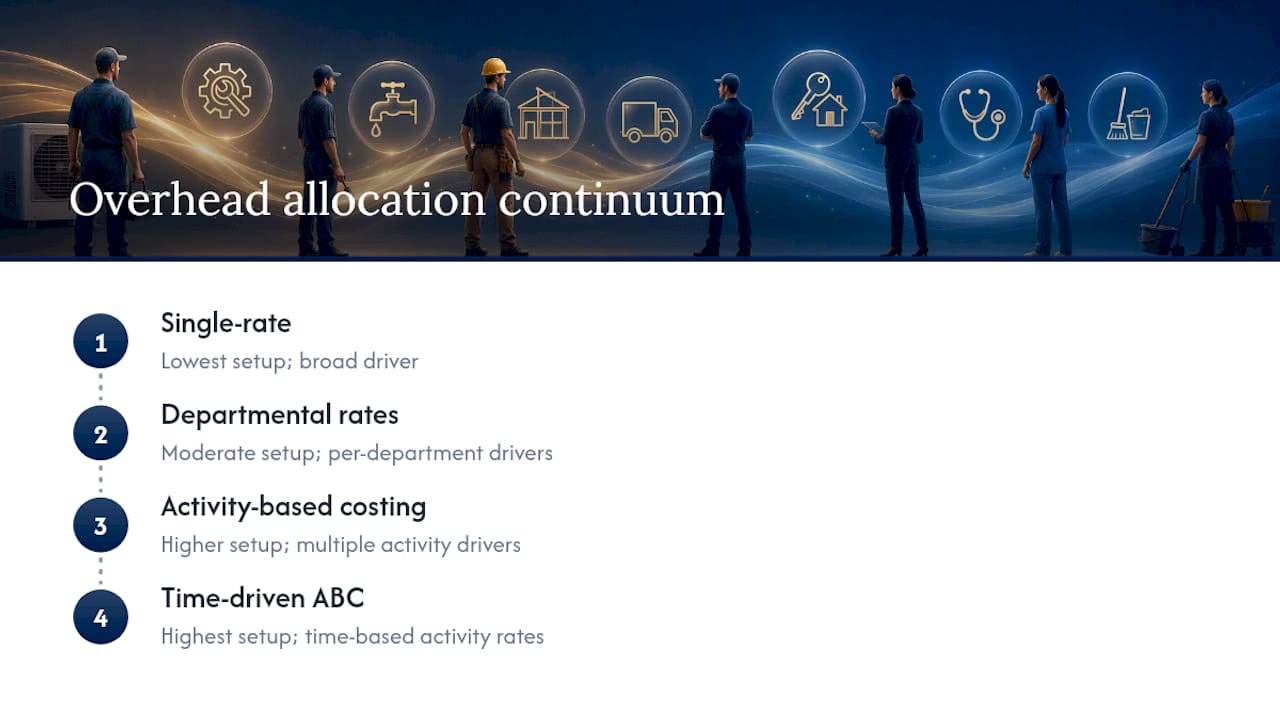
Each method trades accuracy for setup effort differently, and understanding that trade-off is the whole game.
1. Single-rate (plant-wide) allocation
One overhead rate applies to the entire business, using one allocation base company-wide. In the $180,000 overhead, 9,000 labor hour example above, every job gets charged $20 per labor hour regardless of what kind of job it is.
This method is defensible when your services or products are genuinely similar and overhead makes up a modest share of total cost. It’s fast, cheap to maintain, and easy for anyone on your team to explain to a customer. The drawback shows up the moment your jobs stop looking alike: a simple service call and a complex, equipment-heavy installation get charged the same overhead rate per hour, even though the installation probably consumes far more supervision, scheduling, and support. Traditional absorption costing works fine until product or job diversity creeps up, and most growing businesses don’t notice the creep until margins start looking strange.
2. Departmental rates
Instead of one rate for the whole business, you split overhead into department-level pools, then apply a different base to each. A plumbing company might allocate service department overhead based on technician hours and allocate install department overhead based on project days. A trucking company might allocate maintenance overhead based on fleet miles while allocating dispatch overhead based on load count.
This single change often produces the largest accuracy gain relative to effort of any method shift a mid-market company makes. You’re not building a new system, just recognizing that your service department and your installation department don’t consume overhead the same way, and giving each one its own math.
3. Activity-based costing (ABC)
ABC breaks overhead into activity cost pools, tied to what actually drives the cost: setup time, quality inspections, customer onboarding, dispatch coordination. Each pool gets its own driver and its own rate, then costs get assigned to jobs or customers based on how much of each activity they actually consume.
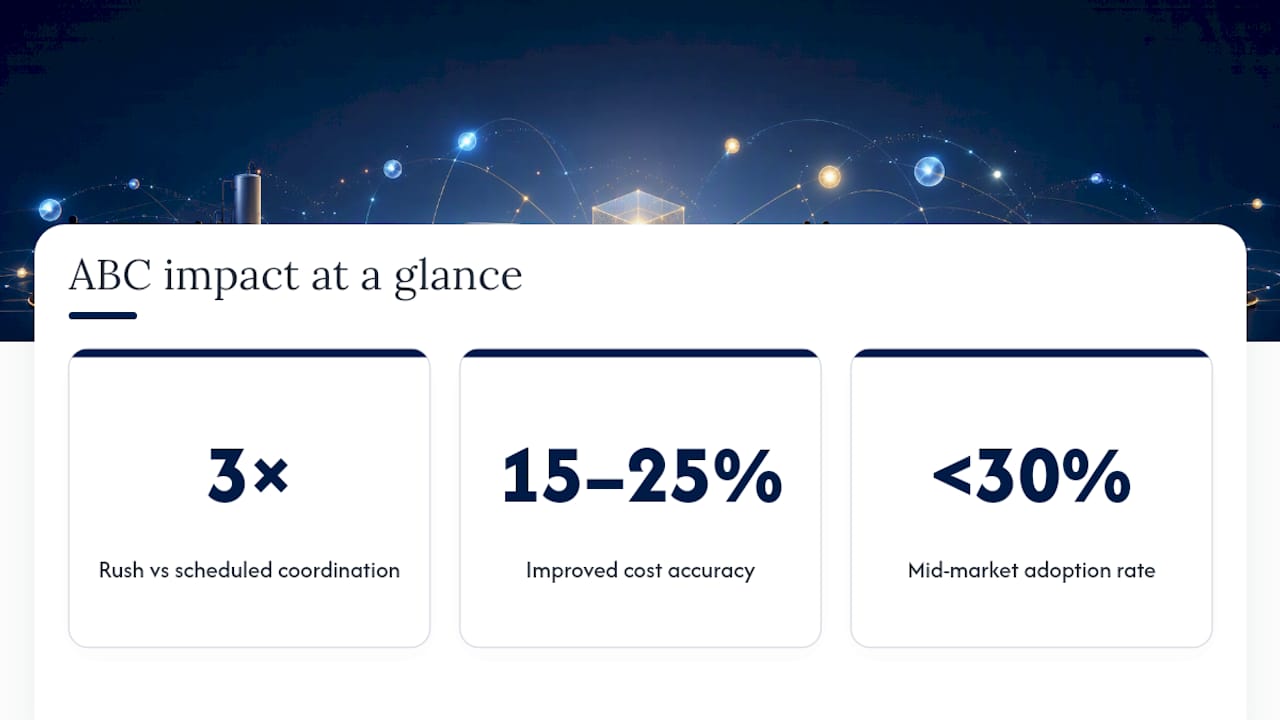
Here’s where it gets interesting. Say a company allocates overhead purely on labor hours and finds every job costs roughly the same per hour. Once they build activity pools, and one of them is “rush order coordination,” they discover their rush jobs consume nearly triple the coordination time of scheduled jobs, but were being charged the same overhead rate as everyone else. That’s a margin leak, hiding in plain sight, that single-rate allocation could never reveal.
ABC can improve cost accuracy by roughly 15% to 25% compared with revenue-based allocation, according to industry summaries, though adoption among mid-market firms stays under 30% because building and maintaining activity pools takes real work. That’s the honest trade: better numbers, more upkeep.
4. Time-driven ABC (TDABC)
TDABC strips out the survey-heavy, subjective part of classic ABC. Instead of asking employees to estimate what percentage of their time goes to each activity, you calculate a cost-per-time-unit rate (total resource cost divided by practical capacity) and build simple time equations for each activity variant. A dispatcher’s time equation might read: 5 minutes base call handling, plus 3 minutes if the job is a rush order, plus 4 minutes if it requires subcontractor coordination.
TDABC requires only two real inputs per resource: the cost-per-time rate and the time equation. That makes it dramatically cheaper to maintain than classic ABC once it’s built, which matters because the maintenance burden, not the initial setup, is what usually kills ABC projects a year in.
Here’s how the four stack up on the trade-off that actually matters:
- Single-rate: Lowest effort, lowest accuracy, fine for uniform, low-overhead operations.
- Departmental: Moderate effort, meaningfully better accuracy, best return on time invested for most mid-market firms.
- ABC: High effort, high accuracy, worth it when overhead is large and jobs vary a lot.
- TDABC: Moderate ongoing effort after setup, ABC-level accuracy, best fit when you have many activity variants (rush vs. standard, new vs. repeat customer).
Which Overhead Allocation Method Fits Your Business?
The decision comes down to two numbers: your overhead percentage and how varied your jobs or services really are. Overhead percentage works as a practical screening tool: below roughly 20%, added allocation complexity delivers diminishing returns; above roughly 30%, the cost of getting it wrong rises fast.
| Method | Accuracy vs. complexity | Effort & maintenance | Best for | Typical allocation base |
|---|---|---|---|---|
| Single-rate | Low accuracy, low complexity | Minimal, set once a year | Uniform jobs, overhead under 20% of cost | Direct labor hours |
| Departmental | Moderate to high accuracy, moderate complexity | Low, review annually | Multiple departments with different cost drivers | Labor hours or machine hours by department |
| ABC | High accuracy, high complexity | High, needs ongoing driver maintenance | Overhead over 30%, diverse products or customers | Multiple drivers by activity pool |
| TDABC | High accuracy, moderate complexity | Moderate after setup | Many activity variants, service businesses with rush/standard mix | Time equations, billable hours |
Before you switch methods, confirm a few things internally:
- Someone owns the allocation model and updates it on a set schedule, not “whenever someone remembers.”
- You’ve picked a pilot scope (one department, one product line, one customer segment) rather than trying to convert everything at once.
- You’ve defined what success looks like: tighter bid accuracy, fewer money-losing jobs, clearer customer profitability.
- Your team can actually track the new allocation base (billable hours, dispatch minutes) without adding an unreasonable amount of admin work.
What’s the Practical Path to Better Overhead Allocation?
Skip the software purchase until you’ve proven the concept with a spreadsheet. Here’s a four-phase approach that keeps disruption low while still producing real answers fast.
- Diagnose (about 2 weeks). Pull your overhead as a percentage of total cost and identify your two or three largest indirect cost pools. Look for the job types or customer segments most likely to be mispriced under your current method.
- Pilot (4 to 6 weeks). Build two or three cost pools in a spreadsheet, assign drivers, and recalculate overhead for a sample of recent jobs. Compare the new numbers against what your current allocation method actually charged those same jobs.
- Validate. Back-test the new method against historical bids. Would it have changed your pricing or your decision to take the job at all? This step catches false positives before you commit real time to a rollout.
- Govern. Assign a specific owner for the allocation model, set a review cadence (quarterly works for most mid-market firms), and monitor overhead percentage, cost variance, and job-level margin shifts over time.
Pro Tip: Start your pilot with the customer or job type that produces the biggest margin surprise, not the easiest one to analyze. That’s where the real money is hiding, and proving the concept there builds buy-in for expanding the method elsewhere.
Driver-based forecasting ties your overhead to operational reality, headcount, active job count, fleet miles, rather than revenue alone, which makes this phased approach far easier to defend to a bank, a partner, or your future self during tax season.
What Overhead Allocation Mistakes Cost You the Most?
Underapplied and overapplied overhead is normal, not a sign you did the math wrong. It happens because overhead rates get set in advance using estimates, and actual costs almost never match the forecast exactly. Reconcile the variance at period end and adjust your rate going forward rather than treating a mismatch as a crisis.
The bigger risks are self-inflicted:
- Overbuilding ABC. Twenty activity pools nobody updates is worse than five pools somebody actually maintains. Keep it lean.
- Trusting revenue-based allocation. Spreading overhead by revenue hides the fact that your lowest-revenue customers often cost the most to serve, a classic trap in service businesses.
- Skipping the before/after check. If you can’t point to a pricing or staffing decision that changed because of new allocation data, the project didn’t work yet.
What TrueMeasure Has Learned From Owner-Operated Businesses
We pilot allocation changes in a spreadsheet before recommending any software, because the method matters more than the tool. With HVAC and contractor clients, building just three to five cost pools around dispatch time and subcontractor coordination has repeatedly surfaced margin leaks that a single labor-hour rate buried completely. Seasonality, a growing subcontractor mix, or falling fleet utilization are all signals it’s time to revisit how you’re allocating overhead, not wait for year-end to find out the damage.
— Tony
How TrueMeasure Helps You Fix Overhead Allocation for Good
This approach offers an alternative to guessing at overhead by building allocation models around how jobs actually move, not around a textbook formula.
If your books are still lumping every job into one overhead bucket, that’s usually the first thing to fix. Our bookkeeping and job-costing services start with clean, reconciled numbers, then layer in profitability tracking by job, customer, or employee so you can see exactly where overhead is eating margin. Contractors and field service owners get a head start with our job costing setup guide, which pairs naturally with a departmental or TDABC pilot. When the numbers get complex enough to need a second set of eyes, our fractional CFO work picks up where bookkeeping leaves off. Book a diagnostic call and bring your last twelve months of job data. We’ll tell you within one conversation whether departmental rates or full ABC makes sense for your business.
Sources
- Overhead Allocation Methods — From Revenue-Based Defaults to Driver-Based Accuracy | Onetribe Advisory
- Overhead rate meaning, formula, calculations, uses, examples | Investopedia
- Principles of Managerial Accounting — Traditional overhead allocation | OpenStax
- How to calculate (and forecast) overhead cost | Workday
- Activity-based costing: driving operational excellence & profitability insights | GBQ