
Real estate development accounting is defined as a specialized financial discipline that tracks costs, revenues, and compliance across multi-year projects with phased income recognition and complex entity structures. Standard business accounting simply cannot handle these demands. A retail shop records a sale and books the revenue the same day. A real estate developer may spend $4 million on land, permits, and construction before recognizing a single dollar of income. That gap, measured in years and millions, is why real estate development accounting differs so fundamentally from every other industry.
Understanding these differences is not just an academic exercise. The accounting method you choose directly affects your tax liability, your ability to attract investors, and whether your project looks profitable on paper when it actually is. Developers who apply standard bookkeeping to development projects routinely misstate income, mismanage cash flow, and face compliance problems that cost far more to fix than to prevent.
Why real estate development accounting differs from traditional methods
Real estate development projects span years of costs before any revenue appears. That single fact forces every accounting decision downstream to work differently. Land acquisition, permitting, construction draws, and phased sales all happen on separate timelines, and each stage carries its own accounting treatment.

Traditional accounting operates on a relatively simple cycle: record income when earned, record expenses when incurred, and reconcile monthly. Real estate development breaks that cycle at every step. Costs pile up for months or years before a project generates cash. Revenue arrives in large, irregular chunks tied to closings or lease-up milestones rather than daily transactions.
The industry standard for handling this complexity is governed by ASC 606, the revenue recognition framework issued by the Financial Accounting Standards Board. ASC 606 requires developers to recognize revenue based on the transfer of control to the buyer, not simply when cash is received. That distinction changes how every sale is reported and when tax obligations are triggered.
Project-based cost tracking is the other defining feature. Unlike a service business that tracks expenses by department, a developer must track every dollar by project, phase, and cost category. Without that granularity, you cannot calculate true project profitability or defend your numbers to a lender or investor.
How project lifecycles drive unique accounting needs
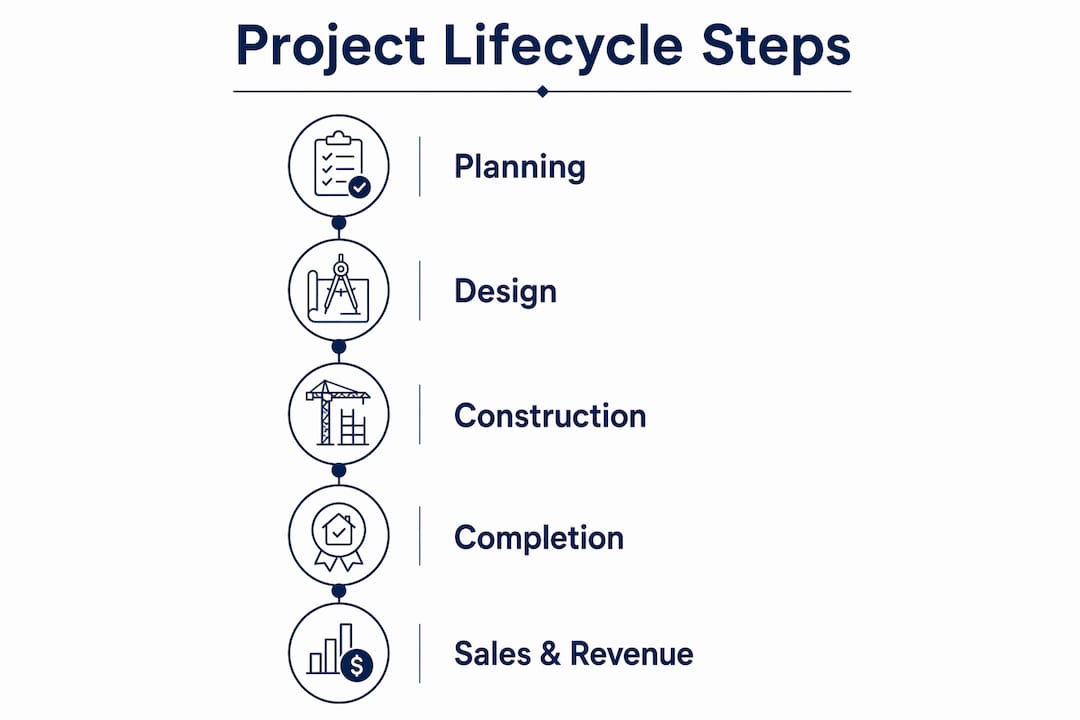
The lifecycle of a development project creates accounting challenges in four distinct waves, and each wave demands a different financial response.
-
Land acquisition. The purchase price, closing costs, and due diligence fees are all capitalized as part of the land asset. These costs do not hit your income statement immediately. They sit on the balance sheet until the project is sold or placed in service.
-
Permitting and pre-development. Architectural fees, environmental studies, and permit costs are also capitalized in most cases. The key question is whether a cost directly enables the project to move forward. If it does, it gets capitalized. If it is a general overhead cost, it gets expensed.
-
Construction. This is where costs accelerate fastest. Labor, materials, subcontractor draws, and financing costs all accumulate simultaneously. Job costing by project is the only reliable way to track budget adherence at this stage. Tracking labor, materials, permits, and subcontractor payables by project prevents overspending and keeps profitability calculations accurate.
-
Sales and lease-up. Revenue recognition begins here, but the method matters enormously. The percentage-of-completion method, known as POC, recognizes revenue as construction progresses. The completed-contract method, known as CCM, recognizes revenue only after the project is finished. POC aids cash flow management by aligning reported income with actual progress. CCM is better suited to projects where final costs are unpredictable.
Cash flow forecasting across all four stages is not optional. Delayed income and variable expenses create gaps that can stall a project even when the underlying economics are sound. A developer who does not model cash flow 12–24 months forward is flying blind.
Pro Tip: Build a rolling 13-week cash flow forecast updated every week during active construction. It catches funding gaps early enough to act on them, not after a draw request is already late.
How are costs and revenues categorized differently in development accounting?
Real estate development accounting separates costs into three primary categories, and getting this separation right determines whether your financial statements are accurate.
- Land costs. The purchase price plus all direct acquisition costs, including title fees, transfer taxes, and broker commissions.
- Development expenses. Pre-construction costs such as architectural plans, engineering reports, environmental assessments, and permit fees that are directly attributable to the project.
- Construction costs. All hard costs including labor, materials, and subcontractor fees, plus soft costs like construction-period interest and insurance that are capitalized under generally accepted accounting principles.
The distinction between capitalized costs and immediately expensed costs is where most developers make mistakes. Capitalized costs are recorded as assets on the balance sheet. They reduce taxable income only when the project is sold or depreciated over time. Costs expensed immediately reduce taxable income in the current period. Misclassifying a capitalized cost as an immediate expense inflates current-year deductions and distorts project profitability.
The table below shows how the same type of cost is treated differently depending on its relationship to the project.
| Cost Type | Capitalized or Expensed | Accounting Impact |
|---|---|---|
| Land purchase price | Capitalized | Recorded as asset; no immediate income statement impact |
| Architectural and engineering fees | Capitalized | Added to project cost basis |
| Construction labor and materials | Capitalized | Recognized at sale or depreciation |
| General office overhead | Expensed immediately | Reduces current-period taxable income |
| Construction-period loan interest | Capitalized | Added to project cost per ASC 835-3 |
| Legal fees for entity formation | Expensed immediately | Deducted in the year incurred |
Milestone-based revenue recognition aligns income reporting with actual construction progress. A developer who sells 30% of units in a condominium project before construction is complete does not necessarily recognize 30% of total project revenue immediately. The timing depends on which recognition method applies and whether control has transferred under ASC 606. Getting this wrong creates tax and financial statement inaccuracies that can trigger audits and restatements.
How do complex financing structures affect real estate development accounting?
Most development projects use multiple financing layers: equity from investors, senior construction loans, mezzanine debt, and sometimes preferred equity. Each layer has different repayment terms, interest rates, and reporting requirements. Tracking all of them in a single set of books is a recipe for errors.
The standard solution is to use Special Purpose Vehicles, known as SPVs, to isolate each project. An SPV is a separate legal entity created solely to own and develop one project. Each SPV requires its own reporting, reconciled into consolidated financials at the parent company level. This structure limits liability, satisfies lender requirements, and keeps project finances clean.
Fund-level accounting and property-level accounting serve entirely different purposes, and mixing these two layers leads to inaccurate reporting and compliance failures. Fund accounting handles consolidated investor capital, distributions, and management fees at the portfolio level. Property accounting manages operational performance, net operating income, and asset-level expenses at the individual project level.
Key items that must be segregated across entities include:
- Investor equity contributions and preferred return calculations
- Construction loan draws and repayments by project
- Management fees charged at the fund level versus operating expenses at the property level
- Intercompany transactions between the developer, the SPV, and any affiliated contractors
Misallocating management fees to property operating expenses distorts net operating income and misleads investors about asset performance. This is one of the most common and most damaging errors in real estate accounting.
Regulatory compliance adds another layer of complexity. Lenders require audited financials at the entity level. Investors expect quarterly reports that separate fund performance from property performance. Tax authorities require each entity to file separately. A developer operating five projects across five SPVs is managing five separate accounting systems plus a consolidated parent.
Pro Tip: Set up a chart of accounts that mirrors your entity structure from day one. Retrofitting your books to match your legal structure after a project is underway costs significantly more in accounting fees and creates reconciliation errors that take months to resolve.
Why does cash flow management look different for real estate developers?
Cash flow in real estate development is irregular by design. Large costs hit early. Revenue arrives late. The gap between the two can span years, and timing delays and large upfront costs create liquidity risks that regular financial reviews and forecasting help prevent.
The financial reports that matter most to a developer are not the same ones a retail business tracks. Developers need project-level profitability reports, liquidity ratios by entity, leverage ratios by loan, and variance reports comparing actual costs to budget. A standard profit and loss statement tells you almost nothing useful about a project that is 18 months from its first closing.
The numbered list below shows the reporting cadence that keeps development projects financially visible.
- Weekly. Cash position by entity, outstanding draw requests, and upcoming payment obligations.
- Monthly. Project cost report versus budget, accounts payable aging, and loan balance reconciliation.
- Quarterly. Investor reporting package including fund-level returns, property-level NOI, and distribution calculations.
- Annually. Audited financials by entity, consolidated tax returns, and year-end capital account reconciliation for each investor.
Software built for real estate development integrates cost tracking, multi-entity management, revenue recognition, and forecasting in a single platform. Tools like NetSuite and Yardi improve accuracy and provide real-time visibility across projects. General-purpose bookkeeping software can handle simple rental portfolios, but it breaks down quickly when a developer is managing multiple SPVs, construction draws, and investor distributions simultaneously. Choosing the right accounting software setup at the start of a project prevents costly migrations mid-development.
Customized financial reports focused on project profitability, liquidity, and leverage ratios give developers the visibility they need to make real decisions. Knowing your current loan-to-cost ratio on an active construction project tells you whether you have room to absorb a cost overrun. Knowing your projected cash-on-cash return tells you whether the project still makes sense at current market conditions. These are the numbers that drive decisions, and they only exist if your accounting system is built to produce them.
Key Takeaways
Real estate development accounting requires project-level cost tracking, phased revenue recognition under ASC 606, and separate entity accounting to produce accurate financials and protect investor confidence.
| Point | Details |
|---|---|
| Revenue recognition method matters | Choose between POC and CCM based on project predictability; the wrong choice distorts income and tax liability. |
| Capitalize costs correctly | Land, development expenses, and construction costs are assets, not immediate expenses; misclassification inflates deductions and misstates profitability. |
| Separate fund and property accounting | Mixing fund-level and property-level books creates compliance failures and misleads investors about asset performance. |
| Use SPVs for each project | Each Special Purpose Vehicle needs its own chart of accounts, reconciled into consolidated parent financials. |
| Build a rolling cash flow forecast | Weekly cash flow tracking across all entities prevents liquidity crises caused by delayed sales or cost overruns. |
What I’ve learned from watching developers get the accounting wrong
I have worked with enough real estate developers to know that the accounting problems almost never start with bad intentions. They start with the wrong system applied to the right project.
The most common pattern I see is a developer who built a successful rental portfolio using basic bookkeeping, then moved into ground-up development and kept the same approach. Rental accounting is relatively forgiving. Development accounting is not. When you start capitalizing costs across a two-year construction timeline and managing three SPVs with different investor groups, a simple chart of accounts becomes a liability.
The second pattern is conflating property-level operations with fund-level reporting. I have seen developers present investors with property-level NOI figures that included fund management fees as operating expenses. The result was an understated NOI that made the asset look less profitable than it was. Investors lost confidence, not because the project was failing, but because the numbers told the wrong story.
What actually works is building the accounting structure before the first dollar is spent. That means setting up your entities, your chart of accounts, and your reporting templates at the same time you are signing the purchase agreement. It means deciding on your revenue recognition method before construction starts, not after your CPA asks about it at year-end. And it means treating your financial reports as a management tool, not a compliance obligation.
The developers I see succeed financially are the ones who treat accounting as part of their project management system. They review job cost reports the same way they review construction schedules. They know their loan-to-cost ratio the same way they know their square footage. That level of financial visibility does not happen by accident. It requires the right structure, the right software, and someone who understands both the numbers and the project.
If you are moving from rental investing into development, or if you are already in development and your books feel like they are always catching up, the fix is not more bookkeeping. The fix is a better system. You can learn more about real estate accounting methods that fit development-stage projects specifically.
— Tony
Real estate accounting support from Truemeasureaccounting
Real estate development projects carry too much financial complexity for generic bookkeeping to handle reliably. Truemeasureaccounting works directly with real estate developers and investors to set up project-level accounting systems, manage multi-entity reporting, and produce the financial reports that lenders and investors actually need.
From real estate bookkeeping services to fractional CFO support across active development projects, Truemeasureaccounting connects your financial data to the decisions that affect project profitability and cash flow. The firm’s founder has more than 20 years of experience operating multi-million-dollar businesses, which means the advice you get is grounded in how projects actually work, not just how the accounting rules read. If your books are not giving you the visibility you need to manage your next project confidently, schedule a consultation to see how the right accounting structure changes what you can see and decide.
FAQ
Why does real estate development accounting differ from standard accounting?
Real estate development accounting manages costs and revenues across multi-year projects with phased income recognition, capitalized costs, and multi-entity compliance requirements. Standard accounting is designed for businesses with regular, recurring transactions and does not accommodate these structures.
What is the difference between POC and CCM in real estate accounting?
The percentage-of-completion method recognizes revenue as a project progresses, while the completed-contract method recognizes revenue only after the project is finished. POC supports cash flow management during construction; CCM is better when final project costs are difficult to predict.
What is an SPV and why do developers use them?
A Special Purpose Vehicle is a separate legal entity created to own and develop a single project. Developers use SPVs to isolate project risk, satisfy lender requirements, and maintain clean entity-level financial reporting that can be reconciled into consolidated parent company financials.
How does fund accounting differ from property accounting in real estate?
Fund accounting tracks consolidated investor capital, distributions, and management fees at the portfolio level. Property accounting manages operational income and expenses at the individual asset level. Mixing the two distorts net operating income and creates compliance problems.
What financial reports does a real estate developer need most?
Developers need weekly cash position reports by entity, monthly project cost-versus-budget reports, quarterly investor reporting packages, and annual audited financials per entity. These reports provide the visibility needed to manage liquidity, track profitability, and meet lender and investor obligations.