
If you’re searching for ultraprecisebookkeeping.com alternatives: the strongest options for US-based small and owner-operated service businesses are Maxim Liberty, RemoteBooksOnline, Pilot, Baker Tilly, Zeni, and Truemeasureaccounting. Each takes a different approach to pricing, automation, and service depth, so the right fit depends on your business size, industry, and how much financial guidance you actually need beyond basic recordkeeping.
Here’s a quick look at where each one stands:
- Maxim Liberty — Best for small businesses wanting affordable, human-handled bookkeeping with flexible monthly pricing. Works well for contractors and service firms under $1M in revenue.
- RemoteBooksOnline — Suited for businesses that need fast turnaround on monthly books at a predictable flat rate. Integrates with QuickBooks and Xero.
- Pilot — Built for venture-backed startups and tech companies. Uses a software-forward model with dedicated bookkeepers. Pricing starts higher than most alternatives.
- Baker Tilly — A full-service CPA and advisory firm for mid-market businesses that need audit, tax, and consulting alongside bookkeeping. Not a fit for micro-businesses.
- Zeni — AI-driven bookkeeping platform targeting funded startups. Combines automation with human review. Strong on real-time financial dashboards.
- Truemeasureaccounting — Best for owner-operated service businesses in HVAC, plumbing, trucking, construction, and similar trades generating $250,000–$5 million annually. Covers bookkeeping, tax planning, cash flow management, and fractional CFO services with a focus on profitability, not just compliance.
What are the best alternatives to UltraPrecise Bookkeeping?
Choosing among outsourced bookkeeping services comes down to more than price. The right provider should fit your industry, your software stack, and the level of financial insight your business actually needs to grow.
Side-by-side comparison of top providers
| Provider | Pricing | Best for | Software compatibility | Human vs. automation | Service depth | Support reliability |
|---|---|---|---|---|---|---|
| Maxim Liberty | Low monthly flat rate | Small businesses, solo operators | QuickBooks, Xero | Primarily human | Basic bookkeeping | Moderate |
| RemoteBooksOnline | Flat monthly fee | Small to mid-size businesses | QuickBooks, Xero | Human-led | Bookkeeping, reconciliations | Moderate; mixed reviews on Trustpilot |
| Pilot | Mid to high monthly fee | Startups, tech companies | QuickBooks | Automation-heavy with human review | Bookkeeping, tax add-ons | Generally positive; some Trustpilot complaints on responsiveness |
| Baker Tilly | Custom enterprise pricing | Mid-market, complex entities | Multiple ERP systems | Human-led, advisory | Full CPA, audit, tax, consulting | High, dedicated account teams |
| Zeni | Subscription, higher tier | Funded startups | QuickBooks, Xero | AI-first with human oversight | Bookkeeping, CFO dashboards | Moderate |
| Truemeasureaccounting | Fixed monthly pricing | Service businesses $250K–$5M | QuickBooks | Human-led, advisory | Bookkeeping, tax, CFO, profitability analysis | High, proactive and responsive |
Pricing and contract terms
Pricing transparency and contract flexibility directly affect how long a client relationship lasts. Providers with clear monthly fees and reasonable cancellation policies tend to build stronger, longer-term partnerships with small business owners. Hourly billing models, by contrast, create unpredictable costs that make cash flow planning harder.
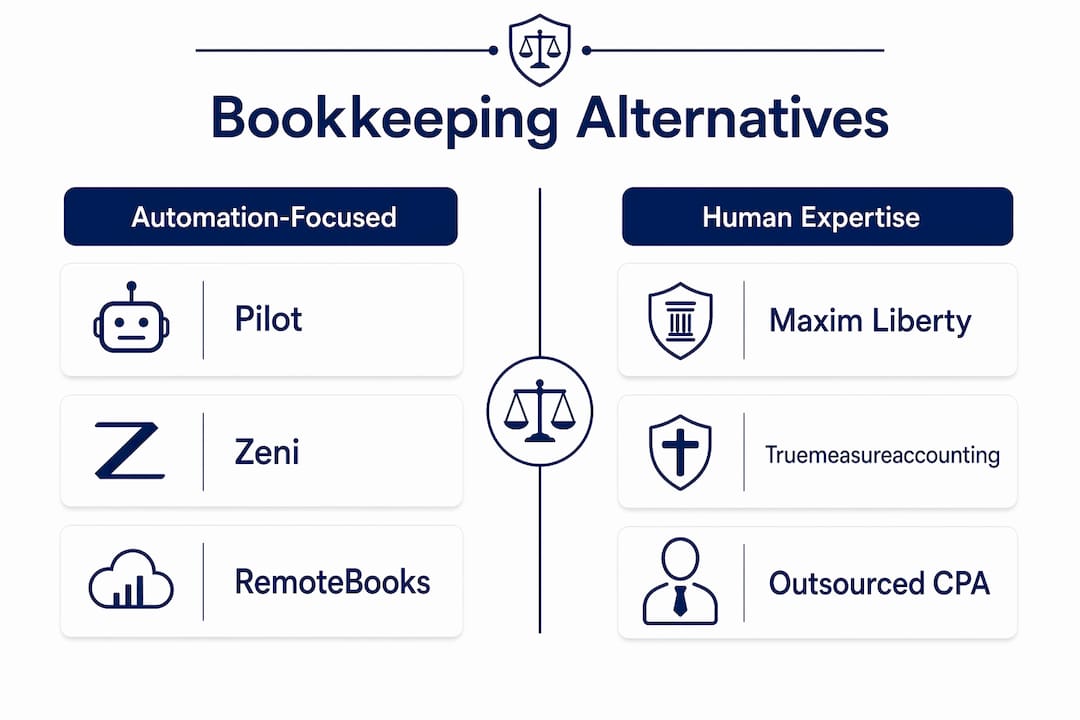
Maxim Liberty and RemoteBooksOnline both use flat monthly pricing, which works well for businesses that want cost certainty. Pilot and Zeni charge more, partly because their platforms include software infrastructure. Baker Tilly operates on custom engagements, which means pricing is not publicly listed and typically reflects larger, more complex clients. Truemeasureaccounting uses fixed monthly pricing with no surprise fees, which is particularly valuable for owner-operators managing tight margins in trades and service businesses.
Human expertise vs. automation
High-quality outsourced bookkeeping providers combine human expertise with automation to improve accuracy while cutting manual workload. The balance matters. A fully automated system may miss the nuance of a job costing entry or a subcontractor payment that needs to be categorized differently for tax purposes.

Zeni and Pilot lean heavily on automation, which suits startups with straightforward, recurring transactions. Service businesses in HVAC, plumbing, or trucking often have more complex financial activity, including job-level costs, equipment depreciation, and variable labor. Those businesses benefit more from human-led bookkeeping with advisory capabilities layered on top.
Pro Tip: Ask any provider how they handle industry-specific transactions like job costing, equipment purchases, or owner draws before you sign. The answer tells you quickly whether they understand your business or just your bank feed.
Customer reviews and reputation
Trustpilot reviews for RemoteBooksOnline include complaints about communication delays and errors in reconciliations. Pilot’s Trustpilot profile shows similar concerns around responsiveness when issues arise. Baker Tilly carries a strong reputation in the mid-market CPA space, though it is not designed for small service businesses. Truemeasureaccounting’s client focus on owner-operated businesses means its team is built around the specific financial complexity those businesses carry, including cash flow management challenges and profitability analysis.
How do you choose the right outsourced bookkeeping service?
The wrong bookkeeping partner costs you more than their monthly fee. Inaccurate books lead to bad pricing decisions, missed tax deductions, and cash flow surprises that can stall growth or force you into short-term debt.
Key factors to evaluate
- Pricing transparency — Can you see exactly what you pay each month, and what triggers a price increase? Fixed pricing protects your cash flow planning.
- Industry expertise — Does the provider understand job costing, equipment depreciation, subcontractor payments, or the specific tax strategies relevant to your trade?
- Software integration — Bookkeeping that integrates directly into your daily workflows reduces manual compilation and cuts the time you spend pulling financial documents together.
- Service scalability — Will this provider still fit your needs when revenue doubles? Some entry-level services cap out at basic reconciliations.
- Support responsiveness — Dedicated support teams with proactive financial advice score higher on reliability and client satisfaction than ticket-based systems.
- Contract flexibility — Month-to-month arrangements give you leverage. Long-term contracts with steep cancellation fees are a red flag for a service business with seasonal cash flow.
Questions to ask before you commit
Before signing with any provider, ask these directly:
- How do you handle catch-up bookkeeping if my records are behind?
- What accounting software do you use, and who owns the data if I leave?
- Do you provide financial reports I can actually use to make decisions, or just a monthly close?
- How do you handle tax planning, and is it included or billed separately?
- What is your cancellation policy?
The IRS requires small businesses to maintain accurate financial records to support tax filings and withstand audits. A bookkeeping provider who cannot produce clean, organized records on demand is a liability, not an asset.
Trust signals worth checking
Certifications matter, but they are not the whole picture. Look for providers with QuickBooks ProAdvisor credentials, CPA oversight, or demonstrated experience in your specific industry. Check the Better Business Bureau profile for complaint history. Maxim Liberty carries a BBB listing. RemoteBooksOnline and others have Trustpilot profiles worth reading before you decide.
Pro Tip: Ask for a sample financial report before you sign. If the report is just a profit and loss statement with no commentary or KPIs, you are paying for data entry, not financial clarity. The best providers tell you what the numbers mean for your business.
For service businesses comparing multiple options, exploring bookkeeping alternatives across different provider categories can surface options that fit niche operational needs better than the most-advertised names.
How does the right bookkeeping partner improve profitability and cash flow?
Bookkeeping quality has a direct line to your bottom line. Clean, timely financials let you make pricing decisions based on actual costs, not gut feel. They let you see which jobs, customers, or service lines are making money and which ones are quietly draining it.
Accurate bookkeeping supports cash flow management by enabling timely pricing adjustments and job costing that improve profitability for service businesses. An HVAC company that cannot see its cost per job cannot know whether a service call is profitable or not. A trucking company without clean per-route financials cannot tell which lanes to drop and which to expand.
What better bookkeeping actually changes
- Pricing accuracy — When your books reflect true labor, materials, and overhead costs, you can price jobs to actually make money instead of just staying busy.
- Cash flow visibility — Monthly reconciliations and cash flow reports let you anticipate shortfalls before they hit, not after you’ve missed payroll.
- Tax planning — Clean books make proactive tax strategy possible. Disorganized records mean you pay more than you owe because your accountant cannot find the deductions.
- Job costing — Service businesses in construction, plumbing, and electrical need job-level cost data to evaluate crew efficiency and project margins.
- Profitability by customer or service line — Knowing which customers generate profit and which ones consume it lets you make smarter decisions about where to grow.
Owner-operated service businesses gain the most when bookkeeping integrates directly into daily workflows rather than requiring manual document compilation at month end. That integration is what separates a financial partner from a data entry service.
The difference between a bookkeeper who records transactions and one who connects those transactions to your business decisions is the difference between knowing your revenue and knowing your profit. For a plumbing company running $1.5 million in annual revenue, even a 3% improvement in net margin from better job costing and pricing clarity is a meaningful gain.
Financial mismanagement is one of the leading reasons small businesses fail. Businesses with clean, current financials are better positioned to catch problems early, respond to market changes, and make confident growth decisions.
Truemeasureaccounting was built specifically for this gap. Its founder, Anthony Boncimino, spent more than 20 years building and operating multi-million-dollar service businesses before launching the firm. That background means the team recognizes profit leaks, cash flow gaps, and pricing problems that a traditional bookkeeper would never flag.
Key Takeaways
The best outsourced bookkeeping service for a small service business is the one that matches your operational complexity, integrates with your existing software, and delivers financial clarity you can act on, not just reports you file away.
| Point | Details |
|---|---|
| Match service to business size | Entry-level flat-rate services fit micro-businesses; service firms at $250K–$5M need advisory depth. |
| Prioritize integration | Bookkeeping that connects to your daily workflows cuts manual work and improves accuracy. |
| Fixed pricing protects cash flow | Transparent monthly fees make budgeting predictable; hourly billing creates cost uncertainty. |
| Industry expertise drives real value | Providers who understand job costing, trades, and service operations deliver insights, not just records. |
| Truemeasureaccounting | Covers bookkeeping, tax planning, cash flow management, and fractional CFO for owner-operated service businesses. |
What most business owners get wrong when picking a bookkeeping service
Most business owners evaluate bookkeeping services the same way they shop for software: they compare the feature list and pick the cheapest option that checks the boxes. That approach works fine for a solo freelancer. For an HVAC company running $2 million in revenue with five technicians, three trucks, and seasonal cash flow swings, it tends to create expensive problems.
The real question is not “what does this service do?” It is “does this service understand what my business actually does?” A bookkeeper who has never worked with a service business will categorize a truck repair as a general expense instead of a vehicle maintenance line item tied to a specific asset. That error compounds over time, distorting your cost-per-job data and your tax position simultaneously.
Automation is genuinely useful, but it is not a substitute for judgment. Platforms that rely heavily on AI to categorize transactions work well when transactions are simple and recurring. Service businesses have messy, variable financials: subcontractor invoices, owner draws, equipment purchases, job deposits, and retainage. Those transactions need a human who understands the business context, not an algorithm trained on e-commerce data.
The providers that consistently deliver the most value to small service businesses are the ones that treat bookkeeping as the foundation for financial decision-making, not the end product. When your books are clean and current, you can have a real conversation about pricing strategy, tax planning, and where your cash is actually going. That conversation is where the real return on your bookkeeping investment lives.
Truemeasureaccounting gives service business owners financial clarity, not just clean books
If you run an HVAC company, a plumbing operation, a trucking fleet, or any owner-operated service business, you need more than a monthly reconciliation. You need to know which jobs are profitable, where your cash is going, and how to reduce your tax liability before year-end, not after.
Truemeasureaccounting delivers exactly that. The firm handles monthly bookkeeping and reconciliations, QuickBooks cleanup, financial reporting, cash flow management, tax planning, and fractional CFO services, all under fixed monthly pricing with no surprise fees. Clients are typically service businesses generating between $250,000 and $5 million annually who need real financial guidance, not just a data entry service. The team brings operational experience from running multi-million-dollar service businesses, which means they spot profit leaks and cash flow problems that a traditional bookkeeper would miss entirely.
Ready to see what your numbers are actually telling you? Schedule a call with Truemeasureaccounting and get a clear picture of where your business stands financially.