
A financial advisor for small business owners is a strategic partner who improves profitability, reduces tax liability, and stabilizes cash flow through forward-looking financial planning. This role is distinct from a traditional accountant or bookkeeper. The industry standard term is financial planner or financial advisor, and for owner-operated businesses, this person functions as a fractional CFO who connects your numbers to real business decisions. According to the TIAA Institute, advised households report an average net worth of $800,000 compared to $388,000 for non-advised households. That gap does not happen by accident. It is the result of better habits, smarter tax strategies, and disciplined financial planning applied consistently over time. Understanding why small business owners need a financial advisor starts with recognizing that running a profitable business and managing your personal wealth require two different skill sets. Most owners are experts at their trade. Very few are experts at both.
Why small business owners need a financial advisor
The core reason to hire a financial advisor is simple: most small business owners are too close to daily operations to see the full financial picture. A financial advisor provides the outside perspective and forward-looking analysis that keeps a business financially healthy, not just compliant.

The difference between accounting and advisory
Financial advisors differ from accountants in one critical way. Accountants report what happened. Advisors plan what should happen next. An accountant prepares your tax return and reconciles your books. A financial advisor takes that same data and builds a 12-month forecast, stress-tests your revenue assumptions, and tells you whether your pricing covers your overhead. For an HVAC company or a plumbing contractor, that distinction is the difference between reacting to problems and preventing them.
Financial advisory for small businesses covers several areas that accounting alone does not:
- Cash flow forecasting: Projecting 90-day and 12-month cash positions so you never get caught short on payroll or materials
- Profit margin targets: Setting realistic gross and net margin goals by service line, job type, or customer segment
- Revenue stress testing: Modeling what happens to your business if revenue drops 20–30% so you can build a response plan before the crisis hits
- Owner compensation planning: Structuring how you pay yourself in a tax-efficient way that also supports personal wealth building
- Capital allocation: Deciding whether to buy equipment, hire staff, or hold cash based on your current financial position
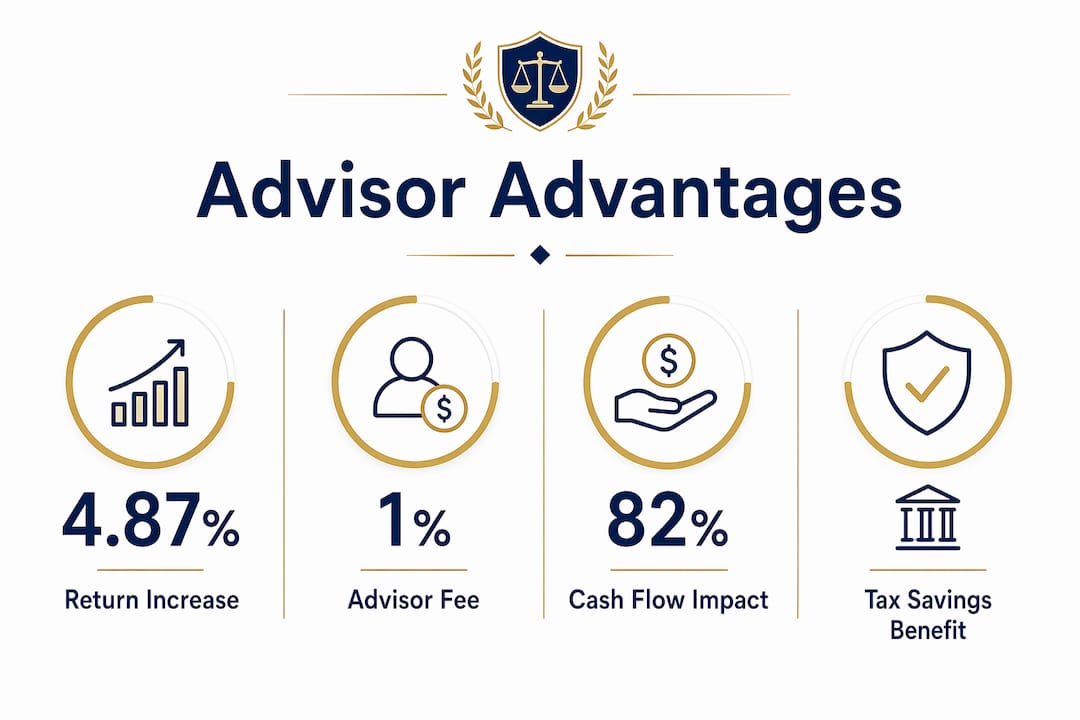
Cash flow problems drive 82% of small business failures. That number reflects how many owners run their businesses on gut feel rather than financial models. A financial advisor replaces gut feel with data.
Pro Tip: Open a dedicated business operating account and a separate cash reserve account. Your advisor should help you target a reserve equal to 3–6 months of operating expenses, and up to 6–12 months if your industry is seasonal or project-based.
For service businesses like general contractors, electrical companies, and trucking operations, cash flow is especially volatile. Jobs get delayed. Customers pay late. Equipment breaks down. A financial advisor builds the buffer and the plan that keeps you operating through those disruptions.
What tax and investment advantages does a financial advisor provide?
Hiring a financial advisor pays for itself through tax savings and improved investment returns. This is not a vague claim. The numbers are specific and well-documented.
How advisors improve your investment returns
Professional financial advice can add up to 4.87% to long-term portfolio returns. The typical advisor fee runs around 1% annually. That means the net benefit to you is substantial, and it compounds over time. The return improvement comes from three sources: preventing emotional selling during market downturns, optimizing asset allocation, and applying tax-sensitive investment strategies.
For small business owners, the investment picture is more complex than it is for salaried employees. Your business is itself a major asset. Your personal retirement accounts, real estate holdings, and business equity all need to be managed as a single portfolio. A financial advisor coordinates all of it.
Tax planning strategies that reduce your liability
Tax planning is where financial advisors deliver some of their most measurable value for small business owners. Here is how a structured tax strategy works in practice:
- Entity structure review: Advisors evaluate whether your S-corp, LLC, or sole proprietorship structure minimizes your self-employment and income tax burden.
- Retirement account optimization: SEP-IRAs, Solo 401(k)s, and defined benefit plans can shelter significant income from taxation each year.
- Timing of income and expenses: Advisors help you defer income or accelerate deductions based on your projected tax bracket.
- Depreciation and Section 179 elections: For contractors and trucking companies with equipment, these elections can dramatically reduce taxable income in the year of purchase.
- Quarterly estimated tax management: Advisors set accurate quarterly payment schedules so you avoid underpayment penalties and do not overpay throughout the year.
| Tax Strategy | Who Benefits Most | Typical Impact |
|---|---|---|
| S-corp election | Sole proprietors earning $80,000+ | Reduces self-employment tax |
| SEP-IRA contributions | Self-employed owners | Shelters up to 25% of net earnings |
| Section 179 deductions | Contractors, trucking, HVAC | Immediate expensing of equipment |
| Income timing strategies | Project-based businesses | Shifts tax liability across years |
| Quarterly tax planning | All small business owners | Avoids penalties, improves cash flow |
Prioritizing liquidity management and tax-sensitive strategy produces greater net wealth impact than market timing. For a business owner, this means your advisor should spend more time on your tax structure and cash reserves than on picking investments.
Pro Tip: Ask your advisor to run a side-by-side comparison of your current entity structure versus an S-corp election. For many service business owners generating $100,000 or more in net profit, the tax reduction for service firms can be significant enough to justify the advisory fee on its own.
When should small business owners hire a financial advisor?
The highest value from a financial advisor comes during growth and volatility phases, not just near retirement or exit. Many owners wait too long. They assume advisors are for wealthy individuals or businesses preparing to sell. That assumption is costly.
The right moments to engage an advisor
The following business events signal that you need a financial advisor immediately:
- Starting or acquiring a business: Entity structure, initial capitalization, and owner compensation need to be set up correctly from day one.
- Crossing a revenue milestone: When your business hits $250,000, $500,000, or $1 million in annual revenue, your financial complexity increases significantly.
- Hiring your first employees: Payroll taxes, benefits costs, and labor efficiency ratios require active financial management.
- Taking on debt or a major equipment purchase: A financial advisor models the cash flow impact before you commit.
- Experiencing a sudden revenue drop or spike: Both scenarios require immediate financial planning to protect your margins and cash position.
Financial advice received just before retirement can increase sustainable annual income by 10%. That figure shows the value holds across every stage of business life. The earlier you start, the more compounding works in your favor.
How to choose the right financial advisor
Not all advisors are built for small business owners. When selecting one, prioritize these factors:
- Fee-only fiduciary: A fee-only advisor charges you directly and is legally required to act in your best interest. Avoid advisors compensated by product commissions.
- Industry experience: An advisor who has worked with HVAC companies, contractors, or trucking businesses understands your cost structure and cash flow patterns. Generic wealth managers often do not.
- Integrated planning capability: Your advisor should coordinate with your bookkeeper or accountant, not operate in isolation. Siloed advice creates gaps.
- Operational understanding: The best advisors for service businesses understand job costing, labor burden rates, and equipment depreciation, not just portfolio allocation.
Advisors reduce complexity and help owners make confident financial decisions, which increases profitability and reduces the risk of costly mistakes. That value is especially high for owner-operators who wear every hat in the business.
How to get the most value from your financial advisor
Hiring an advisor is only the first step. The value you extract depends on how you structure the relationship and what information you bring to every conversation.
Build a monthly financial review habit
Your advisor needs current, accurate financial data to give you useful guidance. That means maintaining monthly financial statements and reviewing them with your advisor on a regular schedule. A monthly review should cover your profit and loss statement, balance sheet, and cash flow statement at minimum.
The review meeting should answer four questions every month:
- Are we hitting our profit margin targets by service line?
- Is our cash reserve growing, holding steady, or shrinking?
- Are there any customers, jobs, or service lines losing money?
- What financial decisions are coming in the next 60–90 days?
Set specific financial targets with your advisor
Vague goals produce vague results. Your advisor should help you set specific, measurable targets for your business. The table below shows the types of targets worth tracking:
| Financial Metric | Target Range | Why It Matters |
|---|---|---|
| Gross profit margin | 35–55% (service businesses) | Measures pricing and labor efficiency |
| Net profit margin | 15–25% | Indicates overall business health |
| Cash reserve | 3–6 months of expenses | Protects against revenue disruption |
| Accounts receivable aging | Under 30 days average | Reflects collection efficiency |
| Owner compensation ratio | 10–20% of gross revenue | Balances reinvestment and personal income |
Use scenario planning to stress-test your business
One of the most valuable things a financial advisor does is model adverse scenarios before they happen. Ask your advisor to run a projection showing what your cash position looks like if your largest customer cancels, if a key piece of equipment fails, or if material costs rise 15%. These exercises feel uncomfortable. They are also the reason businesses survive disruptions that sink their competitors.
Mixing personal and business finances is the most common and costly mistake small business owners make. Your advisor should enforce a clean separation from the start. This is not just about clean books. It is about having accurate data to make real decisions.
Pro Tip: Give your advisor read-only access to your QuickBooks or accounting software. When they can see your numbers in real time, every conversation is more productive and every recommendation is grounded in your actual financial position.
Key takeaways
Small business owners who work with a financial advisor consistently build more wealth, pay less in taxes, and survive financial disruptions at a higher rate than those who manage finances alone.
| Point | Details |
|---|---|
| Advisor vs. accountant | Advisors build forward-looking plans; accountants report historical data. |
| Cash flow protection | Advisors help maintain 3–6 months of cash reserves to prevent the failures that affect 82% of businesses. |
| Tax savings justify fees | Advisors can add up to 4.87% in portfolio returns while reducing tax liability through entity and retirement planning. |
| Engage early | The highest advisory value comes during growth and volatility phases, not just at exit or retirement. |
| Monthly reviews matter | Regular financial reviews with accurate data produce better decisions and measurable profit improvements. |
What i’ve learned after 20 years of running service businesses
Most business owners I talk to think they need an advisor when things go wrong. A cash flow crisis hits, a tax bill surprises them, or they are thinking about selling. By that point, the advisor is doing damage control instead of building wealth.
The owners who come out ahead are the ones who bring in a financial advisor when things are going well. That is when you have the most options. You can restructure your entity, fund a retirement account, build a cash reserve, and model your growth plan without pressure. When you wait for a crisis, every decision is reactive and expensive.
I have seen HVAC companies with $2 million in revenue that could not make payroll in February because no one modeled their seasonal cash flow. I have seen general contractors who paid $80,000 more in taxes than necessary because they never reviewed their entity structure. These are not rare situations. They are the norm for businesses that treat financial management as a once-a-year tax filing exercise.
The other thing I want to be direct about: accounting and financial advisory are not the same thing. Your bookkeeper keeps your records accurate. Your accountant files your returns. Your financial advisor uses all of that information to tell you what to do next. You need all three functions working together. Most small businesses have the first two and skip the third. That is exactly where the gap in wealth accumulation shows up.
If you are running a service business and generating more than $250,000 a year, you are past the point where gut feel is a reliable financial strategy. The bookkeeping and profitability connection is real, and it starts with having an advisor who understands both sides of your business.
— Tony
How Truemeasureaccounting helps you build a stronger business
If you are ready to move beyond basic bookkeeping and get real financial guidance, Truemeasureaccounting was built for exactly this. We work with owner-operated service businesses generating $250,000 to $5 million annually, including HVAC companies, contractors, trucking operations, and professional service firms.

Our approach combines accurate monthly bookkeeping with the kind of financial advisory that actually changes business outcomes. We track your profit margins by service line, manage your cash flow, and help you build a tax strategy that reduces your liability year over year. You get the clarity of clean books and the strategic guidance of a fractional CFO, without the cost of a full-time hire. Explore our small business bookkeeping services or schedule a free consultation to see how we can help you hit your financial targets.
FAQ
What does a financial advisor do for a small business owner?
A financial advisor provides forward-looking financial planning, including cash flow management, tax strategy, profit margin analysis, and scenario planning. This goes beyond what an accountant or bookkeeper provides.
How much can a financial advisor improve my business profitability?
Professional financial advice can add up to 4.87% to long-term portfolio returns, according to Fidelity, while also reducing tax liability through entity structure and retirement account optimization.
When is the right time to hire a financial advisor?
The best time is during growth phases or major business transitions, such as crossing a revenue milestone, hiring employees, or taking on significant debt. Waiting until retirement or exit means leaving years of compounding value on the table.
Do i need a financial advisor if i already have a bookkeeper?
Yes. A bookkeeper records transactions and keeps your books accurate. A financial advisor uses that data to build strategies that improve profitability, reduce taxes, and protect your cash flow. The two roles complement each other.
How do i find a financial advisor who understands my industry?
Look for a fee-only fiduciary with direct experience in your industry, whether that is construction, HVAC, trucking, or professional services. Ask whether they have worked with businesses at your revenue level and whether they coordinate with your existing accountant or bookkeeper.