

Trucking businesses struggle to scale because growth outpaces their financial and operational infrastructure before owners realize it. Cash runs out before invoices clear, margins erode under hidden costs, and the owner becomes the single point of failure holding everything together. The problems compound at predictable thresholds: what works at 5 trucks quietly breaks at 10, visibly breaks at 25, and can sink the company at 50.
The core failure drivers, in order of impact:
- Cash gaps: Fuel, payroll, insurance, and repairs hit your bank account weeks before freight invoices are collected.
- No per-truck P&L: Without knowing which trucks make money, you can’t tell whether adding capacity helps or hurts.
- Threshold shocks at 10, 25, and 50 trucks: Each band requires different systems, financing structures, and management layers.
- Owner as bottleneck: When every dispatch decision, billing question, and compliance issue runs through you, growth stalls.
- Poor financing choices: Rigid term loans tied to temporary spot-rate strength create fixed obligations that survive rate corrections.
- Hidden operating costs: Deadhead miles, detention, unpaid driver time, and deferred maintenance don’t show up on a load confirmation.
- Missing systems: Excel and group chats can’t give you real-time visibility into profitability, compliance, or driver performance.
If cash flow is your most urgent concern, jump to the financial reality section. If you’re approaching a fleet size milestone, the threshold framework is where to start. If you want a ready-to-implement fix, go straight to the TrueMeasure playbook.
Table of Contents
- Why scaling a trucking company is harder than most small businesses
- Cash flow, margins, and job costing: the financial reality of growth
- The threshold framework: what breaks at 10, 25, and 50 trucks
- What operational systems must be in place before you add trucks
- What scaling actually costs: cash, time, and administrative burden
- Financing options that match trucking’s cash cycles
- Should you add a truck? A decision checklist for owners
- The TrueMeasure playbook: financial controls that make scaling work
- Key Takeaways
- What I’ve seen owners get wrong, and what actually fixes it
- How Truemeasureaccounting helps trucking companies scale with confidence
- Useful sources for owners who want to dig deeper
Why scaling a trucking company is harder than most small businesses
Trucking is capital-intensive in a way that most service businesses simply are not. A plumber adds a van and a technician. A carrier adds a truck, a driver, insurance, permits, fuel, and a debt payment, all of which begin drawing cash before the first load delivers. The timing mismatch between outflows and inflows is the structural problem that makes trucking company expansion struggles so common.

Spot-rate spikes make the timing problem worse. When rates climb, owners see revenue opportunity and move fast. But firms that expand during temporary spot-market strength often experience amplified cash swings and margin mistakes when rates normalize. The truck payment doesn’t drop when the market does.
Industry-specific factors that compound the difficulty:
- Heavy fixed obligations: Loan payments, insurance premiums, and lease costs continue during slow periods regardless of revenue.
- Driver churn: The labor market outlook projects substantial annual openings for heavy and tractor-trailer truck drivers over the next decade, largely from workers leaving the labor force. Buying a truck before securing a qualified driver means paying for capacity that earns nothing.
- Repair shocks: A single engine or transmission failure can erase months of margin gains.
- Regulatory recordkeeping: Every added truck and driver multiplies FMCSA compliance obligations, driver qualification files, hours-of-service records, and drug-testing requirements.
- Insurance underwriting changes: Premiums rose an additional 3.0% in 2024 after a 12.5% increase the prior year, according to ATRI’s 2025 industry research, and renewals in the first half of 2025 rose by nearly 10%.
Statistic to know: Non-fuel operating costs reached $1.779 per mile in 2024, the highest in 17 years of ATRI tracking, while the truckload sector averaged profit margins of -2.3%. Scaling into that environment without a clear per-truck cost picture is a losing bet.
Cash flow, margins, and job costing: the financial reality of growth
Cash is the gatekeeper of growth. You can be profitable on paper and still run out of money if your working capital can’t cover the lag between when expenses hit and when invoices clear. That gap widens with every truck you add.
The margin problem starts with cost-per-mile. Gross revenue per mile looks healthy until you account for deadhead, detention, unpaid driver time, and deferred maintenance. A load that bills at $2.80 per loaded mile might net $1.40 per total mile once empty miles and waiting time are factored in. Owners who don’t run load profitability reporting by lane and by truck are making expansion decisions on incomplete data.
Job costing for carriers means attributing every cost to the right truck, lane, and load: fuel, driver pay, tolls, maintenance, insurance allocation, and a share of overhead. Without that attribution, you can’t tell whether a lane is profitable or just busy. Busy and profitable are not the same thing, and confusing them is one of the most common bookkeeping mistakes trucking companies make.
Financial reports every owner must run:
- Per-truck P&L: Revenue, direct costs, and net contribution for each unit, monthly.
- Cash conversion cycle: How many days between paying expenses and collecting receivables.
- AR aging report: Which customers are slow-paying and by how much.
- Utilization metrics: Loaded miles as a percentage of total miles, and revenue-generating hours as a percentage of available hours.
- Rolling 13-week cash forecast: The single most important report for a growing fleet.
Pro Tip: Before buying another truck, run a simple accretion test. Take the truck’s projected weekly gross revenue, subtract its direct costs (fuel, driver pay, insurance allocation, debt service, and a maintenance reserve), and check whether the net contribution is positive after 60 days of ramp-up. If it isn’t, the truck weakens the company, not strengthens it.
The threshold framework: what breaks at 10, 25, and 50 trucks
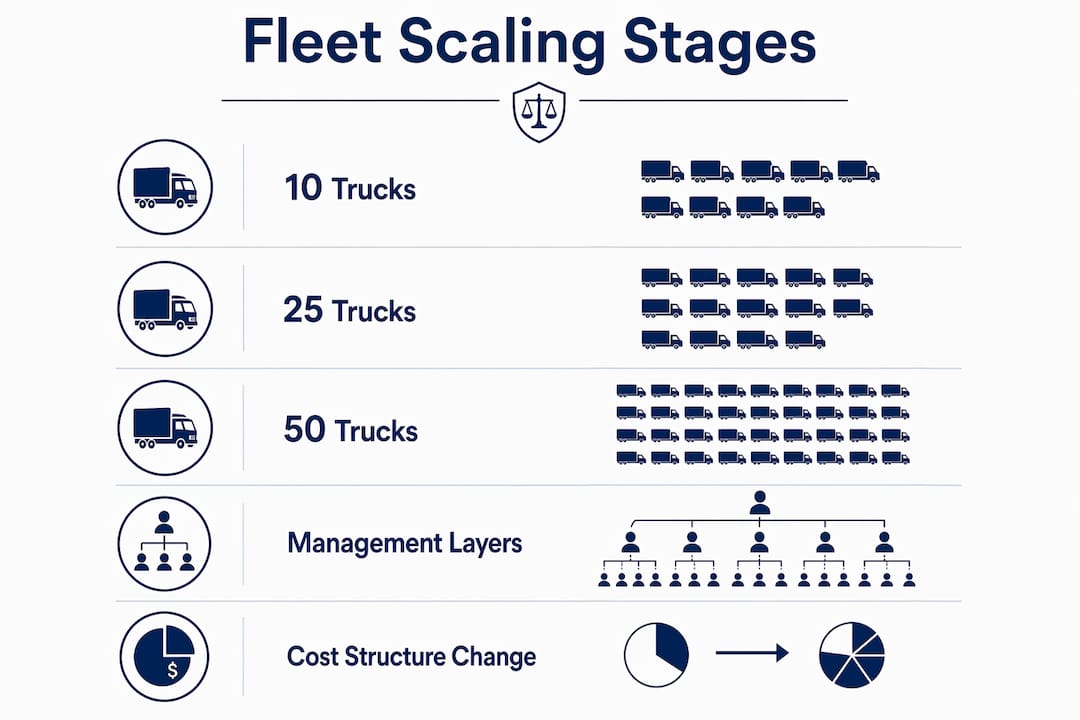
Fleet size thresholds change your cost structure, your management needs, and your lender’s perception of you. What worked at 5 trucks becomes a liability at 25, and what worked at 25 can sink you at 50. Growth behaves like a set of thresholds, and owners who don’t anticipate them get blindsided by costs and complexity they didn’t budget for.
Around 10 trucks: repeatability becomes the problem
At this size, the owner’s time is fully consumed. Every dispatch decision, every driver question, every billing dispute lands on the same desk. The business can’t grow further without the owner stepping back from at least one major function.
- New obligations: Documented dispatch rules, a basic TMS, and a part-time bookkeeper or outsourced accounting.
- Hidden costs: Owner labor that was “free” now has a real opportunity cost.
- Common failure mode: Owner tries to manage 10 trucks the same way they managed 3, loses visibility, and misses profit leaks for 60–90 days.
- Mitigation: Document one decision rule per week. Capture the answer, write the rule, delegate the question.
Around 25 trucks: administrative scale and lender scrutiny
At 25 trucks, insurance underwriters and lenders start treating you differently. Your safety score, loss history, and financial statements get real scrutiny. Hidden structural shifts occur as fleets pass this threshold, including higher per-unit insurance costs and stricter loan covenants.
- New obligations: A dedicated safety and compliance function, formal financial reporting, and a line of credit or factoring arrangement.
- Hidden costs: Insurance premiums often reset at this size; budget for a meaningful per-unit increase.
- Common failure mode: Owner assumes the same financing terms will hold. They don’t.
- Mitigation: Model the insurance and financing cost changes before crossing 20 trucks, not after.
Around 50 trucks: formal management layers required
At 50 trucks, you need a management structure, not just good people. A shadow process running on spreadsheets and messaging apps produces data so lagged that problems appear only at month end, when they’re already expensive to fix.
- New obligations: Operations manager, safety director, and a formal accounting function with monthly close discipline.
- Hidden costs: The administrative workload alone may require two or three additional hires.
- Common failure mode: Owner promotes a good driver to dispatcher and a good dispatcher to operations manager without giving either the tools or authority to actually manage.
- Mitigation: Hire for the next threshold, not the current one.
Pro Tip: The most common threshold mistake is crossing 10 trucks without moving at least one role off the owner’s plate. Dispatch, billing, or compliance, pick one and fully hand it off before adding the 11th truck.
| Threshold | Key Shift | Stop Condition |
|---|---|---|
| ~10 trucks | Owner time fully consumed; repeatability required | No documented dispatch rules or outsourced bookkeeping |
| ~25 trucks | Lender and insurer scrutiny increases per-unit cost | No formal financial reporting or flexible credit line |
| ~50 trucks | Management layers and formal compliance required | No operations manager; shadow processes still running |
What operational systems must be in place before you add trucks
Systems replace owner memory. That’s the whole point. Without documented processes, every new truck adds complexity that flows directly back to the owner, and the owner becomes the bottleneck that caps growth. When decision rules aren’t documented, owners repeatedly answer the same questions and block delegation, which is equivalent to borrowing time at high interest.
Critical systems and what “good” looks like:
- Dispatch rules: Written criteria for load acceptance, rate minimums by lane, and driver assignment. Not in someone’s head.
- TMS (Transportation Management System): Real-time load tracking, driver communication, and document management. Even a basic TMS eliminates the data lag that hides profit leaks.
- Maintenance cadence: Scheduled PM intervals by mileage, a repair log per truck, and a maintenance reserve fund. Reactive maintenance is always more expensive than planned maintenance.
- Driver onboarding: A documented checklist covering qualification files, equipment orientation, and compliance training. Informal onboarding creates compliance exposure as the fleet grows.
- Compliance tracking: Hours-of-service monitoring, drug and alcohol testing records, and FMCSA registration updates. The FMCSA requires carriers to maintain driver qualification files and safety records; informal tracking fails as driver counts rise.
- Telematics: GPS tracking, ELD compliance, and driver performance data (hard braking, idle time, speed). Telematics pays for itself through fuel savings and insurance premium reductions at most fleet sizes.
The shadow-process problem is real and expensive. Running operations on Excel and text messages means your profitability data is always 30 days old. By the time you see a problem in a month-end report, it has already cost you. Owners who set up bookkeeping for their trucking company with proper cost allocation from the start avoid most of this lag.
Pro Tip: Prioritize systems by the ROI they deliver at your next threshold. Before 10 trucks, dispatch rules and basic bookkeeping matter most. Before 25, add a TMS and formal financial reporting. Before 50, telematics and a compliance management system become non-negotiable.

What scaling actually costs: cash, time, and administrative burden
Every new truck creates costs before it creates revenue. That’s not a cash-flow problem you can manage around. It’s a structural reality you must forecast and fund. Expanding a trucking company changes its balance sheet and raises cash-flow pressure because expenses like down payments, insurance, and payroll arrive before freight invoices are collected.
| Cost Category | Timing | Illustrative Range |
|---|---|---|
| Down payment or financing deposit | Upfront, before first load | — |
| Insurance activation (new unit) | Upfront, before first load | — |
| Permits and registration | Upfront | — |
| Driver onboarding and orientation | First 1–2 weeks | — |
| Initial maintenance and inspection | Before first load | — |
| First 30–60 days of fuel and payroll | Ongoing before first invoice clears | Largest variable; plan for 45–60 days of float |
Ranges above are illustrative; actual costs vary by equipment type, state, driver profile, and freight category. Get real quotes before committing.
The cash-timing mismatch is the critical variable. Down payments and insurance hit immediately. Fuel and payroll run continuously. But freight invoices, depending on your customers’ payment terms, may not clear for 30–60 days. That gap is where growing carriers run into trouble.
Moves that shorten the timeline or reduce upfront cash required:
- Invoice factoring: Accelerates receivables to 24–48 hours; costs 1.5%–5% of invoice value but eliminates the collection wait.
- Equipment leasing vs. purchasing: Reduces upfront cash but creates a fixed monthly obligation regardless of revenue.
- Negotiating faster payment terms: Even moving a major customer from net-60 to net-30 meaningfully reduces your float requirement.
- Staged hiring: Secure the driver before finalizing the truck purchase, not after.
- Maintenance reserves: Set aside a fixed amount per truck per week to avoid repair shocks hitting operating cash.
Financing options that match trucking’s cash cycles
Choose financing that mirrors your revenue rhythm. Flexible credit and factoring often outperform rigid term loans for early-stage fleet growth because they expand and contract with volume. Reliable access to working capital via factoring or asset-aware financing enables growth without overextending when structured correctly.
Common financing options and their trade-offs:
- Invoice factoring: Fast access to cash tied directly to receivables. The cost (typically 1.5%–5% per invoice) is real, but for a carrier with 45-day payment terms, the liquidity benefit often outweighs it. Watch for recourse vs. non-recourse terms.
- Equipment loans: Fixed payments tied to a specific asset. Works well when the truck’s net contribution clearly covers the payment. Becomes dangerous when funded by spot freight that may not last.
- Equipment leases: Lower upfront cost, but you’re building no equity. Operating leases offer flexibility; finance leases function like loans. Know which you’re signing.
- Asset-based lines of credit (ABL): Borrowing capacity tied to receivables and equipment value. Flexible, but covenant-heavy. Lenders will monitor your financial ratios and can reduce availability if metrics slip.
- Lines of credit: Useful for short-term cash gaps, but expensive if used as permanent working capital. Reserve them for timing mismatches, not ongoing operations.
Insurance underwriting and lender risk profiles shift as your fleet grows. At 25+ trucks, lenders and insurers review your safety score, loss history, and financial statements more carefully. Permanent obligations become dangerous when funded by temporary freight, and that risk compounds with every fixed payment you add.
Pro Tip: Read every financing contract for covenants that punish seasonality. Common traps include minimum monthly revenue requirements, restrictions on additional debt, and cross-default clauses that let a lender call a loan if another obligation defaults. Have an accountant or attorney review these before signing.
Should you add a truck? A decision checklist for owners
Add capacity only when doing so increases firm-level liquidity and per-truck net contribution. If a new truck dilutes your cash position or lowers your average margin, it weakens the company regardless of how busy it looks.
Run through these questions before committing:
Green lights (you need all of these):
- Does the current fleet’s per-truck contribution margin average positive after all direct costs?
- Is AR aging under 45 days on average, with no single customer over 60 days?
- Is fleet utilization above 85% of available capacity on existing trucks?
- Do you have a documented driver ready to fill the seat on day one?
- Has at least one major owner function (dispatch, billing, or compliance) been fully delegated?
- Do you have a minimum cash buffer of 60 days of fixed obligations after the down payment?
- Is the freight for this truck coming from a repeatable lane or committed customer, not a spot board?
- Does the customer paying for this truck have a track record of paying within agreed terms?
Red flags that should stop expansion immediately:
- No cash buffer after the down payment clears.
- No per-truck P&L in place, meaning you don’t know whether existing trucks are profitable.
- Owner is still the single point of contact for dispatch, billing, and compliance.
- More than 40% of revenue comes from one customer or broker.
- Existing trucks are running below 80% utilization without a clear explanation.
Re-run this checklist monthly during any active growth plan. Conditions change faster than annual reviews can catch.
The TrueMeasure playbook: financial controls that make scaling work
The carriers that scale successfully share one trait: they build financial visibility before they need it, not after. This playbook covers the first actions Truemeasureaccounting implements for trucking clients who are serious about crossing thresholds safely.
First 6–8 actions to take:
- Set up a per-truck P&L in QuickBooks or your accounting system, with revenue and direct costs attributed by unit.
- Implement an AR aging report reviewed weekly, with a documented collections process for invoices over 30 days.
- Build a rolling 13-week cash flow forecast updated every Monday with actual vs. projected variances.
- Document dispatch and maintenance SOPs, one rule at a time, until the owner is no longer the answer to routine questions.
- Secure a flexible financing arrangement (factoring line or ABL) before you need it, not during a cash crunch.
- Build a utilization and lane profitability dashboard showing loaded miles %, revenue per total mile, and net contribution by lane.
- Establish a maintenance reserve fund: a fixed weekly transfer per truck into a dedicated account.
- Review insurance coverage and lender covenants against your next threshold before crossing it.
KPIs to track weekly and monthly:
- Net contribution per truck (weekly)
- Cash runway in weeks (weekly)
- Fleet utilization percentage (weekly)
- AR days outstanding (weekly)
- Maintenance cost per mile (monthly)
- Revenue per total mile by lane (monthly)
- Driver retention rate (monthly)
Pro Tip: Sequence the work. In weeks 1–4, focus on per-truck P&L and the 13-week cash forecast. In months 2–3, build the AR process and document dispatch rules. In months 4–6, add the utilization dashboard and formalize the maintenance reserve. Trying to do everything at once means nothing gets done well.
Truemeasureaccounting provides trucking-specific bookkeeping and accounting services, rolling cash forecasts, load profitability reporting, and fractional CFO advisory for carriers navigating growth. If you want to know whether your fleet is ready to add a truck, that conversation starts with a cash forecast and a per-truck P&L review.
| Control | Frequency | What It Tells You |
|---|---|---|
| Per-truck P&L | Monthly | Which trucks make money and which don’t |
| 13-week cash forecast | Weekly | Whether you can fund the next 90 days |
| AR aging report | Weekly | Which customers are slowing your cash cycle |
| Utilization dashboard | Weekly | Whether existing capacity is fully deployed |
| Maintenance cost per mile | Monthly | Whether repair costs are trending toward a shock |
Key Takeaways
Trucking businesses fail to scale sustainably when cash gaps, missing per-truck visibility, and owner bottlenecks compound at predictable fleet-size thresholds before financial controls are in place.
| Point | Details |
|---|---|
| Cash is the gatekeeper | Expenses hit before invoices clear; model 45–60 days of float for every truck you add. |
| Per-truck P&L is non-negotiable | Without knowing which trucks are profitable, expansion decisions are guesswork with a debt payment attached. |
| Thresholds change everything | At 10, 25, and 50 trucks, your cost structure, financing terms, and management needs all shift. |
| Owner must step back first | Delegate dispatch, billing, or compliance before adding the next truck, or you become the ceiling. |
| Truemeasureaccounting builds the foundation | Cash forecasts, per-truck profitability reporting, and fractional CFO advisory give carriers the visibility to scale safely. |
What I’ve seen owners get wrong, and what actually fixes it
The most common mistake I see in trucking businesses isn’t a bad truck purchase or a bad lane. It’s an owner who is genuinely excellent at running freight but has never had a clear financial picture of what each truck actually earns. They’re busy, revenue is climbing, and everything feels like it’s working. Then a repair bill hits, a customer pays 60 days late, and suddenly payroll is a problem. The business wasn’t failing. It was just running without a margin for error.
The fix is almost always the same: build the per-truck P&L first, then the cash forecast, then start delegating. Not the other way around. Owners who try to hire their way out of chaos before they have financial visibility just create more expensive chaos.
The other pattern I see consistently is owners who wait for a “good time” to document their processes. There is no good time. The documentation has to happen before the next truck, not after. Every informal answer to a recurring question is a decision rule that lives only in the owner’s head, and that’s a liability that grows with every truck added.
Patience with lane selection matters more than most owners expect. Repeatable freight from customers who pay on time is worth far more than a hot spot rate that disappears in 90 days. The carriers who scale well are the ones who resist the temptation to chase volume and instead build depth on lanes they already understand.
How Truemeasureaccounting helps trucking companies scale with confidence
Trucking owners who are serious about growth need more than clean books. They need a cash forecast that tells them whether they can fund the next truck, a per-truck P&L that shows which units are carrying the company and which are dragging it, and an AR process that keeps receivables from becoming a cash crisis.
Truemeasureaccounting delivers exactly that. The firm’s trucking bookkeeping services are built around load profitability reporting, rolling cash forecasts, and KPI dashboards designed for fleet operators, not generic small businesses. For owners approaching a threshold or already past one, the fractional CFO service provides the financial advisory layer that turns data into decisions. Services are available virtually across the United States, with deep experience in Georgia, Florida, South Carolina, Alabama, and Tennessee.
If you want to know whether your fleet is financially ready to add capacity, the right next step is a cash forecast review. Visit Truemeasureaccounting’s bookkeeping services page to see how the firm works, or reach out directly to schedule a conversation.
Useful sources for owners who want to dig deeper
- FreightWaves: Should You Scale in 2026? — Covers why spot-market signals are a poor basis for expansion decisions and what organizational readiness actually looks like.
- ATRI: Critical Issues in the Trucking Industry 2025 — The most authoritative annual data on operating costs, insurance trends, and industry-wide margin pressure.
- eCapital: Growing a Trucking Company Sustainably — Practical guidance on financing structures that match trucking cash cycles without overextending.
- Millennialstrucking: Scaling a Trucking Fleet — The clearest explanation of the 10/25/50 threshold framework and what changes at each level.
- Kordovatek: Why Small Fleets Don’t Scale — Focused on per-truck visibility and the repeatable systems that separate growing fleets from stalled ones.
- FasterQuotes: The 50-Truck Growth Wall — Explains the shadow-process problem and why informal operations break down at scale.
- STPS: You Don’t Have a People Problem — The owner-as-bottleneck argument, with a practical framework for documenting decision rules and delegating.
- GrowthNavigate: The Growth Risk Small Trucking Businesses Miss — Detailed breakdown of hidden costs, cash-timing gaps, and the margin quality problem that fuel prices alone don’t explain.
- FMCSA — Primary source for compliance requirements, driver qualification rules, and safety regulations that affect every carrier as it grows.
- Truemeasureaccounting: Trucking Financial Services — Overview of financial services built specifically for trucking businesses navigating growth and margin pressure.
Pro Tip: Bookmark the ATRI Operational Costs of Trucking report and update your cost-per-mile benchmarks annually. The gap between your actual cost per mile and the industry figure is one of the clearest early signals that a profit leak exists somewhere in your operation.
Recommended
- Transportation Business Growth: From Startup to Fleet Success – TrueMeasure Accounting LLC-Small Business Accounting Services
- Zero to Five Trucks: A Financial Roadmap for Fleet Growth – TrueMeasure Accounting LLC-Small Business Accounting Services
- How Trucking Business Cash Flow Works: Owner’s Guide
- Load Profitability Reporting for Trucking: 2026 Guide