
Property management trust accounting is a fiduciary bank account and ledger system that holds third-party funds — tenant rent, security deposits, owner reserves — completely separate from your operating funds. If you manage rental properties in the U.S., three actions protect your license right now:
- Open a properly titled trust account at a bank that understands fiduciary accounts before processing another client dollar.
- Stop commingling — your management fees, payroll, and vendor payments must never touch trust funds.
- Start monthly three-way reconciliations and keep signed worksheets on file.
Pro Tip: Check your state real estate commission’s website today for deposit timelines and security-deposit interest rules. Most states require deposits within 3–5 business days, and the rules vary enough that what’s compliant in Georgia may be a violation in California.
Key Takeaways
Compliant property management trust accounting requires separate accounts, individual sub-ledgers, monthly three-way reconciliations, and documented internal controls that protect both client funds and the qualifying broker’s license.
| Point | Details |
|---|---|
| Separate accounts are mandatory | Trust funds must never mix with operating funds; title accounts as fiduciary before the first deposit. |
| State rules vary significantly | Verify deposit timelines, security deposit account requirements, and interest rules with your state real estate commission. |
| Three-way reconciliation is the core control | Bank balance, trust ledger, and sum of sub-ledgers must agree monthly; unsigned worksheets are a primary audit failure. |
| Operational controls protect the broker | Written policies, dual approvals, and segregated duties reduce error rates and limit the qualifying broker’s exposure to staff mistakes. |
| Truemeasureaccounting provides ongoing oversight | Monthly reconciliations, sub-ledger cleanup, and owner reporting services keep trust accounts audit-ready and owner distributions on schedule. |
Table of Contents
- What property management trust accounting actually covers
- U.S. legal requirements and how state rules vary
- Core components of an effective trust accounting system
- How to set up trust accounts step by step
- Monthly reconciliation workflow and sample journal entries
- Common errors that trigger audits or license action
- What to require from your trust accounting software
- How to verify compliance and prepare for an audit
- Practical examples: how cleaner trust accounting improves cash flow
- Practical dos and don’ts for daily and monthly operations
- Why operational controls matter more than checkbox compliance
- Truemeasureaccounting handles trust account setup and ongoing oversight
- Sources
What property management trust accounting actually covers
Trust accounting in property management is a specific discipline within broader real estate accounting methods. The core principle: money that belongs to someone else must be tracked, held, and returned as if it were never yours to begin with.
What belongs in trust:
- Tenant rent collected on behalf of owners
- Security deposits and last-month prepaid rent
- Owner reserves held for repairs or capital improvements
- HOA dues collected and held for disbursement
- Third-party holdbacks pending lease resolution
What does not belong in trust:
- Your management fees (until a documented sweep to operating)
- Vendor refunds that belong to your company
- Payroll and company operating expenses
- Interest earned on trust funds that belongs to the company rather than clients
Two common scenarios trip up property managers. A late rent deposit — say, a tenant pays on the 10th — still belongs in trust the moment you receive it, not after you decide whether to apply it to arrears. A repair reserve draw belongs in trust until you actually pay the vendor; pulling it to operating before the invoice is processed is a commingling violation.
Most states allow a single pooled trust account that holds funds for multiple owners, with individual sub-ledgers tracking each owner’s balance. Some states, however, require security deposits to sit in a completely separate account from operational trust funds. Verify which model your state mandates before you structure your accounts.
U.S. legal requirements and how state rules vary
The federal baseline is straightforward: property managers owe a fiduciary duty to clients, which means segregating funds, maintaining accurate records, and returning money promptly. Everything else varies by state, and the variation is significant.
Common state-level rules to verify:
- Deposit timelines: Most states require deposits within 3–5 business days of receipt; some require next-day deposits.
- Security deposit accounts: Several states mandate a separate account for security deposits, distinct from the general trust account.
- Interest on deposits: Some states require interest-bearing accounts for security deposits and specify who receives the interest.
- Reconciliation frequency: Most state commissions expect monthly reconciliations; some require quarterly audits or annual reviews.
- Record retention: Retention periods typically range from 3–7 years depending on the state.
Enforcement reality: State real estate commissions treat commingling, missing reconciliations, and unexplained fee sweeps as primary audit triggers. A single mismanaged trust account can result in fines, license suspension, or revocation — not just a warning letter. Auditors often request the last 12 months of reconciliation worksheets as their first document request.
Your verification checklist:
- Bookmark your state real estate commission’s website and locate the trust account statute or administrative rule.
- Download the commission’s audit checklist if one is publicly available.
- Identify your state’s deposit timeline, security deposit rules, and interest requirements.
- Confirm record retention minimums with your state’s statute, not a third-party summary.
Core components of an effective trust accounting system
A compliant trust accounting system has four layers: the right bank accounts, a clean chart of accounts, documented internal controls, and clear role assignments. Getting all four right means you’re audit-ready on any given day, not just when a regulator calls.
Bank account structure:
- Pooled trust account: Holds all owner and tenant funds; titled as “[Company Name], Property Management Trust Account.”
- Security deposit account (if required by state): Separate account titled specifically for security deposits.
- Operating account: Holds management fees after authorized sweep, payroll, and company expenses — never mixed with trust funds.
Ledger and chart-of-accounts elements:
- Individual sub-ledgers per owner and per tenant
- Liability accounts for security deposits held
- Management fee clearing account (funds sit here until sweep criteria are met)
- Reserves sub-ledger per property
- Suspense account for unidentified or disputed payments
Internal controls that actually prevent problems:
- Segregation of duties: the person who receives funds should not be the same person who reconciles the account.
- Dual approvals for disbursements above a defined threshold (commonly $2,500–$5,000).
- Read-only bank access for the reconciliation reviewer.
- Immutable audit log in your software so no entry can be deleted without a trace.
Pro Tip: Design your chart of accounts so each owner’s sub-ledger maps directly to their monthly owner statement. When the ledger and the statement tie perfectly, owner disputes drop sharply and payout cycles shorten. This is the same principle Truemeasureaccounting applies when setting up real estate investor accounting for owner-operators.
How to set up trust accounts step by step
Step 1: Complete your legal review
Confirm your state’s requirements for account structure, deposit timelines, and record retention before opening any account. Pull the actual statute, not a blog summary.
Step 2: Select the right bank
Not every bank understands fiduciary accounts. Ask these questions before you open:
- Can you title this account as a trust or fiduciary account in the company’s name?
- Do you provide monthly statements that show beginning balance, all transactions, and ending balance?
- Does your system support FDIC pass-through insurance for pooled beneficiary accounts?
- Is your platform compatible with QuickBooks or your property management software via direct bank feed?
FDIC pass-through deposit insurance can extend coverage to individual beneficiaries of a pooled fiduciary account when beneficiaries are properly documented. Confirm the bank understands this and can support the required recordkeeping. The FDIC insures deposits up to statutory limits, so proper account titling and beneficiary documentation directly affect how much of your clients’ money is protected.
Step 3: Title the accounts correctly
Account naming examples that typically pass audit scrutiny:
ABC Property Management LLC, Trust Account — Client FundsABC Property Management LLC, Security Deposit Trust Account
Never title a trust account in your personal name or in a way that implies the funds are company assets.
Step 4: Configure your software
Map your chart of accounts in your property management or accounting software before the first deposit. Set up owner sub-ledgers, tenant ledgers, and the liability account for security deposits held.
Step 5: Write your policies and assign roles
Before processing funds, document:
- Who is authorized to deposit and disburse
- The dollar threshold requiring dual approval
- Who owns the monthly reconciliation
- Where signed reconciliation worksheets are stored
Step 6: Test the process
Run one complete cycle with a small test deposit before going live. Confirm the bank feed pulls correctly, the sub-ledger updates, and the reconciliation ties to the bank statement.

Monthly reconciliation workflow and sample journal entries
Three-way reconciliation is the control auditors check first. State commissions treat an unsigned or missing three-way reconciliation worksheet as a primary audit failure. The three balances that must agree: the adjusted bank balance, the trust ledger total, and the sum of all client sub-ledgers.
Monthly reconciliation steps:
- Pull the bank statement as of the last day of the month.
- Adjust the bank balance for outstanding deposits and outstanding checks.
- Confirm the adjusted bank balance matches the trust ledger total in your software.
- Export all owner and tenant sub-ledger balances and sum them.
- Confirm the sum of sub-ledgers equals the trust ledger total.
- Investigate any variance before signing off — even a $1 difference requires documentation.
- Print or save the reconciliation worksheet, sign it, and file it.
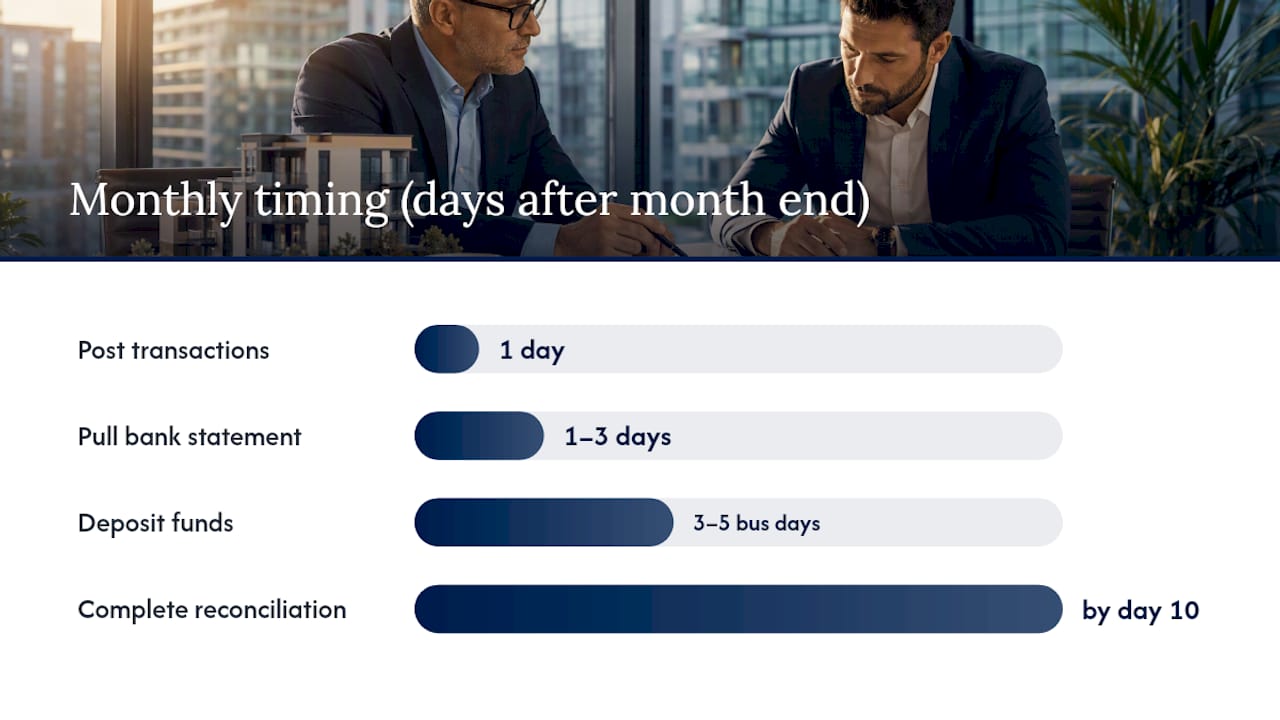
Monthly timeline and checklist:
| Task | Timing | Responsible Party |
|---|---|---|
| Deposit all received funds | Within state-required window (typically 3–5 business days) | Property manager or bookkeeper |
| Post all transactions to sub-ledgers | Daily or within 24 hours of receipt | Bookkeeper |
| Pull bank statement | 1st–3rd of following month | Bookkeeper |
| Complete three-way reconciliation | By the 10th of following month | Bookkeeper |
| Supervisor review and sign-off | By the following month | Qualifying broker or manager |
| File signed reconciliation worksheet | Same day as sign-off | Bookkeeper |
| Issue owner statements | By the following month | Bookkeeper |
Sample journal entries:
Rent receipt:
- Debit: Trust Bank Account
- Credit: Tenant Liability (Owner Sub-ledger)
Owner distribution:
- Debit: Owner Liability (Sub-ledger)
- Credit: Trust Bank Account
Management fee sweep:
- Debit: Management Fee Liability (Trust)
- Credit: Operating Bank Account
Security deposit return:
- Debit: Security Deposit Liability
- Credit: Trust Bank Account
When you find a variance: Stop. Do not process additional disbursements until the variance is explained. Trace every transaction for the period, compare to source documents (deposit slips, check copies, wire confirmations), and document your investigation in writing. If the variance reflects an error, post a correcting entry with a memo explaining what happened and why.
Common errors that trigger audits or license action
The most costly trust accounting mistakes are almost always preventable. They share a common root: unclear policies, inadequate oversight, or software that isn’t configured to match the account structure.
Commingling funds
Paying a company expense from the trust account, even temporarily, is commingling. The corrective action is an immediate transfer back with documentation. The preventive control is a hard rule in your software: vendor payments can only originate from the operating account.
Delayed deposits
Holding a tenant check on your desk for a week before depositing violates most state timelines. Corrective action: deposit immediately and document the delay with a written explanation. Preventive control: a same-day deposit policy with a supervisor notification if any deposit is delayed beyond 24 hours.
Uncleared fee sweeps
Management fees that sit in the trust account past the authorized sweep date create a liability imbalance. Corrective action: sweep immediately with a dated authorization memo. Preventive control: automate the sweep on a fixed calendar date each month.
Incorrect ledger allocations
Posting a payment to the wrong owner’s sub-ledger causes both accounts to be wrong. Corrective action: reverse the entry and repost with a memo. Preventive control: require a property code or owner code on every transaction before it posts.
Poor documentation
Missing deposit slips, unsigned reconciliations, and undocumented fee sweeps are what turn a minor error into a major audit finding. Keep source documents for every transaction for the full state-required retention period.
Staff training note: Delegation does not remove liability. The qualifying broker remains responsible for trust account compliance regardless of who handles day-to-day bookkeeping. Train staff on written procedures, not verbal instructions, and conduct a quarterly spot-check of reconciliations and source documents.
What to require from your trust accounting software
Software reduces error rates, but it does not replace documented policies or monthly sign-offs. The right platform makes compliance easier; the wrong one creates a false sense of security. When evaluating or configuring accounting software, verify these capabilities:
Non-negotiable features:
- Trust sub-ledgers per owner and per tenant, with liability tracking
- Automated bank feeds with daily sync and error alerts
- Immutable audit log (no entry can be deleted without a visible record)
- Owner statement generation tied directly to sub-ledger activity
- Fee-sweep automation with approval controls and date restrictions
- Multi-account bank mapping (trust account and operating account tracked separately)
- Role-based access controls so staff only see and touch what they’re authorized to
Capability comparison by category:
| Capability | What to verify |
|---|---|
| Trust ledger | Sub-ledgers per owner/tenant; liability account for security deposits |
| Reconciliation support | Three-way reconciliation report; variance flagging |
| Bank feed reliability | Daily sync; automatic matching; error notifications |
| Owner reporting | Statement generation from sub-ledger; customizable date ranges |
| Access controls | Role-based permissions; read-only audit access for reviewers |
| Audit log | Immutable; timestamps; user ID on every entry |
Integration pro tips:
Map your chart of accounts in the software before connecting the bank feed. Test the bank sync with one month of historical data to confirm transactions import correctly and match your manual records. Validate that vendor payment workflows only allow debits from the operating account, not the trust account. Run a test reconciliation before going live.
Pro Tip: If your current software doesn’t support true trust sub-ledgers, you’re likely doing manual workarounds in spreadsheets. That’s a reconciliation error waiting to happen. A software configuration review with a specialist can often resolve this in a single session.
How to verify compliance and prepare for an audit
Audit readiness is not a one-time project. It’s a monthly habit. When a state commission auditor or an owner requests documentation, you should be able to produce everything within hours, not days.
Audit documentation checklist:
- Signed monthly reconciliation worksheets for the past 12 months (minimum)
- Bank statements with all transactions for the same period
- Owner sub-ledger exports showing beginning balance, activity, and ending balance
- Tenant ledger exports for all active and recently closed tenancies
- Supporting documents for every fee sweep (authorization memo, date, amount)
- Vendor payment records tied to specific properties and owner approvals
- Security deposit ledger with deposit dates, amounts, and return documentation
Bank confirmation steps:
- Contact your bank and request a written confirmation of the account title, account type (fiduciary/trust), and balance as of the audit date.
- Pull a complete transaction history for the audit period directly from the bank portal.
- Cross-reference the bank’s transaction history against your software’s trust ledger line by line.
- Retain the bank confirmation letter in your audit file.
Remediation for common audit findings:
- Missing reconciliation: complete it retroactively using bank statements and sub-ledger exports; document why it was missed.
- Unexplained variance: trace to source documents; post a correcting entry with a full memo; notify your qualifying broker.
- Commingling finding: reverse the transaction, restore the correct balance, and implement the preventive control immediately.
Quarterly internal compliance check:
- Pull the three-way reconciliation report and verify it ties.
- Confirm all fee sweeps for the quarter have authorization memos on file.
- Spot-check five random tenant sub-ledgers against bank deposit records.
- Review the audit log for any unusual entries or deletions.
- Confirm all signed reconciliation worksheets are filed and accessible.
Practical examples: how cleaner trust accounting improves cash flow
The operational impact of clean trust accounting shows up in two places: owner payout speed and dispute frequency. When sub-ledgers are accurate and reconciliations are current, owner distributions go out on schedule and owners stop calling to ask where their money is.
Example 1: Reconciliation backlog resolved
A property management company managing 60 units had fallen three months behind on reconciliations. Owner payouts were delayed because the bookkeeper couldn’t confirm available balances without a current ledger. After a cleanup engagement that rebuilt the sub-ledgers from bank statements and source documents, reconciliations were brought current. Owner payout processing moved from a rolling 25-day cycle to a consistent 10-day cycle. The real estate bookkeeping mistakes driving the backlog — incorrect ledger allocations and missing deposit documentation — were resolved through a corrected chart of accounts and a written deposit policy.
Example 2: Fee sweep confusion eliminated
A 120-unit portfolio had management fees accumulating in the trust account for 45–60 days before sweep because there was no documented sweep schedule. This created a liability imbalance that made every reconciliation a manual investigation. After implementing a fixed monthly sweep date with an authorization memo template, the reconciliation time dropped from roughly four hours to under one hour per month.
30/60/90 action plan:
- Days 1–30: Legal review, bank account setup, chart-of-accounts configuration, and written policies.
- Days 31–60: First complete monthly reconciliation, staff training on deposit and ledger procedures, and software bank feed validation.
- Days 61–90: First quarterly internal compliance check, owner statement review, and reconciliation sign-off process confirmed.
Outsourcing reconciliations to a specialist frees the qualifying broker and operations staff to focus on leasing, maintenance, and owner relationships. The cash flow forecasting that becomes possible when trust account data is clean and current is a direct operational benefit, not just a compliance outcome.
Practical dos and don’ts for daily and monthly operations
Daily:
- Deposit all received funds the same day or within your state’s required window.
- Tag every transaction with the property code and owner code at the time of posting.
- Update tenant and owner sub-ledgers in real time, not in batches at month-end.
Weekly:
- Review the trust account bank feed for unmatched or unposted transactions.
- Confirm no operating expenses have been paid from the trust account.
- Check that any pending fee sweeps have the required authorization.
Monthly:
- Complete the three-way reconciliation by the 10th of the following month.
- Get the reconciliation signed by the qualifying broker or designated supervisor.
- Issue owner statements and confirm distributions match sub-ledger balances.
- File all reconciliation worksheets and supporting documents.
Never:
- Pay company bills, payroll, or vendor invoices from the trust account.
- Delay a fee sweep beyond the authorized date without a written explanation.
- Allow a single person to both receive funds and reconcile the account without oversight.
- Delete or alter a posted entry without a visible correcting entry and memo.
Pro Tip: Delegate daily posting and bank feed review to a trained bookkeeper, but keep reconciliation sign-off with the qualifying broker or a senior manager. That one control point protects the license and creates a natural monthly review of cash position and owner payout readiness.
Why operational controls matter more than checkbox compliance
Most property managers think about trust accounting as a compliance obligation. That framing is too narrow, and it leads to the wrong priorities.
Clean trust accounting is a cash-flow management tool. When your sub-ledgers are accurate and your reconciliations are current, you know exactly how much cash is available for owner distributions on any given day. You can forecast payout dates, catch shortfalls before they become disputes, and identify which properties are generating reserves versus drawing them down.
The KPIs worth tracking monthly are not just reconciliation completion. Track owner payout lag (days from month-end to distribution), reconciliation variance rate (how often your three-way reconciliation ties on the first attempt), and unallocated cash (funds sitting in the trust account without a sub-ledger assignment). Those three numbers tell you more about the health of your trust accounting operation than any compliance checklist.
One more thing that gets overlooked: the qualifying broker’s liability does not transfer when tasks are delegated. If a staff member misallocates a payment or delays a deposit, the broker’s license is still at risk. Operational controls — written procedures, dual approvals, and monthly sign-offs — are what protect the broker when something goes wrong at the staff level.
Truemeasureaccounting handles trust account setup and ongoing oversight
Property managers who want clean trust accounting without building the entire system themselves have a clear path forward with Truemeasureaccounting.
The firm handles trust account setup, monthly reconciliations, sub-ledger cleanup, owner reporting, and fractional CFO oversight for property management companies and real estate investors across the U.S. The engagement starts with a discovery review of your current account structure and reconciliation history, followed by a cleanup phase that brings ledgers current and corrects chart-of-accounts errors. From there, ongoing monthly oversight keeps reconciliations signed, owner statements accurate, and your documentation audit-ready.
For property managers who’ve been doing reconciliations manually or running behind on sub-ledger updates, the shift to a structured monthly process typically reduces reconciliation time and eliminates the owner payout delays that come from unclear balances. The result is faster distributions, fewer owner disputes, and a trust account that supports bookkeeping profitability rather than draining it.
Ready to get your trust accounts in order? Review Truemeasureaccounting’s bookkeeping services or reach out directly to discuss your current setup.
Sources
Federal and regulatory:
- Pass-through deposit insurance coverage | FDIC
State-level verification:
Truemeasureaccounting resources:
EDGAR for entity verification:
Use the SEC’s EDGAR database to verify REIT registrations and review prospectuses when managing funds for institutional or REIT-structured ownership entities. This is particularly relevant for larger portfolios where owner entities may have SEC reporting obligations.
This article is general information, not a substitute for advice from a qualified financial advisor. Consult a qualified financial professional about your own circumstances before acting on anything here.