
Need a price increase letter that gets the message across without alienating customers? This article gives you ready-to-use templates and a clear process for raising your rates, plus a profit check to confirm the increase actually moves the needle for your business.
Lead with the effective date and the fact that the monthly service rate is increasing. Say that in the first sentence, then stop apologizing. Give month-to-month customers at least a month’s notice, recurring service clients more notice, and long-term or B2B contracts even longer advance notice. Update your billing system and name a real contact before you hit send.
TL;DR:
- Notifying customers 30 to 60 days in advance is standard; high-value and long-term accounts may require up to 90 days or more.
- A staged communication plan—60, 30, and 7 days before the increase—helps customers adjust their budgets smoothly and reduces complaints.
- Clearly outline the change, effective date, value-added reasons, and exact old and new prices to avoid confusion and build trust.
- Tailor the message tone and approach based on customer value, using phone calls for top accounts and emails for others.
- Verify that the rate increase improves customer-specific profit margins before implementation to prevent unprofitable accounts from being forced into higher rates.
Table of Contents
- When and How to Notify Customers About a Price Increase
- What Belongs in a Price Increase Letter or Email
- Price Increase Letter Templates for Different Customer Types
- Handling Customer Pushback and Transition Requests
- The TrueMeasure Take: Tie the Notice to Profitability, Not Just Pricing
- Why Most Price Increase Advice Misses the Real Problem
- Sources
When and How to Notify Customers About a Price Increase
Timing depends entirely on contract type, and treating every customer the same is the fastest way to trigger complaints you could have avoided. Month-to-month HVAC or lawn care clients need less runway than a plumbing company locked into a two-year commercial service agreement. Advance notice standards generally run 30 to 60 days for most service relationships, with 90 days recommended for high-value B2B contracts where procurement teams need budget approval time.
A staged cadence outperforms a single blast. Consider this sequence:
- 60 days out: Send the primary notice with full details and effective date.
- 30 days out: Follow up with a shorter reminder, especially for annual accounts.
- 7 days out: Send a final confirmation, ideally paired with the first invoice showing the new rate.
This 60/30/7 pattern gives customers time to adjust budgets without feeling ambushed, and it’s a proven structure for subscription and recurring-revenue businesses.
Channel choice matters as much as timing. Email works as the default for most of your customer base. But your top accounts, the ones generating outsized revenue or referrals, deserve a phone call or in-person conversation before the email even lands. High-touch outreach for top revenue accounts preserves relationships in a way a form email never will.
Before any notice goes out, run through this internal checklist:
- Brief your office staff and account managers so nobody gives conflicting information.
- Update your invoicing and billing software with the new rates and effective date.
- Confirm which existing quotes or signed contracts must be honored through a cutoff date.
- Assign one named point of contact for customer questions.
If your business bills on a schedule tied to accrual timing, review how accrual accounting affects billing cycles before you lock in an effective date.
What Belongs in a Price Increase Letter or Email
Structure beats length here. Customers skim, so the first two sentences need to carry the entire message: what is changing and when. Everything after that is support, not the headline.
A complete notice includes five elements: the specific change, the effective date, a brief reason, what it means for that customer’s bill, and where to direct questions. That structure consistently outperforms vague or apologetic announcements because it respects the reader’s time.
Your justification should take one sentence, framed around value delivered rather than your rising costs. Value-based framing performs measurably better than cost-based explanations, because customers care about what they’re getting, not what your fuel or labor costs are doing. “We’re raising rates due to inflation” invites pushback. “This increase reflects the expanded response times and equipment upgrades we’ve added this year” invites nothing.
Show the actual numbers. Don’t make customers do math. State the old price, the new price, and the dollar or percentage difference for their specific plan or service tier.
Close with three things: genuine appreciation for the relationship, a named contact person, and a clear next step if they want to discuss options. Skip the groveling. A respectful, direct letter builds more trust than one that over-apologizes for running a business that pays its bills.
- Lead with the change and date, not a greeting or preamble.
- State the reason in one sentence, tied to customer value.
- Show exact old and new pricing.
- End with a name, a contact method, and an offer to talk.
Pro Tip: Keep the letter under 150 words for standard customers. If you need more space to explain, that’s usually a sign your justification is too complicated, not too short.
Price Increase Letter Templates for Different Customer Types
Different customers need different framing, even when the underlying message is identical. A one-off customer doesn’t need the same tone as a five-year commercial account.
Template 1: Month-to-month or recurring service customer
Subject line: “Your service rate is updating starting [date]”
“Starting April 1, 2026, your monthly HVAC maintenance plan will increase from $89 to $99. This reflects the additional priority scheduling and extended warranty coverage we added to all maintenance plans this year. Your next invoice will reflect the new rate automatically. Questions? Reply here or call [name] at [number].”
Template 2: Long-term or high-value account
Subject line: “An update on your account pricing, effective [date]”
For these accounts, lead with a call, then follow with written confirmation. “As we discussed, your service agreement rate will move from $2,400 to $2,650 per month starting June 1, 2026. This aligns with the expanded coverage we added last quarter. We value the partnership and want to make sure this transition works for your budget. Let’s talk through timing if needed.”
Template 3: One-off or project-based customer
Subject line: “Updated pricing for your next service request”
“Our rates for [service] are updating to $[new price], effective for jobs booked after [date]. Any quote you’ve already received stands as written. This keeps our pricing consistent with the quality and turnaround you expect.”
Template 4: SMS or invoice note reminder
“Reminder: your rate updates to $[amount] starting [date]. Questions? Text or call [name] at [number].”
A few adjustments make these land better:
- Swap generic phrases for the actual outcome that customer experienced (faster response time, fewer callbacks, specific equipment upgrades).
- Reference the account by name and history when writing to long-term clients.
- Send the reminder template 7 to 14 days before the effective date, not the day of.
For inspiration on packaging and framing pricing changes clearly, look at how fixed-price service models communicate value instead of cost.
Handling Customer Pushback and Transition Requests
Some pushback is inevitable, and how you respond to retain customers determines whether you keep the account. Scripted, calm answers work better than improvised justifications.
When a customer asks “why now,” the answer should point back to value: “This reflects the upgraded equipment and faster response times we’ve rolled out this year,” not a breakdown of your supply costs. When someone asks for an exception, decide in advance whether grandfathering makes sense. Phasing a large increase over two or three billing cycles can reduce churn risk for long-term clients, though this is a judgment call based on the account’s history and lifetime value rather than a hard rule.
- Escalate any account generating more than a set revenue threshold to a manager or owner, not front-line staff.
- Offer phased increases only for customers with multi-year tenure or high lifetime value.
- Track churn rate, inbound questions, and downgrade requests for 60 days post-rollout.
- Revisit any account that asks for a discount instead of accepting the new rate.
Track the response rate closely. If more than a small fraction of your base calls to complain, your justification or timing likely needs adjusting before the next round.
The TrueMeasure Take: Tie the Notice to Profitability, Not Just Pricing
A price increase without profitability data behind it is a guess. Before you send anything, check margins by customer or job type. Some accounts might already be unprofitable even after a rate hike, and no notice fixes that math.
- Confirm profitability by job or customer before setting the new number.
- Update your cash flow forecast to model the revenue shift and any gap from cancellations.
- Brief your team, update invoicing software, and honor existing quotes through a firm cutoff date.
- Run the numbers again 60 days after rollout to confirm the increase actually improved margin, not just top-line revenue.
TrueMeasure Accounting works with owner-operated service businesses on exactly this kind of profitability analysis, turning a pricing decision into a data-backed one instead of a gut call.
Why Most Price Increase Advice Misses the Real Problem
Most guides on this topic treat the letter as the hard part. It isn’t. Writing three sentences about a new price is easy. Knowing which customers can absorb it, and which ones were already dragging your margins before the increase, is the part nobody talks about.
The conventional advice, give notice, explain value, stay polite, is correct but incomplete. It assumes the number you’re raising prices to is the right number. Plenty of owner-operators pick a round figure or match a competitor instead of pricing off actual job costs and overhead allocation. That’s backwards. Run the profitability numbers first, then write the letter.
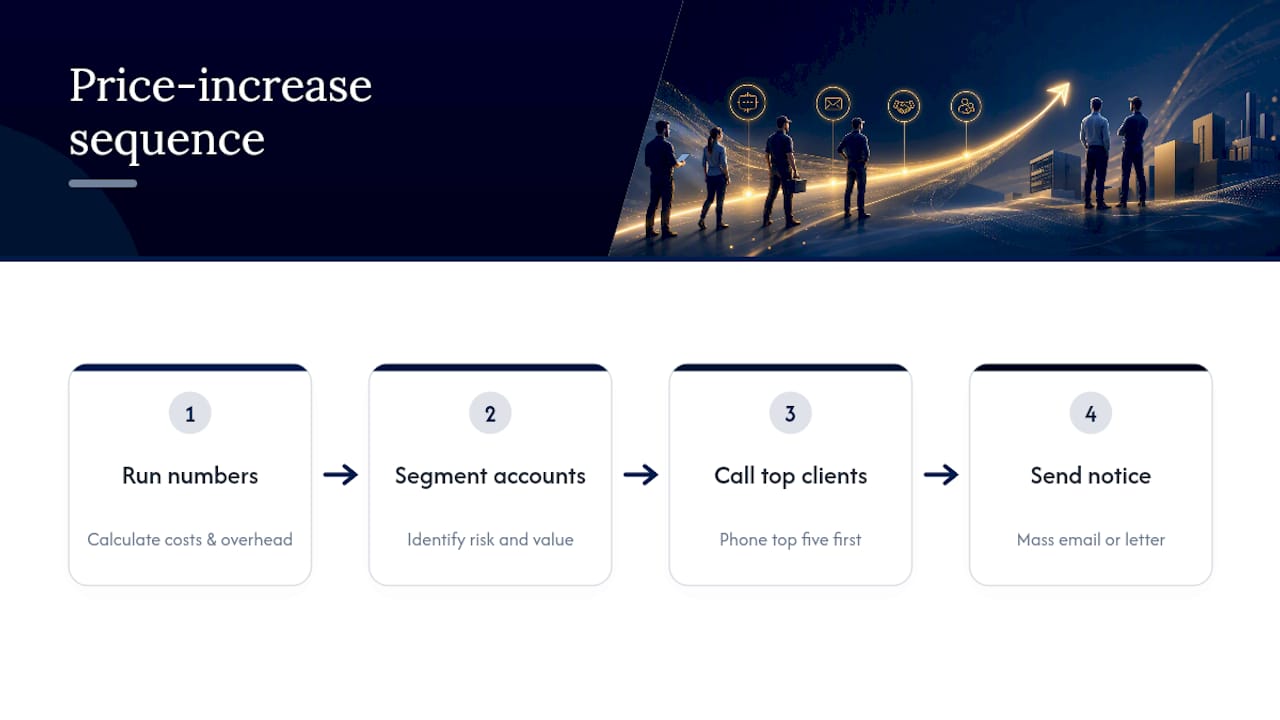
Prioritize your top accounts differently, not because they’re the loudest, but because losing one costs more than losing ten small ones. A phone call to your five biggest clients matters more than a perfectly worded mass email. Get the sequencing right: numbers first, segmentation second, letter last. Businesses that skip straight to drafting language usually end up raising prices again within a year because the first increase was never grounded in real cost data.
— Tony
Common Questions
How much notice should a price increase letter give?
Notice depends on the relationship: month-to-month customers generally need less lead time than recurring or contracted clients, who should get more advance notice to plan around the change.
Should every customer get the same letter?
Not necessarily. The core facts—effective date, old and new price, and reason for the change—should stay consistent, but tone and delivery method can be adjusted based on the account’s value to your business.
Do I need to check profit margins before raising prices?
Yes. A rate increase should be checked against your actual cost to serve each customer so you know the change is improving margin rather than just shifting numbers around.
If you want help reviewing pricing decisions alongside your broader financial picture, TrueMeasure Accounting works with owner-led businesses on bookkeeping, reporting, and financial-operations support. Service scope varies by client partnership and signed agreement.
Sources
For deeper templates and framing strategies, see Forbes Business Council on price increase messaging, Userpilot’s announcement framework, Shopify’s letter templates, and Mailchimp’s guide and templates.
- The Right Way To Communicate Price Increases To Customers — Forbes Business Council
- Price Increase Announcement: How to Do It Right in 2026 — Userpilot
- How To Write a Price Increase Letter: Two Practical Templates (2026) — Shopify