
Yes, an S corporation can pay or reimburse health insurance premiums for a shareholder who owns more than 2% of the company, and that owner can generally deduct the cost on their personal return. The catch is procedural, not conceptual: the premium has to run through payroll, land in Box 1 of the W-2, and stay out of Boxes 3 and 5. Miss any one of those steps and the IRS treats the deduction as void, no matter how many receipts you kept.
TL;DR:
- The health insurance premium for more-than-2% S corp shareholders must be included in Box 1 wages, not just reimbursed personally, to meet IRS requirements.
- The premium deduction is limited by the shareholder’s Box 5 wages, which only include Medicare wages, not total Box 1 wages, so low salary can cap the deduction.
- Proper payroll setup requires the premium to be added to Box 1 payroll, excluded from Boxes 3 and 5, and documented thoroughly for audit protection.
- State plan eligibility and the interaction with health savings accounts influence the best coverage options for shareholder-owners.
- Correcting W-2 reporting errors involves timing salary adjustments and maintaining detailed records to preserve deductibility and compliance.
Table of Contents
- The >2% Shareholder Rule and How the IRS Treats S Corp Owner Premiums
- Step-by-Step: How to Arrange Payment, Payroll Entries, and the Personal Deduction
- The Box 5 Trap: Why Showing the Premium in Box 1 Isn’t Always Enough
- Plan and Coverage Options for S Corp Owners
- Common Mistakes, Red Flags, and a Compliance Checklist
- TrueMeasure’s Practical Payroll and Accounting Checklist
- Why Health Insurance Is Part of Compensation Design, Not a Side Detail
- How TrueMeasure Accounting Helps S Corp Owners Get This Right
- Sources
The >2% Shareholder Rule and How the IRS Treats S Corp Owner Premiums
The IRS draws a hard line at 2% ownership, and it’s not a line you can dodge by spreading shares around the family. Under IRC §318, attribution rules pull in stock owned by a spouse, children, grandchildren, and parents. If you own 1% directly but your spouse owns 5%, you’re both treated as more-than-2% shareholders for this purpose. That distinction controls everything else in this article, so get it right before you touch payroll.
For a regular employee, the company pays health premiums and nobody pays tax on the value of that coverage. For a more-than-2% shareholder-employee, the IRS forces the premium into Box 1 wages specifically to prevent a tax-free fringe benefit from slipping through. The corporation still deducts the premium as a business expense. The shareholder just has to recognize it as income first, then claim it back through a separate deduction on their personal return.
Here’s what that means in practice for what gets covered and how it’s reported:
- Covered plans: health insurance, dental coverage, and qualified long-term care premiums all qualify.
- Covered people: the shareholder, their spouse, and their dependents, even if the dependents aren’t employed by the S corp.
- W-2 mechanics: the full premium amount goes into Box 1 (subject to federal income tax withholding), but it’s excluded from Box 3 (Social Security wages) and Box 5 (Medicare wages).
- Who this does NOT apply to: employees owning 2% or less get the standard tax-free treatment, with no Box 1 addition required.
This isn’t a loophole or a workaround. It’s the trade the IRS built into subchapter S: you get the deduction, but only after the income shows up on your W-2 first. Skip that step and you’ve got a health plan with no paper trail connecting it to payroll, which is precisely the kind of gap that turns into a disallowed deduction on audit.
Step-by-Step: How to Arrange Payment, Payroll Entries, and the Personal Deduction
Getting this right isn’t complicated, but it does require sequencing. Skip a step and the whole structure falls apart even if every dollar was spent correctly.
- Establish the plan through the corporation. The S corp has to be the one that pays or reimburses the premium, not the shareholder writing a personal check and hoping it counts. The most common fatal error here is treating a personal policy as a business expense without ever running it through the company.
- Choose your payment flow. Either the company pays the insurer directly, or the company reimburses the shareholder for premiums paid personally. Both work, but reimbursement requires documentation: keep the original invoice, proof of payment, and a record showing the reimbursement came from the corporation, not just a casual transfer.
- Add the premium to Box 1 wages. Your payroll provider needs to include the full annual premium in Box 1, taxable for federal income tax and typically state income tax, while explicitly excluding it from Boxes 3 and 5.
- Use Box 14 as a memo (optional but smart). Labeling the amount in Box 14 as “S corp health insurance” or similar makes it instantly visible to whoever prepares your personal return, which matters more than you’d think when tax season gets busy.
- Claim the deduction on Form 1040. The shareholder reports the self-employed health insurance deduction on Schedule 1, which flows into the above-the-line deductions on Form 1040. This lowers adjusted gross income, not just taxable income, which has knock-on benefits for other AGI-based calculations.
- Reconcile with premium tax credits if applicable. If anyone in the household received marketplace subsidies, the interaction between the self-employed deduction and the premium tax credit calculation gets iterative. This is a spot where a tax professional earns their fee.
Pro Tip: Keep a standing folder, digital or physical, with the insurance policy, twelve months of payment records, your payroll register showing the Box 1 addition, and a one-page memo explaining the arrangement. If you’re ever audited, that folder is the difference between a five-minute conversation and a drawn-out dispute.
The Box 5 Trap: Why Showing the Premium in Box 1 Isn’t Always Enough
Here’s where a lot of owner-operators get burned even after doing everything else right. The self-employed health insurance deduction can’t exceed your earned income from the business, and for an S corp shareholder, that earned income is measured by Box 5, your Medicare wages, not Box 1.
That distinction matters because Box 1 already includes the health insurance premium itself. Box 5 does not. So if your regular salary is thin and most of your compensation comes through distributions, your Box 5 figure might be too small, or close to zero, to support the deduction at all.
Worked example: Say your S corp pays $18,000 in annual health premiums for you and your family. Your salary before adding the premium is $15,000, so Box 1 shows $33,000 ($15,000 salary plus $18,000 premium), but Box 5 shows only $15,000, since premiums are excluded from Medicare wages. Your self-employed health insurance deduction is capped at your earned income, that $15,000 Box 5 figure, not the $33,000 in Box 1. You’d lose $3,000 of the deduction entirely, even though the corporation paid the full $18,000 premium and reported it correctly.
If you catch this before filing, you have options:
- Increase the shareholder’s reasonable salary so Box 5 wages exceed the premium amount.
- File a corrected W-2c if the error is discovered after issuance but before the return is filed.
- Time the compensation decision earlier in the year so payroll adjustments aren’t a scramble in December.
The fix almost always comes down to reasonable salary, a number many owner-operators set too low to begin with, often to minimize payroll taxes, without realizing it can quietly cap other deductions.
Plan and Coverage Options for S Corp Owners
Not every health plan structure works the same way once you’re a more-than-2% shareholder, and this is where a lot of well-intentioned setups go sideways.
Group plans work fine for S corps, but single-employee group eligibility varies by state. Some states allow a true one-person group plan; others require a minimum number of employees to qualify for group rates. Check with your insurance broker on your specific state’s threshold before assuming a group plan is available to a solo owner-operator.

Individual and marketplace plans are the most common route for smaller S corps, especially those with just the owner and a handful of field employees. The corporation reimburses the premium, and the mechanics described earlier still apply in full.
Association and self-funded plans can make sense for contractors and trucking operators who band together through trade groups, though these arrangements need careful vetting for state insurance law compliance.
Here’s the part that trips people up: HRAs, QSEHRAs, and ICHRAs generally don’t work for more-than-2% shareholders. These arrangements are built for employees receiving tax-free reimbursements, and S corp guidance excludes owners in that category from that tax-free treatment. Setting one up for yourself creates compliance risk rather than savings.

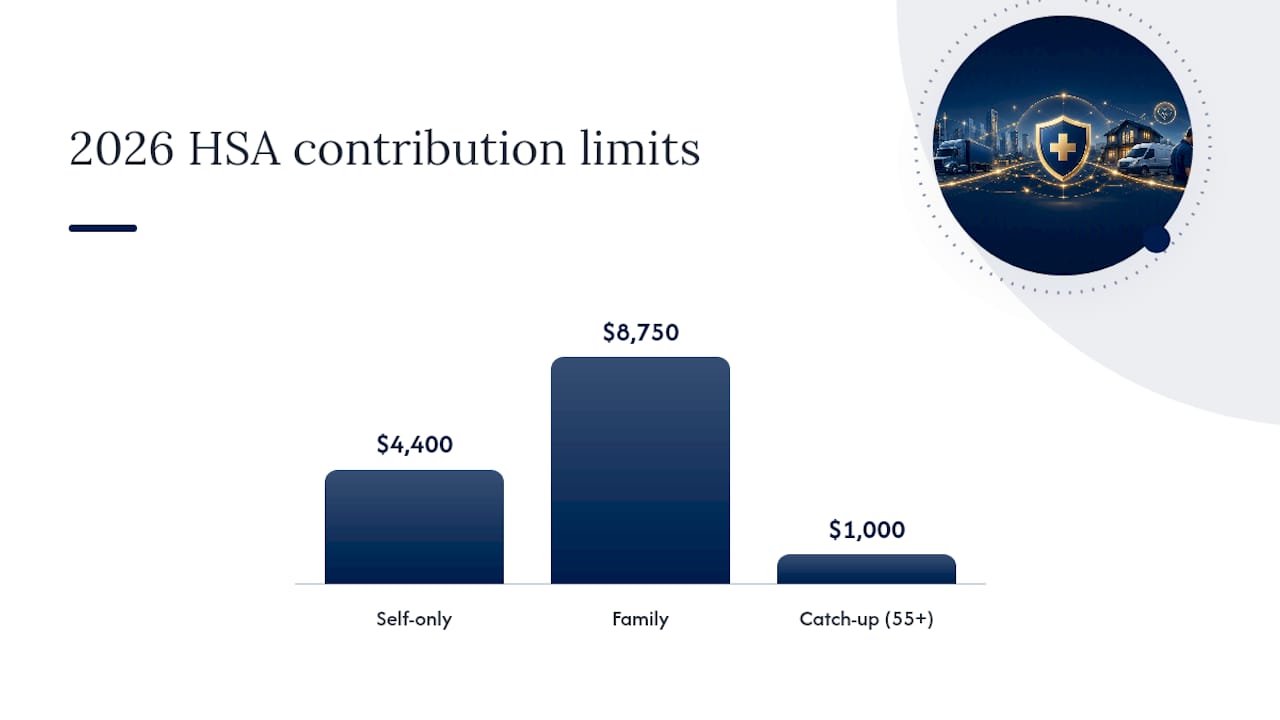
HSA contributions remain a strong complementary strategy. For 2026, the HSA contribution limits are $4,400 for self-only coverage and $8,750 for family coverage, with an additional $1,000 catch-up contribution for those 55 and older. A more-than-2% shareholder’s HSA contributions are typically made personally and deducted on Form 1040, since employer HSA contributions to a more-than-2% shareholder get the same Box 1 treatment as health premiums.
Before locking in a plan type, run through this checklist:
- Confirm your state’s rules on single-employee group eligibility.
- Verify you’re not accidentally structured into an HRA or ICHRA.
- Check whether an HSA-qualified high-deductible plan fits your family’s actual medical spending.
- Map out how the choice affects your Box 5 wages and deduction eligibility.
Common Mistakes, Red Flags, and a Compliance Checklist
Most lost deductions trace back to a handful of repeat offenders:
- Paying premiums personally without ever routing them through the corporation.
- Leaving premiums out of Box 1 entirely, treating them as a tax-free benefit.
- Failing to exclude the premium from Boxes 3 and 5.
- Ignoring the months a spouse was eligible for other subsidized coverage, which can disqualify that period.
- Setting salary so low that Box 5 wages can’t absorb the deduction.
Run this checklist before every filing season: confirm plan establishment, verify W-2 boxes with your payroll provider, check spouse eligibility gaps month by month, and compare Box 5 against total premiums paid. If you find an error from a prior year, a Form W-2c and amended Form 1120-S can often correct it, followed by a personal 1040-X.
Pro Tip: Don’t wait for your CPA to catch this in April. Review your Box 1 and Box 5 figures with your payroll provider every October, while there’s still time to adjust salary or reimbursements before year-end.
TrueMeasure’s Practical Payroll and Accounting Checklist
Getting the tax treatment right on paper means nothing if your payroll system doesn’t execute it correctly month after month. Here’s what we walk owner-operator clients through:
- Payroll configuration: ask your provider to create a dedicated pay type labeled something like “S Corp Owner Health Premium,” coded to hit Box 1 but explicitly excluded from Social Security and Medicare wage bases.
- Bookkeeping entries: record the premium as a payroll expense on your P&L, not as a separate insurance line item disconnected from wages. Reconciling reimbursed payments against direct-pay premiums monthly keeps your books audit-ready.
- Compensation design: if Box 5 wages are running thin relative to premium costs, that’s a signal to revisit reasonable salary, weighing the payroll tax cost against the deduction you’d otherwise lose.
- Provider briefing template: give your payroll company the shareholder’s name, ownership percentage, annual premium total, and the specific instruction to include in Box 1 and exclude from Boxes 3 and 5.
Pro Tip: Print your payroll register in December and compare Box 1, Box 3, and Box 5 side by side. If Box 1 doesn’t show the premium bump or Box 5 looks identical to Box 3, flag it before your W-2s go out, not after. Sound documentation practices, similar to what governs accountable plan reimbursements, protect this deduction the same way they protect any other reimbursement arrangement.
Why Health Insurance Is Part of Compensation Design, Not a Side Detail
Most owner-operators treat health insurance as a benefits question and reasonable salary as a payroll tax question. They’re the same decision. Every dollar you shift between salary and distributions changes your Box 5 wages, your deduction ceiling, and your cash flow all at once. That’s not a detail to hand off blind to whoever runs your payroll. Build compensation and health coverage together, ideally with a year-end tax planning review, and run the numbers before December, not after.
— Tony
How TrueMeasure Accounting Helps S Corp Owners Get This Right
TrueMeasure Accounting is the partner owner-operators call when a W-2 doesn’t match what the payroll provider promised, because catching a Box 5 shortfall in October costs nothing compared to discovering it after you’ve filed. We set up payroll pay types correctly from day one, review your W-2 before it goes out, and run compensation scenarios that balance your deduction against your actual take-home pay and business cash flow.
If you’re an HVAC contractor, trucking operator, or construction business owner running compensation through an S corp, this is exactly the kind of detail that gets missed between tax season and the day-to-day of running jobs. We also cover the payroll tax mechanics that connect directly to this issue in our breakdown of small business payroll tax obligations, and for a deeper look at compliance stakes generally, Payroll Tax Problem’s guide on payroll compliance is worth a read.
Reach out before you make salary or distribution changes for next year, or the moment you spot a mismatch on a W-2. Start with our bookkeeping and payroll services page to schedule a review.
Sources
Verify these details directly with primary sources: the IRS guidance on S corp compensation and medical insurance, Form 1040 instructions, and current HSA contribution limits. For multi-state operations or complex ownership structures, loop in a tax professional before filing.
- S corporation compensation and medical insurance issues | Internal Revenue Service
- S Corp Owner Health Insurance Deduction: The Box 5 Rule Most Owners Miss | Manay CPA
- HSA 2026 contribution guidance (Dartmouth HR page) | Dartmouth College