

The simplest lawful ways to pay independent contractors fall into four categories: direct pay with manual 1099 tracking, contractor-focused payment platforms, full-service payroll systems that also handle 1099s, and AP or invoice automation tools. Most owner-operated service businesses with under 20 contractors do best starting with a contractor-focused platform. It balances cost, compliance, and bookkeeping effort better than the alternatives.
TL;DR:
- Contractor-focused payment platforms automate 1099 tracking and reporting for businesses with more than five contractors, reducing compliance risk and manual effort.
- Full-service payroll systems can support both employee and contractor payments but may be costly if your primary need is contractor management alone.
- Businesses working with irregular billing or project-based payments should consider invoice automation tools, which shift payment scheduling to contractor invoicing.
- Collecting signed W-9 forms and maintaining detailed, organized payment records before paying contractors is essential for avoiding IRS penalties at tax time.
- Multi-state contractor work requires careful tracking of payment locations to meet varying state reporting obligations and prevent unexpected liabilities.
Table of Contents
- Contractor Payroll Options: How Each Model Actually Works
- Which Contractor Payment Method Wins on Cost, Speed, and Risk?
- What Contractor Payroll Actually Costs and How Fast Payments Move
- How to Onboard Contractors and Stay Compliant on 1099s
- Matching the Payroll Model to Your Trade
- Do You Owe State Payroll Taxes on Contractor Payments?
- Paying Contractors Who Work Across State Lines
- Connecting Contractor Payments to Your Accounting Software
- Keeping Contractor Payment Records Audit Ready
- Handling Payment Disputes With Contractors Without Losing the Relationship
- The Payroll Method You Choose Shapes Your Profitability, Not Just Your Compliance
- An Outsourced Alternative for Contractor Pay and Job Costing
- Where to Verify the Rules and Get Set Up Right
- Sources
Contractor Payroll Options: How Each Model Actually Works
Every one of these four models solves the same problem differently, and the differences show up fastest in how much manual work lands on you at tax time.
Direct payments mean you write checks, send Zelle transfers, or push ACH payments from your business bank account, then track everything yourself in a spreadsheet or your accounting software. It works fine when you have two or three contractors and simple, predictable payments. It falls apart fast past ten contractors, because you’re now manually tracking payment totals for 1099-NEC purposes, and one missed entry means a wrong number on a tax form with your business’s name attached to it.
Contractor-focused payment platforms automate the parts that break down in the direct-pay model. You enter a contractor once, they fill out their own W-9 through a portal, and the platform tracks year-to-date payments automatically. Most of these tools generate 1099-NECs at year-end without you touching a spreadsheet, and they give contractors self-service access to their own payment history and tax documents. This removes a surprising amount of friction. Fewer texts asking “did you pay me for that job in October?”
Full-service payroll systems are built primarily for W-2 employees but many now support 1099 contractor payments as a secondary feature. If you already run payroll for a crew of employees and only have a handful of contractors, running both through one system can simplify your bookkeeping. The tradeoff is you’re often paying for employee-payroll features you don’t need just to get contractor support bundled in.
AP and invoice automation flips the model: instead of you initiating payment on a schedule, the contractor submits an invoice and the system routes it for approval and payment. This fits businesses that work with contractors who bill irregularly, like a specialty subcontractor who invoices per project rather than per pay period.
Key differences that determine which model fits your operation:
- Direct pay: lowest cost, highest manual burden, error prone past a handful of contractors
- Contractor platforms: automated 1099s, self-service contractor portals, moderate monthly cost
- Full-service payroll: best when you already run W-2 payroll and want one system
- AP/invoice automation: best when contractors bill irregularly or per project rather than on a schedule
The right choice usually comes down to contractor volume and how your business already handles payments to vendors and subs.
Which Contractor Payment Method Wins on Cost, Speed, and Risk?
Choosing between these four models isn’t about finding the “best” one. It’s about matching the model to your actual contractor volume, your appetite for compliance risk, and how much bookkeeping time you’re willing to spend.
Five factors decide the right fit:
- Compliance risk: how easily the system tracks payment totals, generates accurate 1099s, and flags missing W-9s
- Cost: monthly platform fees, per-transaction fees, and the hidden cost of your own time
- Payment speed: how fast contractors actually see money in their account
- Bookkeeping effort: how much manual reconciliation lands on you or your bookkeeper each month
- Contractor experience: whether contractors can self-serve their payment history and tax forms, or whether they’re calling you every January
Direct pay carries the highest compliance risk because there’s no system forcing you to collect a W-9 before the first payment or catching a contractor who crossed the $600 threshold mid-year. Cost is lowest on paper (often just bank transfer fees), but that ignores the hours you or your bookkeeper spend reconciling everything by hand every December. Payment speed depends entirely on you remembering to send it.
Contractor-focused platforms sit in the middle on cost, typically running a flat monthly base fee plus a small per-contractor or per-payment charge, but they win decisively on compliance and contractor experience. The automated 1099 generation alone often justifies the fee if you have more than five or six contractors, since a missed or incorrect 1099 creates real IRS exposure.
Full-service payroll systems tend to cost more overall because you’re paying employee-payroll pricing to unlock 1099 support. They make sense only if you’re already running employee payroll and the marginal cost of adding contractors is small.
AP and invoice automation wins on flexibility for irregular billing but usually adds the most bookkeeping effort, since someone still has to code every invoice to the right job and account.
Pro Tip: Ask any platform you’re evaluating one question before signing up: “Can I export a contractor’s full payment history and W-9 status with one click if the IRS or my accountant asks for it?” If the answer is no, keep looking.
Hidden costs tend to show up in three places: rush-payment fees for same-day transfers, per-1099 filing fees that only appear at year-end, and the cost of a bookkeeper cleaning up a full year of unreconciled direct payments in January.
What Contractor Payroll Actually Costs and How Fast Payments Move
Budgeting for contractor payments means looking at three things: the fee structure, how fast money moves, and how early you need to start the paperwork.
- Fee structures vary by model. Direct pay costs little beyond your bank’s transfer fees. Contractor-focused platforms typically charge a flat monthly base fee plus a small per-payment or per-contractor add-on. Full-service payroll systems bundle contractor support into employee-payroll pricing, which is usually a per-employee-per-month structure that scales up fast if you add contractors on top. AP automation tools often charge per invoice processed.
- Payment timing shapes contractor relationships. Same-day and next-day ACH transfers cost more per transaction but keep contractors happy, especially subcontractors who are managing their own crew’s cash flow. Standard ACH transfers taking two to five business days are the cheapest option but can strain relationships with contractors who need faster turnaround, particularly during slow seasons when their own cash reserves run thin.
- Year-end reporting rewards early habits. If you collected a W-9 from every contractor before their first payment, generating 1099-NECs in January is mostly automatic. If you didn’t, January becomes a scramble tracking down Social Security numbers and addresses from contractors who worked for you back in March and may not respond quickly.
The businesses that avoid year-end panic are the ones that treat W-9 collection as a hard gate. No signed form, no first payment, no exceptions.
How to Onboard Contractors and Stay Compliant on 1099s
Compliance here isn’t complicated, but it’s unforgiving if you skip a step. The IRS doesn’t care that you were busy running jobs when a contractor’s paperwork slipped through the cracks.
Before the first payment, collect a signed W-9 and a written contract or scope-of-work agreement that describes the relationship, deliverables, and payment terms. That contract matters more than most owners realize. It’s often the first document reviewed if a contractor’s classification is ever questioned, because it documents that you’re paying for a defined outcome rather than directing day-to-day work like an employee.
Reporting thresholds and deadlines are set by the IRS and haven’t changed the fundamentals in years: if you paid a non-employee $600 or more in a calendar year for services, you generally need to issue a Form 1099-NEC, with copies due to the contractor and the IRS by January 31 following the tax year. Missing that deadline or filing an incorrect form can trigger IRS penalties that stack up per form, so a business with a dozen late 1099s is looking at a real dollar amount, not a slap on the wrist.
Your recordkeeping checklist should cover:
- Signed W-9 for every contractor, collected before payment one
- Written contract or scope agreement on file
- Running payment total per contractor, reconciled monthly, not just in December
- Copies of all 1099-NECs filed, with confirmation of IRS submission
- Invoices or payment records supporting every 1099 total
When classification is genuinely unclear, whether someone is truly an independent contractor or should be treated as an employee, you or your tax professional can request an official determination using Form SS-8. It’s slow, but it’s the right move when the answer isn’t obvious and the stakes are real.
Matching the Payroll Model to Your Trade
The right model depends less on your industry label and more on contractor volume and how much administrative bandwidth you have. That said, some patterns show up consistently across trades.
- Construction: If you’re on public or government-funded jobs, certified payroll reporting adds a layer most contractor platforms don’t handle well. Retainage further complicates cash flow, since a portion of every payment gets held back. Look closely at whether your system tracks retainage against job costs, not just at how retainage accounting works.
- Trucking: Owner-operators and lease drivers often need fuel and mileage reimbursements handled separately from base pay, and multi-state work adds filing complexity fast.
- HVAC and plumbing: Seasonal swings mean your contractor count fluctuates, so pick a platform with no long-term commitment and pricing that scales down in slow months.
- General contracting: Multiple subs per job make job costing setup the priority. The payment method matters less than whether it feeds job-level cost data back into your books.
Do You Owe State Payroll Taxes on Contractor Payments?
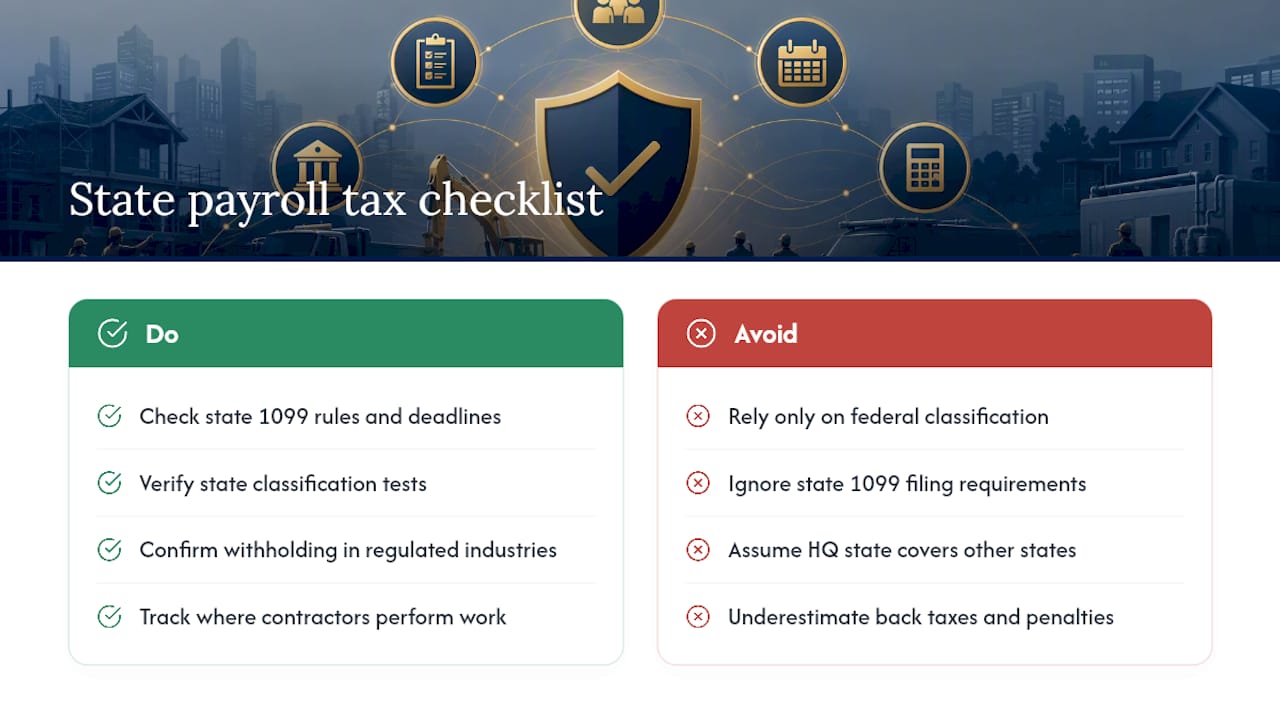
Federal rules get most of the attention, but state-level obligations trip up more small business owners than the IRS does. States don’t universally treat contractor payments the same way, and a handful require state-level 1099 reporting on top of the federal filing, sometimes with earlier deadlines than the January 31 federal cutoff.
Some states also require withholding on certain contractor payments in specific industries, or impose their own worker-classification tests that are stricter than the federal standard. A contractor who passes a federal classification test can still get reclassified as an employee under a state’s rules, which triggers back payroll taxes, penalties, and sometimes unemployment insurance liability you never budgeted for.
The practical fix is boring but effective: know your state’s specific 1099 filing requirement and deadline, and check whether your state uses a stricter classification test than the federal one before you lean too heavily on the “independent contractor” label for someone who looks a lot like an employee. This is exactly the kind of state-specific detail that payroll tax obligations guidance should walk through for your specific state, because a generic national answer can miss a filing requirement that only applies where you operate.
If you run crews or subs across state lines, this compounds. Each state where a contractor performs meaningful work can trigger its own reporting obligation, regardless of where your business is headquartered.
Paying Contractors Who Work Across State Lines
Multi-state contractor work is increasingly normal, especially in construction and trucking, and it creates a filing puzzle that a single-state business owner never has to solve.
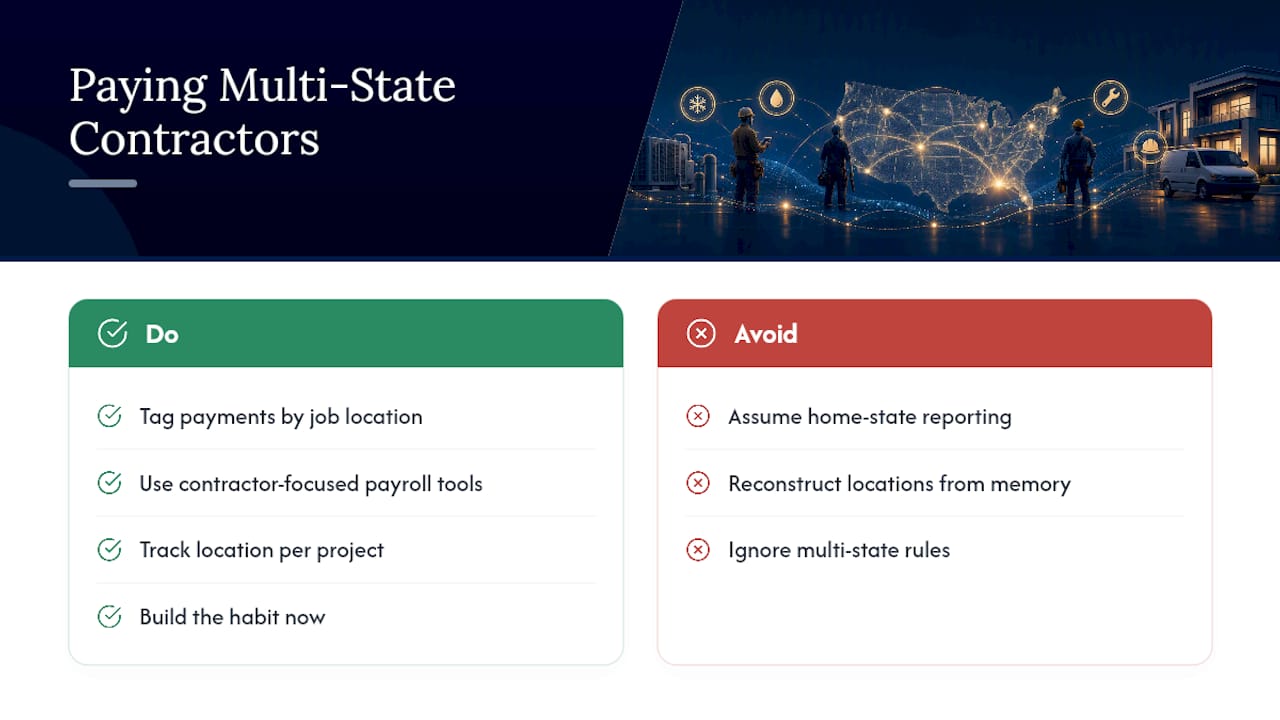
The core question is where the work happened, not where your business is based. A contractor who lives in one state but did a three-week job in another may trigger a reporting obligation in that second state, depending on that state’s specific rules. This is different from employee payroll, where nexus and withholding rules are more heavily litigated and better understood; contractor-side multi-state rules vary more and get far less attention from generic payroll guidance.
Practically, this means tracking not just how much you paid a contractor, but where the work was performed, project by project. A contractor-focused platform that lets you tag payments by job location makes this dramatically easier than trying to reconstruct it from memory in January. Full-service payroll systems built for multi-state employee withholding sometimes handle this well for contractors too, since the underlying multi-state logic already exists in the software.
The businesses that struggle most here are ones that scaled into multi-state work without updating their payment tracking to match. If you’re bidding jobs two states over from your home base, build the location-tracking habit now, before your contractor count and your paperwork both get harder to untangle at once.
Connecting Contractor Payments to Your Accounting Software
A contractor payment system that doesn’t talk to your accounting software just creates a second set of books you have to reconcile by hand. That reconciliation gap is where most small business bookkeeping problems actually start.
The better contractor-focused platforms and AP automation tools sync directly with QuickBooks and similar accounting software, pushing each payment into the right expense category and, ideally, tagging it to a specific job or customer automatically. That last part, job-level tagging, matters more than most owners realize until they try to figure out why a job came in over budget and can’t isolate contractor labor costs from everything else.
Without that integration, someone on your team is manually re-entering every contractor payment into your books, which is slow and creates room for double-entries or missed transactions. With it, your monthly financials reflect contractor costs almost in real time, which makes month-to-month profitability tracking by job or customer far more reliable.
If you’re evaluating a new contractor payment tool, ask specifically whether it integrates with your accounting software or only exports a CSV file you’d have to import manually. That single detail determines whether the tool actually saves you time or just moves the manual work to a different spot in your process.
Keeping Contractor Payment Records Audit Ready
Good recordkeeping isn’t about preparing for an audit that may never happen. It’s about having answers ready the moment anyone, an accountant, a lender, or the IRS, asks a question about a specific payment.
The minimum record set for every contractor includes the signed W-9, the written contract or scope agreement, every invoice or payment authorization, and a running total of payments made during the year. Store these together, not scattered across email threads and bank statements, so a specific contractor’s full file can be pulled in minutes rather than hours.
Reconciling contractor payments monthly, rather than waiting until year-end, catches problems while they’re still easy to fix. A duplicate payment or a contractor paid from the wrong bank account is a five-minute fix in March. Found in December while you’re also trying to close out twenty other contractors’ files, it becomes a genuine headache.
Keeping these records organized year-round is also what makes 1099 season painless instead of miserable, and it’s the same discipline that supports accurate job costing, since every contractor payment tied to a specific job feeds directly into your profitability analysis for that project.
Handling Payment Disputes With Contractors Without Losing the Relationship
Payment disputes with contractors usually come down to one of three things: a disagreement about scope, a timing misunderstanding, or a simple invoicing error. How you handle the first dispute with a contractor often determines whether they keep working for you or quietly stop returning calls.
Start every dispute by pulling the actual documentation: the original contract or scope agreement, the invoice in question, and the payment record. Most disputes resolve quickly once both sides are looking at the same paperwork, because a lot of friction comes from someone remembering a verbal agreement differently than it was written.
When the dispute is about scope, meaning the contractor believes they did more work than the contract covered, resist the urge to settle it verbally on the spot. Document the resolution in writing, even if it’s a short email confirming the agreed adjustment, so it doesn’t resurface as a different disagreement three months later.
For recurring contractors, a clear written process for handling change orders or scope adjustments prevents most disputes before they start. This matters more in construction and general contracting, where scope creep on a job site is common and expensive if it isn’t captured in writing as it happens.
The Payroll Method You Choose Shapes Your Profitability, Not Just Your Compliance
Most advice on contractor payroll treats it purely as a compliance exercise: collect the W-9, file the 1099, avoid the penalty. That framing misses the bigger issue. The payroll method you pick determines whether contractor labor costs actually show up correctly against the jobs that generated them.
I’ve seen owner-operated businesses run profitable-looking jobs that were actually losing money once contractor costs got properly allocated, because the payment system never tagged those costs to the right project in the first place. That’s not a compliance failure. It’s a job-costing failure wearing a compliance disguise, and it’s far more common than most owners realize until someone finally reconciles it.
The conventional advice, “just pick a payroll service and follow IRS rules,” undersells how much the choice affects your ability to price future jobs accurately. If you can’t see labor cost by job in real time, you’re pricing your next bid on guesswork dressed up as experience.
Prioritize the system that keeps job-level visibility intact first. Compliance follows naturally from good bookkeeping. It rarely works the other way around.
— Tony
An Outsourced Alternative for Contractor Pay and Job Costing
If you’d rather not become the in-house expert on 1099 thresholds, state filing quirks, and multi-state contractor tracking, that’s a reasonable call, and it’s exactly the gap Truemeasureaccounting fills for owner-operated service businesses.
Rather than just running your books after the fact, Truemeasureaccounting sets up contractor payment workflows that feed straight into job costing, so you can see labor cost by project without a separate reconciliation project every month. That’s the difference between hiring a bookkeeper who logs transactions and working with a firm that treats contractor pay as a lever on your profitability. For HVAC, plumbing, electrical, construction, and trucking businesses generating between $250,000 and $5 million a year, this usually means fewer surprises at tax time and a clearer read on which jobs actually make money. Explore outsourced accounting services built for growing service businesses, or start with a look at Truemeasureaccounting’s bookkeeping services and set up a conversation about your current contractor-pay setup.
Where to Verify the Rules and Get Set Up Right
For the federal rules themselves, go straight to the source: the IRS page on Form 1099-NEC filing requirements covers thresholds and deadlines, and Form SS-8 is the official route for a formal worker-classification determination when you’re genuinely unsure.
For the operational side, Truemeasureaccounting’s guide to bookkeeping for contractors walks through job-cost setup in more depth, and the contact page is the fastest way to talk through your specific contractor-pay situation with someone who has actually run service businesses, not just filed their taxes.
This article is general information, not a substitute for advice from a qualified financial advisor. Consult a qualified financial professional about your own circumstances before acting on anything here.