

What is factoring receivables in trucking?
Factoring receivables in trucking means selling your unpaid freight invoices to a factoring company for immediate cash, instead of waiting 30 to 90 days for a broker to pay. You deliver the load, submit your paperwork, and the factor advances most of the invoice value within hours. The factor then collects from the broker on their normal payment terms; you never chase the payment.
This is not a loan. Factoring is the sale of a business asset — your accounts receivable — so it creates no debt on your balance sheet and does not affect your credit score. The factor’s underwriting focuses on the broker’s creditworthiness, not yours. That distinction makes factoring accessible to new carriers and owner-operators who cannot qualify for a traditional bank line of credit.
Three documents drive every factored load:
- Rate confirmation: The broker-issued document locking in the load rate, origin, destination, and reference number.
- Signed Bill of Lading (BOL): The consignee’s signature at delivery, proving the freight arrived in acceptable condition.
- Carrier invoice: Your bill to the broker, referencing the rate confirmation number, load number, and your MC number.
Once you factor a broker, your factoring company sends that broker a Notice of Assignment (NOA), a legal document directing all payments to the factor instead of you. The broker is legally obligated to comply. The factor holds a reserve of roughly 2–5% of the invoice until the broker pays, then releases it to you minus the factoring fee.
Table of Contents
- How the factoring process works step by step
- Why trucking businesses use factoring
- What factoring costs and what risks to watch for
- How to choose the right factoring company
- Using factoring as part of your financial strategy
- How factoring affects your credit and business reputation
- Factoring vs. other financing options for trucking businesses
- How to negotiate better terms with your factoring company
- Factoring works best when your books are clean
- Key Takeaways
How the factoring process works step by step
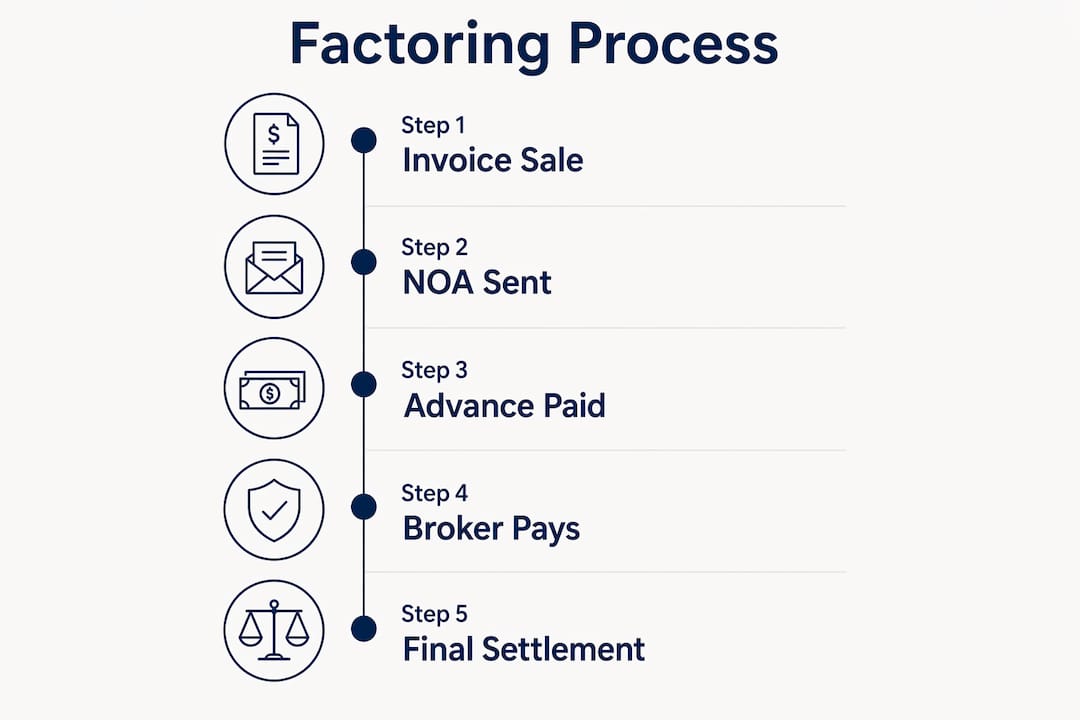
The process runs the same way on every load once your account is active. Here is the full sequence:
-
Set up your account. Account setup takes 1–3 business days. You will need your MC authority documentation, a W-9, a voided check for ACH deposits, a certificate of insurance, and a signed factoring agreement. The factor verifies your MC is active and checks for any prior factoring defaults.
-
Check broker credit before accepting the load. Most factors offer free broker credit checks as part of your account. Run one before you book. If the broker has poor credit or sits on a “do not factor” list, the factor may decline the invoice, leaving you waiting on net terms with no advance.
-
Deliver the load and collect signed documents. Pick up the freight, verify the load matches the BOL, and get the shipper’s signature. At delivery, get the consignee’s signature on the BOL with printed name and date. Photograph the signed BOL immediately.
-
Submit your three core documents. Upload the rate confirmation, signed BOL, and carrier invoice through the factor’s portal or mobile app. Submit same-day or within 24 hours of delivery for the best rates and fastest funding. Invoices older than 30 days may be flagged or declined.
-
Factor verifies and wires your advance. The factor checks your documents and the broker’s credit standing. Once approved, they wire or ACH you 90–98% of the invoice value. Same-day funding is standard for clean submissions before the daily cutoff, typically 11:00 AM to 2:00 PM Eastern.
-
Factor collects from the broker. The factor contacts the broker via the NOA and collects the full invoice amount on net terms. You are done with that invoice. No follow-up calls, no chasing.
-
Reserve is released to you. Once the broker pays the factor, you receive the reserve balance minus the factoring fee. On net-30 terms, that typically arrives about 30 days after delivery.
Pro Tip: Always check broker credit before accepting the load, not after. If a broker cannot be factored, you need to know that before your truck rolls, not after delivery.

Why trucking businesses use factoring
The core problem factoring solves is simple: brokers pay on net-30 to net-90 terms, but fuel, insurance, maintenance, and payroll do not wait. Factoring converts that gap into working capital the same day you deliver.
Key benefits for owner-operators and small fleets:
- Immediate cash flow to cover fuel, maintenance, insurance, and driver pay without waiting weeks.
- No debt created. Because factoring is a sale of assets, it does not appear as a liability on your balance sheet.
- Professional receivables management. The factor handles billing, collections, and broker follow-up, freeing your time for operations.
- Free broker credit checks to vet payers before you accept a load, reducing the risk of non-payment.
- Predictable cash flow that scales with your revenue. The more loads you haul, the more capital you can pull.
- Access to working capital without a strong credit history. Approval is based on broker creditworthiness, not your FICO score.
- Spot factoring flexibility for carriers who want to factor selectively without committing every invoice.
Understanding how trucking business cash flow actually works makes it clear why so many owner-operators turn to factoring. The 30 to 90-day payment gap is not a minor inconvenience. For a small fleet running tight margins, it can stop operations entirely.

What factoring costs and what risks to watch for
Factoring fees typically range from 1% to 5% of the invoice value, depending on your monthly volume, the broker’s payment history, and whether you choose recourse or non-recourse factoring. Higher volume usually earns lower rates. Non-recourse factoring costs more because the factor absorbs the credit risk if a broker goes insolvent.
Key costs and risks to understand:
- Advance rate: The percentage you receive upfront, commonly 90–98%. The remainder is held in reserve.
- Reserve: Typically 2–5% of the invoice, held until the broker pays. Released to you minus the factoring fee.
- Recourse factoring: Lower fees, but if the broker does not pay within the recourse window (usually 90 days), you must buy back the invoice. The factor deducts the advance from your reserve or future invoices.
- Non-recourse factoring: Higher fees, but the factor absorbs the loss if the broker goes bankrupt. Most non-recourse contracts still hold you liable for disputes, short-pays, or freight claims.
- Hidden fees: Watch for ACH or wire transfer fees, monthly minimums, and contract termination penalties. Ask for a full fee schedule before signing.
- Invoice disputes: If a broker disputes an invoice (damaged freight, late delivery, short-pay), the factor holds your reserve until the dispute resolves. Good delivery documentation speeds resolution.
- Invoice age: Factors prefer invoices submitted within 24 hours of delivery. Older invoices may carry premium rates or be declined outright.
A 3% factoring fee on a $2,000 invoice costs $60. That is the price of getting $1,940 today instead of waiting 45 days. Whether that trade-off makes sense depends on your cash position and your cost of waiting.
How to choose the right factoring company
Not all factoring companies serve trucking operators the same way. The right partner depends on your invoice volume, broker mix, and how much operational support you need.
Key criteria to evaluate:
- Advance rate and fee structure. Compare net rates across recourse and non-recourse options at your expected monthly volume.
- Trucking industry experience. A factor that specializes in freight understands broker relationships, NOA filing, and freight-specific disputes.
- Broker credit check capability. Confirm the factor covers your broker mix and offers free credit checks before load acceptance.
- Contract type. Whole-ledger contracts require you to factor every invoice and typically come with lower fees. Spot factoring lets you factor invoices selectively for more flexibility at a higher per-invoice cost.
- Submission platform. Look for a mobile-friendly portal that makes document upload fast and confirms receipt. Slow or clunky platforms cost you same-day funding.
- Customer service. You need a live person available when a broker disputes an invoice or a payment goes sideways. Ask about response times before you sign.
- Transparency on fees. Request a complete fee schedule in writing. Any factor that resists this is not worth your business.
- Integration with your workflow. Some factors integrate directly with load boards or transportation management systems, auto-generating invoices from rate confirmations and cutting submission time significantly.
Pro Tip: Ask prospective factors for a sample NOA and a sample factoring agreement before you apply. Reading both documents tells you more about a factor’s practices than any sales pitch.
Two providers worth knowing in the trucking factoring space are C.H. Robinson Factoring by Triumph, which serves carriers already working within the C.H. Robinson network, and eCapital, which offers both recourse and non-recourse options with same-day funding for qualified carriers. Evaluate both against the criteria above before committing.
Using factoring as part of your financial strategy
Factoring solves a cash flow timing problem. It does not fix a profitability problem. That distinction matters more than most carriers realize.
Factoring should be treated as an operational expense and built into your load-by-load profitability calculations from day one. If a load pays $1,800 and your factoring fee is 3%, your net revenue on that load is $1,746, not $1,800. Miss that math consistently and your margins erode without a clear explanation on your financials. Tracking load profitability with factoring costs included gives you an accurate picture of what each run actually earns.
Practical ways to use factoring strategically:
- Run broker credit checks proactively on every new broker before accepting a load, not just when you suspect a problem.
- Use spot factoring when cash flow is tight on specific loads rather than committing your entire receivables ledger to a whole-ledger contract.
- Align factoring with cash flow forecasting. Know your weekly cash needs and factor accordingly, rather than factoring reactively when you are already short.
- Track factoring fees separately in your bookkeeping so you can see the true cost over time and renegotiate terms as your volume grows.
- Integrate factoring data into your financial reporting to identify which brokers, lanes, or load types generate the best net margin after fees.
On the tax side, factoring fees are generally deductible as a business expense. The advance you receive is not income at the time of receipt because you are selling an asset, not earning revenue at that moment. The full invoice amount is recognized as revenue when earned, and the factoring fee is recorded as an expense. Getting your bookkeeping set up correctly from the start prevents costly cleanup later and keeps your tax reporting accurate.
Pro Tip: Treat factoring fees the same way you treat fuel costs: as a known, budgeted line item on every load, not a surprise deduction at month end.
How factoring affects your credit and business reputation
Factoring does not hurt your credit. Because factoring is the sale of a receivable rather than a loan, it does not appear on your personal or business credit report and does not create a debt obligation. The factor evaluates the broker’s creditworthiness, not yours. Carriers with sub-600 FICO scores factor invoices regularly with no rate impact.
On the reputation side, the NOA is standard practice in the freight industry. Brokers deal with factored carriers every day and treat the NOA as routine. Confirming your NOA is on file with each broker before your first load with them prevents misdirected payments and keeps your factoring agreement in good standing.
One area where reputation does matter: invoice disputes. A carrier with a history of freight claims, late deliveries, or documentation errors will face more disputes, which delays reserve releases and can complicate the factoring relationship over time. Clean delivery documentation, prompt submission, and responsive communication when disputes arise protect both your cash flow and your standing with the factor.
Factoring vs. other financing options for trucking businesses
Factoring is one of several ways trucking operators can access working capital. Each option fits a different situation.
| Financing Option | How It Works | Best For |
|---|---|---|
| Invoice factoring | Sell receivables for immediate cash; factor collects from broker | Carriers needing daily cash flow without debt |
| Business line of credit | Borrow against a credit limit; repay with interest | Established carriers with strong credit history |
| SBA loan | Fixed-term loan with low interest rates | Long-term equipment or expansion financing |
| Equipment financing | Loan or lease secured by the truck or trailer | Purchasing or upgrading equipment |
| Quick pay (broker) | Broker pays early for a fee, typically 1–3% | Occasional cash needs without a factoring agreement |
Factoring scales with your revenue in a way that a fixed credit line does not. The more loads you haul, the more capital you can pull. A bank line of credit is fixed and requires repayment regardless of your revenue cycle. For an owner-operator running variable load volumes, factoring often fits better than a loan structure.
The trade-off is cost. A 3% factoring fee on every invoice adds up over a full year of operations. Carriers with strong cash reserves and reliable broker payment histories may find a business line of credit cheaper over time. The right answer depends on your cash position, credit profile, and how predictable your broker payment cycles are. Understanding why profitable businesses run out of cash helps frame which option actually solves your problem.
How to negotiate better terms with your factoring company
Factoring agreements are negotiable, especially once you have a track record. Most carriers accept the first offer without pushing back.
Practical negotiation points:
- Volume commitments. If you can commit to a minimum monthly invoice volume, use that as leverage for a lower fee rate. Factors price risk and predictability; consistent volume reduces both.
- Recourse vs. non-recourse. If you haul primarily for creditworthy brokers with strong payment histories, recourse factoring at a lower rate may cost you less over time than non-recourse protection you rarely need.
- Flat-rate vs. tiered pricing. A flat rate gives you cost predictability. A tiered rate rewards fast-paying brokers. Know your broker mix before choosing.
- Spot factoring rights. If you want flexibility, negotiate the right to spot factor without penalty rather than signing a whole-ledger contract.
- Fee transparency. Push for a written schedule of all fees before signing, including ACH fees, wire fees, monthly minimums, and termination penalties. Eliminate or cap any fee that is not clearly justified.
- Contract length and exit terms. Shorter initial terms with renewal options give you leverage to renegotiate once you have demonstrated volume and clean submissions.
Your negotiating position improves as your business grows. A carrier factoring $50,000 per month has more leverage than one factoring $10,000. Start with reasonable terms, build your track record, and renegotiate at renewal.
Factoring works best when your books are clean
Factoring solves the cash timing problem. But if your books are a mess, you will not see the full picture of what factoring is actually costing you or how it affects your profitability by lane, broker, or load type.
At Truemeasureaccounting, we work with trucking operators and owner-operators across the United States to build the financial clarity that makes tools like factoring work harder for your business. That means accurate bookkeeping, factoring fees tracked as operational expenses, load-level profitability reporting, and cash flow forecasting that tells you what next month looks like, not just last month.
If you are ready to stop guessing and start managing your trucking finances with confidence, explore our trucking bookkeeping services or reach out directly to talk through your situation.
Key Takeaways
Factoring receivables in trucking converts unpaid freight invoices into same-day cash by selling them to a factor that advances 90–98% of the invoice value and collects from the broker directly.
| Point | Details |
|---|---|
| Three documents required | Every factored load needs the rate confirmation, signed BOL, and carrier invoice — missing any one stops funding. |
| Advance rate and reserve | Factors advance 90–98% upfront and hold a 2–5% reserve until the broker pays, then release it minus the fee. |
| Factoring fees | Fees range from 1% to 5% per invoice; recourse factoring costs less but leaves the carrier liable if the broker does not pay. |
| Not a loan | Factoring is the sale of a receivable, so it creates no debt and does not affect your credit score. |
| Factor fees as operating costs | Record factoring fees as a line-item expense on every load to see true net margin per run. |