
Catch-up bookkeeping is the process of reconstructing and reconciling past financial transactions to bring your records fully current after weeks, months, or even years of missed entries. If your books are behind, the single most useful thing you can do right now is pull your most recent three months of bank and credit card statements and get them in one folder.
Here is what catch-up bookkeeping fixes:
- Cash visibility — you will finally see where money is going and what your real balance is
- Tax readiness — accurate records let you file on time, avoid penalties, and claim every deduction you are entitled to
- Job costing — for HVAC, construction, and trucking owners especially, clean books reveal which jobs are profitable and which are bleeding cash
Quick reference:
- Typical timeline for a single year of moderate backlog with professional help: 4–6 weeks
- Cost range preview: a moderate amount for a simple one-year project; higher costs for multi-year or complex books
- First two steps: gather bank statements and schedule a 30-minute intake call with a bookkeeper
Table of Contents
- What catch-up bookkeeping actually covers (and what it does not)
- Catch-up vs. cleanup vs. ongoing bookkeeping: which one do you need?
- Signs your business needs catch-up bookkeeping right now
- How catch-up bookkeeping actually works: a practical phase-by-phase breakdown
- Documents and access you must gather before starting
- How much catch-up bookkeeping costs and how long it takes
- Common challenges, mistakes, and red flags to watch for
- After catch-up: how to stop the backlog from returning
- Should you DIY or hire a pro? A practical decision framework
- How a practitioner approaches catch-up bookkeeping: the Truemeasureaccounting method
- Key Takeaways
- Why facing your messy books is one of the best business decisions you can make
- Truemeasureaccounting can run your catch-up project from start to finish
- Useful sources and further reading
What catch-up bookkeeping actually covers (and what it does not)
Catch-up bookkeeping is not a single task. It is a phased project that touches every corner of your financial records. Bookkeeping at its core is the recording of financial transactions, and catch-up work is the process of doing that recording retroactively for periods that were missed or done incorrectly.
The discrete tasks in a catch-up project include:
- Document collection — pulling bank statements, credit card statements, merchant processor reports, invoices, payroll exports, and loan documents
- Data entry and transaction mapping — entering or importing every transaction and assigning it to the correct category, customer, or job
- Bank and credit card reconciliation — matching every line in your accounting software to the corresponding bank or card statement
- Adjustments — recording depreciation, amortization, owner draws, bad-debt write-offs, and accruals that were skipped
- Receivables and payables cleanup — clearing stale invoices, correcting vendor balances, and removing duplicates
- Financial statement generation — producing a clean Profit & Loss, Balance Sheet, and cash flow statement.
What catch-up bookkeeping does not do: it does not file your taxes, replace a CPA for complex tax strategy, or audit your business. It creates the accurate records that make those things possible.
At the end of a proper catch-up project, you should receive a clean general ledger, fully reconciled accounts, a Profit & Loss and Balance Sheet for each period covered, a cash flow statement, and a short exceptions memo that explains the major corrections made and flags anything that needs a tax professional’s attention. Those deliverables are what turn raw transaction history into decision-ready financial records for pricing, job costing, loan applications, and tax filing.
Catch-up vs. cleanup vs. ongoing bookkeeping: which one do you need?
These three terms get used interchangeably, but they describe different problems and different scopes of work.
Ongoing bookkeeping is the regular monthly cadence of recording transactions, reconciling accounts, and producing financial statements. It assumes your books are current and you are simply maintaining them.
Catch-up bookkeeping means you missed periods entirely. Months or years of transactions were never recorded. The work is reconstructive: you are building the record from scratch using source documents.
Cleanup bookkeeping means your books are current in terms of timing, but the data is wrong. Transactions are miscategorized, accounts are duplicated, or personal and business expenses are mixed together. The work is corrective rather than reconstructive.
The one-sentence decision rule: if you missed months entirely, you need catch-up; if your books are current but full of errors and miscategorized entries, you need cleanup; if your books are accurate and current, you need ongoing bookkeeping to keep them that way.
In practice, many businesses need both catch-up and cleanup at the same time. A bookkeeper who has not touched the books in 18 months will often find both missing periods and incorrect entries in the periods that were recorded.
Signs your business needs catch-up bookkeeping right now
Most owners know something is wrong before they can name it. Here are the clearest signals.
High-urgency signs that require immediate professional help:
- You received a tax notice from the IRS or your state revenue department
- You cannot confirm payroll tax deposits were made correctly
- A lender or investor is asking for financial statements you cannot produce
- You are facing an audit
Operational warning signs:
- Your bank balance and your accounting software balance do not match
- You have not produced a Profit & Loss statement in more than 90 days
- You cannot tell which jobs, routes, or service calls are actually profitable
- Cash flow surprises keep catching you off guard, even in months with strong revenue
- You are guessing at your tax liability rather than calculating it
Industry-specific examples: A trucking owner who cannot match fuel card charges to individual drivers or loads has a job-costing problem that starts with missing transaction records. An HVAC company that cannot track change orders against original job estimates is likely undercharging on a significant portion of its work. A general contractor who mixes personal credit card purchases with job expenses will have no reliable way to know true job margins until those records are separated and corrected.
If you recognize two or more of these signs, the backlog is already costing you money. Messy books do not just create compliance risk; they hide profit leaks that compound every month you wait.
How catch-up bookkeeping actually works: a practical phase-by-phase breakdown
Understanding the workflow helps you know what to prepare, what decisions you will be asked to make, and how long each phase realistically takes.
Phase 1 — Intake and assessment
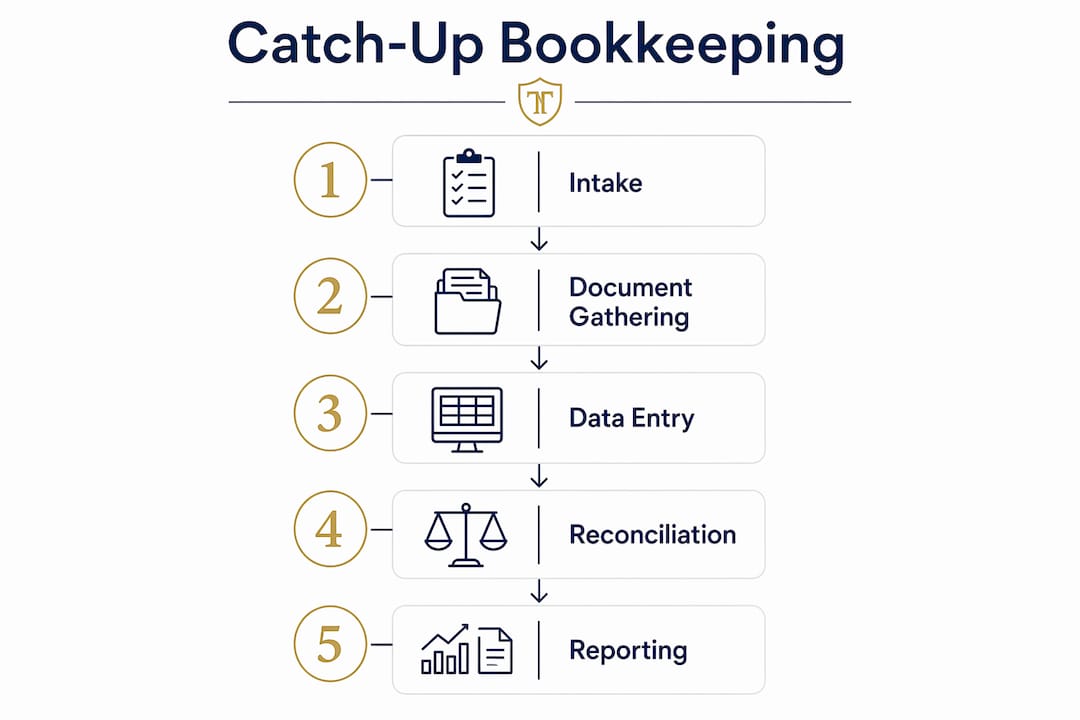
The bookkeeper reviews your existing records, counts the months behind, identifies every bank account, credit card, merchant processor, and payroll provider involved, and estimates the total hours. A reputable firm will provide a fixed project price after this assessment rather than an open-ended hourly estimate. Expect this phase to take one to three business days.

Phase 2 — Document gathering
You provide: bank and credit card statements (PDFs or online access), merchant processor reports (Stripe, Square, or similar), invoices and supplier bills, payroll reports and tax filings, loan and lease agreements, and prior-year tax returns. The more organized your documents, the faster and cheaper this phase goes.
Phase 3 — Data entry and transaction mapping
Transactions are entered or imported into your accounting software (typically QuickBooks Online or Desktop). Each transaction is assigned a category, vendor, customer, or job code. Mixed personal and business transactions are flagged for your review and decision. This is usually the most time-intensive phase for large backlogs.
Phase 4 — Reconciliation and adjustments
Every account is reconciled to its statement, period by period. Errors are corrected. Depreciation and amortization are recorded. Bad-debt write-offs, owner draws, and loan principal splits are entered. This phase often surfaces the most significant corrections.

Phase 5 — Reporting and handoff
The bookkeeper produces a Profit & Loss, Balance Sheet, and cash flow statement for each period covered, plus an exceptions memo explaining major corrections and flagging items that need a CPA’s attention (unreported income, payroll tax discrepancies, large unexplained deposits). You review, ask questions, and leave with records you can actually use.
Timeline estimates by backlog size:
| Backlog Size | Estimated Timeline (with a professional) |
|---|---|
| 1–3 months | 1–2 weeks |
| 4–6 months | 2–4 weeks |
| 7–12 months | 4–6 weeks |
| 13–18 months | 6–12 weeks |
| 19+ months | 12+ weeks (project-scoped) |
Pro Tip: Do not wait until tax season to start a catch-up project. Bookkeepers are at peak capacity from January through April. Starting in May through September typically means faster turnaround and more bookkeeper attention on your project.
A practical checklist approach, similar to the 12-step cleanup framework widely used by practitioners, helps ensure no account or period gets skipped during reconciliation.
Documents and access you must gather before starting
The single biggest cause of catch-up project delays is waiting on documents after the project begins. Gathering everything upfront cuts your timeline and your cost.
Document checklist:
- Bank statements (PDFs) for every business account, covering every month in the backlog period
- Credit card statements for every business card, same period
- Merchant processor reports (Stripe, Square, PayPal, or your POS system) showing gross deposits and fees
- Invoices issued to customers and bills received from vendors
- Payroll reports and 941 filings for each quarter in the backlog
- Loan and lease agreements (so principal vs. interest splits can be recorded correctly)
- Prior-year business tax returns (and personal returns if you are a sole proprietor or single-member LLC)
- Point-of-sale system exports if you run a retail or service counter operation
Access checklist:
- Accountant/bookkeeper user access to your accounting software (QuickBooks, Xero, or similar) with sufficient permissions to create and edit transactions
- Online banking read-only access or the ability to download statements directly
- Payroll provider access or the ability to export reports
- Permission to contact vendors or your bank for missing statements if needed
Security tip: Most accounting platforms let you create a separate “accountant” login with defined permissions. Set one up, share it, and revoke it when the project is complete. Never share your primary admin password. If your bank requires statement downloads rather than read-only access, download the PDFs yourself and share them via a secure file-sharing link rather than email attachments.
How much catch-up bookkeeping costs and how long it takes
Cost is the question every owner asks first, and the honest answer is: it depends on scope. But you can get close to a real number before you ever talk to a bookkeeper.
Pricing models
Fixed project price is the most owner-friendly model. The bookkeeper assesses your backlog, quotes a single number, and delivers the work. You know the cost upfront. Reputable firms typically quote a fixed price after a brief intake assessment rather than leaving the meter running.
Hourly billing is common for smaller or simpler projects. The risk is scope creep: if more transactions or accounts surface mid-project, the cost rises. Always ask for a not-to-exceed estimate before starting.
Milestone-based pricing breaks a large project into phases with a price attached to each. Useful for multi-year backlogs where the full scope is hard to assess upfront.
Pricing ranges by complexity
| Complexity Level | Typical Scope | Estimated Cost Range |
|---|---|---|
| Low | 1–3 months, 1–2 accounts, no payroll | a moderate amount |
| Moderate | 4–12 months, 3–5 accounts, basic payroll | higher costs |
| High | 12+ months, multiple accounts, payroll, POS | higher costs |
| Multi-year / complex | 2+ years, multiple entities or currencies | higher costs |
Main cost drivers
- Number of bank and credit card accounts — each account adds reconciliation time
- Months behind — more periods means more data entry and more reconciliation passes
- Payroll complexity — multi-state payroll, garnishments, or contractor 1099 tracking adds hours
- Point-of-sale integrations — reconciling POS deposits to merchant processor reports is time-consuming
- Personal/business account mixing — every flagged transaction requires an owner decision, which slows the project
- Missing source documents — reconstructing records from secondary sources (bank forensics, vendor re-statements) adds cost
Pro Tip: When requesting a fixed-fee quote, send the bookkeeper a sample of your current books (a screenshot or export), a list of every bank and credit card account, and the number of months you are behind. The more context you provide, the more accurate the quote will be. Vague requests produce padded estimates.
Common challenges, mistakes, and red flags to watch for
Even well-organized catch-up projects hit predictable obstacles. Knowing them in advance helps you avoid delays and unnecessary cost.
Missing source documents are the most common problem. Banks typically retain statements for seven years, and most will provide them on request, sometimes for a fee. For older periods, your accounting software’s import history or your merchant processor’s transaction export may serve as a secondary source.
Commingled personal and business transactions slow every project. Each mixed transaction requires an owner decision: is this a business expense, an owner draw, or a personal item that should be excluded entirely? The more mixing, the more back-and-forth between you and your bookkeeper. The fix going forward is a dedicated business checking account and a business-only credit card.
Unreconciled merchant processor deposits are a specific trap for service businesses using Stripe, Square, or similar platforms. The gross sale, the processing fee, and the net deposit are three separate figures. If only the net deposit hits your bank account and the gross sale was never recorded, your revenue is understated. A bookkeeper needs the merchant processor’s payout reports, not just the bank statements.
Ignored payroll liabilities are the highest-risk item. If payroll taxes were withheld from employees but not remitted to the IRS, the liability is real and growing. The IRS employment tax due dates are strict, and failure-to-deposit penalties compound quickly. If you suspect payroll tax deposits were missed, call a CPA or tax professional before the bookkeeper finishes the catch-up project.
When to call a tax professional: If the catch-up project surfaces unreported income, large unexplained deposits, or payroll tax discrepancies, stop and call a CPA. Restoring accurate records and filing amended returns demonstrates proactive compliance to the IRS and is typically the best protection if the business faces a review. The IRS accuracy-related penalty applies to underpayments caused by negligence or disregard of rules, which is exactly what unaddressed bookkeeping errors can create.
After catch-up: how to stop the backlog from returning
Getting caught up is the hard part. Staying current is mostly a matter of building a few habits and letting technology handle the repetitive work.
Monthly close checklist
Every month, before you close the books:
- Reconcile every bank and credit card account to its statement
- Review and code any uncategorized transactions
- Confirm all invoices issued that month are recorded and any past-due ones are flagged
- Run a quick aged accounts receivable report and follow up on anything over 30 days
- Confirm payroll tax deposits were made on schedule
Automation that actually helps
Bank feeds (available in QuickBooks Online, Xero, and most modern accounting platforms) pull transactions directly from your bank and card accounts daily. Paired with recurring transaction rules, they handle the majority of routine coding automatically. Receipt capture apps (such as Dext or Hubdoc) let you photograph receipts and attach them to transactions without a filing cabinet. Merchant processor integrations push Stripe or Square data directly into your accounting software, eliminating the manual deposit-reconciliation problem described above.
The key is pairing automation with a weekly human review. Automated feeds reduce hours, but they do not catch miscategorized transactions or flag unusual items the way a trained bookkeeper does.
KPIs to track monthly after catch-up
Once your books are clean, these four metrics give you a real-time read on business health:
- Gross margin by job or service line — tells you which work is actually profitable
- Aged accounts receivable — tells you how much cash is sitting uncollected and for how long
- Cash burn rate — tells you how fast you are spending relative to revenue
- Cash runway — tells you how many months of operating expenses your current cash balance covers
For HVAC, plumbing, and construction owners, gross margin by job is the single most valuable number to track. It is the difference between pricing confidently and guessing.
Should you DIY or hire a pro? A practical decision framework
The honest answer depends on four variables: how far behind you are, how complex your books are, how much time you have, and when you need the finished records.
DIY makes sense when:
- You are fewer than three months behind
- You have one or two bank accounts and no payroll
- You have basic QuickBooks or Xero experience
- There is no immediate deadline (tax filing, loan application, investor review)
Hire a professional when:
- You are four or more months behind
- You have payroll, multiple accounts, or a point-of-sale system
- You have mixed personal and business transactions
- You are facing a tax deadline, an IRS notice, or a lender’s request for financials
- Your time is worth more than the cost of hiring help
The catch-up bookkeeping process for a complex business with payroll and multiple accounts is not a weekend project. A trucking company with 12 months of fuel card charges, driver pay, and factoring company deposits will spend far more in owner time than a professional would charge.
Questions to ask a bookkeeper or firm before hiring
- What is your fixed-fee quote after reviewing my backlog, and what does it include?
- What are your deliverables, and will I receive a Profit & Loss, Balance Sheet, and exceptions memo?
- What is your estimated timeline, and what could extend it?
- Which accounting software do you use, and will I retain full access to my data?
- Do you have experience with businesses in my industry (HVAC, trucking, construction, etc.)?
- How do you handle data security, and how will you share and store my documents?
- Can you provide references from clients in a similar industry or with a similar backlog size?
Provider red flags
- No clear written scope before work begins
- Unwillingness to provide a fixed price or a not-to-exceed estimate
- No references from clients in your industry
- Cannot explain what adjustments they made or why
- Quotes an unusually low hourly rate with no estimate of total hours
How a practitioner approaches catch-up bookkeeping: the Truemeasureaccounting method
Truemeasureaccounting was built by Anthony Boncimino, who spent more than 20 years operating multi-million-dollar service businesses before founding the firm. That background shapes how every catch-up project is run: the goal is not just compliant records, it is decision-ready financial data that an owner can use to price better, manage cash, and identify profit leaks.
The Truemeasureaccounting phased approach:
- Assess — scope the backlog, count accounts, identify integrations, and provide a fixed-fee quote
- Gather — collect all source documents and set up secure access to accounting software and bank feeds
- Import — pull or enter transactions, map to categories, customers, and jobs
- Reconcile — match every account to its statement, period by period
- Adjust — record depreciation, correct payroll liabilities, clear stale receivables, and split loan principal from interest
- Report — deliver Profit & Loss, Balance Sheet, cash flow statement, and an exceptions memo
- Coach — walk the owner through the findings, explain key corrections, and set up a monthly close process to prevent recurrence
The emphasis on operationally focused deliverables matters. A clean general ledger and reconciled bank accounts are the foundation. But for a trucking owner, the real value is seeing fuel cost per mile by driver. For an HVAC company, it is gross margin by service type. For a general contractor, it is job cost variance against estimate. Those insights only become visible when the underlying records are accurate.
Truemeasureaccounting serves owner-operated service businesses across the United States, with particular depth in HVAC, plumbing, electrical, construction, trucking, and real estate. The firm’s bookkeeping services are built around producing financial clarity first, then connecting that clarity to real business decisions.
Key Takeaways
Catch-up bookkeeping is the fastest path from financial fog to decision-ready records, and the cost of delay almost always exceeds the cost of the project itself.
| Point | Details |
|---|---|
| What it is | Catch-up bookkeeping reconstructs missing or incomplete financial records to bring your books fully current. |
| When you need it | If you have missed months of recording, face a tax deadline, or cannot produce a Profit & Loss, start now. |
| Cost and timeline | A single-year moderate backlog typically costs a moderate amount and takes 4–6 weeks with professional help. |
| DIY threshold | DIY is reasonable for backlogs under three months with one or two accounts and no payroll; hire a pro for anything more complex. |
| Truemeasureaccounting | Truemeasureaccounting runs phased catch-up projects for owner-operated service businesses, delivering clean books and a coaching session on findings. |
Why facing your messy books is one of the best business decisions you can make
Most owners I talk to have been avoiding the books for the same reason: they are afraid of what they will find. An unprofitable job they suspected but never confirmed. An owner draw that was larger than the business could actually support. A tax liability that has been quietly growing.
Here is what practitioners consistently observe: the owners who confront the backlog come out the other side with something they did not have before. They know their numbers. They can price a job with confidence because they know their actual cost structure. They can look at a month’s cash flow and understand why it looks the way it does. They stop being surprised.
The business outcome is not just cleaner records. It is better decisions. An HVAC owner who discovers through catch-up work that residential service calls are running at 18% gross margin while maintenance contracts are running at 41% has a pricing and sales strategy decision sitting right in front of them. A trucking company that finally reconciles fuel card charges to individual drivers can see which routes and drivers are profitable and which are not. That information was always there. The catch-up project just made it visible.
The discomfort of facing messy books lasts a few weeks. The clarity that comes from clean ones lasts as long as you maintain them.
Truemeasureaccounting can run your catch-up project from start to finish
For owner-operated service businesses that are behind on their books, Truemeasureaccounting offers a structured, fixed-fee catch-up service built around producing financial clarity, not just compliance.
The process starts with a short intake call to scope your backlog and provide a fixed quote. From there, the team handles document gathering, data entry, reconciliation, adjustments, and reporting. You receive a clean Profit & Loss, Balance Sheet, cash flow statement, and a coaching session that walks you through what was found and what it means for your business. No open-ended hourly billing. No vague deliverables.
Truemeasureaccounting works with HVAC companies, plumbers, electrical contractors, general contractors, trucking operators, and real estate investors across the United States. The firm’s catch-up and cleanup bookkeeping services are designed for businesses generating $250,000 to $5 million annually that need more than data entry. If your books are behind and you want a clear picture of where your business actually stands, schedule an intake call to get a fixed quote and a realistic timeline.
Useful sources and further reading
- IRS Recordkeeping for Small Businesses — The IRS’s official guidance on how long to retain business records and what documentation supports deductions. Essential reading before starting a catch-up project.
- IRS Deducting Business Expenses — Explains which expenses are deductible and what records are required to support each deduction. Directly relevant to expense categorization during catch-up.
- IRS Accuracy-Related Penalty — Explains the penalties that apply when tax underpayments result from negligence or disregard of rules, which is the direct consequence of unaddressed bookkeeping errors.
- IRS Employment Tax Due Dates — Critical reference for any business with employees; shows deposit schedules and the deadlines that trigger failure-to-deposit penalties.
- Bookkeeping — Wikipedia — A clear overview of bookkeeping methods, the role of the general ledger, and the distinction between bookkeeping and accounting.
- QuickBooks 12-Step Bookkeeping Cleanup Checklist — A practical operational checklist widely used by practitioners during cleanup and catch-up projects; useful as a self-audit tool.
- Catch-Up Bookkeeping: A Complete Guide — Covers the definition, scope, timeline estimates, and expected outcomes of a catch-up project in plain language.
- What Is Catch-Up Bookkeeping? Process & Cost — Explains pricing models, scope drivers, and the step-by-step process from a practitioner’s perspective; includes guidance on fixed-fee vs. hourly billing.