
Every small business with employees owes four types of payroll tax: federal income tax withholding, FICA (Social Security and Medicare), federal unemployment tax (FUTA), and state unemployment tax (SUTA), plus any state-specific levies your state adds. As the employer, you withhold the employee’s share, match a portion yourself, deposit the money on a schedule the IRS assigns you, and file Form 941, Form 940, and W-2s on time.
If you just hired your first employee or you’re cleaning up a payroll mess, do these three things today:
- Get your EIN if you don’t have one, since you can’t remit federal deposits without it.
- Collect a signed W-4 from every employee before the first paycheck goes out.
- Enroll in EFTPS or confirm your payroll provider handles deposits on the correct schedule, because a missed federal deposit triggers penalties within days, not months.
Everything below explains the mechanics, but those three moves stop the bleeding while you read.
Key Takeaways
Payroll tax compliance protects your cash flow and your personal liability only when deposits, deductions, and reconciliations happen on a fixed operational rhythm, not as an afterthought to running the business.
| Point | Details |
|---|---|
| Know your four tax types | Federal withholding, FICA (split with employer match), FUTA (employer-only), and state unemployment all apply to every employee. |
| Separate trust funds from operating cash | Keep a dedicated payroll liability account so withheld taxes never fund materials, fuel, or payroll gaps. |
| Watch the lookback and $100k triggers | Your deposit schedule can shift from monthly to semiweekly, and a single large payroll can trigger next-day deposit rules. |
| Classify workers correctly | Misclassifying employees as contractors risks back taxes, penalties, and personal liability under the Trust Fund Recovery Penalty. |
| Bring in support before errors repeat | TrueMeasureaccounting’s payroll and fractional CFO services help owner-operated businesses reconcile payroll liabilities and build cash-flow cushions before small mistakes become IRS problems. |
Table of Contents
- Which Payroll Taxes Do Small Businesses Actually Pay?
- How Do You Calculate Payroll Taxes for a Pay Period?
- When Are Payroll Tax Deposits and Filings Due?
- What’s the Setup Checklist for New Payroll Tax Compliance?
- What Payroll Tax Mistakes Cost Small Businesses the Most?
- How Should You Reconcile Payroll Taxes for Better Cash Flow?
- How Do You Handle Payroll Taxes When Hiring or Firing Staff?
- Are Payroll Taxes Different for Contractors Than for Employees?
- What Records Do You Need to Keep for Payroll Tax Compliance?
- How Are Payroll Tax Rules Changing for Small Businesses?
- An Editorial Take on Payroll Tax Compliance for Service Businesses
- Get Payroll Tax Support Built for Service Businesses
- Sources
Which Payroll Taxes Do Small Businesses Actually Pay?
Payroll tax isn’t one bill. It’s a stack of separate obligations, some paid entirely by the employee (through withholding) and some split or paid entirely by you as the employer. Understanding which is which matters because it directly affects your labor cost per hour, which feeds into every bid, quote, and hourly rate you set.
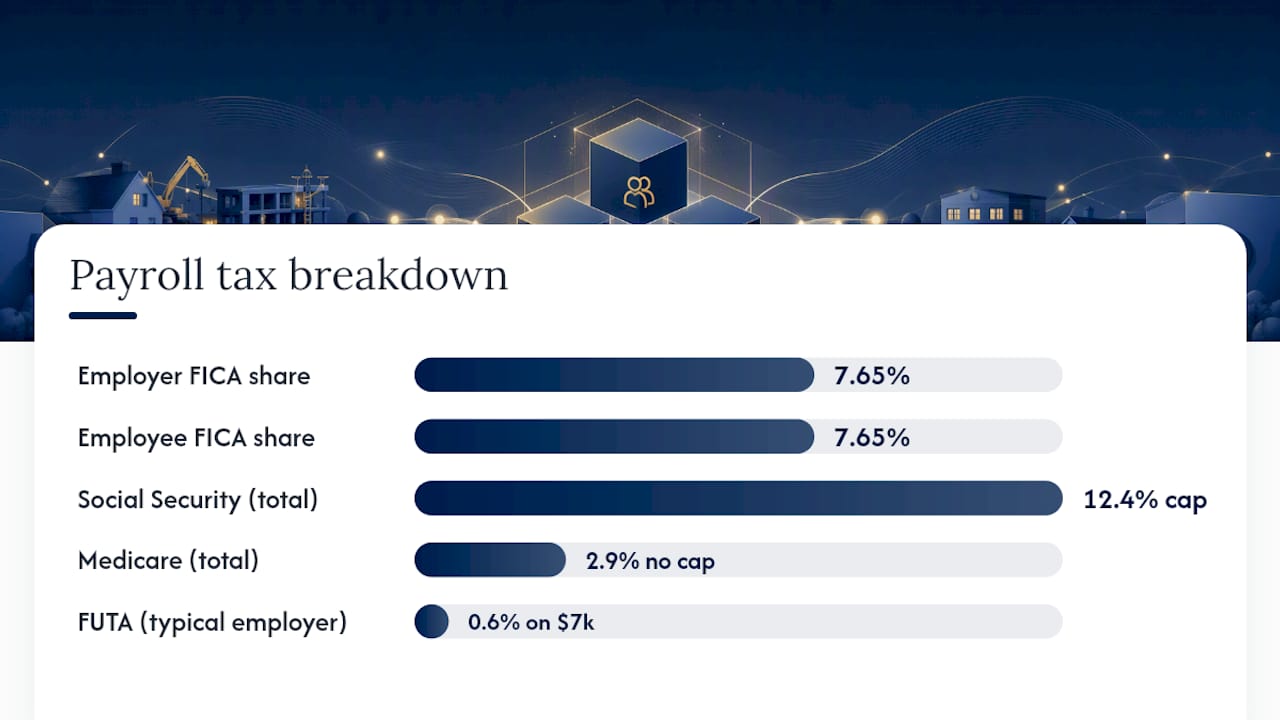
FICA is the big one. Social Security and Medicare together make up FICA, and both you and your employee pay into it. The employer and employee each contribute 7.65%, for a combined 15.3% total: 12.4% for Social Security (6.2% each side) and 2.9% for Medicare (1.45% each side). Social Security tax only applies up to an annual wage base cap set by the Social Security Administration, which adjusts every year, so track it rather than assuming last year’s cap still applies. Medicare has no cap. It applies to every dollar of wages.
This one only applies to the employee. You don’t match it. But you’re on the hook for withholding it correctly once that employee crosses the line, and missing it is a common cleanup item when we take over a new bookkeeping client’s payroll history.
FUTA is entirely employer-funded. The statutory rate is 6% on the first $7,000 of each employee’s wages for the year. Almost no employer actually pays 6%, though. If you’re current on your state unemployment tax payments, you get a credit of up to 5.4%, which drops your effective FUTA rate to 0.6%. That’s the number most owners have in their head, but it’s conditional. Fall behind on state unemployment payments, or operate in a state that’s borrowed federal unemployment funds and hasn’t repaid them, and that credit shrinks or disappears.
Quick math: FUTA at the full statutory rate on the taxable wage base costs significantly more per employee than the reduced rate employers receiving the credit pay, illustrating how much your FUTA cost depends on state unemployment tax status.
State payroll taxes vary widely and this is where owners in multi-state operations get tripped up. Every state runs its own unemployment insurance program (SUTA), with rates that depend on your industry, your claims history, and your state’s fund health. Some states layer on additional payroll levies: state disability insurance, paid family leave contributions, or local payroll taxes in certain cities. If you run a trucking company with drivers domiciled in different states, or an HVAC business expanding into a neighboring state, each jurisdiction’s rules stack on top of federal obligations, and none of them are optional just because you’re small.
How Do You Calculate Payroll Taxes for a Pay Period?
The calculation runs in a fixed order every time. Skip a step and the whole paycheck is wrong.
- Start with gross pay. Hourly rate times hours worked, or the salary amount for the period.
- Subtract pretax deductions. Health insurance premiums, 401(k) contributions, and certain HSA contributions typically reduce taxable wages before you calculate withholding.
- Calculate federal income tax withholding. Use the employee’s Form W-4 and the withholding tables in IRS Publication 15-T to determine the amount.
- Calculate FICA. Apply 6.2% Social Security and 1.45% Medicare to taxable wages, checking whether the employee has already hit the Social Security wage base for the year.
- Calculate FUTA separately. This doesn’t come out of the paycheck. It’s an employer cost calculated against the first $7,000 of that employee’s annual wages, tracked cumulatively across pay periods.
- Apply state withholding and SUTA. Rates and rules depend entirely on your state.
Here’s a worked example for a monthly-paid employee earning $5,000 gross, with no pretax deductions, well under the Social Security wage cap for the year:
| Item | Calculation | Amount |
|---|---|---|
| Gross pay | Monthly salary | $5,000 |
| Federal income tax withheld | Per W-4 and Pub. 15-T tables (estimate) | $480 |
| Employee Social Security | 6.2% of $5,000 | $310 |
| Employee Medicare | 1.45% of $5,000 | $72.50 |
| Employer Social Security match | 6.2% of $5,000 | $310 |
| Employer Medicare match | 1.45% of $5,000 | $72.50 |
| Net pay to employee | Gross minus withholding | $4,137 |
| Total employer payroll tax cost | Employer FICA match plus FUTA share | $382.50 |
FUTA doesn’t show up in this table as a per-check line item because it’s tracked against the $7,000 annual cap, not deducted from a specific paycheck. Once this employee’s cumulative wages cross $7,000 for the year, FUTA liability on them stops.
The gotchas that trip up owners: pre-tax benefits lower taxable wages but not gross wages, so your job costing needs to use gross labor cost, not taxable wages, when you’re pricing a job. Fringe benefits like a company vehicle or gym membership can be taxable and need to be added back into wages for withholding purposes. And pay frequency changes the math. Switching from biweekly to semimonthly changes how you prorate annual thresholds like the Social Security wage base, which is a common source of errors when businesses change payroll providers mid-year.
When Are Payroll Tax Deposits and Filings Due?
The IRS decides your deposit schedule using a 12-month lookback period, not your current guess about how much you owe. If your total tax liability during that lookback period exceeded $50,000, you’re a semiweekly depositor: deposits are due Wednesday for payrolls paid Wednesday through Friday, and Friday for payrolls paid Saturday through Tuesday. Stay under that threshold and you’re a monthly depositor, with deposits due by the 15th of the following month. New employers are assigned a monthly deposit schedule initially, subject to change based on tax liabilities.
There’s a separate rule that catches growing businesses off guard: the next-day deposit rule. If your accumulated federal employment tax liability hits $100,000 on any day, the deposit is due the next business day, regardless of your normal schedule. A trucking company that runs a big payroll during a hiring surge, or a construction company that pays out a large bonus round, can trip this rule without realizing it, and the cash-flow hit lands fast.
Filing requirements run alongside deposits:
- Form 941 reports federal income tax, Social Security, and Medicare withheld, filed quarterly by most employers.
- Form 944 replaces Form 941 for employers with $1,000 or less in annual employment tax liability, filed once a year instead.
- Form 940 reports FUTA and is filed annually.
- W-2s go to employees and the Social Security Administration by January 31 following the tax year.
All federal deposits must be made electronically through EFTPS. If you’re setting up a new payroll system or bank account, test the connection well before your first real deposit is due. A partner like Infinity Benefits Group’s payroll processing service can also handle these mechanics if you’d rather hand off the deposit calendar entirely.
Pro Tip: Set a recurring calendar reminder to check your cumulative federal tax liability every payroll, not just at quarter-end. Businesses that grow fast are the ones most likely to cross the $50,000 lookback threshold mid-year and get bumped from monthly to semiweekly deposits without warning.
What’s the Setup Checklist for New Payroll Tax Compliance?
Getting the infrastructure right before your first hire saves you a cleanup project later. Work through this in order:
- Obtain your EIN from the IRS if you don’t already have one.
- Register for state withholding and SUTA in every state where you have employees working, not just where your business is headquartered.
- Collect a completed W-4 from each employee before their first paycheck.
- Set your payroll schedule (weekly, biweekly, semimonthly, or monthly) and stick to it, since changing frequency mid-year complicates wage base tracking.
- Open a dedicated payroll or tax liability bank account, separate from your operating account, so withheld funds never mix with cash you use to cover materials or fuel.
- Enroll in EFTPS and run a test deposit before your first real one is due.
- Choose your payroll system or provider, whether that’s software you run yourself or a service that handles it end to end.
On every payroll day, verify three things before you move on: the withholding amounts match what your system calculated, the EFTPS or ACH transmission actually went through, and your payroll liability account reconciles to the payroll register. That third check catches most errors before they become a filed-form problem.
If you’re evaluating a vendor, prioritize one that integrates with QuickBooks and supports job costing. For a construction or HVAC business, labor cost needs to flow into project profitability reports automatically. A payroll system that lives in isolation from your books just creates reconciliation work every month.
What Payroll Tax Mistakes Cost Small Businesses the Most?
The mistakes that create real financial damage are almost always operational, not conceptual. Owners generally understand that payroll tax exists. They get hurt by timing and cash management, not by misunderstanding rates.
The most common failures: depositing late, treating withheld payroll tax as available operating cash, misclassifying employees as contractors, and missing W-2 or filing deadlines. Research on payroll compliance failures points to the same pattern repeatedly: it’s the missed deposit and the commingled bank account that cause penalties, far more often than a rate calculation error.
The penalty structure escalates fast. Late federal deposits start at a 2% penalty and climb toward 15% depending on how late the payment is. Failing to file required forms adds separate penalties on top. And the Trust Fund Recovery Penalty is the one owners underestimate most: the IRS can hold you personally liable for unpaid withheld taxes, piercing right through your LLC or corporate structure if you’re found responsible for the failure.
The fix is structural, not just careful bookkeeping. Keep a dedicated payroll liability account, reconcile it weekly, and build a response plan for what you do the moment a deposit fails to go through.

How Should You Reconcile Payroll Taxes for Better Cash Flow?
Withheld payroll taxes aren’t your money. They’re trust funds you’re holding for the IRS and your state, and treating them that way changes how you manage cash. Reconcile your payroll tax liability account to your general ledger every pay period, not just at month-end, so a discrepancy shows up while it’s still small enough to fix quietly.
Build a payroll tax cushion into your cash-flow forecast, not as an afterthought but as a fixed line item, the same way you’d plan for a fuel bill or a materials order. A cushion covering roughly three payroll cycles gives you room to absorb a large deposit or an unexpected next-day trigger without scrambling for a short-term loan.
Payroll timing also affects your job costing directly. If you’re pricing a construction job or an HVAC service contract based on labor cost, gross wages plus your full employer tax burden, not just the paycheck amount, need to be in that calculation. Leave out the employer’s FICA match and FUTA share, and every bid quietly underprices labor.
Recurring deposit errors, multi-state payroll complexity, or a hiring pace that’s outrunning your internal systems are the three clearest signals that it’s time to bring in outsourced payroll support or a fractional CFO rather than trying to patch the process yourself.
Pro Tip: Review your cash-flow forecast against your payroll tax deposit calendar every month. The businesses that get blindsided by the next-day $100,000 rule are almost always the ones tracking cash and payroll liability in two separate spreadsheets that never talk to each other.
How Do You Handle Payroll Taxes When Hiring or Firing Staff?
New hires and terminations both create payroll tax reporting obligations that are easy to miss when you’re focused on the operational side of the transition.
For a new hire, you owe a signed W-4 before the first paycheck and, in most states, a new-hire report filed with your state agency within a set window, usually 20 days or fewer. That report exists to support child support enforcement and unemployment fraud checks, and skipping it is a compliance gap many small employers don’t realize they have until a state audit flags it.
For a termination, the final paycheck needs to include all wages due, and depending on your state, that deadline might be immediate (the final day) or the next regular payroll cycle. Payroll tax withholding on that final check works the same as any other, but you also need to update your payroll system so FUTA and SUTA calculations stop including that employee going forward. Cumulative wage-base tracking, especially for the Social Security cap, should carry forward correctly if that employee is rehired later in the same year.
If you’re laying off staff, your state unemployment account will see claims activity that can affect your SUTA rate in future years. A single termination rarely moves the needle, but a pattern of layoffs, common in seasonal trucking or construction work, can push your experience rating up over time. That’s a cost worth factoring into seasonal staffing decisions, not just an HR afterthought.
Are Payroll Taxes Different for Contractors Than for Employees?
Yes, and the difference is the entire basis of worker classification risk. You don’t withhold or pay any payroll tax on an independent contractor. No FICA match, no FUTA, no state unemployment contribution. Instead, contractors handle their own self-employment tax, and you simply issue a 1099 for payments over the annual reporting threshold.
That’s exactly why misclassification is such an attractive shortcut and such a dangerous one. Calling someone a contractor when they function as an employee, set hours, provided tools, ongoing exclusive work, directed daily tasks, doesn’t just risk a tax bill for the payroll taxes you should have paid. It exposes you to back taxes, penalties, and potentially the Trust Fund Recovery Penalty if withholding should have happened and didn’t.
This shows up constantly in service industries. A general contractor bringing on a “subcontractor” who works exclusively for them, uses their equipment, and follows their schedule looks a lot more like an employee to the IRS than a genuine independent contractor. The same risk applies to trucking companies classifying drivers as owner-operators when the company controls routes, schedules, and equipment. If you’re unsure which category a worker falls into, that uncertainty itself is a signal worth resolving before the IRS resolves it for you.
What Records Do You Need to Keep for Payroll Tax Compliance?
The IRS generally expects employment tax records kept for at least four years after the tax becomes due or is paid, whichever is later. That covers W-4 forms, payroll registers, deposit confirmations, filed 941s and 940s, W-2 and W-3 copies, and records supporting any pretax benefit deductions you applied.
Keep these organized by pay period, not just by year. When a deposit gets questioned or an employee disputes a withholding amount, you need to pull the specific pay period’s numbers quickly, not reconstruct them from twelve months of transactions. Digital payroll systems generally retain this automatically, but confirm your provider keeps records accessible for the full retention window, since some platforms purge older data after a shorter default period.
Bank records matter as much as payroll records here. Your deposit confirmations from EFTPS, matched against your payroll liability account, are your first line of defense if a deposit ever gets flagged as late or missing. If you’re still reconciling payroll manually or your bookkeeping has fallen behind, a QuickBooks cleanup project that rebuilds accurate historical records gives you a defensible paper trail instead of a guessing game.
How Are Payroll Tax Rules Changing for Small Businesses?
Payroll tax rates and thresholds move every year, even without major legislation. The Social Security wage base adjusts annually based on national wage growth, which means the cap you tracked last year is already outdated. FUTA credit reduction states, where the federal government has had to step in on unpaid unemployment loans, can shift from year to year depending on which state unemployment trust funds are running low, directly affecting your effective FUTA rate.
Beyond the annual mechanical adjustments, state-level activity has been the bigger driver of change recently. More states have added or expanded paid family and medical leave programs funded through payroll contributions, which means employers operating across state lines need to check every jurisdiction annually rather than assuming last year’s obligations still apply. If you added an office or a crew in a new state this year, treat state registration as a fresh compliance project, not an extension of what you already had set up.
The practical response isn’t trying to memorize every change. It’s building a habit of checking your year-end tax planning checklist every fourth quarter, before rates reset for the new year, so you’re never calculating January payroll against outdated numbers.
An Editorial Take on Payroll Tax Compliance for Service Businesses
Most payroll tax content treats compliance as the finish line. File the forms, hit the deadlines, done. That framing misses what actually sinks owner-operated businesses: the gap between knowing the rules and having the cash-management systems to follow them under pressure.
The conventional checklist approach assumes a steady payroll. Real HVAC, plumbing, and trucking businesses don’t have steady payroll. They have seasonal hiring surges, overtime spikes, and bonus rounds that can silently trip the $100,000 next-day deposit rule or bump a company from monthly to semiweekly deposits mid-year. Compliance knowledge doesn’t prevent that. Cash-flow forecasting that accounts for payroll tax timing does.
What I’d prioritize first isn’t memorizing rates. It’s separating payroll tax dollars from operating cash the day you hire your first employee, before there’s ever a temptation to treat a slow month as a reason to delay a deposit. Everything else, the forms, the schedules, the wage caps, is manageable once that structural habit exists.
Get Payroll Tax Support Built for Service Businesses
Truemeasureaccounting is the alternative to handling payroll tax compliance with a generic bookkeeping template or a payroll platform that has no idea what a job-costed labor rate looks like. If you run an HVAC, plumbing, construction, or trucking business, your payroll tax reconciliation needs to connect to project profitability, not sit in a silo separate from the numbers that tell you whether a job actually made money.

Truemeasureaccounting builds payroll tax reconciliation directly into monthly bookkeeping, so your liability account, your general ledger, and your job costing reports all tell the same story. For businesses generating $250,000 to $5 million in revenue, that means catching a deposit timing problem before it becomes a Trust Fund Recovery Penalty conversation, and understanding exactly what payroll costs are doing to your margins on every job. If recurring payroll errors, multi-state complexity, or fast hiring have you wondering whether it’s time for real financial oversight, start with a look at Truemeasureaccounting’s bookkeeping services and book a conversation about what your payroll process is actually costing you.
This article is general information, not a substitute for advice from a qualified financial advisor. Consult a qualified financial professional about your own circumstances before acting on anything here.
Sources
- Department of Labor — FUTA / Unemployment Insurance topics
- IRS Publication 15 (Employer’s Tax Guide)
- EFTPS — Electronic Federal Tax Payment System